Cockroaches are among the most instantly recognisable insects on the planet, characterised by their flattened oval body, long antennae, spiny legs, and rapid scuttling movement — a combination of features that triggers an immediate and visceral response in most people. What is less widely appreciated is that a surprisingly large number of completely unrelated insects share enough of these features to be convincingly mistaken for cockroaches in a brief or poorly lit encounter. This phenomenon of convergent appearance spans multiple insect orders, from beetles and crickets to water bugs and earwigs, reflecting how broadly successful the cockroach body plan has proven across hundreds of millions of years of evolution.
There are approximately 4,600 described cockroach species worldwide, but only around 30 — less than 1% — are considered pest species associated with human habitation. The remaining 99% are ecologically vital decomposers, nutrient recyclers, and prey species in forest, grassland, and cave ecosystems worldwide. Despite this, the pest reputation of a handful of species colours public perception of the entire order Blattodea, meaning that any insect resembling a cockroach — however distantly — is likely to provoke alarm, disgust, or an urgent exterminator call from a significant proportion of the people who encounter it.
The features most responsible for cockroach misidentification include a flattened, broadly oval body, long filiform antennae, a prominent pronotum partially shielding the head, brownish to dark colouration, and rapid ground-level movement. Beetles are the most frequent cockroach lookalikes, particularly ground beetles, darkling beetles, and certain longhorn species, but crickets, water bugs, earwigs, and even some moths share enough of these characteristics to generate genuine confusion. Learning to distinguish true cockroaches from their many lookalikes is a practical skill with real implications for pest management, as misidentification can lead to inappropriate and costly treatments targeting entirely harmless or beneficial species.
Also Read: Bugs That Look Like Ticks But Aren’t
Bugs That Look Like Cockroaches
Ground Beetle (Carabus nemoralis)
The European ground beetle is one of the most convincing cockroach lookalikes in temperate gardens, sharing the cockroach’s flattened oval body, long antennae, dark brownish-black colouration, and rapid, ground-level movement. Found under stones, logs, and leaf litter across Europe and widely introduced to North America, it is an entirely beneficial predator of slugs, worms, and soil invertebrates. The key distinction from a cockroach is its clearly defined elytra meeting in a straight line down the centre of the back and the absence of a flattened, shield-like pronotum covering the head.
Darkling Beetle (Tenebrio molitor)
The mealworm beetle, in its adult darkling beetle form, is a frequently encountered cockroach lookalike found in grain stores, chicken coops, and dark cupboards worldwide. Its elongated oval, matte black to dark brownish body, long antennae, and habit of running rapidly across floors in low-light conditions creates a cockroach-like impression that causes significant alarm when encountered unexpectedly indoors. Unlike cockroaches, its elytra are fused and finely ridged, and it lacks the flattened, spread-legged posture characteristic of true cockroaches.
Field Cricket (Gryllus campestris)
The field cricket is a robust, shiny black insect with a broadly oval body, long antennae, and a rapid, unpredictable movement pattern that makes it one of the most common cockroach misidentifications in gardens and homes across Europe and North America. Its dark colouration and similarly sized, flattened profile can cause genuine confusion in dim lighting or when encountered suddenly indoors. The distinctive long hind legs adapted for jumping and the presence of auditory organs on the front legs quickly distinguish it from any cockroach species on closer inspection.
Water Scavenger Beetle (Hydrophilus piceus)
The great silver water beetle of Europe is one of the continent’s largest beetles, reaching up to 5 cm in length with a broadly oval, shiny black body and long, clubbed antennae that create a compelling cockroach-like silhouette when encountered outside water. Individuals regularly leave their aquatic habitats at night to fly in search of new ponds, landing on roads and garden paths where their large, dark, oval bodies moving across surfaces are regularly reported as giant cockroaches. The beetle’s distinctly humped underside bearing a prominent keel distinguishes it from cockroaches on examination.
Giant Water Bug (Lethocerus americanus)
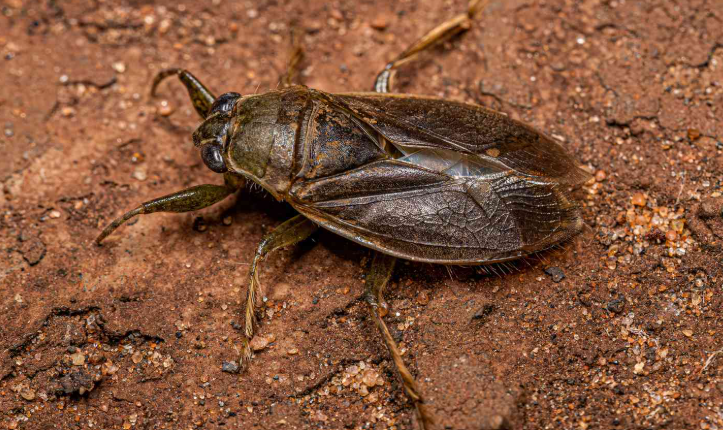
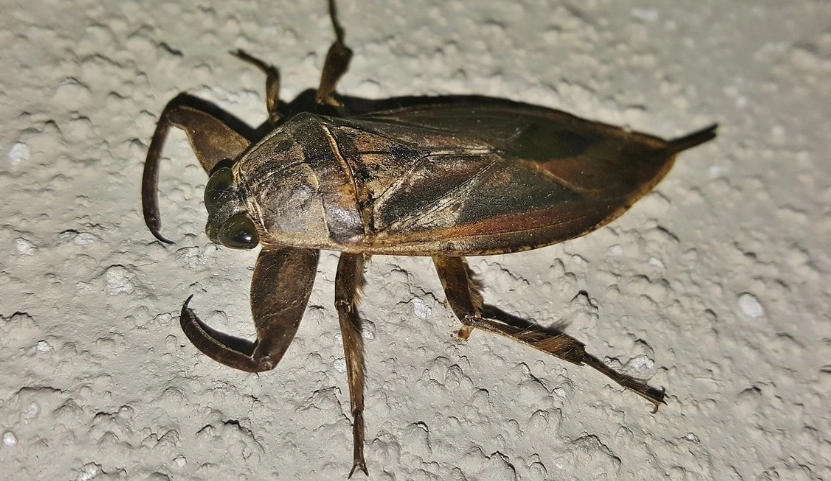
The giant water bug is a large aquatic true bug that emerges from ponds and streams at night to fly between habitats, and its broad, flat, oval brownish body and similar size to large cockroach species makes it one of the most alarming cockroach lookalikes in North America. Found at porch lights and on footpaths after nocturnal flight, it is regularly reported as a cockroach by startled homeowners. The giveaway is its raptorial forelegs held folded against the body and the piercing beak visible on its underside — structures absent from all cockroaches.
Also Read: Bugs with Lots of Legs
Rhinoceros Beetle (Sinodendron cylindricum)
The rhinoceros beetle is a broadly oval, shiny black European beetle found in woodland and garden compost heaps, and its rounded, humped body and long, elbowed antennae generate convincing cockroach comparisons when encountered at ground level. Males bear a short curved horn on the head, but this is easily missed in a brief encounter. Its slow, deliberate movement and preference for dark, damp environments — compost bins, rotting logs, and leaf piles — places it in the same ecological niches frequently associated with cockroaches, reinforcing the confusion.
Blister Beetle (Epicauta pennsylvanica)
The black blister beetle of North America has a soft, elongated body, long antennae, a prominent rounded head, and a scuttling movement that creates a strong cockroach impression when found in gardens and meadows. At 10 to 15 mm in length, it falls squarely within the cockroach size range, and its all-black colouration and flexible, somewhat flattened body enhance the resemblance. Critically, blister beetles contain cantharidin, a toxic compound causing severe skin blistering on contact, making correct identification important for anyone who might otherwise handle them.
Cave Cricket (Diestrammena asynamora)
The camel cricket or cave cricket is a humpbacked, wingless insect with a broadly oval profile, very long antennae, and a brownish colouration that generates frequent cockroach misidentifications when encountered in basements, garages, and dark outbuildings. Its habit of lurking in damp, dark spaces — precisely the environments associated with cockroach infestations — reinforces the confusion. Though its enormously enlarged hind legs distinguish it on careful examination, the initial shock of encountering a large, dark, fast-moving insect in a cellar is sufficient for most people to immediately assume cockroach.
May Bug (Melolontha melolontha)
The cockchafer or May bug is a large, broadly oval European beetle with a reddish-brown body, long antennae, and a clumsy, buzzing flight that brings it indoors through open windows on warm spring evenings, where it stumbles across floors in a manner alarmingly reminiscent of a large cockroach. Its underside is pale and hairy, and up close the feathered, fan-like antennae clearly distinguish it from any cockroach. Nevertheless, its size, colour, and indoor presence reliably generates cockroach reports from homeowners who encounter it at night.
Stink Bug (Halyomorpha halys)
The brown marmorated stink bug is a shield-shaped true bug with a broadly oval, mottled brownish body and long antennae that creates a compelling cockroach silhouette when seen from above without its characteristic shield shape being noticed. It invades homes in enormous numbers during autumn, seeking warmth for overwintering, and the sudden appearance of dozens of brownish, oval insects on walls and ceilings is reliably misidentified as a cockroach infestation by alarmed homeowners. Its tendency to release a pungent odour when disturbed is a useful identifying feature absent from cockroaches.
Wood Louse (Oniscus asellus)
The common shiny woodlouse is a flattened, broadly oval crustacean with long antennae, a segmented body, and a scuttling movement pattern that generates cockroach comparisons from observers unfamiliar with isopods. Found beneath stones, bark, and in damp corners of homes and outbuildings across Europe and North America, it inhabits precisely the damp, dark environments associated with cockroach activity. While its grey colouration and clearly segmented body distinguish it from any cockroach, the brief glimpse of a fast-moving oval creature in a cellar is frequently enough for an immediate cockroach identification.
Earwig (Forficula auricularia)
The common earwig is a slender, reddish-brown insect with long antennae, a flattened body, and rapid movement that generates regular cockroach misidentifications when it scurries across floors and walls indoors. At 10 to 15 mm in length, it falls within the size range of smaller cockroach species, and its habit of hiding in dark crevices and emerging at night reinforces the association. The distinctive abdominal forceps immediately distinguish it from any cockroach on closer examination, but in a panicked glimpse the overall impression is convincingly cockroach-like.
Also Read: Beetles With Red and Black
Palmetto Bug (Eurycotis floridana)
The Florida woods cockroach is itself frequently called a palmetto bug — a regional euphemism that also gets applied to several large beetle and cricket species in the southeastern United States that are mistaken for cockroaches. At up to 4 cm in length, this large, dark reddish-brown cockroach is found outdoors under palmetto leaves and bark but regularly enters homes, generating enormous alarm due to its size. It is notable for spraying a foul-smelling chemical defence when threatened — a trait that genuinely distinguishes it from most beetle lookalikes.
Longhorn Beetle (Prionus californicus)
The California root borer longhorn beetle has a broad, flat, dark brownish body, extremely long antennae, and a size — up to 5 cm in length — that places it firmly in large cockroach territory. Found in western North America, adults emerge at night and are attracted to lights, landing on walls and floors where their large, dark, oval profile moving across surfaces generates immediate cockroach alarm. The distinctly long, segmented antennae and visible wing covers meeting in a straight line down the back quickly distinguish it on examination.
Giant Diving Beetle (Dytiscus marginalis)
The great diving beetle is a large, broadly oval, dark olive-green to black aquatic beetle that leaves its pond habitat at night to fly between water bodies, landing on garden paths and entering homes through open doors. At up to 3.5 cm in length, its smooth, oval, darkly coloured body moving rapidly across a floor in low light is reliably reported as a cockroach. The yellow margin running around the edge of its body and elytra — giving it its species name marginalis — is the most obvious distinguishing feature visible on close inspection.
Bess Beetle (Odontotaenius disjunctus)
The bess beetle or patent-leather beetle of North America is a large, shiny black beetle with a broadly oval, flattened body, long elbowed antennae, and a preference for dark, damp rotting wood — creating a suite of cockroach-like characteristics that generates frequent misidentification. Found across eastern North America beneath the bark of decaying hardwood logs, it moves with a deliberate, ground-hugging posture similar to that of larger cockroach species. Its short, clubbed antennae and single small horn on the head distinguish it from cockroaches on close examination.
Click Beetle (Agrypnus murinus)
The click beetle is a narrow, elongated beetle with a grey-brown, mottled body and long antennae that creates a cockroach-like impression when found on garden soil and walls. Its most famous feature — the ability to spring itself into the air with a loud click when placed on its back — immediately distinguishes it from any cockroach. Nevertheless, its size, colour, antennae length, and ground-dwelling habits make it a consistent subject of cockroach misidentification, particularly in southern European gardens where several large species are common.
Cellar Beetle (Blaps mucronata)
The cellar beetle is a large, matte black, broadly oval darkling beetle found in cellars, caves, stables, and dark outbuildings across Europe and the Middle East, and is one of the most historically significant cockroach lookalikes due to its preference for the same damp, dark domestic environments associated with pest cockroaches. Reaching up to 25 mm in length, its slow, deliberate movement and all-black colouration creates a convincing cockroach impression in low light. Its fused elytra, ending in a distinctive mucron or tail-like tip, and the absence of long flexible antennae distinguish it on examination.
Ground Beetle (Pterostichus madidus)
The black clock beetle is a widespread European ground beetle whose entirely black, broadly oval body, long antennae, and rapid scuttling movement across garden paths and floors makes it one of the most common cockroach misidentifications in British and European gardens. Highly active on overcast days and at night, it hunts slugs, worms, and invertebrates across garden beds and enters homes through ground-level gaps. Its parallel-sided body and clearly visible elytra seam distinguish it from cockroaches, but the initial encounter almost universally triggers a cockroach alarm.
Also Read: Common Bugs With Pinchers
Palmetto Weevil (Rhynchophorus cruentatus)
The palmetto weevil is the largest weevil in North America, reaching up to 3.5 cm in length with a broad, oval, shiny black to reddish-black body that generates cockroach misidentification when found at the base of palm trees or on garden paths across the southeastern United States. Its relatively small head and large, rounded body produce a cockroach-like silhouette at a distance. The distinctive down-curved snout — the defining feature of all weevils — immediately identifies it on close inspection, but this is easily missed in a brief outdoor encounter.
Wharf Borer (Nacerdes melanura)
The wharf borer is a soft-bodied, elongated beetle found in damp, rotting wood near water across North America and Europe, with a yellowish-brown to reddish body and long, black-tipped antennae. Its habit of emerging in large numbers from rotting structural timber indoors generates widespread alarm, and its movement across floors and walls creates a cockroach-like impression that has caused numerous unnecessary pest control interventions. Its presence is actually a reliable indicator of serious structural moisture problems and wood decay rather than a pest problem in its own right.
Burying Beetle (Nicrophorus vespilloides)
The burying beetle is a large, broad-bodied beetle with striking orange-red and black banded elytra and long, clubbed antennae found across Europe and North America. While its colouration clearly distinguishes it from most cockroach species, its size, shape, and movement pattern when encountered on garden soil generates cockroach comparisons from observers who see the movement and shape before the colour. It plays a vital ecological role in burying and consuming small vertebrate carcasses, within which it raises its young — one of the most sophisticated examples of parental care in the beetle world.
Rove Beetle (Staphylinus olens)
The devil’s coach horse is a large, entirely black rove beetle found across Europe with a long, flexible, narrow body and dramatically short elytra exposing most of its abdomen — features that might seem to distinguish it from cockroaches. However, its overall black colouration, long antennae, rapid movement, and defensive posture of curling its abdomen over its back while opening its large mandibles creates an alarming and cockroach-adjacent impression in garden settings. It is a fierce predator of slugs and invertebrates and one of the most beneficial beetles a garden can host.
Also Read: Insects That Glow at Night
Brown Cricket (Acheta domesticus)
The house cricket is a pale to medium brown insect with long antennae, a broadly oval body, and the rapid movement and dark hiding-place preferences that generate regular cockroach comparisons. Historically kept in homes for good luck across Europe and Asia, it has become established in urban environments worldwide and is a major feeder insect in the reptile pet trade. Escaped individuals in homes reliably trigger cockroach concerns due to their size, colour, and nocturnal activity patterns, with the distinctive chirping of males being the most immediate distinguishing characteristic.
Flat Bark Beetle (Cucujus clavipes)
The red flat bark beetle has a dramatically flattened, broadly oval body in vivid red — unlike any cockroach — but its overall body shape, running behaviour, and preference for dark crevices beneath bark make its form instantly recognisable as cockroach-like in silhouette. The flattened body plan is an adaptation shared with cockroaches for precisely the same reason: enabling access to the tightest crevices and bark gaps. Its striking colouration immediately rules out cockroach identification in good light, but in dim conditions or glimpsed movement, the body plan is unmistakably cockroach-derived in shape.
Predatory Ground Beetle (Abax parallelepipedus)
This large European ground beetle has a broad, parallel-sided, glossy black body reaching up to 20 mm and moves with the rapid, directional ground-level sprint characteristic of cockroaches when disturbed. Found in woodland, hedgerows, and gardens across central and northern Europe, it shelters beneath bark and logs during the day and hunts invertebrates at night — habits that place it in cockroach territory both ecologically and visually. Its completely smooth, polished elytra and the absence of any pronotum covering the head are the most visible distinguishing features from a cockroach.
Mole Cricket (Gryllotalpa gryllotalpa)
The European mole cricket has a broadly oval, robust, reddish-brown body, short antennae relative to its body length, and powerful shovel-like forelegs that create an overall impression quite different from a typical cockroach — yet its size, colouration, and ground-level movement pattern consistently generates cockroach reports when individuals emerge from soil at night. At up to 5 cm in length, it is one of the larger insects likely to be encountered in a European garden or home. Its unmistakable velvety texture, stout build, and excavating forelegs immediately distinguish it from any cockroach on examination.
Brown Lacewing (Micromus variegatus)
Brown lacewings have soft, oval, pale brownish bodies with long antennae and move with a slow, deliberate ground-level walk when not flying — creating a cockroach-like impression when encountered on walls and surfaces in dim lighting. Significantly smaller than most cockroach species at just 6 to 10 mm, they are predators of aphids and other small insects and are entirely beneficial in gardens. Their large, prominently veined wings folded tent-like over the body immediately identify them on examination, but at rest with wings closed against a dark surface the overall impression is surprisingly cockroach-like.
Harlequin Ladybird (Harmonia axyridis)
The harlequin ladybird has a broadly oval, domed body that is distinctly cockroach-shaped in silhouette when viewed from the side, and the dark-coloured forms — which can appear almost entirely black with faint markings — generate occasional cockroach comparisons when encountered at ground level or on walls. Native to Asia and now invasive across Europe and North America, it overwinters in aggregations indoors, sometimes in very large numbers that alarm homeowners. Its short, clubbed antennae, strongly domed body, and maximum size of just 8 mm distinguish it clearly from all cockroach species.