Ornamental trees can completely change the character of a garden. A carefully chosen tree may provide spring flowers, colorful foliage, attractive bark, autumn color, unusual shapes, berries for wildlife, or welcome shade. Unlike many short-lived flowering plants, a well-placed ornamental tree can become a permanent feature around which an entire landscape is designed.
The term ornamental tree does not refer to one botanical family. Instead, it describes trees grown primarily for attractive features such as flowers, foliage, fruit, bark, form, or seasonal interest. Some are naturally small, while others become substantial landscape trees and need considerably more room.
Flowering trees are particularly valuable in residential landscapes because they add seasonal interest that ordinary shade trees may lack. Extension specialists recommend considering mature size, form, sunlight, soil, drainage, flowering period, fruit, and maintenance requirements before planting.
Size matters more than many gardeners realize. Research on urban trees has found that larger trees can provide greater ecosystem benefits than smaller, shorter-lived trees, although the best choice still depends on available space and site conditions.
Below are 50 ornamental trees ranging from compact specimens for small gardens to large trees suitable for spacious properties, parks, streets, and larger landscapes.
1. Japanese Maple
Botanical name: Acer palmatum
Size: Small to medium
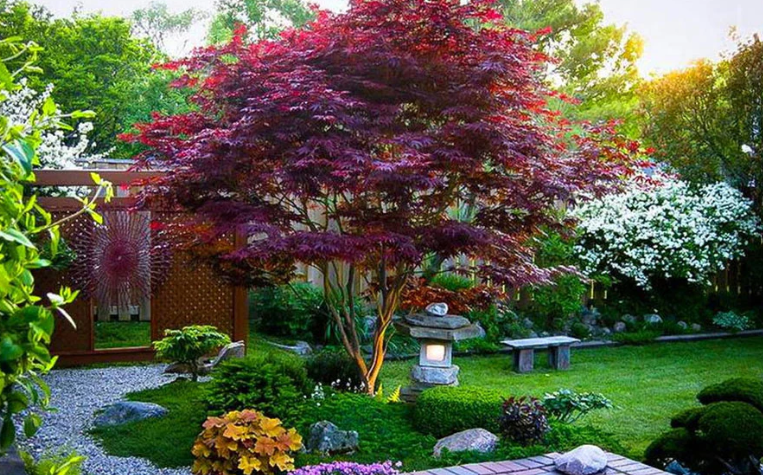
Japanese maple is one of the most versatile ornamental trees for gardens. Its greatest attraction is its foliage, which can be green, red, purple, orange, or yellow depending on the cultivar and season.
The leaves are deeply divided, giving the tree a delicate appearance. Some cultivars have upright forms, while others develop cascading or weeping branches.
Japanese maple works particularly well as a specimen tree near patios, entrances, paths, ponds, or shaded garden areas. Because different cultivars vary dramatically in mature size, it is important to check the eventual dimensions before planting.
2. Flowering Dogwood
Botanical name: Cornus florida
Size: Small to medium
Flowering dogwood is one of the classic ornamental trees of North America. It is valued for its spring display of white or pinkish bracts, red fruits, and attractive fall foliage.
The actual flowers are small and clustered in the center of the showy bracts. A mature tree commonly reaches around 20 to 30 feet tall, although size varies with conditions and cultivar.
Its combination of spring flowers, summer foliage, autumn color, and wildlife-friendly fruit gives it several seasons of interest.
3. Kousa Dogwood
Botanical name: Cornus kousa
Size: Small to medium
Kousa dogwood is an Asian relative of flowering dogwood. It develops attractive white bracts in late spring or early summer, often after many other flowering trees have finished blooming.
Its exfoliating bark can become increasingly interesting with age, while the tree may produce red fruits that resemble small berries.
Kousa dogwood is also generally more tolerant of somewhat dry conditions than flowering dogwood, making it useful in landscapes where moisture is not consistently abundant.
4. Eastern Redbud
Botanical name: Cercis canadensis
Size: Small to medium
Eastern redbud is famous for producing clusters of pink to rosy-purple flowers directly along its branches before or as the leaves emerge.
Its heart-shaped leaves provide additional ornamental value throughout the growing season. Some cultivars have burgundy or golden foliage.
The spreading, rounded form makes redbud particularly attractive as a lawn specimen or small shade tree.
5. Saucer Magnolia
Botanical name: Magnolia × soulangeana
Size: Medium
Saucer magnolia is one of the most recognizable spring-flowering ornamental trees. Its large, cup-shaped flowers appear in shades of white, pink, purple, and combinations of these colors.
The flowers can appear before the leaves, creating a dramatic display on otherwise bare branches.
It is best given sufficient room because mature trees can develop a broad canopy.
6. Star Magnolia
Botanical name: Magnolia stellata
Size: Small
Star magnolia is particularly useful for gardens where a large magnolia would be impractical. Its narrow, strap-like white petals create star-shaped flowers in early spring.
The tree generally develops a rounded or spreading form and can work well near patios, lawns, entryways, and smaller gardens.
Its relatively compact size makes it one of the better magnolias for residential landscapes with limited space.
Also Read: Different Types of Ornamental Grasses
7. Crape Myrtle
Botanical name: Lagerstroemia spp.
Size: Small to medium, depending on species and cultivar
Crape myrtles are valued for their long-lasting summer flowers and attractive bark. Flower colors include white, pink, lavender, purple, and red.
Their smooth, exfoliating trunks provide winter interest after the leaves fall.
Because cultivars vary considerably in size, gardeners can find selections suitable for relatively small yards as well as larger landscapes.
8. Yoshino Cherry
Botanical name: Prunus × yedoensis
Size: Medium
Yoshino cherry is famous for its clouds of pale pink to white flowers in spring. It has an elegant branching structure and is frequently used along avenues, lawns, parks, and formal landscapes.
The flowers appear in abundance, creating a short but highly visible seasonal display.
The tree is especially effective when planted where its flowering canopy can be viewed from a distance.
9. Kwanzan Cherry
Botanical name: Prunus serrulata ‘Kwanzan’
Size: Medium
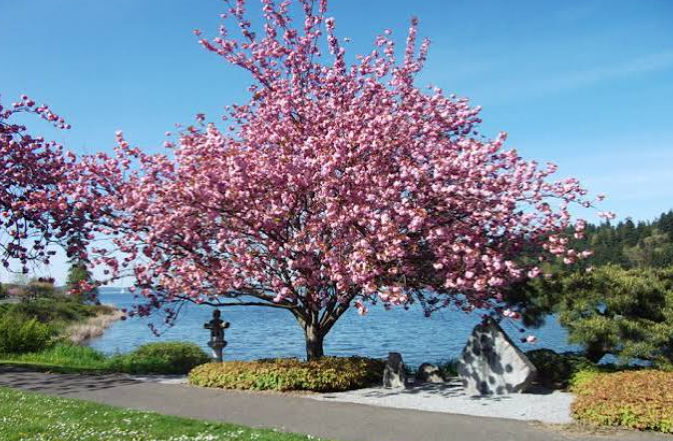
Kwanzan cherry produces large, double pink flowers that resemble miniature roses.
Unlike Yoshino cherry, which generally has simpler flowers, Kwanzan is prized for its dense clusters of double blooms.
Its upright-to-vase-shaped form makes it useful as a specimen tree or in rows along driveways and walkways.
10. Crabapple
Botanical name: Malus spp.
Size: Small to medium
Crabapples are among the most versatile ornamental fruit trees. They can produce white, pink, or red flowers followed by small fruits in shades ranging from yellow to orange and deep red.
Some cultivars retain their fruits well into winter, extending their ornamental season.
Crabapples are particularly useful for gardens where spring flowers and colorful fruit are both desirable.
11. Golden Chain Tree
Botanical name: Laburnum spp.
Size: Small to medium
Golden chain tree is famous for its long hanging clusters of bright yellow flowers.
When in bloom, the flowers can create a curtain-like effect beneath the branches.
It is best suited to climates and locations where its growing requirements can be met, and gardeners should be aware that parts of the plant are poisonous if eaten.
12. Fringe Tree
Botanical name: Chionanthus virginicus
Size: Small to medium
Fringe tree is named for its unusual flowers. The white blooms consist of narrow petals that hang in clusters, giving the tree a soft, fringe-like appearance.
The flowers appear in spring, followed by dark fruits on female trees when pollination occurs.
It is an excellent choice for gardeners who want something less conventional than a cherry or magnolia.
13. Serviceberry
Botanical name: Amelanchier spp.
Size: Small to medium
Serviceberry offers several attractive features in one tree. It produces white spring flowers, edible berries, and colorful autumn foliage.
The berries are also valuable to birds and other wildlife.
Because serviceberries are available in shrubby and tree-like forms, they can fit a wide range of landscape designs.
14. Japanese Snowbell
Botanical name: Styrax japonicus
Size: Small to medium
Japanese snowbell produces small white flowers that hang beneath the branches in late spring or early summer.
Its horizontal branching and relatively restrained growth make it an elegant choice for smaller landscapes.
It works particularly well near patios and pathways where the flowers can be observed at close range.
15. Golden Rain Tree
Botanical name: Koelreuteria paniculata
Size: Medium
Golden rain tree produces large clusters of yellow flowers during summer. After flowering, distinctive papery seed capsules develop.
The tree also provides attractive yellow fall color in suitable climates.
Its unusual combination of flowers and seed pods makes it a useful specimen tree for landscapes that need more than a single season of interest.
16. Chinese Pistache
Botanical name: Pistacia chinensis
Size: Medium to large
Chinese pistache is particularly valuable for autumn color. Its green summer foliage can transform into shades of orange, scarlet, and red.
It also develops a rounded canopy as it matures, making it useful as a shade and specimen tree.
It is often considered where gardeners want an ornamental tree that can tolerate relatively challenging urban conditions.
17. Persian Ironwood
Botanical name: Parrotia persica
Size: Medium
Persian ironwood is an ornamental tree for gardeners who appreciate foliage and bark as much as flowers.
Its leaves can display brilliant red, orange, yellow, and purple tones in autumn. The bark of older specimens develops an attractive mottled appearance.
Its relatively slow development is offset by its strong seasonal interest and long-term landscape value.
18. Stewartia
Botanical name: Stewartia spp.
Size: Small to medium
Stewartias combine several ornamental characteristics. Depending on the species, they may provide white camellia-like flowers, attractive bark, and vivid autumn foliage.
They are particularly appreciated by gardeners looking for trees with year-round character rather than a single spectacular flowering period.
19. Amur Maple
Botanical name: Acer ginnala
Size: Small to medium
Amur maple is a relatively compact maple with attractive lobed leaves.
Its foliage can turn brilliant red in autumn, while its relatively modest stature makes it useful in smaller properties.
It may be grown as a multi-stemmed small tree or trained into a more conventional tree form.
20. Paperbark Maple
Botanical name: Acer griseum
Size: Small to medium
Paperbark maple is named for its distinctive peeling copper-colored bark.
Its leaves turn attractive shades of red and orange in autumn, but the bark remains its most recognizable feature throughout winter.
This is an excellent specimen tree for a location where its trunk can be seen clearly.
21. Red Buckeye
Botanical name: Aesculus pavia
Size: Small to medium
Red buckeye produces striking tubular red flowers that can attract hummingbirds and other pollinators.
Its compound leaves create a different texture from many ornamental trees.
It can develop into a small tree or large shrub, making it useful where a full-sized shade tree would be excessive.
22. Japanese Pagoda Tree
Botanical name: Styphnolobium japonicum
Size: Large
Japanese pagoda tree develops a broad, rounded canopy and clusters of creamy-white flowers during summer.
Its mature size makes it more appropriate for spacious landscapes than small residential yards.
It can be used as a lawn specimen, street tree, or shade tree where adequate room exists.
23. Tulip Tree
Botanical name: Liriodendron tulipifera
Size: Large
Tulip tree is a large ornamental species with distinctive four-lobed leaves and unusual tulip-shaped flowers.
It can become a substantial tree, so it should be planted where its eventual height and spread will not conflict with buildings or overhead infrastructure.
Its large canopy makes it more suitable for spacious properties.
24. Southern Magnolia
Botanical name: Magnolia grandiflora
Size: Large
Southern magnolia is famous for its huge white, fragrant flowers and glossy evergreen leaves.
Its broad canopy creates a strong architectural presence in warm climates.
Because mature trees can become very large, this is not usually a tree for a tiny garden. It needs a location where its roots, canopy, and eventual height have room to develop.
25. Sweetgum
Botanical name: Liquidambar styraciflua
Size: Large
Sweetgum is primarily valued as an ornamental foliage tree. Its star-shaped leaves can turn red, orange, yellow, and purple in autumn.
The tree develops a tall, pyramidal form when young and can become a large shade tree.
Cultivars selected for reduced fruit production can be preferable in areas where the spiky seed balls would create a maintenance problem.
26. American Yellowwood
Botanical name: Cladrastis kentukea
Size: Medium to large
American yellowwood produces hanging clusters of fragrant white flowers in late spring or early summer.
Its rounded canopy and compound foliage give it a soft, graceful appearance.
It is particularly attractive as a specimen tree on larger lawns.
27. Black Gum
Botanical name: Nyssa sylvatica
Size: Medium to large
Black gum is highly regarded for its brilliant autumn foliage. Leaves can turn scarlet, orange, yellow, or combinations of these colors.
Its naturally attractive branching structure makes it useful even outside the fall season.
It is also an important tree for wildlife and pollinators.
28. Japanese Zelkova
Botanical name: Zelkova serrata
Size: Large
Japanese zelkova forms a broad, vase-shaped canopy and is often used as an ornamental street and shade tree.
Its serrated leaves provide attractive texture and can turn yellow, orange, or reddish in autumn.
It can become a substantial tree, making mature size an important consideration before planting.
29. American Hornbeam
Botanical name: Carpinus caroliniana
Size: Small to medium
American hornbeam is sometimes called musclewood because of its distinctive smooth, muscular-looking trunk.
It has a naturally graceful form and attractive fall foliage.
Its relatively modest size makes it useful for smaller landscapes, especially when a native ornamental tree is desired.
30. Chinese Fringe Tree
Botanical name: Chionanthus retusus
Size: Small to medium
Chinese fringe tree produces clouds of white flowers that can almost hide the foliage during peak bloom.
Its attractive gray bark provides additional winter interest.
The species works well as a specimen near patios, entryways, or garden paths.
31. Saucer Magnolia
Botanical name: Magnolia × soulangeana
Size: Medium
Saucer magnolia deserves special mention because of the enormous diversity among its cultivars. Flower colors can range from nearly pure white to deep pink and purple.
Its large flowers are among the most dramatic spring displays available for a temperate garden.
The tree is best positioned where its flowers can be appreciated without being crowded by surrounding structures.
32. Seven-Son Flower
Botanical name: Heptacodium miconioides
Size: Small to medium
Seven-son flower is unusual because its ornamental season extends into late summer and autumn.
Clusters of white flowers appear late in the growing season, followed by attractive reddish structures as the flowers fade.
Its exfoliating bark can also become attractive with age.
33. Japanese Tree Lilac
Botanical name: Syringa reticulata
Size: Small to medium
Japanese tree lilac brings the familiar fragrance of lilacs into a tree-like form.
It produces large clusters of creamy-white flowers during early summer.
Its relatively upright form makes it useful near streets, patios, and smaller lawns where a traditional large shade tree would be inappropriate.
34. Magnolia ‘Little Gem’
Botanical name: Magnolia grandiflora ‘Little Gem’
Size: Small to medium
‘Little Gem’ is a compact southern magnolia cultivar developed for landscapes where the species’ enormous mature size would be difficult to accommodate.
It retains the glossy evergreen foliage and large white flowers characteristic of southern magnolia while maintaining a more restrained form.
It can be useful as a specimen near a home when adequate room is still provided.
35. Weeping Cherry
Botanical name: Prunus cultivars
Size: Small to medium
Weeping cherries are ornamental cherries selected for cascading branches.
Their flowers may be white or pink depending on the cultivar.
The arching branches create a distinctly different silhouette from upright cherries and make the tree especially effective near ponds, lawns, or garden entrances.
36. Japanese Stewartia
Botanical name: Stewartia pseudocamellia
Size: Small to medium
Japanese stewartia is a four-season ornamental tree.
It produces white flowers resembling small camellias, attractive foliage, colorful autumn leaves, and patterned bark.
Its relatively slow growth makes it a long-term specimen rather than a tree selected for instant size.
37. Chinese Parasol Tree
Botanical name: Firmiana simplex
Size: Medium to large
Chinese parasol tree develops a broad canopy and large, unusual leaves.
Its foliage gives the tree a tropical-looking appearance even in landscapes where the surrounding vegetation is more temperate.
It needs sufficient space because its broad leaves and canopy can create considerable visual and physical scale.
38. Silk Tree
Botanical name: Albizia julibrissin
Size: Small to medium
Silk tree is known for its delicate, fern-like leaves and fluffy pink flowers.
The flowers appear during warm weather and give the tree a distinctly exotic appearance.
Its broad, spreading crown makes it an attractive ornamental specimen, although its suitability varies considerably by region.
39. Jacaranda
Botanical name: Jacaranda mimosifolia
Size: Medium to large
Jacaranda is one of the world’s most recognizable flowering ornamental trees.
Its finely divided foliage creates a soft canopy, while large clusters of violet-blue flowers can produce spectacular seasonal displays.
It is particularly suited to warm climates and is widely planted in subtropical and tropical cities.
A Nairobi study of ornamental vegetation found trees to be the most common growth form among the 638 plant species recorded across 100 urban green spaces, illustrating how important trees are to urban landscapes in warm climates.
40. Delonix regia
Common name: Royal poinciana
Size: Large
Royal poinciana is famous for its broad, spreading canopy and brilliant red-orange flowers.
It is particularly effective in tropical and subtropical landscapes, where the tree can develop a dramatic umbrella-like form.
Its combination of fine foliage and intense flowers makes it one of the most visually striking large ornamental trees for warm climates.
41. Golden Trumpet Tree
Botanical name: Handroanthus chrysotrichus
Size: Small to medium
Golden trumpet tree produces abundant yellow, trumpet-shaped flowers.
The flowers become especially conspicuous when the tree sheds some or most of its foliage around the flowering period.
It is well suited to warm climates and can serve as a colorful street, garden, or courtyard tree where conditions permit.
42. Pink Trumpet Tree
Botanical name: Handroanthus heptaphyllus and related species
Size: Medium to large
Pink trumpet trees are admired for their dramatic clusters of pink flowers.
In warm regions, they can become major landscape features, especially when planted along streets or in large gardens.
Their seasonal flowering makes them particularly useful where a strong burst of color is desired.
43. African Tulip Tree
Botanical name: Spathodea campanulata
Size: Large
African tulip tree is a tropical ornamental tree with large, orange-red flowers.
Its broad leaves and substantial canopy make it better suited to spacious landscapes.
Although spectacular, gardeners should check local ecological guidance before planting it because some ornamental trees can behave differently outside their native ranges.
This is particularly important in tropical regions, where ornamental horticulture can contribute to the spread of species beyond cultivation. Research in Nairobi found that 30% of exotic ornamental plant species recorded had a history of invasiveness somewhere in the world.
44. Pride of India
Botanical name: Lagerstroemia speciosa
Size: Medium to large
Pride of India is a tropical relative of crape myrtle.
It produces large clusters of pink to purple flowers and has broad leaves that can develop attractive seasonal coloration.
Its size makes it particularly suitable for parks, spacious gardens, and large avenues.
45. Cassia Tree
Botanical name: Senna siamea and related species
Size: Medium
Cassia trees are widely grown in warm climates for their attractive yellow flowers and foliage.
Some species can flower heavily during favorable conditions, creating bright displays along roadsides and in gardens.
Because the name “cassia” covers several different trees, the exact species should always be checked before planting.
46. Bauhinia
Botanical name: Bauhinia spp.
Size: Small to medium
Bauhinia trees are recognizable by their unusual butterfly-like flowers and distinctive leaves that resemble a pair of joined lobes.
Flowers may be white, pink, purple, or combinations of these colors depending on species.
They are especially popular in tropical and subtropical landscaping.
47. Bottlebrush Tree
Botanical name: Callistemon spp.
Size: Small to medium
Bottlebrush trees produce cylindrical flowers covered with numerous stamens, giving each flower spike the appearance of a bottle-cleaning brush.
Red is the most familiar flower color, although cultivars and related species can produce pink, white, or yellow flowers.
Their flowers are particularly attractive to nectar-feeding wildlife.
48. Oleander Tree Form
Botanical name: Nerium oleander
Size: Small tree or large shrub
Oleander can be trained into a tree-like form and produces abundant flowers in warm climates.
Depending on cultivar, blooms may be pink, red, white, or other shades.
It is often used for formal plantings, hedges, roadsides, and containers.
However, oleander is poisonous if eaten, so it should be planted thoughtfully around areas where children or pets may encounter it.
49. Australian Willow
Botanical name: Geijera parviflora
Size: Medium
Australian willow develops narrow, willow-like leaves and an elegant, somewhat weeping canopy.
Its restrained appearance makes it suitable for contemporary landscapes, courtyards, streetscapes, and water-conscious gardens in suitable climates.
It is especially useful when a gardener wants the visual softness of a willow without planting an enormous traditional willow.
50. Bottle Tree
Botanical name: Brachychiton spp.
Size: Medium to large
Bottle trees are unusual ornamental trees valued for their distinctive trunks and architectural forms.
Some species develop swollen trunks that store water, while their foliage and flowers provide additional seasonal interest.
They are particularly well suited to warm climates and can become striking focal points in drought-tolerant or contemporary landscapes.
How to Choose the Right Ornamental Tree
The prettiest tree is not necessarily the best tree for a particular garden. Mature size should be one of the first considerations.
A tree that looks small at a nursery can eventually have a canopy several times wider than expected. Large trees should be kept well away from buildings, foundations, utility infrastructure, and narrow planting strips. A UC Master Gardener guide recommends keeping large trees at least 15 feet away from permanent structures and foundations.
Consider these factors before buying:
1. Mature Height
Check the tree’s expected mature height rather than its nursery size.
A 6-foot sapling may eventually become a 60-foot tree.
2. Mature Width
Canopy spread is just as important as height. A broad tree may need considerably more horizontal space than expected.
3. Rooting Conditions
Some trees tolerate compacted urban soils better than others. Soil drainage, available rooting space, and moisture should all influence the choice.
4. Sunlight
Most flowering ornamental trees produce their best blooms with adequate sunlight, although some species prefer partial shade.
5. Flowering Season
Combining trees that bloom at different times can create a longer sequence of seasonal interest.
6. Fruit and Seed Drop
Colorful fruit can be beautiful and beneficial to wildlife, but fallen fruit may create maintenance problems on patios, sidewalks, and driveways. Virginia Tech specifically recommends considering fruiting characteristics when selecting flowering trees.
7. Climate
A tree adapted to a cool temperate climate may struggle in a tropical garden, while a tropical ornamental may be damaged by freezing temperatures.
8. Local Ecological Considerations
An ornamental tree that grows beautifully in one region may become problematic in another. This is especially important when selecting exotic species for tropical and subtropical landscapes.
Large vs. Small Ornamental Trees
There is no universal winner between large and small ornamental trees. The right size depends on the landscape.
Small ornamental trees are generally better for:
- Courtyards
- Small lawns
- Patios
- Town gardens
- Narrow borders
- Residential entrances
- Smaller urban properties
Large ornamental trees are better suited to:
- Large lawns
- Parks
- Estates
- Campuses
- Wide streets
- Large commercial landscapes
- Open gardens
Large trees can also provide greater environmental benefits when they have enough room to develop. Research comparing urban tree species found that larger trees generally provide greater ecosystem-service benefits than smaller trees, although species, location, condition, and management all matter.
Ornamental Trees With the Best Seasonal Interest
If year-round interest is the goal, do not focus only on flowers.
Some of the strongest choices provide several features:
Japanese maple: foliage and fall color.
Flowering dogwood: spring bracts, red fruit, and fall color.
Kousa dogwood: flowers, fruit, bark, and autumn foliage.
Paperbark maple: peeling bark and fall color.
Stewartia: flowers, bark, and autumn foliage.
Crabapple: spring flowers and colorful fruit.
Persian ironwood: foliage, bark, and autumn color.
Crape myrtle: summer flowers and attractive bark.
This multi-season approach is often more effective than planting a tree that looks spectacular for only a few weeks.
Ornamental Trees for Small Gardens
For a small property, some of the most useful choices include:
- Japanese maple
- Star magnolia
- Flowering dogwood
- Kousa dogwood
- Eastern redbud
- Fringe tree
- Serviceberry
- Japanese snowbell
- Japanese tree lilac
- Paperbark maple
- Stewartia
- Japanese stewartia
These trees can provide considerable visual impact without requiring the enormous growing space needed by species such as tulip tree, southern magnolia, or sweetgum.
Ornamental Trees for Large Landscapes
Large properties provide considerably more freedom. Suitable options can include:
- Southern magnolia
- Tulip tree
- Japanese pagoda tree
- Sweetgum
- Japanese zelkova
- Black gum
- Chinese pistache
- Royal poinciana
- Jacaranda
- African tulip tree
Large trees should nevertheless be positioned carefully. Their mature canopy, roots, falling branches, and proximity to structures all need to be considered before planting.
Ornamental Trees Can Do More Than Look Beautiful
The value of ornamental trees extends beyond flowers and foliage. Urban trees can provide shade, habitat, visual screening, improved air quality, stormwater benefits, and other ecosystem services. They can also soften buildings and streetscapes and contribute to the character of neighborhoods.
That makes tree selection a long-term landscape decision rather than simply a choice based on flower color.
For example, a small flowering dogwood might be selected primarily for spring flowers, while a large Chinese pistache could be chosen for autumn color and shade. A jacaranda may be selected for spectacular seasonal flowers, while a paperbark maple may be planted because its trunk remains attractive even after the leaves have fallen.
The best ornamental tree is therefore the one that combines beauty, appropriate size, climate compatibility, manageable maintenance, and a good fit with the surrounding landscape.
A thoughtful combination of small and large trees can create layers of height, seasonal color, shade, texture, and wildlife habitat. Instead of filling every available space with trees, landscape specialists generally recommend using a limited number of well-positioned flowering specimens so that each tree has enough room to display its natural form.