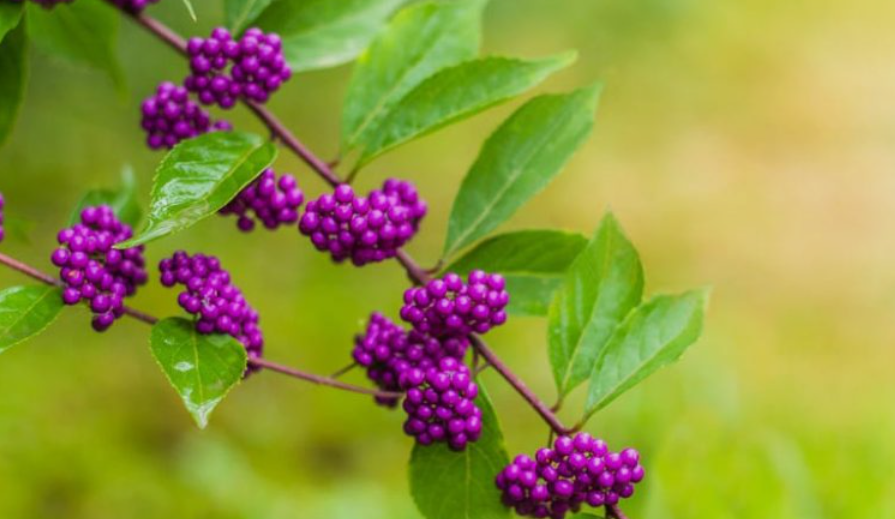
Shrubs with purple berries bring some of the most striking color of the late-season garden, with glossy, jewel-toned fruit that stands out against bare branches, evergreen leaves, or fading fall foliage. A single purple-berried shrub can become the focal point of a planting. The 21 shrubs below range from compact beautyberries to tall silk tassels, and from edible fruit crops to ornamentals meant purely for show.
Size and hardiness vary widely across the group. The smallest, salal, tops out at 1 to 2 feet, while blackhaw viburnum can reach 12 to 20 feet and coast silk tassel 12 to 15 feet. Hardiness runs from zone 2 for the toughest haskap cultivars to zone 11 for American beautyberry, so there’s a purple-berried shrub for almost every climate in the country.
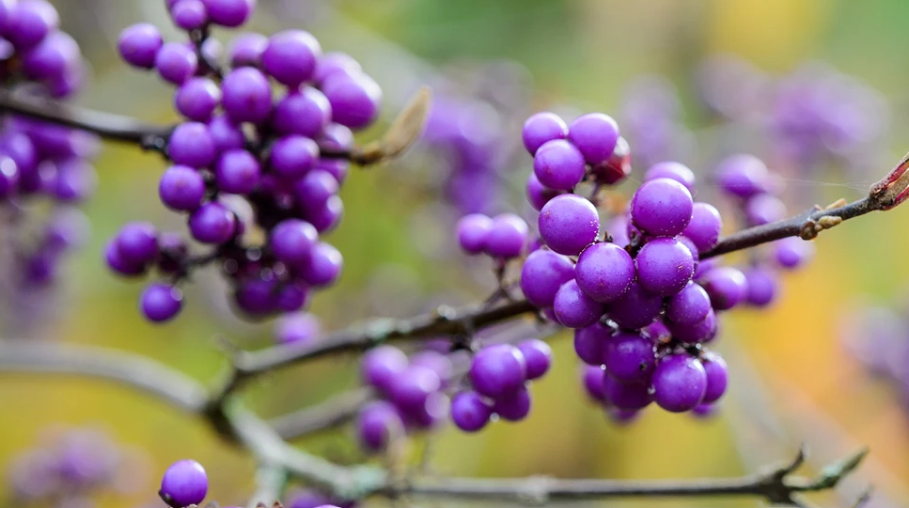
Beautyberries dominate the list because they are the best-known purple-fruited ornamentals. All four main species have purple berries, though white-fruited cultivars exist, and the clusters ripen in late summer and often hang on after the leaves drop into late fall. Many of the other shrubs here are North American natives that feed songbirds, and several produce fruit that people can eat once it is cooked or processed.
Purple berries aren’t automatically safe to eat, and the differences matter. Elderberries should be cooked, Oregon grape berries can upset the stomach, and the fruit of pagoda dogwood is considered inedible. The shrubs below group the 21 shrubs into beautyberries, elderberries and chokeberries, cold-hardy fruit shrubs, western natives, and viburnums and dogwood, with heights and zones shown as ranges where sources differ.
Beautyberries
American Beautyberry
American beautyberry is the native beautyberry of the Southeast, a rapidly growing shrub that produces large clusters of shiny purple berries about a third of an inch across. It typically reaches 4 to 6 feet tall and wide, though plants can grow 3 to 8 feet depending on conditions, and the berries ripen in late summer and persist after the leaves fall into late fall. It’s hardy in zones 7 through 11, which means it won’t survive winters in colder regions.
The fruit is a favorite of songbirds, including robins, cardinals, brown thrashers, mockingbirds, and eastern towhees. The shrub tolerates part shade to shade and looks best massed in a naturalized planting. Old wood can be pruned heavily from late fall to early spring, and the plant generally needs little maintenance.
Japanese Beautyberry
Japanese beautyberry is very similar to the purple beautyberry but tends to grow taller, reaching 4 to 6 feet tall and wide and up to 8 to 10 feet under favorable conditions. It produces clusters of purple berries that ripen in late August and persist into late fall. The berries show best after the leaves drop.
Like other beautyberries, it’s a deciduous shrub with showy clusters that create an eye-catching display when planted as a specimen. White-fruited cultivars exist, so check the label if you want purple. Its size makes it a good choice where a taller beautyberry is wanted.
Purple Beautyberry
Purple beautyberry is native to China, Korea, and Japan and is widely considered the best of the group for fruit display. It grows 3 to 4 feet tall and is hardy in zones 5 through 8, which makes it hardier than the American species. Its bright, lavender-purple berries are borne in dense clusters along arching stems in late summer.
The leaves turn shades of yellow and purple in fall, which pairs nicely with the fruit. It performs best in full sun to light shade and moist, well-drained soil, and dead branches can be pruned off in early spring. Planted en masse, it creates a dramatic fall display that few other small shrubs can match.
‘Issai’ Beautyberry
‘Issai’ is a mounded cultivar of purple beautyberry that grows 3 to 4 feet high and wide with abundant violet-blue berries. It’s noted for fruiting at an early age and producing a heavy crop, which makes it a fast way to get color in a new planting. It’s hardy in zones 5 through 8.
The compact, rounded shape suits a border or a mixed shrub bed. Like the species, it performs best in full sun to light shade and moist, well-drained soil. The fruit display is best in fall, when the berries cluster densely along the stems.
‘Early Amethyst’ Beautyberry
‘Early Amethyst’ is an upright cultivar of purple beautyberry that reaches 3 to 4 feet high and 4 to 5 feet wide. It bears large quantities of small purple berries. The shrub is hardy in zones 5 through 8.
Its small fruit gives a finer, more delicate look than the larger clusters of American beautyberry. A hard prune in late winter or early spring, down to about 6 inches, is sometimes recommended to encourage compact growth and flowering. It’s an easy choice for a small garden.
‘Profusion’ Beautyberry
‘Profusion’ is a medium-sized cultivar that grows 4 to 6 feet tall and produces an abundance of bright, glossy, violet-purple fruit, even on young plants. Clusters of small lilac flowers appear along the stems in summer and attract bees and butterflies. The berries ripen in early fall and persist after the leaves have fallen, standing out until early winter.
It’s hardy in zones 5 through 8. The berries dot every arching branch like beads on a string, which gives it a heavy, reliable fruit display. That reliability, even on young plants, explains why it’s a common recommendation for gardeners who want dependable color.
‘Purple Pearls’ Beautyberry
‘Purple Pearls’ is a patented selection with a distinctive upright growth habit, pink flowers, and violet-purple fruit, along with dark purple-black foliage that holds its color all season. It’s hardy in zones 5 through 8. The dark leaves make it a standout even before the berries ripen.
Its upright form takes up less room than the arching types. The purple-black foliage contrasts with the bright violet fruit in late summer and fall. That gives it interest well before and after the berries ripen.
‘Purple Glam’ Beautyberry
‘Purple Glam’ is a vigorous, upright selection with white flowers, purple-violet berries, and purple foliage all season long. It’s hardy in zones 5 through 8, the same range as its relative ‘Purple Pearls’. The foliage color makes it one of the more ornamental forms.
The combination of dark leaves, white flowers, and purple berries gives it three seasons of interest. Both ‘Purple Glam’ and ‘Purple Pearls’ are patented selections bred for foliage color. That makes them stand out in a garden of mostly green beautyberries.
Elderberries and Chokeberries
American Elderberry
American elderberry is a large, stoloniferous shrub that grows 5 to 12 feet tall and wide and is hardy in zones 3 through 9. In early summer it produces creamy white flower clusters 6 to 10 inches across, followed by abundant dark purple to black berries in mid to late summer. Rutgers Cooperative Extension notes it ranges from Florida to Quebec and presents a lower toxicity risk than some other North American species.
The berries are used for jelly, wine, syrup, and juice, but they should be cooked, not eaten raw. The shrub tolerates shade and wet soil and is one of the most important plants for fruit-eating birds. Berries are harvested by clipping off whole clusters after every berry is fully colored.
Black Elderberry
Black elderberry, the European species, is hardy in zones 5 through 8, though ornamental forms often grow in zones 4 through 8. It produces creamy flower clusters in late spring and glossy purple-black fruit clusters later in the season. Some garden forms have golden or purple foliage that adds to its ornamental value.
The berries are edible only after cooking, and they’re commonly turned into syrups, juices, and teas. It differs from American elderberry in its hardiness range, and Rutgers notes the American species has slightly smaller but more aromatic and sweeter flowers and berries than its European cousin. Elderberry species also vary in how toxic their fresh fruit is, which is another reason to cook the berries before use.
Black Chokeberry
Black chokeberry is a multi-stemmed, thicket-forming native that grows 3 to 6 feet tall and wide and is hardy in zones 3 through 8. Illinois Extension describes small, round, dark purple to black fruit in late summer and autumn, along with white spring flowers and red fall color. It tolerates both wet and dry sites and prefers acidic soil.
The berries are very astringent and aren’t eaten by birds, so they stay on the shrub through much of winter and provide long-lasting ornamental interest. The name comes from the choking, puckering effect of the raw fruit, though the berries aren’t toxic and can be cooked into juice or jam. It spreads by suckers, so give it room.
Purple Chokeberry
Purple chokeberry is a natural hybrid between black and red chokeberry, with intermediate height and dark purple fruit. Like the genus as a whole, it has white spring flowers and colorful fall foliage. It’s described as easy to establish, like the black chokeberry.
The purple-black fruit shrivels at the beginning of winter, earlier than the fruit of some relatives. All chokeberry cultivars can be grown in zones 3 through 8. The raw fruit is astringent, so it’s grown mostly for ornament and wildlife.
Cold-Hardy Fruit Shrubs
Haskap
Haskap, also called honeyberry, is a deciduous shrub that grows 4 to 7 feet tall and produces dark blue to purple berries about a quarter inch across. It’s extremely cold hardy, with some cultivars such as ‘Indigo Gem’ growing in zones 2 through 7 and reaching 4 to 6 feet tall and 3 to 4 feet wide. Berries ripen in early to mid June.
Yield potential depends on the cultivar, but can range from 5 to 15 pounds per plant each year once the shrub matures, and plants can live up to 30 years. Haskap needs a second, different cultivar for cross-pollination, since individual plants are self-incompatible. Its flavor is often described as a cross between blueberry, raspberry, and black currant.
Black Currant
Black currant is a small shrub that grows 4 to 6 feet tall and wide and is hardy in zones 4 through 5 and colder, preferring partial shade. It produces clusters of dark purple-black berries in summer. The berries are better suited to processing than fresh eating, and they’re used for cordials, syrups, and cassis.
Black currants are often cited as having about twice the antioxidant levels of blueberries. The plants can be affected by white pine blister rust, so avoid planting near white pines. Gardeners often plant currants where they get some afternoon shade.
Saskatoon Serviceberry
Saskatoon serviceberry is a medium to large, upright, multi-stemmed shrub that grows 6 to 10 feet high and wide and is hardy in zones 4 through 7. It’s native to North America from Alaska across western Canada into the western and north central United States. Clusters of fragrant white flowers in spring are followed by quarter-inch, bluish-purple berries that are juicy and edible.
The berries look and taste similar to blueberries, and cultivars like ‘Honeywood’, ‘Northline’, ‘Smokey’, and ‘Pembina’ are selected for fruit production. The leaves turn brilliant yellow and red in fall. It tolerates alkaline and clay soils, occasional drought, and road salt.
Western Natives
Tall Oregon Grape
Tall Oregon grape is an evergreen shrub that grows 3 to 6 feet tall and 2 to 5 feet wide in an upright form with few branches. NC State Extension describes dark blue to purple fruits in clusters similar to grapes that may persist into winter. Yellow flowers appear in early spring, and the leaves turn bronze or purple in winter.
The berries are edible and make jelly, wine, or purple dye, but they contain berberine that can cause stomach upset, especially in children. The shrub is Oregon’s state flower and is native from the Pacific Northwest to northern California. It spreads by rhizomes and tolerates shade.
Salal
Salal is a low evergreen shrub that usually reaches only 1 to 2 feet in height, making it an excellent shrubby ground cover in the Pacific Northwest. Long clusters of white or pinkish flowers appear in spring, followed by dark purple, blueberry-size berries that ripen in late summer. The berries are sweet, juicy, and attractive to many birds.
Native peoples of the Pacific Northwest ate the berries fresh or dried them into cakes, often mixing them with Oregon grape to sweeten it. The glossy evergreen leaves look clean through winter. It grows in a variety of climates.
Coast Silk Tassel
Coast silk tassel is a large evergreen shrub that can reach 12 to 15 feet in height and is sometimes trained as a small tree. Plants are either male or female, so you need to plant more than one if you want the fruit that female plants provide. Purple fruits hang on the female plants later in the season until birds eat them.
The purple fruit on the females adds late-season interest, and its evergreen leaves give year-round structure. Because only female plants fruit, it’s best to buy several plants rather than counting on a single one. It’s a large shrub that needs room.
Viburnums and Dogwood
Possumhaw Viburnum
Possumhaw viburnum is a large, easy-to-grow deciduous shrub native to eastern North America and hardy in zones 5 through 9. It has flat-topped clusters of fragrant white flowers in spring, followed by fall fruit that changes from green to pink to blue and finally to purple-black, often with several colors in one cluster. Native plant growers list a mature height around 5 feet in some sources, while others describe larger plants.
The fall foliage turns red to reddish-purple. It’s a host plant for the spring azure butterfly and hummingbird clearwing moths, and the fruit feeds birds. The multicolored berries make it one of the showiest viburnums in fall.
Blackhaw Viburnum
Blackhaw viburnum is a tall, upright shrub that grows 12 to 20 feet and produces clusters of strongly fragrant white flowers in May and June. The fruit is pinkish-rose and matures to bluish-black or purplish-black in fall, and the fall leaves turn red to purple. It’s a host plant for spring and summer azure butterflies.
The twig structure provides shelter to wildlife, and the fruit is a good food source for birds. At 12 to 20 feet, it’s better suited to hedgerows, large borders, and naturalized areas than to small gardens. The red to purple fall color adds a second season of interest.
Pagoda Dogwood
Pagoda dogwood is a native shrub or small tree that reaches about 15 feet and is hardy in zones 4 through 8. It has a striking horizontal, layered branching habit and bears dark purple to blue-black fruit that attracts downy woodpeckers, brown thrashers, eastern bluebirds, and many other birds. The fruit is considered inedible to people.
It prefers shade to part shade and moist soil. The layered branches give it a distinctive silhouette in every season. Its fruit ripens in summer, and it grows best in shade to part shade.
Key Takeaways:
- Shrubs with purple berries add striking color to gardens and natural landscapes, particularly during late summer, fall, and winter when many plants lose their foliage.
- Purple berries can vary from deep violet and blue-purple to almost black, depending on the shrub and the stage of fruit development.
- Common examples include beautyberry, elderberry, privet, and certain viburnums, although their berry appearance and growth habits can differ considerably.
- Many berry-producing shrubs provide valuable food for birds and other wildlife, making them useful additions to wildlife-friendly landscapes.
- Proper identification should consider leaves, flowers, stems, growth habit, and berry clusters, rather than relying on berry color alone.
- Growing requirements vary widely, so check the shrub’s hardiness zone, sunlight, soil, moisture needs, and mature size before planting.
- Never eat unidentified purple berries. Some ornamental shrubs produce fruits that can be harmful if consumed, while others may be edible only when properly prepared.