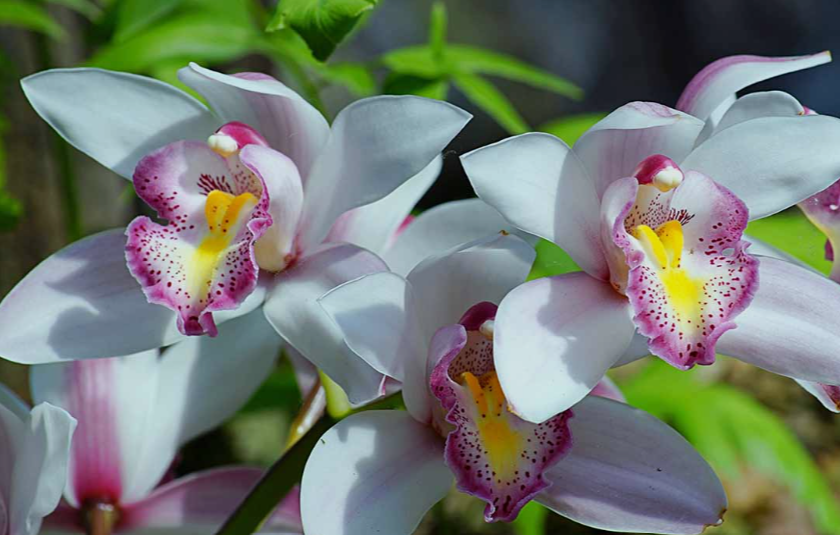
Orchids are one of the largest and most varied plant families on Earth. Botanists recognize roughly 28,000 species in about 760 genera, which is about twice the number of bird species and four times the number of mammal species. More than 100,000 hybrids have also been created by growers, and new ones are registered every year.
Orchids grow on every continent except Antarctica. Most live in the tropics, where many grow on tree branches with thick aerial roots, but others grow in soil in temperate meadows, bogs, prairies and forests. The name “orchid” comes from the Greek word for testicle, a reference to the paired, rounded underground tubers of some European species.
Orchid flowers all share the same basic design. Each has three sepals and three petals, and one petal is a specialized lip that guides pollinators. Their seeds are as fine as dust and contain almost no stored food, so most must team up with soil fungi in order to sprout. Many orchids have formed close partnerships with particular bees, moths, wasps or flies.
The most familiar orchid is the moth orchid, which the University of Vermont notes is now so common it is sold in grocery stores as well as nurseries. Orchids are also national flowers in countries such as Guatemala, Panama, Colombia, Singapore and Belize. The 58 orchids below include popular houseplants, rare tropical species and hardy wildflowers, along with where each one comes from or is grown today.
Popular Houseplant Orchids
1. Moth Orchid
The moth orchid is the best-selling orchid in the world. Its flowers are flat and rounded, like a moth in flight. They come in white, pink, purple, yellow and spotted forms. They bloom in long, arching sprays. Its leaves are broad and glossy. Its flowers can last two to three months.
North Carolina State University notes that it prefers low light, warm temperatures and high humidity. It also warns that blue moth orchids are white flowers that have been dyed. It is easy to rebloom indoors. It is grown in bark or moss rather than soil. Millions are produced in greenhouses every year. Its wild ancestors are native to Southeast Asia, and it is mass-produced in Taiwan, the Netherlands and the United States.
2. Dendrobium
Dendrobiums form one of the largest orchid groups, with about 1,400 species. Their flowers range from tiny to large and showy. They come in white, purple, pink, yellow and green. Many grow on tall, cane-like stems. Some lose their leaves in winter. Their flowers often last for weeks.
They are among the most common orchids in leis and cut-flower arrangements. Different types need different care, from warm and humid to cool and dry. Many need bright light to bloom. They are grown commercially on a large scale. They are popular as houseplants. They are native from India and China through Southeast Asia to Australia and the Pacific islands.
3. Cattleya
Cattleyas are the classic corsage orchids. Their flowers are large, ruffled and often fragrant. They come in purple, pink, white, yellow and orange. Many have a bold, frilly lip. They grow from thick pseudobulbs that store water. They bloom once or twice a year.
They were the most fashionable flowers of the early 1900s. One species is the national flower of Colombia, and another is the national flower of Venezuela. They need bright light to bloom. They are grown in greenhouses and bright windows. Thousands of hybrids exist. They are native to Central and South America, especially Brazil, Colombia and Venezuela.
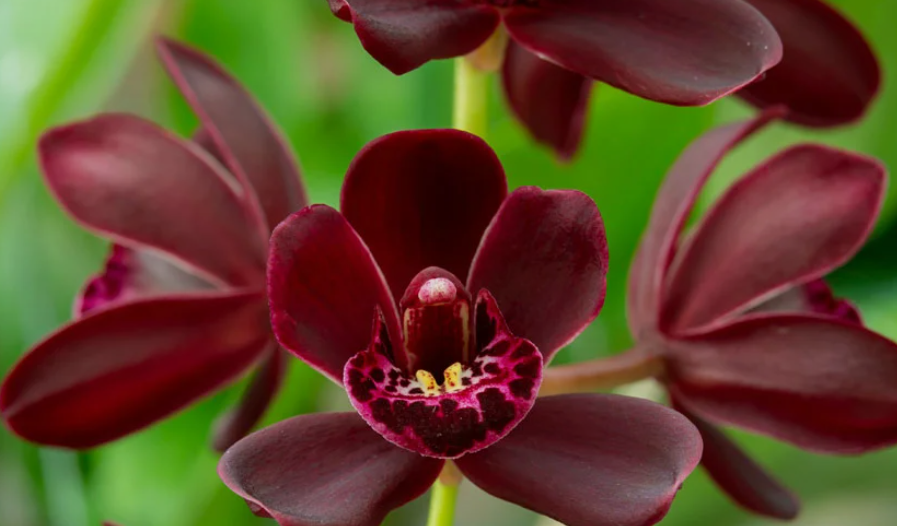
4. Cymbidium
Cymbidiums are popular long-lasting cut-flower orchids. Their flowers are waxy and come in green, white, yellow, pink, red and bronze. They bloom on tall, upright spikes. Their leaves are long and grass-like. Their flowers can last two months or more. They are also called boat orchids.
They need cool nights in fall to set flower buds. They can grow outdoors year-round in mild climates such as coastal California. They are a favorite winter and spring cut flower. Some small species have been grown in China for thousands of years. They form large clumps. They are native to the Himalayas, China, Japan, Southeast Asia and Australia.
5. Dancing Lady Orchid
Dancing lady orchids have flowers that look like twirling dancers. Each flower has a wide, ruffled lip that forms a skirt. They are often bright yellow with brown markings. They bloom in large, airy sprays. A single spike can carry dozens of flowers. Some are fragrant.
They are popular houseplants and cut flowers. Some forms smell of chocolate or vanilla. They need bright light and regular watering. They grow from flattened pseudobulbs. Many hybrids exist. They are native to the tropical Americas, from Florida and Mexico to Argentina.
6. Tropical Slipper Orchid
Tropical slipper orchids have a lip shaped like a slipper or pouch. Their flowers are waxy and often striped, spotted or hairy. They come in green, white, burgundy, yellow and pink. Many have mottled leaves. Each stem usually carries one flower. The flowers last for weeks.
The pouch traps visiting insects and guides them past the pollen. They grow on the forest floor in the wild. They tolerate lower light than most orchids. They are popular with collectors. All wild species are protected by international trade law. They are native to tropical Asia, from India and China to the Philippines and New Guinea.
7. South American Slipper Orchid
South American slipper orchids are the New World relatives of tropical slippers. Their flowers have a pouched lip and long, ribbon-like petals. They come in pink, red, orange, green and brown. They bloom in succession on tall stems. Their leaves are long and strap-shaped. They grow in wet places.
One spectacular purple species was discovered in Peru in 2002 and caused a sensation among orchid growers. They need constantly moist conditions. Some grow beside waterfalls and streams. They are popular with collectors. They need pure water low in minerals. They are native from Mexico to Peru and Brazil, especially in the Andes.
8. Vanda
Vandas are bold, colorful tropical orchids. Their flowers are flat, round and often checkered. They come in blue, purple, pink, red, orange and yellow. They bloom in large clusters. Their thick aerial roots hang freely. They bloom several times a year.
A hybrid in this group is the national flower of Singapore. They are usually grown in hanging baskets with no potting mix. Their roots need watering every day in warm weather. They need bright light and high humidity. They are popular in tropical gardens and cut-flower markets. They are native to Southeast Asia, from India and southern China to the Philippines and Indonesia.
9. Pansy Orchid
Pansy orchids have flowers that look like large pansies. Their flowers are flat and broad. They are patterned with a dark mask in the center. They come in red, pink, white and yellow. Many are fragrant. They bloom in spring and summer.
They need cool, humid conditions. They suffer in hot summers. Their thin leaves need steady moisture. They are popular with collectors in mild climates. Their flowers last several weeks. They are native to the cloud forests of Colombia, Ecuador, Panama and Costa Rica.
10. Zygopetalum
Zygopetalums are fragrant, patterned orchids. Their sepals and petals are green with purple-brown spots. Their lip is broad and white with purple veins. They have a strong, spicy fragrance. They bloom on upright spikes. They grow from egg-shaped pseudobulbs.
They are popular for their scent, which fills a room. They need cool nights and bright light. They are easy to grow for intermediate growers. They are used in cut-flower arrangements. Many hybrids exist. They are native to South America, especially Brazil.
11. Spider Orchid
Spider orchids have long, thin, spider-like flowers. Their sepals can reach several inches long. They are greenish-yellow with brown spots. They bloom in arching sprays. They are often fragrant. They grow from flat pseudobulbs.
Their shape is thought to attract female wasps that hunt spiders. The wasps attack the flower and carry away pollen. They are easy to grow indoors. They need bright light and regular watering. They are popular with beginning collectors. They are native to the tropical Americas, from Florida and Mexico to Brazil.
12. Jewel Orchid
The jewel orchid is grown for its leaves. Its leaves are velvety and dark maroon to nearly black. They are lined with bright pink or copper veins. Its flowers are small and white. They bloom on short spikes in winter. It creeps along the ground.
It grows on the forest floor in the wild. It tolerates low light and grows in ordinary potting soil. It is one of the easiest orchids for beginners. It roots easily from stem cuttings. It suits terrariums. It is native to Southeast Asia, including southern China, Thailand, Malaysia and Indonesia.
13. Lady of the Night
The lady of the night is a fragrant orchid. Its flowers are pale green to white with a large white lip. Its leaves are thick and pencil-like. It blooms several times a year. Its flowers last about a month. It grows mounted on wood or in baskets.
It releases a sweet fragrance after dark. Its scent attracts night-flying moths. It is one of the easiest fragrant orchids to grow. It tolerates bright light and some drought. It is a parent of many hybrids. It is native from Mexico through Central America and the Caribbean to northern South America.
14. Laelia
Laelias are bright orchids related to cattleyas. Their flowers are star-shaped with a bold, colorful lip. They come in purple, pink, white and orange. They bloom on tall, arching stems. Many bloom around the winter holidays. They grow from small pseudobulbs.
Some species tolerate cooler temperatures than most tropical orchids. They need bright light and good air movement. They are often grown mounted on wood. They are popular with collectors. One species is a traditional Day of the Dead flower in Mexico. They are native to Mexico and Central America.
15. Crucifix Orchid
Crucifix orchids are tough, reed-stemmed orchids. Their small flowers bloom in round clusters. Each has a frilly lip shaped like a tiny cross. They come in orange, red, pink, purple, yellow and white. They bloom almost year-round. They grow 2 to 4 feet tall.
They belong to one of the largest orchid genera, with about 1,500 species. They tolerate full sun in warm climates. They produce baby plants along their stems. They are used in tropical landscapes. They are easy to grow. They are native from Florida and Mexico to South America.
16. Cockleshell Orchid
The cockleshell orchid has an upside-down flower. Its dark purple lip points upward like a shell. Its narrow greenish petals hang down like tentacles. It blooms on and off for months. It grows from pear-shaped pseudobulbs. It is sometimes called the octopus orchid.
It is the national flower of Belize, where it is called the black orchid. It is easy to grow indoors. It needs bright, indirect light. It blooms repeatedly from the same stem. It is also native to Florida, where it is protected. It is native from Florida and the Caribbean through Mexico and Central America to Colombia and Venezuela.
17. Lycaste
Lycastes are large-flowered, triangular orchids. Their flowers are waxy and fragrant. They come in pink, white, yellow, green and orange. Each flower sits on its own stem. Their leaves are broad and pleated. Many lose their leaves in winter.
A rare white form is the national flower of Guatemala, known as the white nun. They need cool, humid conditions. They need a dry rest in winter. They are popular with collectors. Their flowers last for weeks. They are native to Mexico, Central America and northern South America.
18. Coelogyne
Coelogynes are cool-growing orchids with graceful sprays. Their flowers are often white with a yellow or brown lip. They hang in drooping chains. Many are fragrant. They grow from round, shiny pseudobulbs. They form large clumps.
The angel orchid is the best-known species in this group. Many need cool nights and a dry winter rest to bloom. They are popular in cool greenhouses. Large plants can carry dozens of flower sprays. They are long-lived. They are native from the Himalayas through Southeast Asia to the Pacific islands.
19. Vanilla Orchid
The vanilla orchid is the source of vanilla flavoring. It is a long, climbing vine. Its flowers are pale yellow-green and waxy. Each flower lasts only one day. Its fruit is a long, green pod. The pods are cured to make vanilla beans.
It is the only orchid grown as a major food crop. Outside its native range, each flower must be pollinated by hand. Madagascar produces much of the world’s vanilla. Curing the pods takes several months. Vanilla is one of the most expensive spices in the world. It is native to Mexico and Central America and is grown in Madagascar, Indonesia, Mexico and Uganda.
Tropical and Specialty Orchids
20. Dove Orchid
The dove orchid hides a tiny white dove in each flower. Its flowers are round, waxy and white. Inside, the column and lip form the shape of a dove. The flowers are fragrant. They bloom on tall spikes. It grows from large pseudobulbs.
The Indian Institute of Science notes that its genus name comes from the Greek word for dove and that it is the national flower of Panama. It is also called the Holy Ghost orchid. It is protected in the wild because of over-collection. It needs warmth and humidity. It grows on the ground or on rocks. It is native from Costa Rica and Panama to Colombia and Venezuela.
21. Masdevallia
Masdevallias are small cloud forest orchids. Their flowers are triangular. Their sepals are fused into a tube and end in long tails. They come in vivid red, orange, purple, yellow and white. They bloom on short stems. They have no pseudobulbs.
They need cool, constantly humid conditions. They suffer in heat. They are popular with collectors of miniature orchids. Some rebloom from the same stems for years. They suit terrariums and cool greenhouses. They are native to the cloud forests of the Andes, especially Colombia, Ecuador and Peru.
22. Monkey Face Orchid
Monkey face orchids have flowers that look like tiny monkey faces. The center of each flower forms eyes, nose and mouth. Their sepals end in long tails. They are often red, purple or spotted. Their flowers hang downward. Some smell of mushrooms.
Their mushroom-like lip attracts small flies that normally lay eggs on fungi. They need cool, wet cloud forest conditions. They are grown in baskets so their flowers can hang. They are prized by collectors. They are difficult to grow in warm climates. They are native to the cloud forests of Ecuador, Colombia and Peru.
23. Bulbophyllum
Bulbophyllums form the largest orchid genus, with about 2,000 species. Their flowers vary from tiny to large and fringed. Many have a hinged lip that rocks when an insect lands. Some smell of rotting meat to attract flies. Others are fragrant. They grow from small pseudobulbs.
Some species carry their flowers in a circle like an umbrella. They creep along branches and form mats. They are popular with collectors of unusual orchids. Most need warmth and humidity. Some are among the smallest orchids. They are native to tropical Asia, Africa, Australia, the Pacific islands and the Americas.
24. Pleurothallis
Pleurothallis orchids are tiny, intricate orchids. Their flowers are often smaller than a grain of rice. They are carried along the leaves or on short stems. They come in red, yellow, green and purple. Many have hairs or fringes. They have no pseudobulbs.
They belong to a huge group of miniature orchids. They need high humidity and steady moisture. They suit terrariums. They are popular with collectors who use magnifying glasses to admire them. Some bloom almost constantly. They are native to the tropical Americas, especially the cloud forests of the Andes.
25. Stanhopea
Stanhopeas have flowers that grow downward. Their flower spikes push through the bottom of the basket or potting mix. Their flowers are large, waxy and spotted. They have a strong, spicy fragrance. Each flower lasts only two or three days. They grow from round pseudobulbs.
They must be grown in open baskets so their flowers can emerge. Their scent attracts male bees that collect fragrance. Their flowers are complex and look like flying insects. They are popular with collectors. They are easy to grow in warm, humid conditions. They are native from Mexico to Brazil.
26. Catasetum
Catasetums are orchids that shoot their pollen at bees. When a bee touches a trigger, a sticky pollen packet flies out and attaches to its back. Their flowers are waxy and often green, brown or spotted. Some plants produce separate male and female flowers. The two look completely different. They grow from large pseudobulbs.
Charles Darwin studied their explosive pollination. They lose their leaves in winter and need a dry rest. They grow quickly in summer. They are popular with collectors of unusual orchids. They need bright light. They are native to Central and South America.
27. Coconut Orchid
The coconut orchid has flowers that smell like coconut. Its flowers are red with yellow spots. They bloom close to the leaves. Its leaves are narrow and grass-like. It grows in a climbing, ladder-like habit. It blooms in spring and summer.
Its fragrance is strong and sweet. It is easy to grow. It suits mounting on wood or growing in baskets. It needs bright, indirect light. It is a favorite with beginners. It is native to Mexico and Central America.
28. Butterfly Orchid
The butterfly orchid has flowers that look like butterflies. Its top sepal and petals are long and antenna-like. Its side sepals are broad and wavy. Its flowers are yellow and orange-brown. It blooms one flower at a time. It can bloom from the same spike for years.
Its flowers inspired a craze for orchids in Victorian England. It needs bright light and warmth. Its old flower spikes should never be cut off. It is popular with collectors. Its leaves are mottled. It is native to Central America, the Caribbean and northern South America.
29. Tolumnia
Tolumnias are small, colorful orchids. Their flowers are flat with a broad lip. They come in pink, red, yellow, white and multicolored patterns. They bloom in sprays. Their leaves are fan-shaped and stiff. They stay only a few inches tall.
They are also called equitant oncidiums. They need bright light and fast drying after watering. They are often grown mounted on wood. They are popular with collectors of miniature orchids. Many colorful hybrids exist. They are native to the Caribbean islands and Florida.
30. Foxtail Orchid
The foxtail orchid has flowers packed into long, drooping spikes. The spikes look like a fox’s tail. Its flowers are white with pink or purple spots. They are fragrant. Its leaves are thick and strap-shaped. It grows on tree trunks.
It is the state flower of Assam in India. It is used in traditional festivals and wedding decorations there. It needs warmth and bright light. It is grown in baskets. It blooms in spring and summer. It is native to tropical Asia, from India and Sri Lanka to Southeast Asia and the Philippines.
31. Fox Brush Orchid
The fox brush orchid has dense, drooping flower spikes. Its flowers are small, waxy and fragrant. They are white, pink or purple. Each has a small curved spur. Its leaves are thick and strap-shaped. It grows on trees.
Its fragrance is strong and sweet. It needs warmth, humidity and bright light. It is grown in baskets or mounted on wood. It is popular in tropical gardens. It blooms in summer. It is native to Southeast Asia, from India and the Himalayas to the Philippines.
32. Fire Orchid
The fire orchid has bright red flowers. Its flowers are spidery and scarlet to orange. They bloom in large, branched sprays. Its leaves grow in two rows along tall, climbing stems. It can grow several feet tall. It blooms for weeks.
It is one of the brightest red orchids. It needs full sun to bloom well. It is grown outdoors in tropical gardens. It is used in cut-flower markets in Asia. It is a parent of many colorful hybrids. It is native to Southeast Asia, including Malaysia, Indonesia and the Philippines.
33. Ascocentrum
Ascocentrums are small, brightly colored orchids. Their flowers are tiny, waxy and densely packed. They come in brilliant orange, red, pink and purple. They bloom in upright spikes. Their leaves grow in two rows. They stay small.
They are popular for their intense colors. They are crossed with vandas to produce compact, colorful hybrids. They need warmth and bright light. They are grown in small baskets. They bloom in spring and summer. They are native to Southeast Asia, from the Himalayas to the Philippines.
34. Darwin’s Orchid
Darwin’s orchid is one of the most famous orchids in science. Its flowers are large, waxy, star-shaped and ivory white. Each has a nectar spur about a foot long. It blooms in winter. Its flowers are fragrant at night. It is also called the comet orchid.
When Charles Darwin saw it, he predicted that a moth with a foot-long tongue must pollinate it. The University of Kansas notes that such a moth was identified in Madagascar in 1903 and documented pollinating the orchid in 1997. It needs warmth and humidity. It is grown by collectors and botanical gardens. It is protected in the wild. It is native to the eastern coast of Madagascar.
35. Aerangis
Aerangis orchids are small, fragrant African orchids. Their flowers are white and star-shaped. Each has a long, slender spur. They bloom in arching sprays. Their leaves are glossy and dark green. They are fragrant at night.
Their long spurs are suited to moths with long tongues. They are grown mounted on wood or in small baskets. They need warmth, shade and humidity. They are popular with collectors of fragrant orchids. They bloom in fall and winter. They are native to tropical Africa and Madagascar.
36. Ghost Orchid
The ghost orchid is one of the rarest orchids in North America. It has no leaves. Its green roots cling to tree bark and make food from sunlight. Its white flowers seem to float in midair. Each has long, curling side petals like frog legs. It blooms in summer.
Only about 2,000 plants are known in Florida. University of Florida researchers showed in 2019 that more than one kind of moth can pollinate it. It is protected as an endangered species in Florida. Poaching was made famous by the book The Orchid Thief. It is nearly impossible to grow in homes. It is native to the swamps of southwestern Florida, Cuba and the Bahamas.
37. Wind Orchid
The wind orchid is a small, fragrant Japanese orchid. Its flowers are white with long, curved spurs. They bloom in small clusters. Its leaves are stiff, curved and fan-shaped. It stays only a few inches tall. Its flowers are fragrant at night.
It was prized by samurai and nobility during Japan’s Edo period. Collectors still grow hundreds of named forms. It is often displayed on mounds of moss in special pots. It tolerates cool winters. It needs bright, indirect light. It is native to Japan, Korea and southern China.
38. Sobralia
Sobralias are tall, reed-like orchids. Their stems look like bamboo. Their flowers are large and trumpet-shaped. They come in purple, pink, white and yellow. Each flower lasts only a day or two. New flowers keep opening for weeks.
They grow in the ground rather than on trees. They can reach 3 to 6 feet tall. Their flowers resemble those of cattleyas. They need bright light and plenty of water. They suit tropical gardens and large containers. They are native to Central and South America.
39. Bamboo Orchid
The bamboo orchid is a tall, grassy ground orchid. Its stems are thin and reed-like. Its flowers are pink to purple and look like small cattleyas. It blooms almost year-round in warm climates. It grows 3 to 6 feet tall. It forms dense clumps.
It is easy to grow outdoors in the tropics. It tolerates full sun. It produces baby plants on its old flower stems. It has become invasive in Hawaii. It is used in tropical landscapes. It is native to tropical Asia, from India and China to Southeast Asia and the Pacific islands.
40. Ground Orchid
The ground orchid is a popular garden orchid for warm climates. Its flowers are purple, pink, white or yellow. They bloom on upright spikes. Its leaves are long, pleated and grass-like. It grows in soil. It blooms almost year-round.
It is one of the easiest orchids for tropical gardens. It tolerates sun and regular watering. It is used in borders and mass plantings. It has naturalized in Florida and Hawaii. It reseeds in good conditions. It is native to Southeast Asia, New Guinea, northern Australia and the Pacific islands.
Hardy, Terrestrial and Wild Orchids
41. Nun’s Orchid
The nun’s orchid is a large ground orchid. Its flowers are brown inside and white outside. The lip is pink to purple. They bloom on tall spikes up to 4 feet. Its leaves are long and pleated. It grows from large pseudobulbs.
Its name comes from the way its flowers resemble nuns in hooded robes. It grows in soil rather than on trees. It suits shady gardens in warm climates. It needs regular water. It is easy to grow in large pots. It is native from India and China through Southeast Asia to Australia and the Pacific.
42. Calanthe
Calanthes are ground orchids of forests. Their flowers bloom on upright spikes. They come in white, pink, yellow and purple. Their leaves are broad and pleated. Some lose their leaves in winter. Some are hardy.
Several species have been grown in Japanese gardens for centuries. Hardy types can survive winters outdoors in mild regions. They grow in shady, moist soil. They suit woodland gardens. Some evergreen types bloom around Christmas in Australia. They are native to Asia, Africa, Madagascar, Australia and the Pacific islands.
43. Hyacinth Orchid
The hyacinth orchid is one of the easiest hardy orchids to grow. Its flowers are magenta-pink and look like small cattleyas. They bloom on slender spikes in late spring. Its leaves are pleated and grass-like. It grows from small underground corms. It forms clumps.
It survives winters outdoors to about zone 6 with mulch. It grows in partial shade and moist soil. It is sold as dormant corms in spring. White and striped forms also exist. It suits woodland gardens. It is native to China, Japan and Korea.
44. Pleione
Pleiones are small, cool-growing windowsill orchids. Their flowers are large for the plant’s size. They come in pink, white, purple and yellow. Each has a fringed lip. They bloom in spring before the leaves appear. They grow from small, round pseudobulbs.
They tolerate near-freezing temperatures. They go dormant in winter. They are grown in shallow pots. They are popular in Britain and Europe. Some can grow outdoors in mild climates. They are native to the Himalayas, China and Taiwan.
45. Lady’s Slipper
Lady’s slippers are hardy orchids with pouch-shaped lips. Their flowers are pink, yellow, white or purple. The pouch looks like a slipper or moccasin. Most bloom in spring. They grow from underground roots. About 14 species grow in the United States.
The University of New Hampshire notes that the pink lady’s slipper depends on a specific soil fungus to germinate and that plants dug from the wild rarely survive. Plants sold from the wild should be avoided. Some species, such as the showy and yellow lady’s slippers, can be grown in gardens from nursery-propagated stock. Several species are threatened or endangered. They grow in woods, bogs and fens. They are native to North America, Europe and Asia.
46. Egret Orchid
The egret orchid has flowers that look like flying white birds. Its lip is deeply fringed on both sides. The fringes resemble an egret’s wings. The flowers are pure white. It blooms in late summer. It grows from small underground tubers.
It is a terrestrial orchid of wet grasslands. It is a beloved flower in Japanese culture. It has become rare in the wild because of habitat loss. It is grown in pots and goes dormant in winter. It needs constantly moist soil in summer. It is native to Japan, Korea and eastern China.
47. Pride of Table Mountain
The pride of Table Mountain is a spectacular red orchid. Its flowers are large and scarlet with darker veins. Its top sepal forms a hood. It blooms in summer. It grows beside streams and waterfalls. It is also called the red disa.
It is pollinated by a single species of butterfly. It needs cool, pure, constantly flowing water. It is the emblem of the Western Cape. It is difficult to grow outside its habitat. Hybrids are grown by specialist collectors. It is native to the mountains of the Western Cape in South Africa.
48. Bee Orchid
The bee orchid has a lip that looks like a bee. The lip is fuzzy, brown and patterned. It looks like a bee feeding on a pink flower. It grows about a foot tall. It blooms in early summer. It grows from underground tubers.
Related species lure male bees by mimicking females in shape and scent. The bee orchid itself usually pollinates itself in northern Europe. It grows in grasslands, dunes and road verges. It appears unexpectedly in lawns and quarries. It is protected in several countries. It is native to Europe, North Africa and the Middle East.
49. Early Purple Orchid
The early purple orchid is a common wild orchid of Europe. Its flowers are purple-pink and grow in a dense spike. Its leaves are often spotted with dark purple. It blooms in spring. It grows about a foot tall. It grows from paired underground tubers.
Its paired tubers gave orchids their name. It grows in woods, hedgerows and grasslands. It was once used in folk medicine and love potions. Its flowers have a faint smell that turns unpleasant over time. It is one of Europe’s most widespread orchids. It is native to Europe, North Africa and western Asia.
50. Marsh Orchid
Marsh orchids are hardy ground orchids. Their flowers are pink, purple, white or red. They grow in dense spikes. Many have spotted leaves. They grow 1 to 2 feet tall. They bloom in early summer.
They grow in wet meadows, marshes and dunes. Some can be grown in gardens from nursery stock. They hybridize freely in the wild. They are among the most common orchids of northern Europe. Some are grown in rock gardens and bog gardens. They are native to Europe, North Africa and Asia.
51. Fringed Orchid
Fringed orchids have flowers with feathery, fringed lips. Their flowers grow in tall, dense spikes. They come in white, orange, yellow and purple. Many are fragrant. They grow 1 to 3 feet tall. They bloom in summer.
They grow in bogs, wet meadows and forests. They are pollinated by butterflies and moths. Many species have declined because of habitat loss. They are protected in several states. They should never be dug from the wild. They are native to North America, Europe and Asia.
52. Ladies’ Tresses
Ladies’ tresses are small, spiraling orchids. Their tiny white flowers twist up a slender stalk. The spiral looks like a braid of hair. Many are fragrant. They grow 6 to 18 inches tall. Most bloom in late summer and fall.
They grow in meadows, fields, lawns and roadside ditches. They are pollinated by bees. Some species appear in mowed lawns. They are among the easier native orchids to grow. They are often overlooked because of their small size. They are native to North America, Europe, Asia and Australia.
53. Grass Pink
Grass pink is a bright pink native orchid. Its flowers are magenta-pink. Unlike most orchids, its lip is at the top of the flower. The lip has yellow hairs that look like pollen. It grows on a slender, grass-like stem. It blooms in early summer.
Its fake pollen lures bees, which then fall onto the real pollen. It grows in bogs, wet meadows and pine savannas. It needs acidic, wet soil. It is grown by specialists in bog gardens. It is one of the showiest native orchids of the East. It is native to eastern North America, from Newfoundland to Florida.
54. Rose Pogonia
Rose pogonia is a small, pink bog orchid. Its flowers are pink and lightly fragrant. Its lip is fringed and bearded with yellow hairs. It grows on a slender stem. It usually has a single flower. It blooms in early summer.
It is also called snake-mouth orchid. It grows in sphagnum bogs and wet meadows. It spreads by underground roots. It is pollinated by bees. It is uncommon in many areas. It is native to eastern North America, from Newfoundland to Florida and Texas.
55. Rattlesnake Plantain
Rattlesnake plantain is a woodland orchid grown for its leaves. Its leaves are dark green and netted with white veins. The pattern looks like snakeskin. Its small white flowers bloom on a fuzzy spike. It grows in a low rosette. It is evergreen.
It grows on the forest floor in shade. Its patterned leaves stand out year-round. It is one of the more common native orchids in eastern forests. It spreads slowly by creeping stems. It should not be dug from the wild. It is native to eastern North America.
56. Coralroot
Coralroot is an orchid with almost no leaves. Its stems are brown, purple or yellow. Its small flowers bloom along the stem. It has little or no green color. Its roots look like branching coral. It blooms in spring or summer.
It gets most of its food from fungi in the soil. It grows in shady forests. It appears only when it flowers. It cannot be grown in gardens. It is often overlooked by hikers. It is native to North America, Europe and Asia.
57. Helleborine
Helleborines are woodland orchids. Their small flowers are green, purple or pink. They bloom along tall, leafy stems. They grow 1 to 3 feet tall. They bloom in summer. They are pollinated by wasps.
One European species was brought to North America in the 1800s and has spread widely. It is now considered invasive in some areas. It grows in woods, gardens and roadsides. Its nectar can make wasps sluggish. It tolerates shade and disturbed soil. It is native to Europe, North Africa and Asia and has naturalized in North America.
58. Australian Spider Orchid
Australian spider orchids are delicate ground orchids. Their flowers have long, thin sepals and petals. They look like spiders. They come in cream, red, yellow and green. They grow from small underground tubers. They bloom in spring.
Many lure male wasps by mimicking female wasps. Many species are rare and endangered. They grow in woodlands and heaths. They depend on soil fungi to survive. They cannot be grown easily in gardens. They are native to Australia, especially the southwest of Western Australia.
Sources:
- University of Vermont: Growing Orchids
- North Carolina State University: Phalaenopsis
- Indian Institute of Science: Dove orchid
- University of Kansas Spencer Museum of Art: Ghost Orchid I
- University of New Hampshire: Can you dig up pink lady’s slippers?
- Scientific Reports: Pollination ecology of the ghost orchid
- University of Maine: Pink Lady Slipper Fact Sheet
- United Plant Savers: Lady’s Slipper Orchid
- Laidback Gardener: Fun facts about orchids