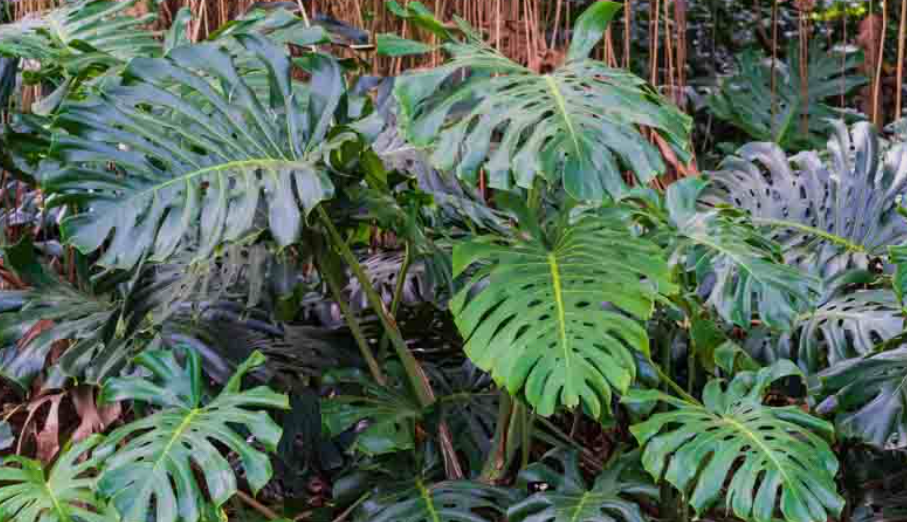
Monstera plants are tropical climbing aroids known for their split and hole-filled leaves. Botanists recognize roughly 60 or more species, with new ones still being described. The best known is the Swiss cheese plant, whose glossy leaves can grow about 3 feet long and whose stems climb as high as 65 feet up rainforest trees.
The genus name likely comes from the Latin word for “monster,” according to the University of Oxford Botanic Garden, a reference to the plant’s unusual leaves. Those holes and slits, called fenestrations, may help leaves withstand wind and heavy rain and let light reach lower leaves. Many species change shape dramatically as they grow, starting with small leaves pressed flat against a tree trunk and ending with huge, deeply cut leaves high in the canopy.
All monsteras are native to the tropical Americas, from southern Mexico through Central America to Brazil and Bolivia. A 2024 botanical revision counted 52 species in Central America alone, with Panama and Costa Rica holding the greatest diversity. Most grow as hemiepiphytes, rooting in the soil and climbing trees with aerial roots.
Monsteras are among the most popular houseplants in the world, and rare variegated forms can sell for hundreds or even thousands of dollars. Their leaves and stems contain calcium oxalate crystals that irritate the mouth of people and pets. The 55 monsteras below include common houseplants, collector cultivars and rare wild species, along with where each one comes from or is grown today.
1. Monstera Deliciosa
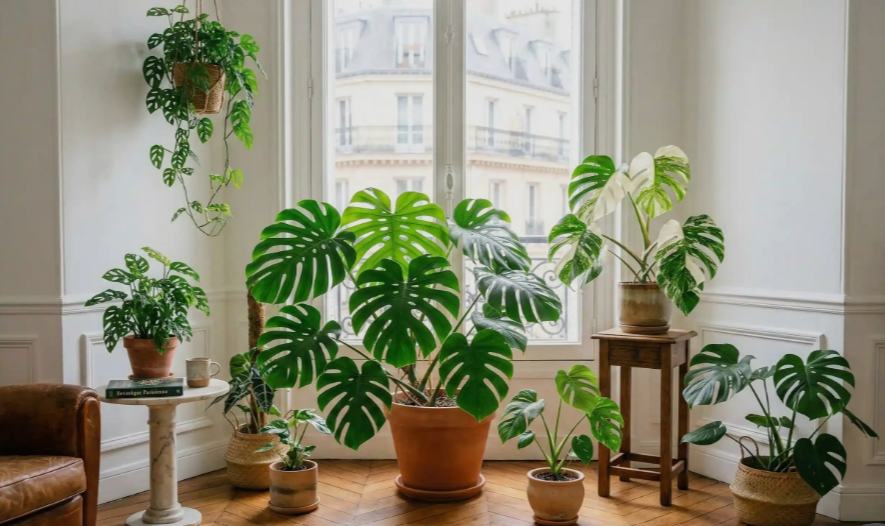
Monstera deliciosa is the classic Swiss cheese plant. Its leaves are large, glossy and heart-shaped. Mature leaves develop deep slits and rows of holes. They can reach 2 to 3 feet across. The plant climbs with thick aerial roots. Indoors it grows 6 to 10 feet tall.
The University of Florida notes that it is grown in Florida landscapes for its foliage and edible fruit. Its fruit tastes like a mix of pineapple and banana when fully ripe. Unripe fruit contains irritating crystals and should not be eaten. It needs bright, indirect light and a moss pole to grow large leaves. It is also called split-leaf philodendron. It is native from southern Mexico to Panama and is grown worldwide as a houseplant.
2. Monstera Borsigiana
Monstera Borsigiana is a smaller, faster-climbing form of Monstera Deliciosa. Its leaves are slightly smaller and more widely spaced. Its leaf stalks lack the ruffled joint found on large Deliciosa plants. It grows quickly as a vine. Its leaves still develop holes and slits. It is often sold interchangeably with Deliciosa.
Botanists now treat it as part of the same species. Nurseries still use the name for the smaller, vining form. It is easier to manage in small spaces. Many variegated monsteras are sold as Borsigiana. It needs a support to climb. It is native to southern Mexico and Central America.
3. Monstera Tauerii
Monstera Tauerii is sold as a dwarf form of Monstera Deliciosa. Its leaves are smaller than the standard form. They develop slits and holes at a younger age. The plant stays more compact. It grows more slowly. It suits smaller rooms.
Its exact botanical status is uncertain. It is mostly sold by specialty nurseries. It needs bright, indirect light and a climbing support. It has the same care needs as Deliciosa. It is less common than standard forms. It is grown as a houseplant in Europe and North America.
4. Thai Constellation
Thai Constellation is a famous variegated monstera. Its leaves are speckled and splashed with creamy white. The pattern looks like a starry sky. The leaves are large and split like Deliciosa. Its variegation is stable and rarely reverts. It grows more slowly than green forms.
It was developed in a tissue culture laboratory in Thailand. Its variegation is genetic, so it stays consistent. It was once very expensive and is now more widely available. It needs bright, indirect light to keep its pattern. Its pale tissue burns in direct sun. It is produced in Thailand and grown as a houseplant worldwide.
5. Albo Variegata
Albo Variegata is a Monstera Deliciosa with bold white variegation. Its leaves are splashed and sectioned with bright white. Some leaves are half white, called half-moons. The pattern varies on every leaf. It grows more slowly than green plants. It is one of the most sought-after monsteras.
Its variegation comes from a mix of cell types in the plant. It cannot be grown true from seed. It is propagated only from cuttings. Fully white leaves cannot feed the plant and often brown. It needs bright light and steady humidity. It is grown as a collector’s houseplant worldwide.
6. Aurea Variegata
Aurea Variegata is a Monstera Deliciosa with yellow variegation. Its leaves are marked with golden yellow to lime green. The pattern can be marbled, streaked or sectioned. It is rarer than the white form. It grows more slowly than green plants. It is also called Marmorata in some nurseries.
Its yellow color can be bright or soft depending on light. It needs bright, indirect light. It is propagated from cuttings. It is expensive and highly collectible. It can revert to green on some leaves. It is grown as a collector’s houseplant worldwide.
7. Mint Variegata
Mint Variegata is a Monstera Deliciosa with pale mint-green variegation. Its leaves are marked with soft, light green patches. The pattern looks washed out compared with the white form. It is subtle and unusual. It grows slowly. It is among the rarest variegated monsteras.
Its mint color appears in streaks and sections. It needs bright, indirect light. It is propagated from cuttings. Collectors prize it for its unusual color. It is expensive and hard to find. It is grown as a collector’s houseplant in Asia, Europe and North America.
8. Yellow Marilyn
Yellow Marilyn is a Monstera Deliciosa with chartreuse leaves. Its leaves are an even yellow-green instead of being variegated. The color is brightest in new leaves. The leaves split and develop holes like the standard form. It grows like Deliciosa. It is a recent introduction.
Its glowing color stands out among green plants. It needs bright, indirect light to keep its color. Its leaves can burn in direct sun. It is propagated from cuttings and tissue culture. It is still fairly rare. It is grown as a houseplant in Asia, Europe and North America.
9. Monstera Adansonii
Monstera Adansonii is the popular Swiss cheese vine. Its leaves are heart-shaped and thin. They are filled with oval holes, even on young plants. The vines trail or climb. It grows quickly. It is much smaller than Deliciosa.
It is one of the easiest monsteras to grow indoors. It suits hanging baskets and moss poles. It needs bright, indirect light and moderate humidity. It roots easily from cuttings. It is often confused with the rare Obliqua. It is native across Central and South America and parts of the Caribbean.
10. Adansonii Laniata
Adansonii Laniata is a larger-leaved form of Monstera Adansonii. Its leaves are broader and more elongated. They develop large, open holes. The leaves are glossy and bright green. It grows as a vigorous climber. It is often sold as Monstera Laniata.
Botanists treat it as a variety of Adansonii. It needs a support to show its full leaf size. It grows quickly in warm, humid conditions. It roots easily from cuttings. It is less common than standard Adansonii. It is native to Central America.
11. Adansonii Archipelago
Adansonii Archipelago is a variegated Monstera Adansonii. Its leaves are splashed with white and cream. The pattern resembles islands in a sea, which inspired its name. The holes appear among the white patches. It grows slowly. It is very rare.
It is one of the most expensive Adansonii forms. It needs bright, indirect light and steady humidity. White sections can brown in dry air. It is propagated from cuttings. It is prized by collectors. It is grown as a collector’s houseplant worldwide.
12. Adansonii Mint
Adansonii Mint is a Monstera Adansonii with pale green variegation. Its leaves are streaked and marbled with mint green. The variegation is soft and subtle. The leaves have holes like the standard form. It grows slowly. It is rare.
It is sought after by collectors of variegated plants. It needs bright, indirect light. It is propagated from cuttings. It needs higher humidity than plain Adansonii. Its pattern varies from leaf to leaf. It is grown as a collector’s houseplant in Europe and Asia.
13. Adansonii Narrow Form
Adansonii Narrow Form is a slender-leaved type of Monstera Adansonii. Its leaves are long and narrow. They have neat rows of holes. The plant has a delicate, lacy look. It grows quickly as a vine. It is sometimes sold as Friedrichsthalii.
It is the most commonly sold Adansonii type. It suits hanging baskets and shelves. It needs bright, indirect light. It roots easily from cuttings. It is easy to grow. It is native to Central and South America.
14. Adansonii Round Form
Adansonii Round Form is a broader-leaved type of Monstera Adansonii. Its leaves are wide and almost round. Its holes are large and plentiful. The leaves are slightly thicker than the narrow form. It grows as a vigorous vine. It is a popular houseplant.
Its fuller leaves give it a lusher look. It is easy to grow indoors. It needs bright, indirect light. It roots easily in water. It can be trained on a moss pole. It is native to Central and South America.
15. Monstera Obliqua
Monstera Obliqua is the most famous rare monstera. Its leaves are paper-thin and filled with huge holes. In its best-known form, the leaves contain more hole than leaf. The leaves are small and delicate. It grows very slowly. It is extremely expensive.
Many plants sold as Obliqua are actually Adansonii. True Obliqua has much thinner leaves and larger holes. It needs very high humidity, often in a glass cabinet. It produces long, leafless runner stems. It is rarely sold outside specialist nurseries. It is native to Central America and the Amazon basin, including Panama, Peru and Brazil.
16. Monstera Siltepecana
Monstera Siltepecana is a monstera with silver leaves. Its young leaves are blue-green with a silver sheen. They have dark green veins. Mature leaves become larger and develop holes. It grows as a trailing or climbing vine. It is easy to grow.
It is also called silver monstera. It is named after Siltepec in Chiapas, Mexico. It suits hanging baskets and terrariums. It needs bright, indirect light. It roots easily from cuttings. It is native to southern Mexico and Central America.
17. El Salvador
El Salvador is a large-leaved form of Monstera Siltepecana. Its leaves are bigger and more silvery than the standard form. It develops holes at a younger age. The leaves are blue-gray with dark veins. It climbs vigorously. It is rare.
Its name refers to the country where this form was collected. Collectors prize it for its large silver leaves. It needs bright, indirect light and humidity. It is propagated from cuttings. It is more expensive than standard Siltepecana. It is native to Central America.
18. Monstera Standleyana
Monstera Standleyana is a monstera without holes. Its leaves are long, narrow and glossy. They are dark green and lance-shaped. The plant grows as a climbing vine. It grows fairly quickly. It looks more like a philodendron than a typical monstera.
It is named after the American botanist Paul Standley. It is easy to grow indoors. It needs bright, indirect light. It roots easily from cuttings. Its variegated forms are more popular than the green type. It is native to Central America, including Costa Rica, Nicaragua and Panama.
19. Standleyana Albo
Standleyana Albo is a variegated Monstera Standleyana. Its leaves are splashed and speckled with white. The pattern ranges from fine dots to large streaks. The leaves are long and narrow. It grows as a climbing vine. It is a popular collector’s plant.
It is often confused with variegated philodendrons. It is more affordable than many variegated monsteras. It needs bright, indirect light to keep its pattern. It is propagated from cuttings. It climbs well on a moss pole. It is a form of a species native to Central America.
20. Standleyana Aurea
Standleyana Aurea is a yellow-variegated Monstera Standleyana. Its leaves are streaked and speckled with golden yellow. The pattern varies from leaf to leaf. The leaves are long and glossy. It grows as a vine. It is less common than the white form.
Its yellow color brightens shelves and plant stands. It needs bright, indirect light. It is propagated from cuttings. It grows a little more slowly than the green form. It suits moss poles and hanging pots. It is a form of a species native to Central America.
21. Monstera Dubia
Monstera Dubia is a shingling monstera. Its young leaves are small and heart-shaped. They grow flat against a tree trunk like roof shingles. They are marked with silver and dark green. Mature leaves become large and deeply split. It is a slow, unusual climber.
It is usually grown on a wooden plank indoors. Its shingling leaves make it a favorite for terrariums. It rarely reaches its mature form indoors. It needs high humidity and bright, indirect light. It is propagated from cuttings. It is native from southern Mexico through Central America to South America.
22. Monstera Pinnatipartita
Monstera Pinnatipartita is a monstera with feather-like mature leaves. Its young leaves are solid and yellow-green. As it matures, the leaves split deeply into narrow segments. The mature leaves look like palm fronds. It climbs vigorously. It is rare.
Its leaves change dramatically as it grows. It needs a tall support to reach its mature form. It needs bright, indirect light and humidity. It is propagated from cuttings. It is prized by collectors. It is native from Belize through Central America to South America.
23. Monstera Peru
Monstera Peru is a monstera with thick, textured leaves. Its leaves are dark green and deeply puckered. They feel rigid and leathery. They do not develop holes. The plant grows as a compact climber. It is easy to grow.
It is sometimes sold as Monstera Karstenianum, a name not accepted by botanists. Its leaves resemble quilted fabric. It tolerates lower humidity than many monsteras. It roots easily from cuttings. It suits shelves and moss poles. It is believed to come from Peru.
24. Monstera Peru Variegata
Monstera Peru Variegata is a variegated form of Monstera Peru. Its leaves are dark green splashed with white or cream. The leaves keep their thick, puckered texture. The pattern varies from leaf to leaf. It grows slowly. It is rare.
Its bold contrast makes it popular with collectors. It needs bright, indirect light to keep its pattern. It is propagated from cuttings. White sections can brown in dry air. It is expensive and hard to find. It is grown as a collector’s houseplant in Asia, Europe and North America.
25. Monstera Esqueleto
Monstera Esqueleto is a monstera with skeleton-like leaves. Its mature leaves have very large, long holes. The holes cover most of the leaf. The leaf looks like a skeleton, which gave it its name. Young plants look ordinary. It grows large.
It is often linked to a rare Costa Rican species. Its name means skeleton in Spanish. It needs high humidity and bright, indirect light. It is rare and expensive. It is often mislabeled in the trade. It is native to Costa Rica and nearby regions of Central America.
26. Monstera Lechleriana
Monstera Lechleriana is a South American monstera. Its leaves are large, glossy and oval. They develop holes near the midrib. The leaves are thicker than those of Adansonii. It grows as a vigorous climber. It is less common in the trade.
It resembles Adansonii but with larger leaves. Botanists consider it a South American species. It needs bright, indirect light. It roots easily from cuttings. It climbs well on a moss pole. It is native to South America.
27. Monstera Acacoyaguensis
Monstera Acacoyaguensis is a rare Mexican monstera. Its leaves are long and glossy. Mature leaves develop holes along each side of the midrib. The leaves can grow quite large. It grows as a climber. It is easy to grow once established.
It is named after Acacoyagua in Chiapas, Mexico. It resembles a large Adansonii. It needs bright, indirect light and a support. It roots easily from cuttings. It is popular with collectors. It is native to southern Mexico and Guatemala.
28. Burle Marx Flame
Burle Marx Flame is a monstera with flame-shaped leaves. Its leaves are deeply lobed into long, pointed fingers. The lobes curve upward like flames. The leaves are glossy and dark green. It grows as a climber. It is rare.
It is named after Roberto Burle Marx, the Brazilian landscape architect. It is believed to have come from his garden collection. Its exact species is uncertain. It needs bright, indirect light and a tall support. It is expensive and sought after. It is believed to have originated in Brazil.
29. Monstera Acuminata
Monstera Acuminata is a shingling monstera. Its young leaves are small and press flat against tree trunks. Mature leaves are larger and develop holes. The leaves are pointed at the tip. It grows as a climbing vine. It is also called shingle plant.
It resembles Adansonii in its mature form. It is grown in terrariums and on planks. It needs high humidity. It is propagated from cuttings. It is less common than most monsteras. It is native to southern Mexico, Guatemala and Honduras.
30. Monstera Sierrana
Monstera Sierrana is a mountain form of Monstera Deliciosa. Its leaves are large and deeply split. It looks very similar to standard Deliciosa. Some growers say it has thicker leaves. It grows as a large climber. It is rarely sold under this name.
The University of South Florida plant atlas lists it as a variety of Deliciosa first described from the Sierra de Juárez in Oaxaca, Mexico. Botanists now consider it part of Deliciosa. It needs the same care as standard Deliciosa. It is mostly of interest to collectors. Its name refers to the mountains where it was found. It is native to the mountains of Oaxaca, Mexico.
31. Monstera Spruceana
Monstera Spruceana is a rare South American monstera. Its leaves are large and glossy. They develop holes and slits as they mature. It grows as a vigorous climber. It is rarely seen in cultivation. It is known mostly from botanical collections.
It is named after the British botanist Richard Spruce, who explored the Amazon. It needs warmth and high humidity. It is grown by a few specialist collectors. It needs a tall support. It is propagated from cuttings. It is native to the Amazon basin of South America.
32. Monstera Subpinnata
Monstera Subpinnata is a monstera with deeply divided leaves. Its leaves are cut into narrow, separate segments. They look like palm or fern fronds. The segments are long and slender. It grows as a climber. It is rare in cultivation.
Its leaves divide even more deeply than Pinnatipartita. It is prized by collectors for its unusual shape. It needs high humidity and bright, indirect light. It is propagated from cuttings. It is expensive when available. It is native to the Andean regions of Colombia, Ecuador, Peru and Bolivia.
33. Monstera Punctulata
Monstera Punctulata is a large Central American monstera. Its leaves are big and glossy. Mature leaves develop holes and slits. Its stems can be speckled. It grows as a vigorous climber. It is rare in cultivation.
It looks similar to Deliciosa from a distance. It is grown mostly in botanical gardens. It needs a large support and warmth. It is propagated from cuttings. It is of interest to aroid collectors. It is native to southern Mexico and Central America.
34. Monstera Florescanoana
Monstera Florescanoana is a recently described Mexican monstera. Its adult leaves are large. The sheath at the base of each leaf stalk persists on the plant. It grows as a climber. It is known from a small area. It is rarely cultivated.
It was described by botanists in the 2010s from Veracruz, Mexico. It is named in honor of a Mexican scholar. It is known mainly from herbarium specimens and botanical gardens. It needs warmth and humidity. It is not sold in the general trade. It is native to Veracruz, Mexico.
35. Monstera Tenuis
Monstera Tenuis is a slender monstera. Its name means thin, referring to its stems and leaves. Its leaves are narrow and glossy. Mature leaves may develop small holes. It grows as a climbing vine. It is rare in cultivation.
It grows in wet forests of Central America. It is rarely sold. Collectors grow it on moss poles. It needs high humidity. It is propagated from cuttings. It is native to Costa Rica and Panama.
36. Monstera Membranacea
Monstera Membranacea is a monstera with thin, membrane-like leaves. Its leaves are soft and delicate. The sheaths at the base of the leaf stalks persist on the plant. Mature leaves are large. It grows as a climber. It is rare.
Its name refers to the thin texture of its leaves. It grows in humid lowland forests. It needs high humidity to keep its leaves healthy. It is grown mostly in botanical collections. It is propagated from cuttings. It is native to Costa Rica and Panama.
37. Monstera Dilacerata
Monstera Dilacerata is a monstera with torn-looking leaves. Its name means torn apart. Its mature leaves are deeply slit and perforated. The cuts make the leaves look ragged. It grows as a large climber. It is rare.
It is known mostly from botanical gardens. It needs a tall support to mature. It needs warmth and humidity. It is propagated from cuttings. It is prized by aroid collectors. It is native to Central America and northern South America.
38. Monstera Dissecta
Monstera Dissecta is a monstera with finely divided leaves. Its mature leaves are cut into many narrow segments. Its young leaves are small and shingle against trees. It grows as a climber. It changes dramatically as it matures. It is rare in cultivation.
It is sometimes grown in terrariums while young. Its mature form needs a tall support. It needs high humidity. It is propagated from cuttings. It is of interest to collectors. It is native from Costa Rica to South America.
39. Monstera Egregia
Monstera Egregia is a rare Central American monstera. Its leaves are large and glossy. Mature leaves develop holes and slits. It grows as a vigorous climber. It was first illustrated by the botanist Heinrich Schott in the 1800s. Its name means outstanding.
It is known mainly from botanical records and collections. It is rarely sold. It needs a large support and warmth. It is propagated from cuttings. It is of interest to aroid enthusiasts. It is native to Central America.
40. Monstera Filamentosa
Monstera Filamentosa is a monstera with thread-like fibers. The sheaths at the base of its leaves break down into fibers. The fibers give its stems a hairy look. Its leaves are large and develop holes. It grows as a climber. It is rare.
It was described by botanists working on Central American aroids. It is known mostly from the wild and botanical collections. It needs warmth and humidity. It is rarely available for sale. It is propagated from cuttings. It is native to Costa Rica and Panama.
41. Monstera Pittieri
Monstera Pittieri is a cloud forest monstera. Its leaves are small to medium in size. They are glossy and often lack holes. It grows as a climber on mossy trees. It prefers cooler conditions than most monsteras. It is rare.
It is named after the botanist Henri Pittier, who studied Costa Rica’s plants. It grows at higher elevations. It needs cool, humid conditions. It is grown by a few specialist collectors. It is propagated from cuttings. It is native to Costa Rica and Panama.
42. Monstera Oreophila
Monstera Oreophila is a mountain monstera. Its name means mountain-loving. Its leaves are glossy and medium-sized. Mature leaves may develop holes. It grows in cloud forests. It is rare.
It prefers cooler, very humid conditions. It is rarely grown outside botanical gardens. It needs bright, indirect light. It is propagated from cuttings. It is of interest to aroid collectors. It is native to the mountains of Costa Rica and Panama.
43. Monstera Praetermissa
Monstera Praetermissa is a Brazilian monstera. Its name means overlooked. It was long confused with other species. Its leaves are glossy and develop holes. It grows as a climber. It is rare in cultivation.
It was described by botanists in the 2000s. It is known mostly from herbarium specimens. It is rarely sold. It needs warmth and humidity. It is propagated from cuttings. It is native to Brazil.
44. Monstera Molinae
Monstera Molinae is a Central American monstera. Its leaves are large and glossy. Mature leaves develop holes and slits. It grows as a climber. It is named in honor of a Honduran botanist. It is rare.
It is known mainly from botanical surveys. It is rarely grown outside collections. It needs warmth and humidity. It is propagated from cuttings. It is of interest to aroid collectors. It is native to Central America, including Honduras.
45. Monstera Monteverdensis
Monstera Monteverdensis is a cloud forest monstera. It is named after Monteverde, Costa Rica. Its leaves are glossy and medium-sized. It grows on mossy trees. It is adapted to cool, wet conditions. It is rare.
It was described by botanists in recent decades. It is known from a small area. It needs cool, very humid conditions. It is grown only in a few collections. It is propagated from cuttings. It is native to the Monteverde region of Costa Rica.
46. Monstera Costaricensis
Monstera Costaricensis is a large Central American monstera. Its leaves are big and glossy. Mature leaves develop holes and splits. It grows as a vigorous climber. It can reach high into the canopy. It is rare in cultivation.
Its name refers to Costa Rica. It is grown mostly in botanical gardens. It needs a large support and warmth. It is propagated from cuttings. It is of interest to collectors. It is native to Costa Rica and Panama.
47. Monstera Gigantea
Monstera Gigantea is one of the largest monsteras. Its young leaves are small and shingle against tree trunks. Mature leaves become enormous. They can be several feet long. It climbs high into the canopy. It is rare in cultivation.
Its shingling juvenile leaves make it popular for terrariums. It rarely reaches its giant form indoors. It needs high humidity. It is propagated from cuttings. It is expensive when available. It is native to Costa Rica and Panama.
48. Monstera Cenepensis
Monstera Cenepensis is a Peruvian monstera. It is named after the Cenepa River region. Its leaves are glossy and develop holes. It grows as a climber. It is known from a small area. It is rare.
It was described by the botanist Thomas Croat. It is known mostly from herbarium specimens. It is rarely grown outside collections. It needs warmth and humidity. It is propagated from cuttings. It is native to the Amazonas region of northern Peru.
49. Monstera Planadensis
Monstera Planadensis is a Colombian monstera. It is named after the La Planada Nature Reserve. Its leaves are glossy and medium-sized. It grows in wet forests. It grows as a climber. It is rare.
It was described by botanists studying Colombian aroids. It is known from a small area. It is rarely grown in cultivation. It needs warmth and humidity. It is propagated from cuttings. It is native to southwestern Colombia.
50. Monstera Amazonica
Monstera Amazonica is an Amazonian monstera. Its leaves are glossy and develop holes. It grows as a climber in lowland rainforest. It thrives in warm, humid conditions. It is rarely cultivated. It is known mostly from botanical collections.
Its name refers to the Amazon basin. It is grown by a few aroid collectors. It needs warmth and high humidity. It is propagated from cuttings. It is rarely sold. It is native to the Amazon basin of South America.
51. Monstera Donosoensis
Monstera Donosoensis is a Panamanian monstera. It is named after the Donoso district of Panama. Its leaves are glossy and develop holes. It grows as a climber. It is known from a small area. It is rare.
It was described in recent botanical work on Central American monsteras. It is known mostly from herbarium specimens. It is rarely grown in cultivation. It needs warmth and humidity. It is propagated from cuttings. It is native to Panama.
52. Monstera Dwyeri
Monstera Dwyeri is a Panamanian monstera. It is named after the botanist John Dwyer. Its leaves are glossy and develop holes. It grows as a climber. It is rare. It is known mostly from the wild.
It was described by the botanist Thomas Croat. It grows in Panama’s humid forests. It is rarely grown outside collections. It needs warmth and humidity. It is propagated from cuttings. It is native to Panama.
53. Monstera Bocatorensis
Monstera Bocatorensis is a Panamanian monstera. It is named after Bocas del Toro province. Its leaves are glossy and develop holes. It grows as a climber. It is known from a small area. It is rare.
It grows in wet forests near the Caribbean coast. It is known mostly from botanical surveys. It is rarely grown in cultivation. It needs warmth and humidity. It is propagated from cuttings. It is native to western Panama.
54. Monstera Copensis
Monstera Copensis is a Panamanian monstera. It is named after the El Copé area of Panama. Its leaves are glossy and develop holes. It grows as a climber. It is rare. It is known mostly from botanical records.
It grows in humid forests of central Panama. It is rarely grown outside collections. It needs warmth and humidity. It is propagated from cuttings. It is of interest to aroid collectors. It is native to Panama.
55. Mini Monstera
The mini monstera is not a true monstera. Its leaves are small, glossy and deeply split. They look like tiny Monstera Deliciosa leaves. It grows as a fast climbing vine. It reaches 6 to 12 feet indoors. It is also sold as Monstera Minima.
North Carolina State University notes that Monstera Deliciosa is often confused with this plant. It belongs to a related genus from Asia. It grows quickly and roots easily from cuttings. It needs bright, indirect light and a support. It is toxic to pets if chewed. It is native to southern Thailand and Malaysia.
Sources:
- University of Oxford Botanic Garden: Monstera deliciosa
- University of Florida: Monstera Growing in the Florida Home Landscape
- University of South Florida: Monstera deliciosa plant atlas
- North Carolina State University: Monstera deliciosa
- University of Wisconsin: Swiss-Cheese Plant
- Missouri Botanical Garden: Revision of Monstera of Central America
- Plazi: Revision of Monstera of Central America, 2024
- Chaminade University: Monstera deliciosa