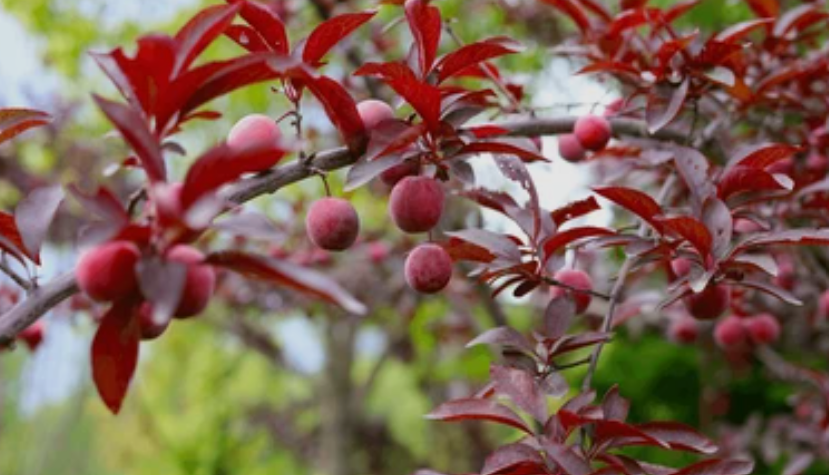
Most people picture a cherry tree the same way: white or pink blossoms floating above bright green leaves in early spring. Cherry trees with dark red leaves flip that image on its head, holding onto deep maroon, plum, and near-black foliage from the moment the leaves unfurl until they drop in autumn. Ornamental purple-leaf cherries have become one of the fastest-growing categories in flowering-tree nurseries over the past decade, and industry surveys tracking landscape tree sales consistently place purple-leaf plum and cherry cultivars among the top five flowering ornamentals sold in the United States each spring. Where a typical flowering cherry gives you two or three weeks of visual drama before reverting to plain green, a dark-leaved variety gives you five to seven months of color, turning a single tree into a season-long landscape anchor rather than a brief spring event.
The dark coloring comes from anthocyanin pigments that accumulate in leaf tissue, the same class of compounds responsible for the color of red cabbage, purple grapes, and autumn maple foliage. Research on anthocyanin production in woody plants has shown that pigment concentration is directly tied to light exposure, meaning a purple-leaf cherry planted in full sun can produce visibly darker foliage than a genetically identical tree grown in partial shade. In most ornamental cherries, pigment is strongest in spring, when new growth can appear almost black-red, then softens slightly toward a deep bronze-green as summer heat sets in, before flaring back up to fiery red or orange in fall. Mature purple-leaf cherry cultivars typically reach heights of 15 to 25 feet with a similar canopy spread, small enough to fit most residential yards while still providing real shade and structure. Below is a tour through the varieties that consistently deliver the deepest, longest-lasting color, along with what makes each one distinct.
1. Thundercloud Purple-Leaf Plum-Cherry
Thundercloud is one of the most widely planted dark-foliage flowering trees in North America and has held that position in nursery catalogs for more than 70 years since its introduction. While it’s technically a plum-cherry hybrid rather than a pure cherry, it’s sold and used almost interchangeably with true purple-leaf cherries because the effect is identical. The tree opens with a flush of single pink blossoms in early spring, and as those fade, the leaves emerge in a deep reddish-purple that darkens further through the season. Mature trees settle into a rounded canopy roughly 20 feet tall and wide, growing at a moderate rate of about 1 to 2 feet per year, which makes Thundercloud a popular choice for smaller residential lots where a full-sized shade tree wouldn’t fit.
2. Krauter Vesuvius Flowering Plum-Cherry
Krauter Vesuvius is often ranked as the darkest of the purple-leaf group, with foliage that reads almost black from a distance, especially against a backdrop of green lawn or lighter-colored siding. Leaf-color trials comparing purple-leaf plum cultivars have repeatedly placed this variety at or near the top for pigment retention through the hottest months of summer. The pale pink spring flowers are less showy than Thundercloud’s, which actually works in this tree’s favor, since the leaf color gets to dominate the display without competing visual noise from the blossoms. This cultivar tends to be more upright and slightly smaller at maturity, staying closer to 15 to 18 feet, which makes it a strong option for narrow side yards or as a paired accent flanking an entryway.
3. Newport Purple-Leaf Plum-Cherry
Newport is notable for being one of the more cold-hardy dark-leaf ornamentals, reliably surviving winter lows down to about minus 20 degrees Fahrenheit, which is roughly 10 to 15 degrees colder than many of its Mediterranean-bred relatives can tolerate. The foliage emerges reddish-purple and holds that tone with unusual consistency through summer heat, resisting the fade-to-green that affects less stable cultivars. Light pink flowers appear before the leaves in spring, and the tree produces small, largely ornamental fruit that birds tend to clear out within days. Newport’s dense, rounded form and proven hardiness make it a favorite for street tree plantings in colder regions where reliable color retention is a priority.
4. Mount St. Helens Flowering Plum-Cherry
Bred as an improvement on older purple-leaf varieties, Mount St. Helens was developed specifically to resist the leaf-fade problem that plagues many dark cherries once summer temperatures climb above 85 degrees Fahrenheit. Its foliage stays a rich burgundy well into late summer, whereas older cultivars often shift toward olive-green by midsummer, a difference growers can spot from across a nursery lot. The tree also produces an unusually heavy show of pale pink to white flowers in spring, giving it a two-stage seasonal display: a bright floral opening followed by months of steady dark-red color. Growers looking for the most reliable long-season color often rank this cultivar above older standards like Thundercloud.
5. Canada Red Chokecherry
Canada Red Chokecherry stands out from the rest of this list because its leaves don’t start out dark. New growth emerges bright green in spring, then gradually deepens to a rich reddish-purple over a period of roughly four to six weeks, creating a two-toned canopy effect that’s genuinely unusual among ornamental trees. By midsummer the tree is uniformly dark red-purple, and it holds that color through fall better than most true cherries, often surviving winter temperatures as low as minus 40 degrees Fahrenheit. Fragrant white flower clusters appear in spring before the color transition begins, and the tree tends to sucker from the base, so gardeners in cold-climate regions who choose this variety should plan for occasional cleanup at the root zone.
6. Vesuvius Flowering Plum-Cherry
Closely related to Krauter Vesuvius but sold under its own name by some nurseries, this cultivar produces some of the darkest foliage available in the ornamental cherry category, often described by growers as nearly purple-black. The tree flowers modestly in early spring with small pink blooms, then shifts focus entirely to its leaves for the remainder of the growing season. Vesuvius performs best in climates with hot, dry summers and at least six hours of direct sun daily, where intense sun exposure actually deepens the pigment rather than washing it out, which is the opposite of how most trees respond to heat stress.
7. Big Cis Purple-Leaf Cherry-Plum
Big Cis is a lesser-known cultivar valued by landscape professionals for its combination of deep burgundy foliage and unusually fast growth for a dark-leaf ornamental. Where many purple cherries take five to seven years to reach a mature, filled-out canopy, Big Cis often achieves a similar look in three to four years, growing at nearly double the rate of Krauter Vesuvius under comparable conditions. This makes it a practical choice for developers and landscapers working on tighter installation timelines. The leaves run slightly larger than those of Thundercloud or Newport, giving the canopy a bolder, coarser texture that reads well from a distance in commercial and park settings.
8. Weeping Purple-Leaf Cherry
Not a single cultivar but a growth habit applied to several dark-foliage varieties, the weeping form combines cascading branches with deep red-purple leaves for a dramatic focal-point tree. These are typically grafted onto a standard trunk 5 to 6 feet tall, producing a mushroom-shaped canopy of drooping branches that trail toward the ground, covered in either pink spring blossoms or dark foliage depending on the season. Because of their compact footprint, often no wider than 10 to 12 feet at full spread, weeping purple cherries are frequently used as single specimen trees near patios, entrances, or water features where a year-round conversation piece is the goal.
9. Royal Burgundy Flowering Cherry
Royal Burgundy is one of the few true ornamental cherries, rather than a plum-cherry hybrid, to reliably produce dark red-purple foliage alongside a heavy double-flower spring display. The blossoms are a rich pink and notably full, almost carnation-like, with individual flowers carrying two to three times the petal count of a standard single-bloom cherry. Once the flowers drop, the tree’s leaves emerge a deep reddish-purple and generally hold that shade more evenly through summer than many hybrid varieties, without the pronounced fade toward green that affects some cultivars in this list.
10. Trailblazer Purple-Leaf Cherry-Plum
Trailblazer was developed for improved disease resistance compared to older purple-leaf cultivars, which historically struggled with certain fungal leaf spots in humid climates, a problem that in trial plantings reduced canopy density by as much as 20 percent in susceptible cultivars during wet summers. Its foliage runs a slightly warmer red-purple than the near-black tones of Krauter Vesuvius, giving it a softer, more approachable look in residential landscaping. The tree flowers in early spring with light pink blooms and maintains a naturally tidy, rounded shape that requires less structural pruning than many of its relatives, which has made it a common choice among growers who want strong color without heavy maintenance demands.
Choosing the Right Dark-Leaf Cherry for Your Landscape
The variety that performs best depends heavily on climate, available space, and how long you want the color to last through the growing season. Gardeners in hot, dry regions tend to get better results from Vesuvius or Krauter Vesuvius, since intense sun exposure deepens rather than fades their pigment. Cold-climate gardeners generally see more consistent performance from Newport or Canada Red Chokecherry, both bred or selected with winter hardiness down to minus 20 or minus 40 degrees Fahrenheit. For anyone prioritizing color retention through a full, hot summer, Mount St. Helens currently outperforms most of the older standards. Whichever variety you choose, planting in full sun, providing consistent moisture during the first two growing seasons, and avoiding heavy shade from neighboring trees will do more to preserve that deep red-purple color than almost any other single factor.
Frequently Asked Questions
Do dark red-leaf cherry trees stay red all year? No. Most purple-leaf cherry and plum-cherry cultivars are deciduous, meaning they lose their leaves in late fall and remain bare through winter. The dark red color is typically visible from spring leaf-out through autumn, roughly six to seven months depending on climate, before the foliage drops and the tree enters dormancy.
Why are my purple-leaf cherry tree’s leaves turning green? Fading toward green usually points to insufficient sunlight, since anthocyanin pigment production depends heavily on light exposure. A tree that was full sun at planting but is now shaded by growing neighboring trees will often show a gradual color shift over several seasons. Older or less stable cultivars are also simply more prone to summer fade regardless of light conditions.
How fast do dark red-leaf cherry trees grow? Most purple-leaf cherry and plum-cherry cultivars grow at a moderate rate of 1 to 2 feet per year, reaching a filled-out mature canopy in five to seven years. Faster-growing cultivars like Big Cis can reach a similar mature appearance in three to four years under good growing conditions.
Are dark red-leaf cherry trees the same as ornamental plum trees? Many of the most popular dark-leaf cherries sold in nurseries, including Thundercloud, Krauter Vesuvius, and Newport, are technically plum-cherry hybrids rather than pure cherry species, though they are marketed and used interchangeably with true purple-leaf cherries because the visual effect is nearly identical.
What is the darkest purple-leaf cherry tree available? Krauter Vesuvius and Vesuvius are generally regarded by growers as the darkest available cultivars, with foliage that reads nearly black-purple, especially when the trees are grown in full sun and hot summer conditions that intensify pigment production.