Spore reproduction is one of the oldest and most successful reproductive strategies in the plant kingdom, predating the evolution of seeds by hundreds of millions of years and allowing certain groups of plants to colonize virtually every terrestrial habitat on Earth without the complex structures of flowers, fruits, or seeds that characterize the more recently evolved flowering plants.
A spore is a single cell, or in some cases a small cluster of cells, enclosed in a protective wall and capable of developing into a new organism under appropriate conditions, representing a remarkably efficient and economical reproductive unit that can be produced in enormous quantities and dispersed over vast distances by wind, water, or other agents. This ancient reproductive strategy has proven so successful that it persists today in several major groups of plants and plant-like organisms that collectively dominate many of Earth’s most challenging environments.
The scale of spore production in nature is staggering. A single mature fern frond can produce over a million spores, while a large tree fern may release hundreds of millions of spores in a single season. A single puffball fungus, while not technically a plant, can release seven trillion spores in its lifetime — more individual reproductive units than there are stars estimated in the Milky Way galaxy.
Mosses produce spore capsules containing tens of thousands of spores each, and a single sphagnum moss plant can release its entire spore load explosively in fractions of a second, launching spores into the air with accelerations exceeding 36,000 times the force of gravity. These extraordinary quantities of spores reflect the statistical reality that the vast majority will land in unsuitable conditions and fail to develop, making high-volume production essential for reproductive success.
Spore-reproducing plants dominated the Earth’s land vegetation for hundreds of millions of years before the evolution of seed plants, with the Carboniferous period, roughly 359 to 299 million years ago, seeing vast forests dominated by giant tree-sized relatives of modern clubmosses, horsetails, and ferns. The compressed remains of these ancient spore-reproducing forests form much of the world’s coal deposits, illustrating both the enormous biomass these plants once produced and the deep time over which spore reproduction has been a successful strategy.
Despite the subsequent diversification and dominance of flowering plants, spore-reproducing plants remain ecologically significant, with mosses alone covering an estimated 1.6% of the Earth’s total land surface and playing critical roles in water retention, carbon storage, and ecosystem function in many of the world’s biomes.
The following overview explores the major groups of spore-reproducing plants, organized by their botanical classification and illustrated with notable examples from each group.

Also Read: Plants That Grow From Tubers
Plants that Grow From Spores
Ferns
Ferns are the most diverse and familiar group of spore-producing plants, encompassing over 10,500 described species distributed across virtually every terrestrial habitat from tropical rainforests to arctic tundra, united by their production of spores in clusters called sori typically located on the undersides of their fronds. The fern life cycle involves two distinct, independent generations — the familiar leafy fern plant and a tiny, heart-shaped intermediate stage called a prothallus.
The sori visible as brown dots or streaks on the undersides of fern fronds are the spore-producing structures, with each sorus containing many individual sporangia that release their spores when mature. Ferns have been used by humans for food, medicine, and decoration throughout history, with certain species such as bracken fern representing some of the most widespread plants on Earth, growing on every continent except Antarctica.
Tree Ferns
Tree ferns represent a distinctive growth form within the broader fern group, developing a trunk-like structure composed of old leaf bases and aerial roots rather than true woody tissue, which can elevate the frond canopy several meters above the ground in the manner of a true tree. They are among the most ancient-looking plants in the modern world.
Tree ferns produce their spores on the undersides of fronds in the same way as smaller ferns, but the elevation of their frond canopy may help disperse spores more widely by releasing them at greater heights above the ground. Several tree fern genera including Dicksonia and Cyathea are popular as garden ornamentals in mild climates, where their prehistoric appearance creates dramatic landscape effects.
Bracken Fern
Bracken fern is one of the most globally widespread of all plant species, occurring on every continent except Antarctica and in habitats ranging from tropical forest margins to temperate heathland and moorland. Its aggressive colonizing ability reflects its efficient spore reproduction combined with spreading underground rhizomes.
Bracken produces its spores along the rolled-under margins of the triangular frond leaflets rather than in discrete sori as seen in many other ferns, a feature that distinguishes it from most other common fern species. While bracken has traditional uses as food, fuel, bedding, and medicine, it is also considered invasive in many habitats where it spreads aggressively after disturbance.
Also Read: Plants That Grow From Rhizomes
Polypody Fern
Polypody ferns are a diverse group of mostly small to medium-sized ferns found in rock crevices, on walls, on the branches of trees as epiphytes, and in woodland settings, producing their distinctive round sori in rows on the undersides of their undivided or pinnate fronds. Their tolerance for dry, exposed conditions makes them among the most adaptable ferns for garden use.
Several polypody species are among the most commonly encountered ferns in European and North American gardens and woodlands, often colonizing old walls and tree bark in a manner that reflects their spores’ ability to establish in minimal substrate. Some polypody cultivars with attractively crested or finely divided fronds have become popular ornamental garden plants.
Maidenhair Fern
Maidenhair fern is renowned for its delicate, lacy fronds composed of small, fan-shaped leaflets on fine, dark, shiny stalks that create an exceptionally graceful appearance quite different from the more robust frond structure of many other fern groups. Its spores are produced around the rolled margins of the leaflets.
The extraordinary delicacy of maidenhair fern fronds has made this plant one of the most sought-after of all ornamental ferns for indoor and sheltered garden cultivation, though its need for consistently moist air and soil makes it more demanding than many hardier fern species. Several maidenhair fern species are found in rock crevices near waterfalls where the permanently moist air provides the high humidity the plant requires.
Mosses
Mosses are small, non-vascular plants that reproduce by spores produced in elongated capsules elevated above the plant body on slender stalks, representing one of the most ancient groups of land plants with a fossil record extending back approximately 400 million years. There are approximately 12,000 described moss species worldwide.
Mosses play ecological roles disproportionate to their small individual size, with dense moss carpets retaining significant quantities of water, modifying soil temperature, providing habitat for microscopic organisms, and storing substantial amounts of carbon in peatland environments. Sphagnum mosses in particular are ecologically extraordinary, capable of holding up to 20 times their dry weight in water and forming the basis of peat deposits that cover millions of hectares worldwide.
Also Read: Plants that Grow From Corms
Sphagnum Moss
Sphagnum mosses are a specialized group of approximately 380 species within the broader moss category, forming the dominant vegetation of bogs and other wet, acidic habitats across the Northern Hemisphere where their unique properties create and maintain the peatland ecosystem. Their ability to produce acidic conditions that inhibit decomposition is fundamental to peat formation.
The spores of sphagnum are released from spherical capsules with explosive force when air pressure builds within the capsule as it dries, launching spores several centimeters into the air where they can catch air currents. Sphagnum’s remarkable water-holding capacity made it valuable as a wound dressing during World War One, when bandaging materials were in short supply.
Club Mosses
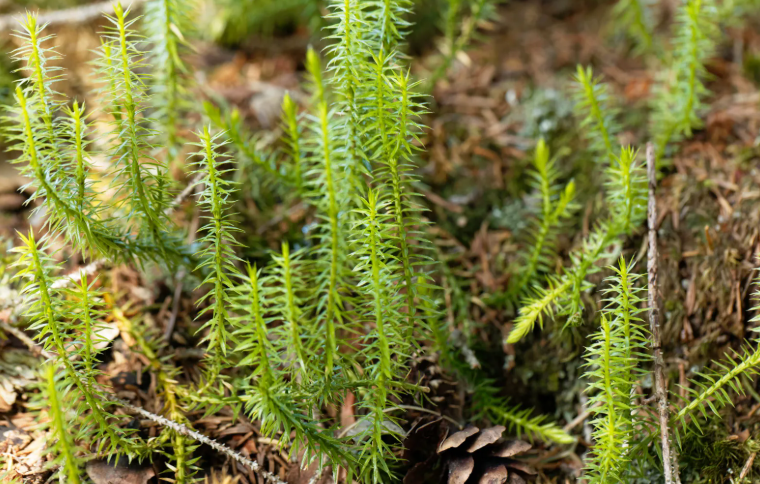
Club mosses are not true mosses but rather members of an ancient lineage of vascular plants that were among the first plants to develop the transport tissues that allow water and nutrients to move through plant bodies. The approximately 400 living species of club moss are diminutive survivors of a group that once included the giant trees of Carboniferous forests.
Club mosses produce their spores in cone-like structures at the tips of their upright branches, with some species producing two different types of spore in a preliminary step toward the sexual specialization characteristic of seed plants. The spores of certain club moss species, known as lycopodium powder, were historically used as flash powder in early photography and theatrical effects.
Quillworts
Quillworts are an unusual and largely aquatic group of spore-producing plants closely related to club mosses, with grass-like, quill-shaped leaves that arise from a compact, root-bearing base and produce spores within a hollow at the base of each leaf rather than in specialized separate structures. There are approximately 250 described species.
These plants typically grow submerged in shallow, clear lakes and pools or in seasonally flooded habitats, and their unusual appearance bears little resemblance to the more familiar spore-producing plants. Quillworts are ecologically significant as indicators of water quality, typically growing only in unpolluted water bodies with limited nutrient enrichment.
Spike Mosses
Spike mosses, belonging to the genus Selaginella, are a diverse group of approximately 700 species that resemble small mosses or club mosses but represent a distinct lineage of primitive vascular plants, found in habitats ranging from tropical rainforests to deserts across much of the world. Some desert species are known as resurrection plants.
Several selaginella species can survive complete desiccation, curling into a ball and appearing dead before rapidly rehydrating and resuming active growth when water becomes available again, a remarkable adaptation that allows them to colonize environments with unpredictable moisture availability. These resurrection species have attracted scientific interest for the mechanisms underlying their extraordinary tolerance for desiccation.
Also Read: Plants That Grow Easily From Cuttings
Horsetails
Horsetails are the sole surviving genus of a once-diverse lineage of primitive vascular plants that included large trees during the Carboniferous period, with the approximately 30 living species being relatively small plants that produce their spores in cone-like structures at the tips of their jointed, hollow stems. Their distinctive whorled branches give them a prehistoric appearance.
The stems of horsetails are silica-reinforced, giving them a rough, abrasive texture that led to their historical use as scouring pads for cleaning pots and polishing surfaces, hence the common name scouring rush given to some species. Horsetail spores are unusual in bearing four ribbon-like arms called elaters that are sensitive to humidity, uncoiling in dry conditions to propel the spore across the ground.
Water Ferns
Water ferns are a group of small, floating or aquatic ferns that reproduce by spores adapted for dispersal in aquatic environments rather than by wind, encompassing several distinct genera including Azolla, Salvinia, and Marsilea that have independently adapted to aquatic lifestyles. Their growth habits differ significantly from terrestrial ferns.
Azolla, the mosquito fern, has attracted considerable agricultural interest for its symbiotic relationship with nitrogen-fixing cyanobacteria, which live within specialized cavities in the plant and allow azolla to accumulate significant quantities of nitrogen that benefit the plant and can enrich the water or soil when the azolla decomposes. Azolla has been used for centuries as a natural fertilizer in Asian rice paddies.
Liverworts
Liverworts are small, non-vascular plants related to mosses that represent one of the most ancient lineages of land plants, with fossil evidence suggesting their ancestors were among the first plants to colonize land surfaces over 450 million years ago. There are approximately 9,000 described species found worldwide.
The spores of liverworts are typically released from elongated capsules that split open when mature, often with the assistance of hygroscopic cells called elaters that twist as humidity changes and help fling the spores into the surrounding air. Liverworts play important roles in colonizing bare surfaces after disturbance, contributing to the early stages of ecological succession on rocks, soil, and other substrates.
Hornworts
Hornworts are a small group of approximately 300 species of non-vascular plants related to mosses and liverworts, distinguished by their elongated, horn-like spore-producing structures that emerge from the flat, ribbon-like plant body and split lengthwise to release spores as they mature. Their unique photosynthetic cells contain a single large chloroplast, unusual among land plants.
Hornworts frequently host colonies of cyanobacteria within cavities in their cells, forming symbiotic relationships that allow nitrogen fixation similar to that seen in azolla, potentially contributing to soil nitrogen enrichment in the ecosystems where hornworts occur. Despite their small size and inconspicuous appearance, hornworts are of considerable scientific interest for what their unique cellular organization reveals about early land plant evolution.
Also Read: Flowers That Grow From Bulbs