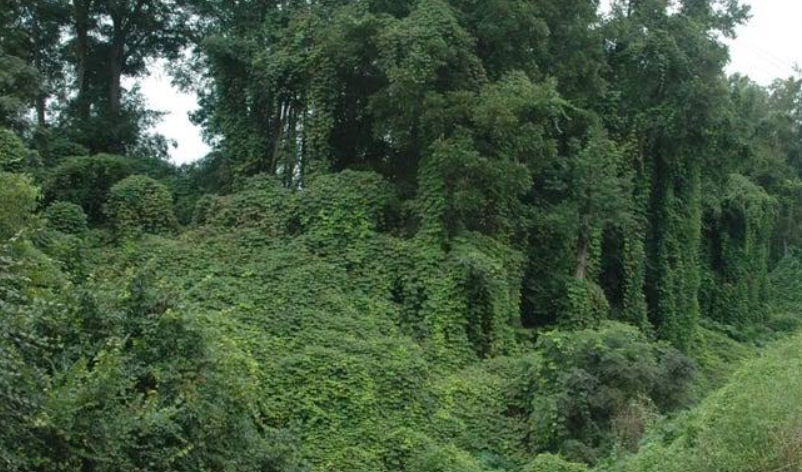
Invasive vines in Florida have an unusually easy path to becoming a serious problem, since the state’s warm, humid, nearly frost-free climate lets tropical and subtropical species grow year-round instead of dying back each winter the way they would almost anywhere else in the continental United States. A surprising number of the vines on this list started out as ordinary houseplants, the same pothos or arrowhead vine sold in a plastic pot at a big-box store, before escaping into a natural hammock and transforming into something almost unrecognizable.
That transformation is a genuinely documented phenomenon rather than exaggeration. According to research compiled by University of Florida IFAS Extension, golden pothos normally stays in a juvenile leaf form as a houseplant, but once established outdoors it produces mature leaves that can reach several feet long while climbing vigorously into the forest canopy. A recent UF/IFAS student survey also found that Syngonium podophyllum, sold under names like arrowhead vine, was stocked in nearly every nursery surveyed despite being formally classified as a Category 1 invasive species as of 2025, meaning it’s already altering native plant communities.
These vines span South Florida hammocks, Panhandle forests, and suburban landscapes throughout the state. What follows covers 21 invasive vines in Florida, along with where each one grows and the data behind its spread.
Air Potato
Air potato produces heart-shaped leaves on a vigorously twining vine capable of growing several inches in a single day and reaching 60 feet or more in length by the end of a single growing season. It reproduces primarily through hundreds of small, potato-like bulbils that form along the vine and drop to the ground, each one capable of sprouting an entirely new plant the following spring.
It’s now illegal to plant anywhere in Florida, though existing populations continue to spread on their own across all 67 counties in the state. Removing and freezing the bulbils before they can sprout remains one of the most effective control methods available to homeowners.
Skunk Vine
Skunk vine produces small, opposite leaves that release a distinctly unpleasant, sulfurous odor whenever they’re crushed or bruised, growing as a twining vine capable of forming dense mats over shrubs and trees. That dense mat blocks the sunlight the host plant needs to survive, and heavily infested areas can end up with almost no other vegetation growing beneath the smothering canopy.
It’s found throughout much of the Florida peninsula, spread readily by birds that eat and disperse its small seeds. Its extensive underground root system also allows it to resprout persistently even after the visible vine has been removed.
Old World Climbing Fern
Old world climbing fern produces delicate, lacy fronds on a vine-like stem capable of climbing high into a tree canopy, where it forms a dense blanket that blocks sunlight and eventually kills the host tree beneath it. It’s widely considered one of the single most damaging invasive plants in southern Florida’s natural areas, having transformed large sections of the Everglades landscape.
Its greatest hazard may actually be during wildfire season, since its dense, dry mats can act as a ladder fuel, carrying flames up into a tree canopy that would otherwise have escaped a ground-level fire. It grows throughout central and southern Florida, particularly in wetland and hammock habitats.
Japanese Climbing Fern
Japanese climbing fern closely resembles its old world relative in growth habit, climbing 90 feet or more into a tree canopy on delicate, vine-like fronds that spread via wind-dispersed spores rather than seed. That spore-based reproduction lets it establish new infestations at considerable distance from the original plant, making its spread genuinely difficult to track or contain.
It grows throughout much of the Florida peninsula and Panhandle, favoring forest edges and disturbed wetland margins. Like its relative, it’s capable of forming a dangerous ladder fuel during dry, fire-prone conditions.
Cat’s Claw Vine
Cat’s claw vine produces small, hooked, claw-like tendrils that let it grip smooth bark and structures alike, climbing quickly into a host tree’s canopy where its dense growth eventually shades out the foliage beneath it. Its thick, tuberous root system stores enough reserve energy to allow the vine to regrow rapidly even after being cut back to the ground.
It grows throughout much of the Florida peninsula, commonly escaping from ornamental plantings into surrounding natural areas. Its bright yellow, trumpet-shaped spring flowers make it a popular garden plant despite its documented invasive behavior.
Ivy Gourd
Ivy gourd produces heart-shaped leaves and small yellow flowers on a fast-growing, tendril-climbing vine capable of covering and shading out shrubs and small trees within a single growing season. A single plant develops an extensive network of vines from just one deep, tuberous root, and that root allows it to survive and resprout even after aggressive above-ground removal.
It’s established throughout much of South Florida, where warm, humid conditions let it grow year-round without the winter dieback that limits its spread farther north. It’s classified as a noxious weed at the federal level given its documented impact on native plant communities.
Climbing Fig
Climbing fig produces small, dense, glossy leaves on a self-clinging vine that attaches to bark and masonry using tiny aerial rootlets, gradually forming a thick mat capable of smothering the foliage of a smaller host tree. Its vigorous, wall-covering growth habit, prized in ornamental landscaping for covering fences and buildings, is the very same trait that allows it to escape into surrounding trees.
It grows throughout the Gulf Coast region of Florida and other warm parts of the state. Removing an established vine from a tree trunk can be surprisingly difficult, since its rootlets cling tightly enough to damage bark during removal.
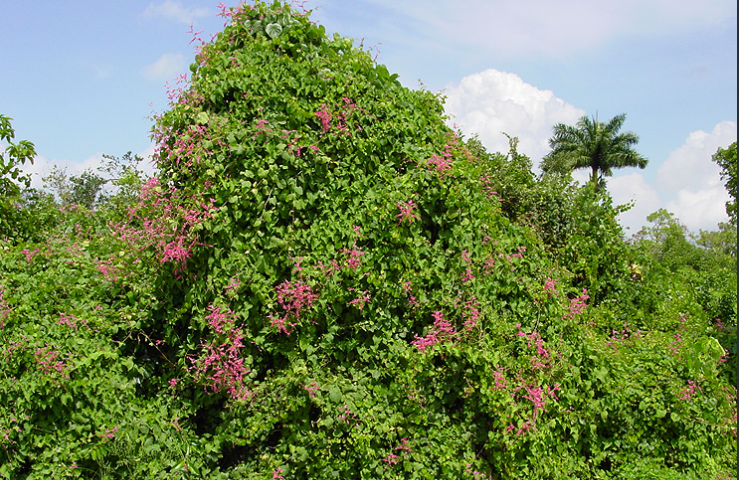
Coral Vine
Coral vine produces cascading sprays of small, bright pink flowers on a fast-growing, tendril-climbing vine that can bloom nearly continuously through Florida’s long warm season. Left unmanaged, a single planting can spread rapidly across fences, shrubs, and small trees, its lightweight but dense foliage shading out whatever it covers.
It’s established throughout much of peninsular Florida, frequently escaping from the same ornamental plantings that made it a popular garden vine in the first place. Its seeds are readily dispersed by both wind and birds, allowing new colonies to establish well beyond an original planting.
Balloon Vine
Balloon vine produces delicate, finely divided leaves and distinctive inflated, papery seed pods on a fast-growing, tendril-climbing vine capable of covering nearby shrubs and small trees. Its buoyant seed pods float readily on water, which has allowed the vine to spread efficiently along Florida’s extensive network of canals, rivers, and drainage ditches.
It’s found throughout much of Florida, particularly concentrated along waterways where its floating seeds have carried it into new territory. Dense infestations can significantly reduce light and airflow to the native shoreline vegetation growing beneath it.
Rosary Pea
Rosary pea produces glossy red seeds marked with a single black spot, held inside slim seed pods on a twining vine capable of climbing 10 to 20 feet using surrounding vegetation for support. Those same strikingly attractive seeds contain abrin, a toxin potent enough that chewing and swallowing even a single properly broken seed can be fatal to an adult.
It’s established throughout much of Florida, particularly in coastal hammocks and disturbed areas, where it’s capable of smothering native shrubs and small trees. Its ornamental use in jewelry and rosaries has unfortunately helped spread both the seeds and the plant itself well beyond its original introduction points.
Kudzu
Kudzu produces large, 3-lobed leaves on vigorous vines capable of growing 60 to 100 feet in a single season, engulfing entire trees, utility poles, and abandoned structures beneath a dense green blanket. Its massive underground tubers can grow many feet deep and store enough energy to allow the vine to regrow persistently even after years of cutting and herbicide treatment.
It’s found primarily in the Florida Panhandle and northern parts of the state, where cooler winters more closely resemble the conditions of the Deep South states where kudzu is most notorious. Its spread is generally less severe in the subtropical southern half of Florida, where other invasive vines tend to dominate instead.
Bitter Melon Vine
Bitter melon vine produces deeply lobed leaves and small yellow flowers on a fast-growing, tendril-climbing vine that develops distinctive warty, orange fruit as it matures. Once ripe, the fruit splits open to reveal seeds coated in a bright red, sticky pulp that birds find highly attractive, helping the vine spread quickly into new areas.
It’s established throughout much of peninsular Florida, particularly in disturbed sites and along fence lines. While the unripe fruit is eaten as a vegetable in several cuisines, the plant’s aggressive climbing and seeding behavior has made it a genuine concern in natural areas.
Stinking Passionflower
Stinking passionflower produces delicate, lacy purple and white flowers similar to the desirable native maypop, but its foliage releases a distinctly unpleasant odor when crushed, which is how it earned its common name. It spreads via a combination of seed and underground runners, quickly forming dense colonies that can overwhelm the low vegetation it grows among.
It’s found throughout much of peninsular Florida, particularly in disturbed, sunny sites. Distinguishing it from the desirable native maypop passionflower is an important step before deciding whether to remove or preserve a given vine.
Noyau Vine
Noyau vine, a relative of morning glory, produces deeply divided leaves and small white flowers with a distinctive reddish-purple throat, twining rapidly over fences and low vegetation throughout Florida’s warm season. Its vigorous annual growth allows a single plant to cover a substantial area within just a few months, particularly in disturbed, sunny sites.
It’s established throughout much of central and southern Florida. Because it reseeds prolifically each year, a single season of unmanaged growth can leave a persistent seed bank that produces new plants for several years afterward.
Japanese Honeysuckle
Japanese honeysuckle produces oval leaves and intensely fragrant, tubular white-to-yellow flowers on a twining, semi-evergreen vine capable of forming dense mats over shrubs and trees throughout much of the state. Its vines can eventually girdle and kill woody host plants over time, and its berries, while attractive to birds, are the primary way the vine spreads rapidly into new natural areas.
It’s found throughout much of northern and central Florida, where it remains green through even the mildest winters. Several states have restricted its sale entirely given how destructive it becomes once established outside cultivation.
Climbing Hempvine
Climbing hempvine produces small, fuzzy, arrow-shaped leaves and clusters of tiny white flowers on a fast-growing, twining vine capable of scrambling over low vegetation and small shrubs throughout wetland and disturbed habitats. Its rapid growth rate and prolific seed production allow a single infestation to expand considerably within a single growing season.
It’s found throughout much of Florida, particularly in moist, disturbed ground near wetlands and ditches. Its fine, twining stems can be difficult to fully remove by hand once they’ve woven through the surrounding vegetation.
Winged Yam
Winged yam, a relative of air potato, produces distinctive leaves and stems with wing-like ridges running their length, twining vigorously into tree canopies and producing its own potato-like bulbils along the vine. Like air potato, those bulbils are the primary way it spreads, each one capable of sprouting a new plant wherever it lands.
It’s established throughout much of Florida, frequently found growing alongside or in similar habitats to air potato itself. Its underground tubers can grow substantially large over time, making complete removal a genuinely labor-intensive task.
Blue Trumpet Vine
Blue trumpet vine, also called sky vine, produces large, showy, trumpet-shaped lavender-blue flowers on a vigorous, twining vine capable of covering trees and structures throughout Florida’s warm growing season. Its dense growth and rapid spread via underground runners allow a single planting to expand into a substantial thicket within just a few years.
It’s found throughout much of central and southern Florida, commonly escaping from the same ornamental plantings that made it a popular choice for covering arbors and fences. Established infestations are notably difficult to eradicate given how readily the plant resprouts from root fragments left in the soil.
Golden Pothos
Golden pothos, familiar to most people as a common houseplant, and according to University of Florida IFAS research, produces leaves that normally stay 4 to 8 inches long in a pot but can grow to nearly 3 feet in length once established in the wild, with vines capable of reaching 150 feet and engulfing entire trees. It’s grown wild in Florida since at least 1934, and while it rarely flowers, its ease of vegetative spread from even small stem fragments makes it extremely difficult to fully eliminate.
It’s found scattered throughout the Florida peninsula, with the largest concentrations in South Florida’s tropical hammocks. Discarded houseplant clippings tossed into a yard or natural area are a common and often overlooked source of new infestations.
Arrowhead Vine
Arrowhead vine, sold commercially as Syngonium podophyllum under cultivar names like ‘Pink Allusion’ and ‘White Butterfly,’ produces distinctive arrow-shaped, often variegated leaves on a vine that climbs vigorously once established outside a container. According to a UF/IFAS student survey of Gainesville nurseries, it made up nearly a third of the invasive plants found for sale, despite its 2025 classification as a Category 1 invasive species already altering Florida’s native plant communities.
It’s established in scattered natural areas throughout the Florida peninsula, frequently escaping from discarded cuttings or intentional outdoor plantings. Its continued widespread sale as a houseplant remains a significant, ongoing source of new introductions into the wild.
Bushkiller Vine
Bushkiller vine produces compound leaves with 5 leaflets on a fast-growing, semi-woody vine capable of climbing trees and structures and becoming quite large in the absence of severe cold weather. Its dense foliage blocks or reduces the sunlight reaching whatever it covers, and over time this light deprivation can kill the shrub or tree the vine has grown over.
It’s found in scattered populations across the Florida Panhandle and Gulf Coast region, an area that shares its warm, humid climate with neighboring Gulf states where the vine is more widely established. It’s notoriously difficult to remove once established, since even small root fragments left behind can regenerate an entirely new infestation.
Further References
- Invasive Vines of Florida — UF/IFAS Gardening Solutions — The strongest general reference. It covers several invasive or potentially invasive vines found in Florida, including Japanese honeysuckle, sweet autumn clematis, and others.
- UF/IFAS Assessment of Non-Native Plants in Florida’s Natural Areas — Useful for checking the invasion risk and Florida status of individual nonnative vines.
- Cat’s-Claw Vine — UF/IFAS Extension — Detailed identification and information about this aggressive invasive vine, including its yellow flowers and climbing characteristics.
- Arrowhead Vine — UF/IFAS Extension — Covers the identification, distribution, impacts, and invasive status of arrowhead vine in Florida.
- Invasive Plants — UF/IFAS Gardening Solutions — A broader Florida invasive-plant reference that includes vines such as air potato, cat’s-claw, old world climbing fern, kudzu, and Japanese honeysuckle.