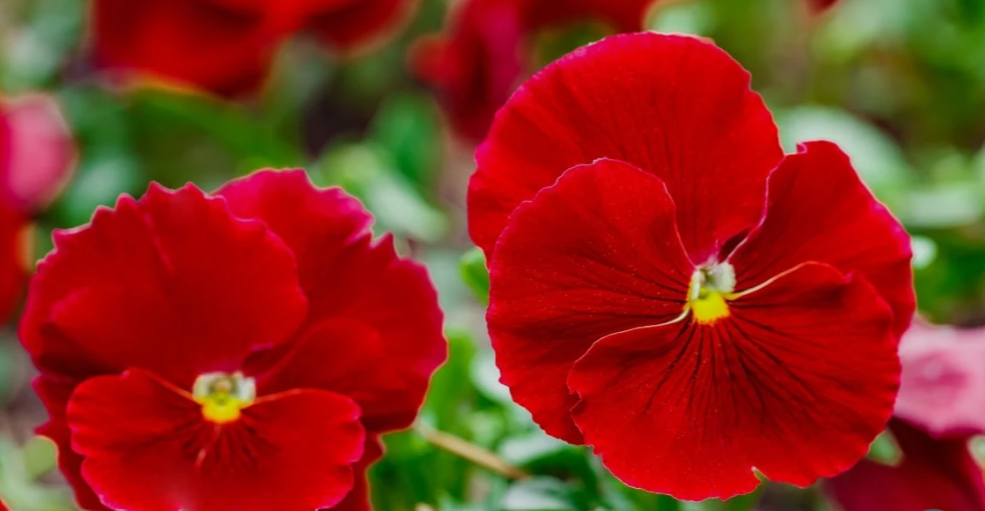
Red flowers with yellow centers are among the easiest blooms to spot from across a yard, because the two colors sit at full strength right next to each other. The pairing shows up in annuals, perennials, shrubs, and even pond plants. It is common enough that most American gardens already hold at least one example.
What few people notice is that the yellow center is not the same thing from one flower to the next. In a peony or a camellia, it is a tuft of pollen-bearing stamens. In a zinnia or a cosmos, it is a packed disk of dozens or hundreds of tiny separate flowers.
The contrast also does a job. Bees see red poorly but pick out yellow with ease, so a yellow middle works like a landing target on a petal color they might otherwise miss. Hummingbirds read the red from a distance and find the nectar on their own.
This list groups 21 flowers by what their yellow center is made of, starting with stamens, moving to daisy-type disks, and ending with a painted eye. Knowing the difference helps when buying, since double-flowered forms of the same plant often hide the yellow completely. Hardiness ranges refer to USDA zones in the United States.
1. Eastern Red Columbine
Eastern red columbine is a native woodland wildflower found from the Great Plains to the Atlantic coast. Each nodding bloom is 1 to 2 inches long, with red spurs pointing up and a yellow middle hanging below. The plant grows about 2 feet tall and is hardy in zones 3 to 8.
The yellow comes from two parts at once, the inner petal blades and a long brush of stamens. The red and yellow flowers open in early spring and can last a month, which lines up with the return of ruby-throated hummingbirds. Individual plants are short-lived, but they reseed freely in part shade.
2. ‘America’ Peony
‘America’ is a single-flowered peony with one row of scarlet petals around a wide boss of golden stamens. The blooms measure 7 to 8 inches across and open in late spring. It won the American Peony Society Gold Medal in 1992.
Single peonies show their centers, while the popular double types bury them under extra petals. The lighter flowers also stay upright in rain, so this variety rarely needs staking. Plants reach 3 feet tall and can live for 50 years or more in zones 3 to 8.
3. ‘Altissimo’ Rose
‘Altissimo’ is a climbing rose with flat, blood-red blooms that carry only 7 petals each. The flowers span 4 to 5 inches and open wide to show a ring of golden-yellow stamens. It was bred in France in 1966 and still sells widely in American nurseries.
The canes climb 8 to 12 feet and bloom in repeated flushes from late spring to fall. The stamens darken from yellow to brown after 2 or 3 days, so the freshest flowers show the best contrast. It grows in zones 5 to 9 and has better disease resistance than most red climbers.
4. ‘Yuletide’ Camellia
‘Yuletide’ camellia is an evergreen shrub that blooms from late fall into winter, when little else flowers. Its single red blossoms are about 3 inches wide and centered with a dense cluster of bright yellow stamens. The variety was introduced by a California nursery in 1963.
The shrub grows 8 to 10 feet tall with a narrow, upright shape that suits hedges and entryways. It is hardy in zones 7 to 10 and common across the Southeast and the West Coast. It takes more sun than the larger spring-blooming camellias, though buds can brown in a hard freeze.
5. ‘Texas Scarlet’ Flowering Quince
‘Texas Scarlet’ flowering quince covers its bare branches with tomato-red blooms in early spring. Each flower is about 1.5 inches wide, with 5 rounded petals around a tuft of yellow stamens. The display often starts in March, weeks before the leaves appear.
This is a low, spreading variety that stays 3 to 4 feet tall and about 5 feet wide. It has fewer thorns than older quinces, which makes pruning easier. The shrub is hardy in zones 5 to 9 and produces small, hard fruits that can be cooked into jelly.
6. ‘Mrs. Bradshaw’ Geum
‘Mrs. Bradshaw’ geum bears ruffled, semi-double scarlet flowers on wiry stems about 2 feet tall. The petals part in the middle to show a small cluster of yellow stamens. It has been sold for more than a century and remains the standard red geum.
The plant blooms from late spring into midsummer and repeats if spent stems are removed. It grows best in zones 5 to 7 and struggles in hot, humid summers. Clumps tend to fade after 3 or 4 years, so dividing them keeps the planting going.
7. Red Pasque Flower
Red pasque flower is a low spring perennial with cup-shaped, wine-red blooms covered in silky hairs. A thick ring of golden stamens fills the middle of each 2-inch flower. It is one of the first perennials to open, often in March or April.
Plants stay 8 to 12 inches tall and need sharp drainage and full sun. Feathery, silver seed heads follow the flowers and last for several weeks. It is hardy in zones 4 to 8, and all parts are toxic if eaten.
8. Red Iceland Poppy
Red Iceland poppy carries crinkled, tissue-thin petals on bare stems 12 to 18 inches tall. Unlike the common red field poppy, which has a black middle, this one has a yellow-green seed capsule ringed with yellow stamens. The cupped blooms reach about 3 inches across.
This is a cool-season plant that stops flowering once nights stay above 70 degrees. Gardeners in California and the South plant it in fall for winter and spring color. In zones 2 to 7 it behaves as a short-lived perennial that blooms in late spring.
9. Red Water Lily
Red water lily is a hardy pond plant whose flowers float at the surface among round green pads. The best-known red variety, ‘Escarboucle’, has deep crimson blooms 6 to 7 inches wide with orange-yellow stamens in the middle. It was bred in France in 1909 and is still considered the benchmark red.
Each flower opens in the morning and closes by late afternoon for 3 or 4 days in a row. The plant needs at least 6 hours of direct sun and still water 1 to 3 feet deep. It survives winter in zones 4 to 10 as long as the roots sit below the ice.
10. Red Moss Rose
Red moss rose is a ground-hugging annual with fleshy, needle-like leaves and satiny flowers about 1 inch wide. The yellow center is a dense tuft, since the petals surround a group of 40 or more stamens. Plants stay 4 to 8 inches tall and spread about a foot.
It thrives in heat, drought, and poor soil where most bedding plants fail. Older types close their flowers on cloudy days and in late afternoon, while newer hybrids stay open longer. Single-flowered forms show the yellow best, because double forms cover it with extra petals.
11. Red Wax Begonia
Red wax begonia is one of the most widely planted bedding annuals in the United States. The small flowers are scarlet with a bright yellow cluster in the middle, set against glossy green or bronze leaves. Plants form neat mounds 6 to 12 inches tall.
Each plant bears separate male and female flowers, and both have yellow centers. It blooms without pause from spring planting until frost and needs no deadheading. Bronze-leaved varieties handle full sun, while green-leaved ones do better with afternoon shade.
12. Red Zinnia
Red zinnia marks the switch to daisy-type flowers, where the yellow center is a ring of tiny star-shaped florets. Each of those yellow stars is a complete flower that makes nectar, which is why butterflies work the middle of the bloom. ‘Profusion Red’ is a reliable single-flowered choice with 2-inch blooms.
That variety grows 12 to 18 inches tall and won an All-America Selections award in 2017. It resists the powdery mildew that ruins many zinnias by August. Seeds sown after the last frost flower in about 60 days.
13. Red Gerbera Daisy
Red gerbera daisy produces large, flat blooms up to 4 inches across on leafless stems 12 to 18 inches tall. The center is a wide disk that comes in two forms, yellow-green or dark brown. Buyers who want the yellow center should look for varieties sold as green-eyed or light-eyed.
The plant is perennial only in zones 8 to 10 and is treated as an annual or a potted gift plant elsewhere. It needs excellent drainage and a crown set slightly above the soil line. Cut stems last 7 to 10 days in a vase.
14. ‘Bishop of Llandaff’ Dahlia
‘Bishop of Llandaff’ is a dahlia known for scarlet, semi-double flowers above nearly black foliage. The open center is a dark disk covered by a ring of bright yellow pollen. It was introduced in Wales in the 1920s and remains popular a century later.
Plants grow about 3 feet tall and bloom from midsummer to frost. The exposed center gives bees easy access, which the big double dahlias do not. Tubers overwinter in the ground in zones 8 to 10 and are dug and stored in colder regions.
15. ‘Dazzler’ Cosmos
‘Dazzler’ cosmos is a tall annual with crimson, saucer-shaped flowers about 3 inches wide. Eight broad petals surround a small, raised button of yellow florets. The plants reach 3 to 4 feet and carry fine, thread-like foliage.
Cosmos grows easily from seed scattered on bare soil after the last frost. It blooms in roughly 60 to 90 days and continues until fall if spent flowers are cut. Rich soil and fertilizer produce tall, leafy plants with fewer blooms, so lean ground works better.
16. Red Strawflower
Red strawflower looks like a stiff, glossy daisy, but its red parts are not petals at all. They are papery bracts, and the real flowers are the bright yellow center they surround. The bracts fold inward over the disk in damp weather and reopen when the air dries.
Plants grow 2 to 3 feet tall and bloom from early summer to frost as annuals in most of the country. The flower heads keep their color for years when cut and hung upside down to dry. Harvesting before the yellow center fully opens gives the longest-lasting dried blooms.
17. ‘Robinson’s Red’ Painted Daisy
‘Robinson’s Red’ painted daisy has crimson petals around a domed, golden-yellow disk. The flowers are 2 to 3 inches wide and sit on straight stems above ferny, finely cut leaves. It blooms in early summer and often repeats lightly if cut back.
The plant grows 18 to 24 inches tall and is hardy in zones 3 to 7. It prefers cool summers and tends to flop or fade in the heat of the Deep South. Painted daisies contain pyrethrins, the natural compounds used in many garden insect sprays.
18. ‘Disco Red’ French Marigold
‘Disco Red’ is a single-flowered French marigold with one flat row of mahogany-red petals. The middle is a tight cushion of golden-yellow florets that stands out sharply against the dark red. Each bloom is about 2 inches wide.
Plants stay compact at 10 to 12 inches tall and flower about 8 weeks after sowing. Single marigolds like this one are more useful to bees and butterflies than the common pom-pom types. Red marigold petals can fade to orange in extreme heat and darken again when nights cool.
19. ‘Mercury Rising’ Coreopsis
‘Mercury Rising’ coreopsis has velvety, wine-red petals around a small golden-orange disk. It belongs to a group of plants native to North America, although this variety is a modern hybrid. The flowers are about 2 inches wide and appear by the hundreds.
The plant is sterile, so it sets no seed and keeps blooming from June until frost. It forms a low mound 15 to 18 inches tall and up to 3 feet wide. It is hardy in zones 5 to 9 and needs full sun and well-drained soil to survive winter.
20. Red Daisy Mum
Red daisy mum is the single-flowered form of the garden chrysanthemum sold every fall. It has a central mass of disc florets surrounded by a ring of ray florets, which leaves the yellow middle fully visible. The more common decorative mums are so double that the center never shows.
Mums set buds as days shorten and flower 6 to 9 weeks later, usually in September and October. Plants grow 1 to 3 feet tall and are hardy in zones 5 to 9. Spring planting gives the roots time to establish and greatly improves winter survival.
21. Red Primrose
Red primrose closes the list with a different kind of yellow center, a painted eye. The yellow is simply pigment at the base of each petal, and the stamens are hidden down inside the flower tube. The eye works as a guide that points insects toward the nectar.
Plants form low rosettes of crinkled leaves with flower clusters 6 to 10 inches tall. They bloom in early spring and are sold as potted plants from January through March. In the garden they are hardy in zones 4 to 8 and need shade and moist soil to last through summer.
Key Takeaways
- Red flowers with yellow centers create a bold contrast that can make garden beds, borders, containers, and landscapes more visually striking.
- Many species combine bright red petals with golden, yellow, or orange-yellow centers, creating distinctive flowers that are easy to notice.
- Popular examples include certain poppies, tulips, lilies, roses, hibiscus, and daisy-like flowers with contrasting centers.
- These flowers vary widely in size, bloom season, growth habit, and growing requirements, so the best choice depends on your climate and garden conditions.
- Many red-and-yellow flowers attract bees, butterflies, hummingbirds, and other pollinators, making them useful additions to wildlife-friendly gardens.
- Combining red flowers with yellow centers alongside blue, purple, white, or green plants can create attractive color contrasts throughout the growing season.