Big Boy Tomato: The Hybrid That Started the Modern Tomato Era
Big Boy is a large, smooth, red slicing tomato that Burpee introduced in 1949, and it changed how Americans grew tomatoes. It was a hybrid that outgrew and outproduced the open-pollinated varieties gardeners had been planting for generations, and its popularity hasn’t faded in more than 70 years. Extension specialists still describe it as a large-fruited hybrid that has kept its popularity for over 50 years, a rare track record in a field where new varieties arrive every season.
The story of Big Boy is the story of the home-garden hybrid. It showed that careful breeding could deliver vigor, size, and reliability in one plant, and it paved the way for the thousands of hybrid tomatoes that followed, including Better Boy, which was bred as an improved version, and Big Beef. Understanding where it came from, and what it does well and poorly, helps gardeners decide whether this classic still earns a spot in a modern garden.
This guide covers the breeder behind Big Boy, the debate over whether it was really the first hybrid tomato, and how to identify it. It then looks at timing, disease resistance, and practical growing advice. It closes with a comparison to the hybrids that came after it.
The Man Behind the Tomato
Big Boy was developed by Dr. Oved Shifriss, who lived from 1915 to 2004 and served as director of research for W. Atlee Burpee & Company. According to University of Arkansas Extension, he was a vegetable breeder who added a dozen early hybrids of cucumber, eggplant, cantaloupe, and watermelon to Burpee’s catalog, and the most lasting of all of them was Big Boy, which appeared in 1949. Home for the Harvest places the work at Burpee’s Fordhook Farms in Bucks County, Pennsylvania.
Burpee’s first significant hybrid, according to an old catalog quoted by the Arkansas extension, was a marigold offered in 1939. That context matters because Big Boy was the product of a company that had already spent a decade learning how to commercialize hybrid seed. Hybrid corn was the classic example of how the technique worked, and Big Boy brought that same logic to the tomato patch.
Was It the First Hybrid Tomato?
Sources disagree on this point, and the disagreement is instructive. Purdue Extension states that Burpee introduced the first F1 hybrid tomato, Big Boy, in 1949, and that plant breeders have introduced thousands of hybrid tomatoes since then. University of Arkansas Extension says it was Burpee’s second hybrid tomato, but that its vigor was revolutionary and ushered in the modern era of tomato breeding.
Home for the Harvest, quoting author Craig LeHoullier, adds the most precise version: Big Boy wasn’t strictly the first hybrid tomato, but it was the first wildly popular one. That’s likely the fairest summary. Earlier hybrids existed, but Big Boy was the one that reached millions of home gardens and made the case for the hybrid advantage.
A Trade-Secret Pedigree
Big Boy’s parentage is unknown to the public. The Arkansas extension notes that because Big Boy seed is still being produced, its exact parentage is a trade secret. Gardening writers have speculated that one parent was an heirloom selection from the Odessa region of Ukraine, the ancestral home of the Shifriss family, and that the other was a variety called Teddy Jones.
That speculation links Big Boy to its most famous successor. Seed industry tradition holds that when breeder John Peto left Burpee, he took Teddy Jones seeds with him, formed Petoseed, and introduced Better Boy there in 1964. Tomato Dirt says Better Boy was bred and marketed as an improved version of Big Boy, and Better Boy is now touted as Burpee’s best-selling tomato seed.
Identifying Big Boy
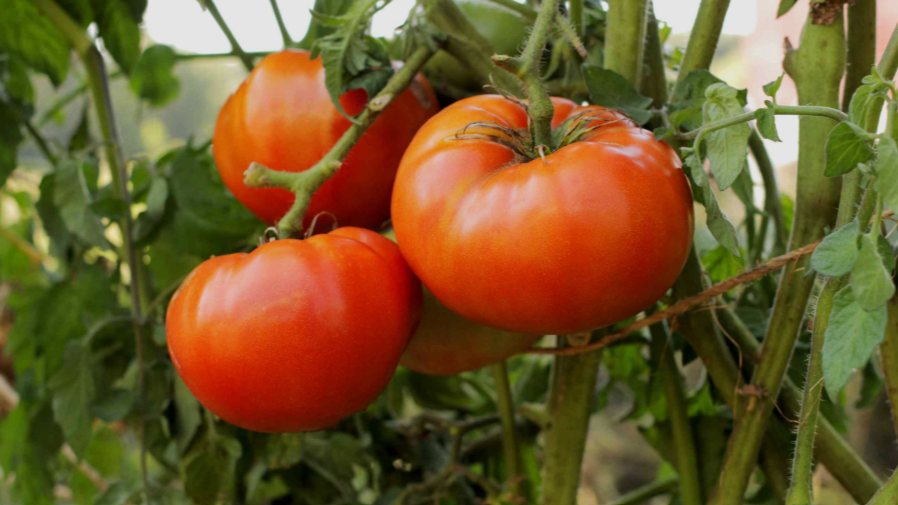
Big Boy produces large, smooth, globe-shaped red fruit. Burpee lists the fruit at 10 ounces with many reaching a pound, and a Rutgers variety list describes a mid-season hybrid with fruit of about a pound. The Arkansas extension describes sweet, fragrant, red, smooth-skinned fruit that can weigh a pound or more.
The plant is indeterminate but, according to the Arkansas extension, bush-like in habit and a strong grower. Reimer Seeds recommends cages 5 to 6 feet tall to keep branches from breaking under the weight of the fruit. North Carolina State’s extension leaflet puts indeterminate tomatoes at 5 to 8 feet, with a fruit cluster forming between every third leaf, so a tall support is the safe choice.
Days to Maturity
Burpee lists Big Boy at 78 days from transplant, and Home for the Harvest reports first fruit 75 to 80 days after seedlings go into the garden. Purdue Extension classifies early tomatoes as 55 to 65 days, midseason as 66 to 80 days, and late types as more than 80, which puts Big Boy firmly in the midseason group. That means plants need a full season of warm weather to deliver their best fruit.
That’s slower than many of its descendants. Better Boy runs about 72 to 75 days, according to Tomato Dirt, and Big Beef is listed at 73. Gardeners in short-season regions may want to start seeds early, use row covers, or pair Big Boy with a quicker variety so the first ripe tomatoes arrive sooner.
Disease Resistance
The Arkansas extension describes Big Boy as blessed with good disease resistance, which was a major selling point in 1949. Seed packets today list different resistance codes depending on the seller, so check the tag. Because the original hybrid is still sold, the exact package can differ between suppliers.
Newer hybrids have extended the package. Oklahoma State’s 2021 tomato variety suggestions list Better Boy and Big Beef with codes covering Fusarium wilt and Verticillium wilt, with Better Boy also coded for nematodes, and note that resistance to Fusarium wilt and nematodes is especially important in Oklahoma. Resistance codes cover only specific diseases, so even a resistant plant can still fall to blight, blossom-end rot, or other problems.
An Early Extension Endorsement
The University of Minnesota Extension was publishing guidance on Big Boy by the late 1950s. A folder titled Big Boy Hybrid Tomato, written by O.C. Turnquist and reprinted in May 1959, appears in the university’s archive. It shows how quickly the hybrid had become a topic for extension programs. Within a decade of its release, extension services were already writing about it for home gardeners.
That early attention helps explain why Big Boy became so entrenched. By the time newer hybrids arrived, it was already the standard by which they were measured. Better Boy’s own marketing as an improved version of Big Boy shows how much weight the older name carried.
Why Hybrids Matter
Purdue Extension explains what hybrids brought to the garden: modern hybrids bring disease resistance, cold tolerance, nematode resistance, and hybrid vigor, along with a dazzling range of colors, shapes, and sizes. Big Boy was the first to show gardeners what that vigor looked like in a backyard. Its plants grew bigger and produced more than the open-pollinated varieties around them.
That advantage is why hybrids dominate seed catalogs today, but it comes with a trade-off. Seeds saved from a hybrid won’t reproduce the parent, so gardeners who like Big Boy have to buy new seed each year. Heirloom varieties, by contrast, can be saved and shared, which is why many gardeners grow a mix of both.
Growing Big Boy
Big Boy wants full sun, rich soil, and consistent water. Plant transplants outdoors after the danger of frost has passed, and give them a strong stake or cage. Reimer Seeds suggests hardening off seedlings in a shady spot for several days before transplanting and picking fruit as it matures to encourage new fruit to form.
Heat affects fruit set in every tomato. The University of Maryland reports that pollination and fruit formation can be disrupted when daytime temperatures exceed 90 degrees Fahrenheit and nights stay above 70, and shade cloth blocking about 30 percent of sunlight can help. The University of Georgia notes that staking gives extra security against wind and heavy fruit, and Cornell describes pruning suckers as a season-long chore.
Common Problems
Large-fruited tomatoes are prone to a few physical disorders. Blossom-end rot, the sunken dark patch on the bottom of the fruit, comes from calcium not reaching the developing tomato. University of Wisconsin Extension says the best prevention is consistent, uniform watering, along with mulch 2 to 3 inches deep and moderate nitrogen.
Cracking is the other frequent complaint, and the same source says it’s associated with large variations in soil moisture. Water evenly and harvest fruit promptly once it reaches full color. Mississippi State’s extension service adds that some varieties are more prone to cat facing, so a bumpy blossom end isn’t necessarily a sign of poor care.
Big Boy vs. Better Boy and Big Beef
Better Boy and Big Beef are the two tomatoes most often compared with Big Boy. Better Boy, from Petoseed in 1964, lists fruit of 6 to 16 ounces in about 72 days according to the University of California Master Gardeners, and carries V, F, and N resistance. Big Beef won an All-America Selections award in 1994 and is listed at 73 days with fruit of 10 to 12 ounces.
Big Boy is the oldest and typically the slowest of the three. Its advantages are its long track record and its sweet, fragrant flavor, while the newer hybrids offer earlier ripening and broader disease resistance. Many gardeners plant Big Boy for nostalgia and tradition and a newer hybrid for reliability.
Harvesting, Using, and Saving Seed
Pick Big Boy when the fruit has developed full red color. The large, smooth fruit slices evenly for sandwiches and salads, and its sweet flavor is a big part of its appeal. Burpee notes that the variety’s rich flavor and aroma are what kept it a best seller over the years.
Because Big Boy is an F1 hybrid, seeds saved from your plants won’t produce identical fruit. Home for the Harvest notes that the seeds are still sometimes labeled as Burpee’s Big Boy, and the company continues to sell them. Buy fresh seed or transplants each year if you want the same performance.
The Bottom Line
Big Boy earned its place in tomato history by proving that a hybrid could outperform the heirlooms gardeners had relied on for generations. It’s large, sweet, vigorous, and midseason, and it still has a loyal following more than seven decades after its release. Give it sun, a tall cage, and steady water, and it will reward you with big, smooth slicers that explain why a 1949 hybrid is still on the shelf.