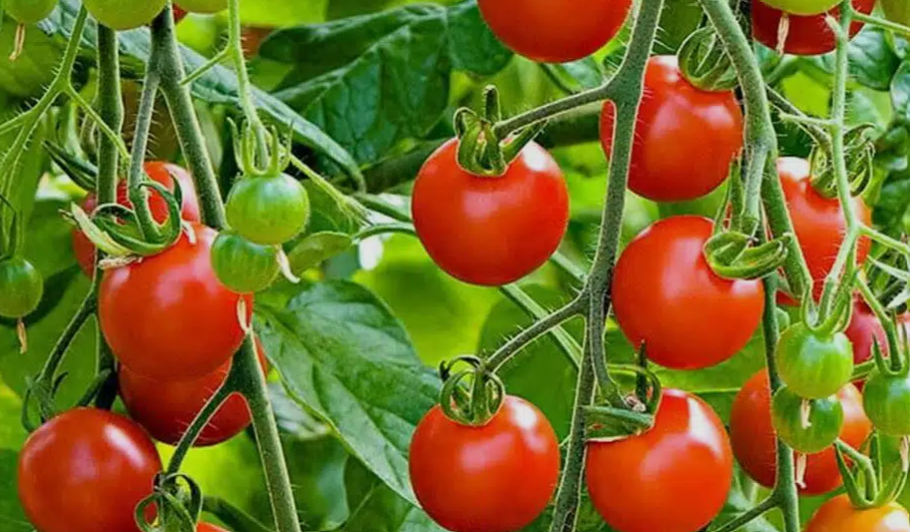
Sweet 100 Tomato: The Cherry Tomato That Changed Home Gardens
Sweet 100 is a red cherry tomato hybrid famous for long, heavy clusters of sweet, bite-size fruit that ripen from midsummer until frost. It’s one of the best-known cherry tomatoes ever sold, a staple of patio pots, children’s gardens, and backyard snacking for more than four decades. Its name promises a hundred tomatoes on a single plant, and while the exact count varies, the plant’s reputation for generous production is well earned.
The story of Sweet 100 is also a story about names. The original hybrid has largely been replaced in the marketplace by an improved cousin, and several open-pollinated look-alikes carry the same flavor and habit without the hybrid label. Knowing which one you’re actually planting makes a real difference in disease resistance, timing, and seed saving.
This guide covers Sweet 100’s history and breeding, how it relates to Super Sweet 100 and other relatives, and how to identify the plant. It then looks at sweetness data from a university trial, disease resistance, and the cracking problem. It closes with practical advice on growing, supporting, and harvesting it.
Origin and History
Sweet 100 was developed by the Northrup-King Seed Company of Minnesota and introduced in 1978. Gardening writers say it shook up the tomato scene with abundant yields and an extra sweet flavor, and Specialty Produce credits it with revolutionizing the cherry tomato world. Hybrid parentage is closely guarded in the seed trade, but there’s strong speculation that the heirloom Gardener’s Delight was among its parents.
The same company introduced an improved version, Super Sweet 100, in 1982, bred for stronger disease resistance. Two open-pollinated versions followed. Peacevine was developed in the 1980s by the breeder Alan Kapuler, and Rideau Sweet was stabilized from a Sweet 100 hybrid by Ken Allan of Kingston, Ontario, in the early 1990s. Those two let gardeners save seed from a plant that tastes much like the original hybrid.
Sweet 100 vs. Super Sweet 100
The two names are often used interchangeably, but they’re different cultivars. Tomato Dirt reports that Super Sweet 100 was bred by Northrup-King for even stronger disease resistance than its older relative, and that it largely replaces the original in the home garden marketplace. Gardener’s Path goes further, saying that even plants marketed as Sweet 100 today are more likely to be the newer hybrid.
University of Florida Extension describes Super Sweet 100 as a hybrid closely related to Sweet 100 and an indeterminate plant that produces sweet tomatoes well through the summer. The same publication says this improved variety is resistant to verticillium wilt, fusarium wilt, and nematodes. Texas A&M AgriLife calls Super Sweet 100 productive and sweet, with verticillium and fusarium resistance, and notes that it was a past rodeo tomato winner.
Identifying Characteristics
Sweet 100 produces bright red, round, cherry-sized fruit in long, grape-like trusses. Ohio State’s extension service describes fruit about half an inch across, while Gardener’s Path lists the fruit of Super Sweet 100 at about an inch. The flesh is juicy and very sweet, which is the trait that built the variety’s reputation.
Cluster counts depend on who’s counting. Specialty Produce reports up to 50 fruits per cluster, Tomato Dirt says long clusters can produce up to a hundred tomatoes on a single stalk, and a University of California list describes long clusters from maturity right up to the first frost. The plant is indeterminate, a vigorous vine that keeps growing, flowering, and ripening fruit all season, and it is not a dwarf. Gardener’s Path stresses that the fruits are petite but the vines aren’t, and that vines can topple or break under the weight of heavy clusters if they’re not trellised.
How Sweet Is It?
University data gives a useful sense of where Sweet 100 stands. In a 2003 grape and cherry tomato trial at Rutgers University’s Snyder Research and Extension Farm in New Jersey, Rutgers researchers measured Sweet 100 at 8.7 Brix, in the top statistical group of the varieties listed in the sugar table. Sun Cherry measured 8.5, Sweet Million 8.1, and one numbered selection only 6.8.
Taste testers were less uniform in their praise. The Rutgers table described Sweet 100 as sweet with a strange aftertaste, while Sweet Million was described as sweet with balance. That’s a reminder that Brix measures sugar, not flavor, and that individual tasters differ. Still, the numbers confirm that Sweet 100’s sweetness is real, in the same range as Sun Gold’s 8 to 10 Brix in a University of California trial.
Days to Maturity
Sweet 100 is an early to midseason tomato. The University of California Master Gardeners list it at 55 to 65 days, Tomato Dirt says 68 to 70 days, and University of Florida lists Super Sweet 100 at 65 days. Gardener’s Path puts Super Sweet 100 at 60 to 65 days.
Colorado State University Extension sorts varieties as early at under 69 days and midseason at 70 to 80 days, so Sweet 100 falls in the early range for most sources. That quick timeline makes it a good choice for short-season gardens and for filling gaps before slicers ripen. Because it keeps producing, it also rewards a long season.
Disease Resistance
Sweet 100 carries resistance to Verticillium and Fusarium wilts, shown by the VF code in seed catalogs. Tomato Dirt lists its resistance as VF, while Super Sweet 100 adds nematode resistance, shown as VFN. Disease resistance varies somewhat among seed sources, so check the codes on your packet or plant tag. Gardenia.net notes that Super Sweet 100 has documented resistance to Verticillium wilt and Fusarium wilt race 1, while some sellers advertise additional Fusarium races or nematode resistance.
Resistance codes aren’t a guarantee against every problem, since each code covers only specific diseases. Cherry tomatoes grown in warm, wet weather can still struggle with other issues. Florida’s extension service notes that the state’s warm, humid weather can contribute to insect and disease problems in all tomatoes, including cherry types.
The Cracking Problem
Cracking is the most common complaint about Sweet 100. Tomato Dirt says it’s the most common drawback, especially after heavy rain, as with most cherry tomatoes. University of Wisconsin Extension explains that fruit cracking is associated with large variations in soil moisture.
The fix is steady moisture. University of Wisconsin Extension recommends watering regularly and mulching with 2 to 3 inches of material around the plants. Sweet Million is often described as an improvement, with Stokes Seeds listing it as less likely to crack, though that claim comes from a seed company. Picking fruit promptly once it turns red also reduces losses.
Growing Sweet 100
Sweet 100 wants full sun and fertile, well-drained soil, and University of Florida notes that cherry tomatoes have the same growing requirements as larger tomatoes. Start seeds indoors and transplant after danger of frost has passed. Because it’s indeterminate, North Carolina State’s extension leaflet says plants of this type grow 5 to 8 feet tall, with a fruit cluster forming between every third leaf, so plan for a sturdy trellis, tall cage, or stake.
Heat can interfere with fruit set. The University of Maryland notes that pollination and fruit formation can be disrupted when daytime temperatures exceed 90 degrees Fahrenheit and nights stay above 70, and it suggests shade cloth blocking about 30 percent of sunlight. University of Florida includes Sweet 100 and Sweet Million among varieties suited to patio growing. In containers, Mississippi State’s extension service recommends a pot at least a foot deep with drainage holes.
Using the Harvest
Specialty Produce notes that Sweet 100 tomatoes hold their shape in salads, pasta, and casseroles, and that they’re sweet, sturdy, and resilient. Tomato Dirt describes them as high in vitamin C. Most gardeners eat them fresh straight from the vine, which is where the sweetness shows best.
Because production is heavy, the harvest can overwhelm a household. Cherry tomatoes can be roasted, tossed into pasta, or halved for salads, and a few plants usually supply far more fruit than a family can snack on. Planting one or two vines rather than a whole row may be enough for a typical household.
Buying Seeds and Plants
Check the exact name on the label. Because Sweet 100 and Super Sweet 100 are different cultivars with different resistance codes, comparing the names and codes is better than assuming they match. Gardenia.net advises comparing the exact cultivar name and resistance codes rather than transferring traits between the two.
Hybrid seed won’t come true if you save it, so buy new seed or plants each year. If you want seed you can save, look for Peacevine or Rideau Sweet, the open-pollinated versions. Local extension plant lists are a good guide to which cherry tomatoes perform best in your region.
Pruning, Support, and Harvest
Pruning an indeterminate cherry vine is a season-long chore. Cornell’s research describes removing suckers to keep the plant manageable, and Arizona’s extension service notes that unchecked growth shades the fruit and reduces air circulation. Tomato Dirt suggests caging or staking Sweet 100 to prevent sprawling and to let light into interior clusters.
Harvest often. Gardener’s Path advises picking all ripe fruit every day or two throughout the season as soon as it starts turning red on the vine. Frequent picking keeps the plant producing and prevents overripe fruit from splitting. Because the fruit comes in clusters, a quick sweep of the vine every day or two is usually enough.
Related Cherry Tomatoes
Several other cherry tomatoes compete with Sweet 100. Sweet Million is described as an improved version with cracking tolerance and disease resistance, and Stokes Seeds lists its fruit at about an inch and 10 to 15 grams, ready in 60 days. Sungold is an orange cherry in the same sweetness range, and Gardener’s Delight is the old heirloom often suspected of being a Sweet 100 parent.
Peacevine and Rideau Sweet are the two open-pollinated alternatives. They’re a good choice for gardeners who want to save seed, since a hybrid like Sweet 100 won’t produce identical plants from saved seed. If you’re comparing cherry tomatoes, think about what matters most: sweetness, crack resistance, disease resistance, or seed saving.
The Bottom Line
Sweet 100 earned its fame with long clusters of sweet red fruit, early ripening, and easy growth. Today the plant on your tag is most likely the improved Super Sweet 100, with extra disease resistance, while open-pollinated cousins like Peacevine and Rideau Sweet let you save seed. Give it sun, a tall trellis, steady water, and frequent picking, and it will fill a bowl all summer.