San Marzano Tomato: The Sauce Tomato Everyone Tries to Imitate
San Marzano is the most famous sauce tomato in the world, an elongated, thin-skinned plum tomato prized for sweet, meaty flesh, low acidity, and few seeds. Chefs build pizza sauce around it, home cooks pay a premium for the canned version, and gardeners plant it hoping to capture a bit of that flavor. Yet the name means three different things depending on whether you’re talking about a variety, a protected Italian product, or a label on a can.
That confusion is the heart of the San Marzano story. The variety can be grown anywhere, but the protected designation applies only to peeled tomatoes grown and canned in one corner of southern Italy. Understanding the difference helps you shop smarter, grow it better, and avoid the myths that surround it.
This guide covers where San Marzano really came from and what its protected status does and doesn’t cover. It then shows how to identify the fruit and how the variety behaves in a home garden. It closes with its biggest growing problem, blossom-end rot, and practical advice on using and sourcing it.
Origin and the Peruvian Legend
The popular story says the first San Marzano seeds were a gift from the Viceroy of Peru to the King of Naples in 1770, planted in the volcanic soil near the town of San Marzano sul Sarno. It’s a charming tale, and it’s repeated on countless can labels and restaurant menus. It’s also widely doubted, since Tomato Dirt points out that Peru had no king in the 1770s and that the earliest Peruvian tomatoes were small and green rather than plump and red.
The documented history is more modest. European Union records describe San Marzano as a tomato that arose in the Agro Sarnese-Nocerino area of Campania through mutation or hybridization of local types, producing the elongated fruit once called Lunga. By the early 20th century it had become important for the Italian canning industry, and Tomato Dirt notes that its seed appeared in German, French, and Italian catalogs in the 1920s and 1930s. Author and gardener Amy Goldman has called it the most important industrial tomato of the twentieth century.
What the Protected Designation Covers
In 1996, the European Union granted the tomato Protected Designation of Origin status, known in Italian as DOP. The designation is far narrower than most shoppers assume. It applies to peeled tomatoes made from the San Marzano ecotype or improved lines, grown and processed in an area of 41 municipalities in the provinces of Salerno, Naples, and Avellino.
The rules also govern the fruit itself. The specification calls for elongated fruit 60 to 80 millimeters long, harvested by hand at full maturity in several passes. Italian press accounts add that the approved lines include San Marzano 2 and KIROS. Food Republic reports that the tomatoes are sold only in cans, whole or halved, and that the designation doesn’t protect fresh fruit or the plant variety.
An important detail follows from that. A European Commission statement quoted by Italian food media notes that the San Marzano variety can be grown outside the delimited area, so it isn’t an exclusive property of the Italian producers. In other words, you can legally plant San Marzano seeds in your backyard, but only canned tomatoes from the designated area can carry the DOP name.
Why the Soil Gets the Credit
Producers and food writers attribute San Marzano’s sweet flesh and low acidity to the rich volcanic soil of the Sarno River valley near Mount Vesuvius. Atlas Obscura describes the soil as high in potassium and phosphorus. The fruit is also described as meatier than Roma and other plums, with fewer seeds, which makes it easier to turn into smooth sauce.
Not everyone is convinced that the certification matters as much as the marketing suggests. The Philadelphia Inquirer reported that some Washington, D.C. pizza restaurants skip DOP San Marzanos, relying instead on a Campania plum tomato grown outside the official area, partly because of consistency and partly because of cost. Food Republic says plainly that while you can grow the variety at home, the tomatoes won’t taste the same as the real thing grown in the Sarno valley.
Identifying San Marzano
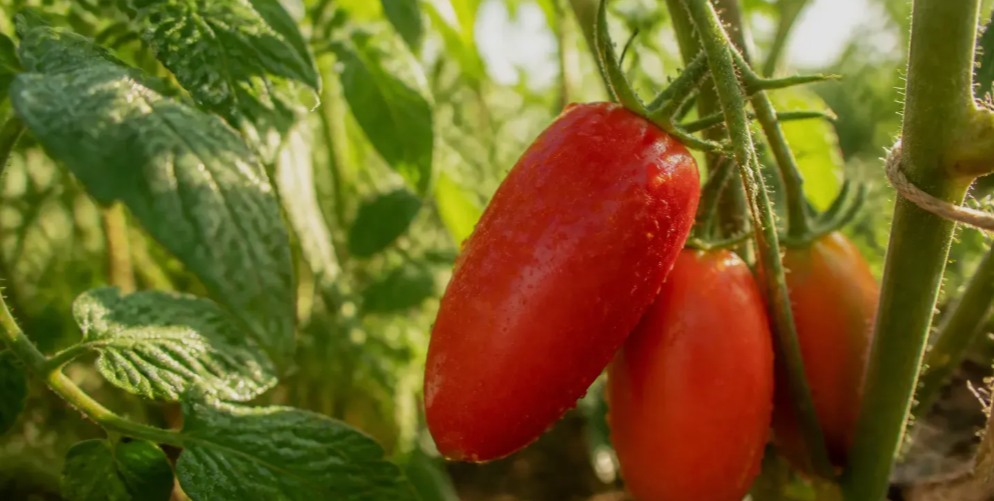
San Marzano fruit is oblong and cylindrical, about an inch wide, with a length of 2 to 5 inches depending on the strain. The skin is thin, the color is bright red, and the flavor is described as sweet, mild, and low in acidity. Tomato Dirt lists several strains, including Redorta and an oversized version called Super San Marzano, so fruit size varies from seed company to seed company.
Seed sellers describe different weights. Johnson’s Garden Center lists fruit of about 4 ounces, and Gardenia.net notes that fruit size varies among strains. The elongated shape, thin skin, meaty flesh, and low seed count are what set it apart from rounder tomatoes, and a side-by-side comparison with Roma is the easiest way to see the difference.
Days to Maturity and Growth Habit
Timing varies by source. Colorado State University Extension lists San Marzano as open pollinated at 80 days, Johnson’s Garden Center gives 70 to 80 days, and the University of Delaware Botanic Gardens lists 85 to 90 days. That spread places it in the midseason to late range, with a long, warm season being the safest bet.
Classification is also inconsistent. Most sources treat the traditional variety as indeterminate, a vining plant that keeps producing, but some seed sellers offer determinate strains and a few lists call it semi-determinate. North Carolina State’s extension leaflet says indeterminate tomatoes grow 5 to 8 feet tall while determinate plants stay at 1 to 5 feet, so checking your packet before you choose a stake or cage saves trouble.
Growing San Marzano at Home
San Marzano wants full sun, rich soil, and a long season. Start seeds indoors and transplant after the last frost, and give vining strains a sturdy trellis or tall cage. The University of Maryland reports that pollination and fruit formation can be disrupted when daytime temperatures exceed 90 degrees Fahrenheit and nights stay above 70, so shade cloth that blocks about 30 percent of sunlight can help in hot summers.
Because paste tomatoes tend to ripen a lot of fruit at once, many gardeners plan their planting around a canning day. Holmes Seed notes that paste types are often determinate because a concentrated harvest suits sauce making. A vining San Marzano trades that burst for a steadier harvest, so you can pick, cook, and freeze in smaller batches through late summer.
The Blossom-End Rot Problem
The biggest challenge in growing San Marzano is blossom-end rot, the dark, sunken patch on the bottom of the fruit. The University of California Cooperative Extension says elongated, paste-type tomatoes are very susceptible, along with fast-growing cultivars with lots of foliage. A Brazilian research study comparing four long-fruited varieties found that San Marzano, the most elongated of them, had a higher incidence of blossom-end rot and lower calcium in the tip of the fruit than Roma.
Blossom-end rot isn’t a disease, and it doesn’t spread. It results from the fruit not receiving enough calcium while it grows, usually because of uneven watering. University of Wisconsin Extension recommends consistent, uniform watering, mulch to retain soil moisture, and avoiding large doses of nitrogen fertilizer. The University of Nebraska-Lincoln adds that even a temporary water stress during early fruit enlargement can trigger it, and that calcium sprays on the fruit won’t help.
San Marzano vs. Roma
Roma is the tomato most often compared with San Marzano, and the two have clear differences. Food Republic says San Marzano is meatier than Roma and other plums and has fewer seeds, while Colorado State lists Roma at 75 days with 2-ounce fruit against San Marzano’s 80 days. Roma is generally grown as a determinate bush, whereas traditional San Marzano is a vine.
Blossom-end rot sorts the two as well. The Brazilian study found that Roma and Mini-Roma, with less elongated fruit, were less susceptible than San Marzano and had better calcium movement into the tip of the fruit. That doesn’t make Roma immune, since University of California Extension rates Roma cultivars among the most susceptible, but it does suggest that the longer the fruit, the harder the plant has to work to deliver calcium to the end.
Strains and Seed Types
Gardeners can choose among several strains. Tomato Dirt lists the standard San Marzano, Redorta, and an oversized version called Super San Marzano, and some seed companies sell determinate selections at about 80 days. The standard open-pollinated types let you save seed, since they aren’t hybrids.
Since strain choice affects fruit length, plant size, and timing, read the description before buying. Look for days to maturity that fit your season, a growth habit that fits your support system, and fruit size that suits your cooking. Italian specifications name San Marzano 2 and KIROS among the approved lines, and seed catalogs may or may not list those names, so ask the seller what a given strain actually is.
Cooking and Preserving
San Marzano earned its reputation as a cooking tomato, and it’s still best for sauce, paste, and canning. The dense flesh and low seed count mean less water to cook off and less straining. Many cooks peel and can the fruit whole, mimicking the Italian product that made the variety famous.
Tomato Dirt notes that San Marzano has earned a reputation as a tomato of choice for sauce, paste, and drying. Sauce made from homegrown tomatoes will taste different from imported DOP cans, but it will taste fresh and reflect your own soil. Drying is another way to preserve a large harvest.
Buying Seeds and Cans
Not every packet labeled San Marzano is the same, because several strains and selections are in cultivation. Gardenia.net notes that San Marzano is an open-pollinated plum or paste tomato with multiple strains, so seed saving is possible, unlike with hybrids. Buying from a reputable seed company and reading the description for size, days to maturity, and growth habit helps you pick the version that fits your garden.
When shopping for canned tomatoes, look for the full name Pomodoro San Marzano dell’Agro Sarnese-Nocerino DOP, the DOP seal, a clear indication of the growing area, and the name of the producer or consortium. Tomatoes labeled San Marzano style may be the same variety grown elsewhere, which can still make good sauce. The Inquirer notes that DOP San Marzanos aren’t cheap, which reflects the narrow growing area and strict production rules.
The Bottom Line
San Marzano is both a real variety and a carefully protected brand. Its legend is partly myth, its protected status covers only canned tomatoes from a defined area, and the variety itself can be grown by anyone with sun, water, and patience. Water evenly to prevent blossom-end rot, choose the strain that suits your growing season, and you’ll get a sweet, meaty sauce tomato worth the trouble.