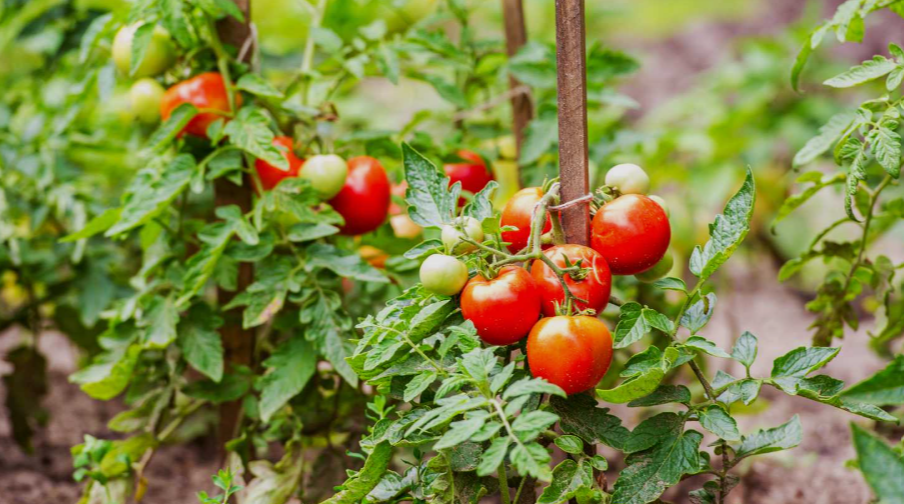
Determinate tomatoes are the compact, bush-type plants that grow to a set size, set fruit on the ends of their shoots, and ripen most of the crop in a short stretch. They’re also called bush tomatoes, and they’re the reason a gardener with a patio, a small bed, or a canning project can grow tomatoes without wrestling a 6-foot vine. Knowing which varieties belong in this group makes it much easier to match a plant to a space, a climate, and a schedule.
The numbers define the type. University of California Master Gardeners of San Luis Obispo County put determinate plants at 3 to 5 feet tall, while North Carolina State’s extension leaflet gives a wider range of 1 to 5 feet. Most of the crop ripens within 1 to 3 weeks, and days to maturity across all tomatoes run from under 50 to more than 90, so a determinate variety with 45 to 60 days can be harvested before a 90-day variety has ripened its first fruit. Colorado State University Extension sorts varieties as early at under 69 days, midseason at 70 to 80 days, and late beyond 81 days, counted from transplanting.
Determinate plants also need less work than their vining cousins. Arizona’s extension service notes that they generally require minimal staking and little pruning, and North Carolina State recommends pruning them only once, when suckers are 2 to 4 inches long, because later pruning reduces size. The trade-off is a lower total yield per plant and a plant that declines soon after its main harvest. Many gardeners deal with that by staggering plantings or mixing determinate and indeterminate types.
Classification isn’t always clean, and sources sometimes disagree. Rutgers is listed as determinate by several sources, yet some seed sellers describe their strains as semi-determinate or even indeterminate, and Celebrity is called determinate by some lists and semi-determinate by others, so it’s left out here.
What follows covers 40 determinate tomatoes, grouped into paste and processing types, classics, heat-tolerant performers, slicers, early and cool-climate varieties, and container selections, with days to maturity and fruit sizes taken from extension publications and seed catalogs.
Paste and Processing Tomatoes
Roma VF
Roma VF is the best-known paste tomato and a determinate type, listed by Colorado State as an open-pollinated variety that matures in 75 days with 2-ounce red fruits. Seed catalogs give slightly different timing, with one listing it at 78 days and a related strain at 75 days. The USDA’s plant germplasm system describes its fruits as medium in size with an elliptic shape.
Holmes Seed notes that Roma and other paste types fall into the determinate group because a concentrated harvest is ideal for sauce. A single planting can deliver enough ripe fruit at once to fill a canning pot, rather than a trickle over the summer. Even so, the USDA’s own record calls Roma VF semi-determinate in one place and determinate in another, a reminder of how loosely these categories are applied.
La Roma IV
La Roma IV is a hybrid Roma-type tomato that matures in about 76 days. Seed catalogs describe it as a high-yielding plant producing bright red fruits of 5 to 8 ounces, which is far larger than the 2-ounce fruit of the classic Roma. It’s classed as a determinate plant, so most of the crop arrives over a short period.
The larger fruit gives it more flesh per tomato, which reduces the number of tomatoes needed to fill a pot of sauce. At 76 days it falls in Colorado State’s midseason range of 70 to 80 days. A sturdy cage helps the plant carry the heavier fruit load without bending.
Paisano
Paisano is an F1 hybrid bush Roma that matures in about 68 days, which puts it in the early category under Colorado State’s 69-day cutoff. Seed catalogs often describe it as a high-yielding bush San Marzano. It’s classed as determinate and is rated as one of the best Roma types for puree, paste, sauce, and canning.
The early timing is the practical advantage, since classic paste tomatoes usually take 75 days or more. Gardeners in cooler regions can fill a canning shelf without waiting until late summer. Its bush habit also keeps the plant manageable in a small garden.
Also Read: Difference Determinate and Indeterminate Tomatoes
Napoli
Napoli is a determinate paste-type tomato listed at 79 days to maturity, placing it at the late end of the midseason range. Gardening references describe it as suitable for sauces and soups, with a tangy flavor. Its determinate habit means the harvest arrives in a concentrated burst.
That tangy flavor makes it a good candidate for cooked dishes, where acidity balances richness. Because it matures later than Paisano, it suits regions with a long, warm season. It also fits the standard advice that determinate paste types work best when you want a large batch at one time.
Principe Borghese
Principe Borghese is an Italian heirloom famous for sun drying, with very small plum-shaped fruits of about 1 to 2 ounces, pointed at one end. Colorado State lists it as an open-pollinated determinate variety at 75 days, while other seed sellers give 62 to 78 days and about 3 feet of height. The fruits grow in large clusters of several dozen, like grapes, and they’re meaty with little juice.
The fruit doesn’t naturally drop from the stem, so branches can be hung to dry until the fruit becomes leathery. In Italy, the vines are traditionally thrown over a fence to dry in the sun. A University of California publication notes that although it’s determinate, it needs some staking to support the heavy clusters, and classifications vary, with a few sellers calling it semi-determinate.
Heinz 1350
Heinz 1350 is a determinate processing tomato developed by the H. J. Heinz Company in 1963, primarily for Eastern Canada and the Northeast. Southern Exposure Seed Exchange describes round 4 to 6 ounce fruits that ripen uniformly and resist cracking, while another catalog lists 6-ounce fruits at 70 days. Seed companies cite 70 to 75 days to maturity.
It’s a leading variety for canning and sauces, though it works for fresh eating too. The plants carry heavy fruit, and growers recommend cages 5 to 6 feet tall to keep the branches from breaking. Picking as fruit matures encourages new fruit to form, which stretches the harvest a little.
Heinz 1439
Heinz 1439 is a determinate hybrid developed by Heinz for making ketchup, puree, and sauces. Seed catalogs list it at 70 to 75 days and describe bright red, crack-resistant fruit of about 6 ounces. It carries disease resistance listed with the codes V, F, and A.
Its crack resistance helps in seasons with uneven rainfall. Like other determinate processing types, it ripens its crop over a short window. That makes it practical for gardeners who want enough tomatoes at once to fill a single canning day.
Heinz 2274
Heinz 2274 is a determinate tomato listed at 77 days to maturity. Seed catalogs state it was specially developed by Heinz for making ketchup, puree, and sauces. At 77 days it falls in the midseason range of 70 to 80 days.
It’s one of several numbered Heinz selections, each bred for processing rather than fresh slicing. Seed catalogs describe all of the Heinz selections in this list as determinate, which fits their use for single large batches. Heavy fruit sets mean cages or sturdy stakes are a good idea.
Heinz 2653
Heinz 2653 is a determinate tomato listed at 68 days, which makes it an early variety by Colorado State’s definition. Seed catalogs note it was developed by the Heinz Research Department. It belongs to the same family of processing tomatoes as Heinz 1350 and Heinz 1439.
The earlier timing is its main distinction among the Heinz selections, since most others mature at 70 to 77 days. A short season also helps in northern gardens where late summer frost arrives early. Like its relatives, it concentrates its crop into a short harvest.
Campbell 33
Campbell 33 is a determinate tomato that matures in about 69 days and is described as perfect for making homemade tomato soup. Gardening references note that its deep red fruits suit salads and sandwiches as well. The name points to the Campbell Soup Company, whose JTD variety was a parent of Rutgers.
That connection runs through American tomato history, since Campbell’s stored seed of JTD and Marglobe later allowed Rutgers scientists to recreate the original Rutgers cross. At 69 days, it sits right at the edge of Colorado State’s early category. Its concentrated harvest suits a single batch of soup.
Classic and Heirloom Determinates
Rutgers
Rutgers was introduced in 1934 by Lyman Schermerhorn, a plant scientist at Rutgers University, as a cross between the sweet Marglobe and the tart JTD. It became the basis for Campbell’s tomato soup and Heinz’s ketchup, and the press nicknamed it the super tomato. Seed sellers list it at about 75 days with 6 to 8 ounce red fruits.
In the 1960s a deadly new tomato disease, along with industry demand for tougher fruit that machines could harvest and ship long distances, ended its run as a commercial tomato. Rutgers revived it in spring 2016 as Rutgers 250, timed to the university’s 250th anniversary. Classifications vary, since some seed sellers describe their strains as semi-determinate or indeterminate, while other lists call it determinate.
Marglobe
Marglobe is a determinate tomato with juicy flesh and orange-red skin, suited to canning. It matures in about 72 days and carries Fusarium wilt resistance. Rutgers describes it as a leading variety developed at the USDA.
It’s best known as a parent of Rutgers, and the Smithsonian describes it as the sweet side of that cross. That lineage makes it one of the most influential tomatoes in American history. Its 72-day maturity places it in the midseason range.
Floradade
Floradade is a determinate slicing tomato that matures in about 77 days. It was developed in 1976 by the University of Florida at Homestead in Dade County. Seed catalogs describe it as especially well suited to hot, humid climates like Florida and the southern United States.
It’s also listed as heat tolerant, which helps with fruit set when summer nights stay warm. The University of Maryland notes that pollination can be disrupted when daytime temperatures exceed 90 degrees Fahrenheit and nights exceed 70 degrees. A variety bred for Florida heat is a natural choice for those conditions.
Homestead 24
Homestead 24 is an old favorite dating from 1954, developed by the University of Florida especially for hot climates. It matures in about 80 to 83 days and is known for reliably setting fruit at high temperatures. Growers describe the fruit as firm and meaty, with resistance to Fusarium wilt.
Its large vines help shade the fruit to protect it from sunburn, and they need staking or caging. A reliable salad slicer, it has stayed in seed catalogs for decades since its 1954 introduction. The University of California Master Gardeners of San Luis Obispo County list it as a suggested variety for inland areas.
Heat-Tolerant Determinates
Solar Fire
Solar Fire is an early, determinate, jointed hybrid developed by the University of Florida, maturing in about 72 days. Fruits are medium to large, just above 6 ounces, and the plant resists Fusarium wilt races 1, 2, and 3, Verticillium wilt race 1, and gray leaf spot. University of Florida professor Jay Scott called it the best bet yet for a tomato that can set fruit at warm temperatures.
Most tomatoes that set fruit in heat have small fruit, but this one doesn’t, and it can be planted earlier in the fall growing season than other varieties. In Texas, that means planting in July and still getting reliable fruit through the unexpected heat of September and October. Iowa State University also lists it among its recommended determinate varieties.
Florida 91
Florida 91 is a determinate hybrid that matures in about 72 days, with red fruits of 9 to 11 ounces. In a taste test by University of Maryland Extension staff, it was rated the most flavorful among 4 heat-tolerant varieties. It was developed by the University of Florida and is listed with resistance to several diseases.
Iowa State University lists it among its recommended determinate varieties for field and high tunnel production, and its vegetable specialist Hank Taber includes it among the varieties he recommends. The plants had strong determinate vines and produced fruit from late July to early October in Maryland. Not every gardener there was impressed, so results depend on the site.
Florida 47
Florida 47 is a late midseason, determinate, jointed hybrid, according to the University of Florida’s tomato production guide. Its disease resistance includes Fusarium wilt races 1 and 2, Verticillium wilt race 1, and Alternaria stem canker. Gardening references describe dark red fruit of up to 10 ounces on small plants.
Iowa State lists the Florida 47R strain among its recommended determinate varieties for field and high tunnel production. The pairing of compact plants and large fruit makes it practical where space is tight. A stake or cage keeps heavy fruit off the ground.
Heatmaster
Heatmaster is a determinate hybrid from the University of Florida, listed at 75 days with red fruits of 7 to 8 ounces. A Texas A&M heat stress study of 43 varieties, both greenhouse and field, found it among the top producers along with Celebrity. University of Maryland trial plants averaged 9.4 ounces per fruit in a midseason harvest.
Experiences varied among University of Maryland staff. One grower rated the flavor close to the top-ranked Florida 91, while another found the fruit tennis-ball sized, hard, and slow to color. Several noted that the plants kept producing in the summer heat without disease or insect problems.
Phoenix
Phoenix is a determinate hybrid that matures in about 72 days with 8-ounce red fruits. In University of Maryland trials, plants produced fruit from late July to early October, and midseason fruit averaged 12.0 ounces. It was one of 4 heat-tolerant varieties compared by Home and Garden Information Center staff.
Staff rated its flavor as bland with a slightly mealy texture. One grower reported it was among the first to show leaf spot symptoms and was less productive than other varieties. It illustrates that heat tolerance doesn’t always come with the best taste.
Jamestown
Jamestown is a determinate hybrid from the University of Florida that matures in about 80 days with fruit of 9 to 10 ounces. It’s purported to have a deep red crimson gene and high lycopene content. In a University of Maryland trial, midseason fruit averaged 13.5 ounces.
Staff rated its flavor as bland with a slightly mealy texture, similar to Phoenix. Its 80-day maturity places it at the top of Colorado State’s midseason range. That longer timeline means it needs a longer warm season than most other heat-tolerant types.
Thunderbird
Thunderbird is a determinate tomato that performed significantly better than the standard varieties in 2022 University of Maryland Extension trials in Southern Maryland. Researchers there were testing 13 varieties on farms and at a research center in response to summer slump, when heat stress reduces pollination and fruit set. Texas A&M’s recommended list describes it as a local commercial tomato.
An indeterminate variety called Carole also beat the standards in the same trials. The results show how regional trials can identify varieties not widely sold in garden centers. Gardeners curious about Thunderbird can ask local extension offices for current trial results.
Heatwave II
Heatwave II is a determinate F1 hybrid that matures in about 68 days and is described as heat tolerant. It falls in Colorado State’s early category, under 69 days. That combination of speed and heat tolerance suits regions with hot summers and short growing windows.
The University of Maryland explains why heat tolerance matters: pollination and fruit formation can be disrupted when daytime temperatures exceed 90 degrees Fahrenheit and nights exceed 70 degrees. Shade cloth that blocks about 30 percent of sunlight is another option. A heat-tolerant variety adds a second layer of protection.
Slicers and Beefsteaks
Bella Rosa
Bella Rosa is a determinate hybrid that matures in about 75 days. In one Louisiana trial of virus-resistant tomatoes, it ranked near the top for productivity, large fruit size, and flavor. The University of California Master Gardeners of San Luis Obispo County suggest it for several inland areas.
Its disease resistance listing includes Verticillium wilt, Fusarium wilt, nematodes, and Tomato Spotted Wilt Virus. That makes it a strong choice in gardens with known disease problems. Fruit is large enough for slicing and sandwiches.
Ace 55 VF
Ace 55 VF is a determinate tomato that matures in about 80 days, at the top of the midseason range. Seed catalogs describe bright red fruit with a good tart tomato flavor complemented by sweetness. Other descriptions emphasize its abundant crops.
It carries resistance to Verticillium and Fusarium wilt, as the VF in its name indicates. Descriptions of its acidity differ, with some calling it low in acid and others calling it tart, so flavor impressions vary. Its heavy, concentrated crop suits a gardener who wants a large harvest at one time.
BHN 589
BHN 589 is a determinate hybrid that matures in about 75 days. Seed catalogs describe large to extra-large attractive fruit with real tomato taste, appealing to home gardeners and farmers market growers alike. It carries disease resistance listed with the codes V, F, F, and T.
Rutgers Cooperative Extension’s Peter Nitzsche is credited with recommending it among varieties for Iowa growers. Fruit this large puts weight on the branches, so sturdy cages or stakes are worth installing. It’s a good example of a market-garden variety that works equally well in a backyard.
Charger
Charger is a determinate hybrid that matures in about 72 days, with disease resistance listed with several codes including V and F. At 72 days it falls in the midseason range. Seed catalogs list it among mid-season determinate hybrids.
Its relatively quick timeline helps in regions with shorter summers. Like other determinate slicers, it ripens most of its fruit over a few weeks. Gardeners who want a steady supply can pair it with an indeterminate plant.
Bush Beefsteak
Bush Beefsteak is a determinate red tomato popular in shorter-season regions, with plants reaching up to 3 feet. Texas A&M AgriLife lists it at 62 days to maturity, producing small to medium fruit. Gardening references list the same 62 days.
It offers a beefsteak look on a compact bush plant. That makes it a practical option for gardeners who want slicing tomatoes without a tall trellis. At 62 days it’s well inside the early range.
Early and Cool-Climate Varieties
Sub-Arctic Plenty
Sub-Arctic Plenty is a determinate tomato developed by Dr. Harris at the Beaverlodge Research Station in Alberta, Canada, and listed in the USDA collection. It matures in about 42 to 45 days, which makes it one of the world’s earliest tomatoes. Garden Betty notes it’s sometimes marketed as Chilly Willie.
The USDA’s records describe it as a cross of Fireball and another selection, with fruit ripening 45 to 55 days from flowering and yields up to 4.1 kilograms per plant. Polish seed sellers describe medium fruit weighing 30 to 60 grams. Cage support and no pruning are the standard recommendations.
Beaverlodge Slicer
Beaverlodge Slicer is a determinate tomato bred at the Beaverlodge Research Centre in Alberta, Canada. Territorial Seed lists it at 55 days, and Garden Betty lists 54 days. Plants are extremely compact and tend to creep rather than grow tall.
The compact habit makes it suitable for hanging baskets and patio containers. Reviews are mixed, with one gardener calling it a favorite and another saying it tasted like a grocery store tomato and suffered disease early. It’s best seen as a very early tomato for cold-summer regions.
Sophie’s Choice
Sophie’s Choice is an heirloom determinate tomato from Edmonton, Canada, listed at about 54 days to maturity. Gardening references describe it as suitable for cooler areas. Its Canadian origin and early timing make it a natural fit for northern gardens.
At 54 days it’s far below Colorado State’s 69-day early cutoff. That speed matters in northern regions where frost can arrive in September. It’s a good companion to a main-season tomato for an early harvest.
Manitoba
Manitoba is a determinate tomato developed by the Experimental Farm in Morden, Manitoba, Canada, with a USDA plant introduction number. It matures in about 58 days. Seed catalogs describe it as suitable for southern Canada and for northern states including Montana, the Dakotas, Minnesota, Wisconsin, Michigan, and New England.
Colorado State University Extension also lists it as an open-pollinated, early, determinate variety. The University of California Master Gardeners of San Luis Obispo County suggest it for cooler coastal gardens. That range of use shows how a variety bred for short summers also works in mild coastal ones.
Scotia
Scotia is a determinate tomato from Canada that matures in about 60 days. It carries a USDA plant introduction number, which means the variety is held in the national germplasm collection. Seed catalogs recommend it for sandwiches, salads, slicing, salsas, sauces, tomato juice, and canning.
That versatile use list makes it more than a fresh-eating tomato. Colorado State counts anything under 69 days as early, and at 60 days this one sits well inside that range. It’s a good pick for gardeners who want one early plant to handle slicing, salsa, and canning.
Cold Set
Cold Set is a determinate heirloom from Canada that matures in about 65 days. Garden Betty calls it the most cold-tolerant tomato, noting it germinates in lower temperatures than normal. It will grow as long as the soil temperature is at least 65 degrees Fahrenheit.
Because of that cold tolerance, it can be direct seeded into a cool garden. That’s unusual for tomatoes, which are normally started indoors and transplanted. It suits gardeners in regions where spring warms slowly.
Early Annie
Early Annie is a determinate tomato that matures in about 60 days. Gardening references note that it has few seeds and is suitable for canning. Garden Betty lists it among its short-season determinate varieties.
The combination of early maturity and canning suitability is useful. Most of the processing types in this list run 68 to 79 days, so a 60-day canning tomato can start the preserving season sooner. A gardener could use it to fill the first jars in midsummer.
Glacier
Glacier is a determinate tomato listed at 55 days in Garden Betty’s list of short-season varieties. The University of California Master Gardeners of San Luis Obispo County suggest it for cooler coastal gardens. It’s popular with gardeners who want an early tomato in a short season.
One Territorial Seed reviewer recommended it as the pick for a good early tomato. The San Luis Obispo County Master Gardeners advise short-season varieties for coastal regions where the warm season is brief. Its early timing makes it a useful bridge between spring planting and the main crop.
Siletz
Siletz is a determinate tomato listed at 70 days and developed at Oregon State University, according to Garden Betty’s list of short-season varieties. The University of California Master Gardeners of San Luis Obispo County suggest it for cooler coastal gardens. At 70 days it falls at the start of Colorado State’s midseason range.
It’s one of the few varieties in this list tied to Oregon State University, a reminder of the role university programs play in tomato breeding. At 70 days it sits at the early edge of the midseason range. Cooler coastal gardeners in California have also been advised to try it.
Container and Small-Fruited Tomatoes
Tiny Tim
Tiny Tim is a determinate cherry tomato developed by the University of New Hampshire’s horticulture department and introduced in 1945. Plants stay only 20 to 40 centimeters tall, roughly 8 to 16 inches, and produce firm red fruits of 2 to 4 centimeters across. Seed sellers list maturity at 45 to 55 days.
It was developed specifically to be a tasty cherry tomato suitable for pot culture. Mississippi State’s extension service recommends a container at least a foot deep with drainage holes for container tomatoes. A sunny windowsill, balcony, or patio is enough.
Tumbler
Tumbler is a small hybrid determinate tomato that matures in 50 to 55 days. Seed sellers describe fruit slightly larger than cherry tomatoes, with a sweet, refreshing flavor. It’s bred for hanging baskets and patio containers.
It bears fruit early in the season, so gardeners get snacking tomatoes sooner. It shouldn’t be confused with Tumbling Tom, which has a similar name but isn’t the same variety. Regular watering matters, since container soil dries quickly.
Red Robin
Red Robin is a determinate tomato that needs about 54 days to reach maturity and has a sweet flavor. Colorado State University Extension lists it as an open-pollinated, early, determinate variety. It’s eaten fresh.
At 54 days it’s one of the quickest tomatoes to ripen in this list, well under Colorado State’s 69-day early cutoff. Gardeners in short-season regions can use it to get ripe fruit before the main crop arrives. Its sweet flavor makes it a good choice for eating straight from the plant.
Early Wonder
Early Wonder is a determinate tomato first introduced in 1950, suitable for container growing. It’s listed with maturity times that run from about 54 to 69 days depending on the source. The wide range shows how much timing varies with climate and growing conditions.
It has been available to gardeners for more than 70 years. That track record makes it a proven early variety for pots and small beds. Regular feeding helps container plants, and Mississippi State suggests a water-soluble fertilizer about every 2 weeks.
Key Takeaways:
- Determinate tomatoes have a naturally limited growth habit, reaching a fairly defined size before focusing mainly on flowering and fruit production.
- They tend to produce most of their tomatoes within a relatively short harvest window, making them ideal for gardeners who want a large crop at once.
- Determinate varieties range from cherry and salad tomatoes to paste, plum, and larger slicing types, offering plenty of choices for different culinary uses.
- Their compact growth habit makes many determinate tomatoes suitable for containers, raised beds, small gardens, and other spaces where room is limited.
- Although they need less training than indeterminate tomatoes, staking or caging is still beneficial because branches can become heavy when loaded with fruit.
- The best variety depends on fruit size and flavor, days to maturity, disease resistance, climate, available space, and how you plan to use the harvest.