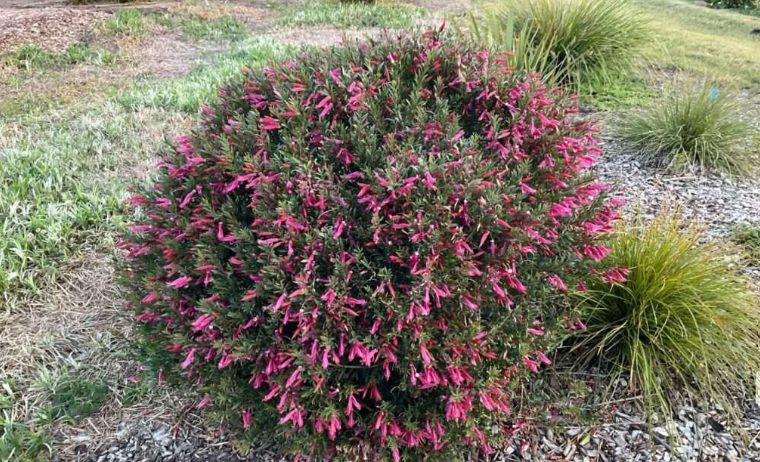
Emu bush describes one of Australia’s most genuinely diverse native plant genera, a group so large and actively studied that taxonomists working through its considerable internal complexity expect the final species count to keep climbing for years to come. Built almost entirely around survival in the harshest, driest parts of the Australian interior, the genus offers an almost bewildering range of flower colors, shapes, and growth habits packed into plants specifically adapted to places where rainfall rarely exceeds 250 millimeters a year.
What makes the genus genuinely unusual among Australian natives is its pollination split. Where many of the country’s most famous native plant groups lean heavily toward bird pollination, roughly 3 out of every 4 Eremophila species instead rely primarily on insects, and that single evolutionary difference has shaped flower color across the entire genus in a remarkably direct, visible way.
This guide covers the genus’s classification and naming history, how to identify it, its unusual pollination patterns, a genuine toxicity concern tied to certain species, its considerable traditional Aboriginal medicinal use, several notable individual species, and what it takes to grow and propagate one successfully.
Botanical Classification
Eremophila has traditionally been classified within the family Myoporaceae, though modern taxonomic treatment now places that group within the larger family Scrophulariaceae instead, a reclassification reflecting genetic research that’s reshaped how the genus relates to its botanical neighbors.
Species counts for the genus have grown considerably over time as research has continued, from 214 recognized species documented in a 2013 peer-reviewed review, to 236 described species by mid-2020, to around 240 species plus numerous additional subspecies and hybrids more recently, with some researchers suggesting the eventual total could reach as high as 300 species once ongoing taxonomic work concludes.
That considerable and still-growing diversity has made Eremophila the fifth most diverse native plant genus in Australia, found across every mainland state though concentrated overwhelmingly in semi-arid and arid regions. A dedicated Eremophila Study Group, formed decades ago under the Australian Native Plants Society, has tracked and encouraged that growing diversity in cultivation ever since, publishing field guides and horticultural references specifically aimed at making more of the genus’s considerable variety accessible to home gardeners.
Western Australia holds the largest number of species, with the greatest concentration specifically found within the Eremaean Botanical Province centered around the Wiluna area in the state’s arid interior.
Brief History and Naming
The genus name comes directly from the Greek words eremos, meaning desert, and phileo, meaning love, a genuinely fitting description for a plant group so thoroughly adapted to Australia’s harshest, driest growing conditions. Beyond the common name emu bush, the genus goes by several other names reflecting different aspects of its character, including fuchsia bush, referencing the tubular flower shape many species share with true fuchsia, poverty bush, a nod to the genus’s tendency to colonize degraded or overgrazed land where richer soil plants can’t compete, and turpentine bush or tar bush, describing the resinous scent certain species produce.
That naming diversity extends down to the individual species level too, and it can get genuinely confusing. Eremophila longifolia alone carries names including berrigan, long-leaved emu bush, weeping emu bush, native plum, juniper tree, and dogwood, several of which are also used for entirely unrelated plant species elsewhere in the Australian flora, meaning a common name alone is rarely enough to confirm exactly which plant you’re dealing with.
Identifying Characteristics and Flower Color Diversity
Eremophila species range considerably in size and form, from low, spreading shrubs to taller, more upright bushes, typically with simple leaves and tubular, often brightly colored flowers that give the genus much of its ornamental appeal. What makes flower color across the genus genuinely remarkable is how directly it tracks with pollination strategy rather than varying randomly from species to species.
Species that rely primarily on bird pollination tend to produce flowers in red, orange, yellow, cream, and green, colors that stand out well against foliage to a bird’s eye, while insect-pollinated species instead favor blue, purple, pink, and white, shades that appeal more directly to the insects responsible for carrying their pollen.
Given that roughly 3 quarters of the genus falls into the insect-pollinated category, with the remaining quarter bird-pollinated, the cumulative effect across all 240-plus species is a genuinely enormous available range of flower color, encompassing essentially the entire visible spectrum somewhere within the genus.
A gardener specifically wanting to attract a particular kind of pollinator, birds for one planting bed, native bees for another, can genuinely choose which Eremophila species to plant based partly on flower color alone, since that color so reliably signals which pollinator group a given species actually targets.
Pollination
That 75-25 split between insect and bird pollination sets Eremophila apart from several other prominent Australian native genera, many of which lean far more heavily toward birds as their primary pollinator. The considerable diversity of insect pollinators involved across so many species has likely contributed to the genus’s remarkable flower color range, since different insect species respond to different visual cues in ways that birds, as a pollinator group, generally don’t discriminate between as finely.
That pollination diversity also makes Eremophila plantings valuable for a considerably broader range of garden wildlife than a purely bird-pollinated native genus would support, drawing in native bees and other pollinating insects alongside the birds attracted to its more traditionally shaped tubular blooms.
A Genuine Toxicity Concern
Not every Eremophila species is safe around livestock, and this is a genuinely important detail for anyone managing land where the plant grows wild or considering it for a rural planting. Certain species carry the alternate common name poison bush specifically because they’re toxic to grazing stock, and at least one documented toxic principle, a cyanogenic compound called prunasin, has been identified as the active toxin in one of these problematic species.
Even species not formally classified as toxic can pose a real, more nuanced risk. Eremophila longifolia, widely regarded as the best fodder species within the entire genus and historically valued as emergency drought feed for sheep and cattle, can actually become toxic if livestock rely on it as their sole food source rather than one part of a more varied diet. That’s a genuinely important distinction between a plant being simply toxic and a plant being safe only in moderation alongside other feed, and it’s exactly the kind of nuance that matters for anyone actually managing grazing animals near Eremophila populations.
Aboriginal Traditional Medicine
Eremophila holds genuine, extensive significance in Aboriginal traditional medicine, and research has documented approximately 70 species within the genus used specifically to treat symptoms of respiratory tract infections, including the common cold, coughing, chest pain, and fever. Beyond respiratory use, various species have also served ceremonial purposes within Aboriginal cultural practice, reflecting a relationship with the plant that runs considerably deeper than its more recent adoption as a drought-tolerant garden shrub.
Eremophila alternifolia specifically was used by Aboriginal Australians to treat colds and skin infections, and modern pharmacological testing has confirmed the plant’s leaves genuinely contain compounds that affect cardiac activity, a real scientific validation of traditional use that goes well beyond folklore. Extracts from at least one Eremophila species have also been reported to show genuine insect-repelling properties, adding yet another practical dimension to the genus’s considerable traditional value.
Notable Species
Eremophila longifolia, commonly called berrigan, stands out as one of the most important plant species to Aboriginal people, particularly those living in Central Australia, and it’s also the most widespread Eremophila species in the country, capable of growing across a remarkably wide range of soil types and habitats outside the more humid eastern coastal regions. Eremophila maculata, the spotted emu bush, has become a genuine garden favorite specifically for its brightly colored flowers marked with distinctive spotted throats, making it a standout ornamental choice in arid and semi-arid landscaping.
Eremophila sturtii, known as turpentine bush, has drawn specific research interest for an unusual biological control relationship: a native scale insect in the genus Pulvinaria has proven valuable for controlling a related, more problematic Eremophila species, though the insect needs to be manually transferred between plants to be effective.
Eremophila lactea, the milky emu bush, represents the genus’s more precarious side, a critically endangered species with a documented wild population of just 547 plants across 4 roadside locations as of 1999, though its genuine tolerance for wind damage has made it a useful filler plant in cultivation specifically where more fragile species would struggle.
Growing and Propagation Considerations
Eremophila species are generally prized for exceptional drought tolerance, and many also withstand fire, frost, flooding, and even grazing pressure with real resilience, a combination of tolerances that’s made the genus a genuine favorite for low-maintenance, waterwise gardens well beyond its native arid range.
Full sun and well-drained soil suit most species best, reflecting their origin in some of Australia’s driest, most exposed growing conditions. Overwatering is a far more common cause of failure than neglect, since many Eremophila species genuinely prefer to dry out between waterings rather than sit in consistently moist soil.
Propagation has historically presented a genuine challenge for much of the genus, and when early attempts to propagate various Eremophila species directly proved unreliable, growers turned instead to grafting onto the closely related genus Myoporum as rootstock. That grafting technique remains, even today, the only consistently successful way to propagate more than 50 Eremophila species, a genuinely significant horticultural workaround that’s allowed considerably more of the genus’s diversity to reach home gardens than direct propagation alone ever could have achieved.
In the genus’s earliest years of organized cultivation, only a small handful of species, 2 with yellow flowers and 1 with white, were being grown at all, a number that grew to somewhere between 30 and 50 species within just a couple of decades as growers worked through these propagation challenges one species at a time.
The Bottom Line
Emu bush is a genus of remarkable, still-expanding diversity, built around surviving Australia’s harshest desert conditions while offering a flower color range that spans nearly the entire visible spectrum depending on whether a given species relies on birds or insects for pollination.
Its considerable traditional medicinal significance, genuine toxicity concerns in certain species, and the real propagation workaround required for much of its diversity all make this a genus worth understanding in real depth rather than treating as just another tough, drought-tolerant native shrub.