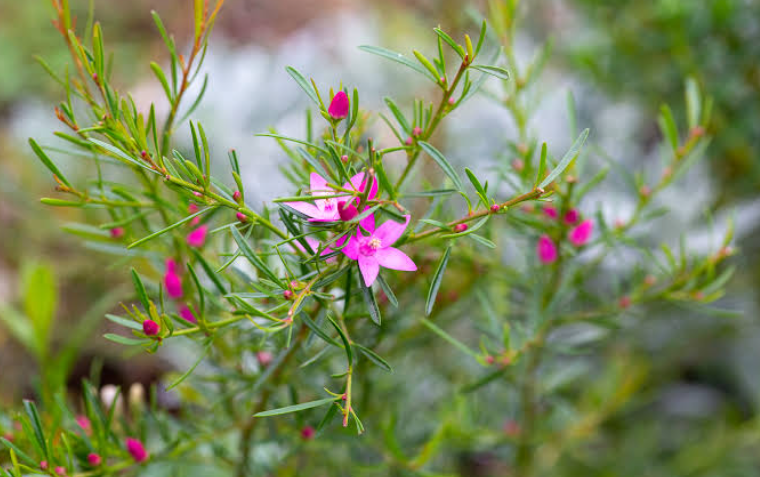
Crowea offers a genuinely refreshing change of pace among Australian native plant genera: rather than sprawling across hundreds of species like so many of its Proteaceae relatives, this particular genus contains just 3 recognized species, each one well documented, individually distinctive, and collectively responsible for one of the more reliable splashes of color in a native garden during the quieter autumn and winter months.
Commonly known as waxflower for the distinctively solid, waxy texture of its star-shaped blooms, Crowea belongs to the citrus family and sits close enough to the similarly popular genus Boronia that the 2 are frequently confused by gardeners, despite one genuinely simple, reliable feature that separates them at a glance. Understanding that distinction, along with the genus’s own documented naming history and the real differences between its 3 species, makes for a surprisingly rich story packed into a genus most people could fit on a single nursery shelf.
This guide covers the genus’s classification and naming history, how to tell it apart from its lookalike relative Boronia, how to identify it more generally, a closer look at each of its 3 species, and what it takes to grow and propagate one successfully.
Botanical Classification
Crowea belongs to the family Rutaceae, the same family that includes Boronia, Eriostemon, Philotheca, and commercial citrus crops like oranges and lemons, with Crowea saligna serving as the genus’s formally designated type species. All 3 recognized species are endemic to Australia, found across New South Wales, Victoria, and Western Australia, with New South Wales specifically home to 2 of the genus’s 3 species.
The genus was formally described and named in 1798 by the botanist James Edward Smith, who chose to honor James Crowe, an English surgeon and botanist who lived from 1750 to 1807 and served twice as Mayor of Norwich. Unlike some botanical namesakes whose biographical details have been largely lost to history, Crowe’s life is genuinely well documented, giving this particular genus name a clearer human story behind it than many other Australian native plants named after European patrons of botany during this same general era.
Crowea vs. Boronia
Given how visually similar Crowea and Boronia can appear at a casual glance, both producing star-shaped flowers on compact evergreen shrubs within the same broader plant family, distinguishing between the 2 genera matters for anyone trying to correctly identify a plant they’ve encountered or purchased. The single most reliable distinguishing feature comes down to simple petal counting: Crowea flowers have 5 petals, while Boronia flowers have only 4.
Beyond that core identification difference, Crowea also tends to prove generally longer-lived than most Boronia species, shows greater drought tolerance once properly established, and adapts more forgivingly to variable soil conditions than its more demanding relative typically allows. That combination of easier care and a straightforward visual tell has made Crowea a genuinely practical alternative for gardeners who’ve struggled with Boronia’s sometimes finicky cultivation requirements.
Identifying Characteristics
Crowea species are small evergreen shrubs with simple, alternate leaves, typically narrow to lance-shaped and dotted with visible oil glands that can release a mild fragrance, sometimes described as having a slight aniseed quality, when the foliage is crushed or brushed against. Flowers are borne singly in the leaf axils rather than in dense clusters, a solitary flowering habit that sets the genus apart from many other Australian native shrubs that display their blooms in more crowded groupings.
Each flower displays the genus’s signature 5 waxy petals arranged in a clean star shape, typically in shades of pink ranging from pale to deep rose, with white forms occurring in at least one species as well. That genuinely solid, waxy petal texture, which gives the whole genus its common name, makes Crowea flowers hold their shape and color remarkably well, a trait that’s made them a reliably recommended choice for cut flower arrangements that need to last indoors.
A Closer Look at the Three Species
Crowea saligna, the genus’s type species and commonly called willow-leaved crowea, takes its species name from the Latin word for willow-like, a reference to its elliptic to lance-shaped leaves, which can grow up to 80 millimeters long and bear a passing resemblance to true willow foliage. Its solitary flowers reach up to 3 centimeters across, typically in pale to mid-pink tones, blooming from late summer through mid-winter, and the species performs best in a sheltered garden position with some protection from drying wind.
Crowea exalata, simply called small crowea, is by a considerable margin the best known and most widely cultivated of the genus’s 3 species, first formally described by the botanist Ferdinand von Mueller in 1854. Its species name, meaning wingless, references an apparent lack of ridges along the stem, though the plant’s own documentation notes this isn’t actually a fully reliable distinguishing trait for the species. Crowea exalata is genuinely variable in growth habit, ranging from almost prostrate forms to upright shrubs reaching a meter or more, and it flowers nearly continuously through much of the year, with a main flush from late summer to mid-winter and only a brief rest during the most extreme heat or cold.
Crowea angustifolia, found only in the far southwestern corner of Western Australia, was described in 1808 by James Edward Smith from a specimen collected by the botanist Archibald Menzies near King George’s Sound. It’s a genuinely variable species in size as well, ranging anywhere from a modest 0.3 meters up to a substantial 3.5 meters tall, growing either erect or in a more spreading, diffuse habit, with white or pink flowers appearing in spring. Despite belonging to the same small, well-documented genus as its 2 eastern relatives, Crowea angustifolia remains rarely available in nurseries across Australia’s eastern states, reflecting the same east-west cultivation divide seen across several other Australian native plant genera.
Growing Considerations
Crowea generally prefers a moist, well-drained position with some shelter from strong wind, though Crowea exalata specifically has been observed growing successfully in full sun without any apparent problems, suggesting a bit more flexibility within the genus than the general guidance alone might imply. Despite belonging to a plant family often associated with fairly particular soil requirements, Crowea species have shown a genuinely surprising ability to adapt across a wide range of soil types, a real point of relief for gardeners whose soil doesn’t perfectly match the genus’s ideal description.
The plants aren’t indefinitely long-lived under difficult conditions, and specimens have been documented dying at around 5 years old following drought combined with drying winds, though a consistently well-watered and properly trimmed plant can realistically be kept going for considerably longer. Crowea is generally considered pest free, though scale insects and sooty mold can occasionally show up under the wrong conditions. Most species show at least moderate frost tolerance, and several named cultivars and varieties have been developed specifically to broaden the range of flower colors and growth habits available to gardeners beyond the straight wild species.
Propagation Challenges
Like many members of the Rutaceae family, Crowea is genuinely difficult to propagate reliably from seed, a real practical obstacle for anyone hoping to grow a large number of plants cheaply from their own seed collection. Garden-grown plants do sometimes produce chance seedlings of their own accord, but this happens unpredictably rather than as a reliable propagation method a grower can actually count on.
For named cultivars specifically, cutting propagation isn’t just preferred, it’s essential, since seed-grown plants of a registered cultivar like ‘Festival’ won’t reliably come true to type, meaning a seedling could look meaningfully different from the specific parent plant a gardener was trying to reproduce. Anyone wanting a guaranteed match to a particular named Crowea selection needs to source a cutting-grown plant rather than relying on seed, a genuinely important distinction for a gardener building a native garden around a specific, intentional color scheme.
The Bottom Line
Crowea proves that a genuinely rewarding Australian native genus doesn’t need hundreds of species to make a real impression, offering waxy, star-shaped, long-lasting flowers precisely when most of the garden has gone quiet for the season, a simple but reliable way to distinguish it from its more demanding Boronia relative, and a documented naming history clearer than many of its more sprawling native plant cousins. Choose the right species or cultivar for your specific climate, keep it reasonably watered through dry spells, and this compact, 3-species genus will reward you with color exactly when a native garden needs it most.