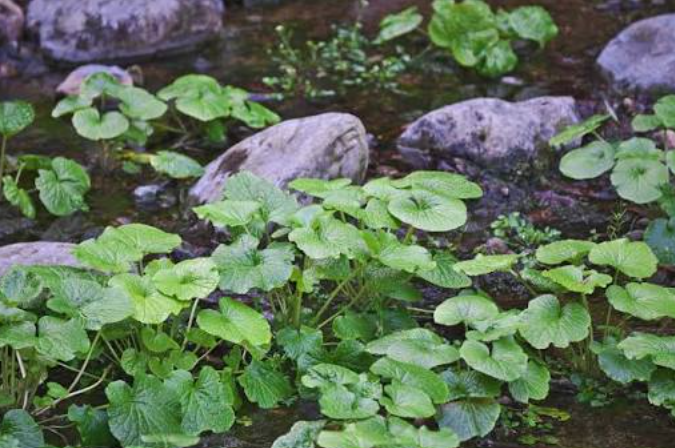
Wasabi, scientifically Eutrema japonicum, is a perennial herb in the mustard family that grows naturally along cold mountain streams, and cultivation of the plant in Japan is believed to have begun roughly 400 years ago. In the wild, the species occurs across a considerable stretch of territory, from Russia’s Sakhalin Island in the north down to Kyushu, the southernmost of Japan’s main islands.
Despite that long cultivation history, wasabi remains genuinely difficult to grow, typically requiring 1.5 to 2 years from planting before the rhizome is ready to harvest. That slow timeline, combined with the plant’s narrow environmental requirements, is a major reason true wasabi stays expensive and rare, and researchers studying the crop note that in Japan, wasabi actually begins flowering in January, triggered specifically by cold winter temperatures.
Decades of regional breeding work across Japan and, more recently, Korea have produced a genuinely large number of distinct named cultivars. Researchers studying wasabi genetics report that approximately 20 modern cultivars are now in common use, and most of today’s cultivated wasabi traces back to just 3 major cultivars in particular, Fujidaruma, Shimane No. 3, and Mazuma, that played a central role in that broader modern breeding effort. Wasabi cultivars are also typically named for either their region of origin, as with Shimane No. 3 for Japan’s Shimane Prefecture, or for the specific breeder who developed them.
Shimane Prefecture itself holds the largest collective wasabi-growing area of anywhere in Japan, underscoring just how regionally concentrated true wasabi production remains even after 4 centuries of cultivation. What follows covers 10 types of wasabi plant varieties, spanning the historic foundational cultivars, 3 major modern Japanese cultivars, and several cultivars maintained in Korea.
Daruma
Daruma is the old foundational cultivar believed to descend directly from the very first domesticated wasabi accession recorded in Shizuoka Prefecture around 400 years ago. Genetic research has confirmed it as the mother line behind Fujidaruma, one of the 3 major modern cultivars grown widely today.
As the root of so much of wasabi’s cultivated lineage, Daruma holds genuine historical significance beyond its own direct use, and researchers studying wasabi’s chloroplast genome have used it as a key reference point for tracing how the plant’s modern cultivars relate to one another.
Fujidaruma
Fujidaruma is one of the 3 major modern Japanese wasabi cultivars, descended from the older Daruma line and maintained at Shizuoka Prefecture’s Izu Agricultural Research Center. Its genome has been used as a representative reference sequence in published genetic studies of the species.
Alongside Shimane No. 3 and Mazuma, Fujidaruma forms part of the genetic foundation behind the great majority of wasabi cultivars grown commercially today, both within Japan and in cultivars that have since spread to Korea.
Mazuma
Mazuma is a widely cultivated wasabi cultivar developed in Shizuoka Prefecture in the 1950s, one of the 3 major modern cultivars underpinning much of today’s commercial wasabi production. It’s recognized for a balanced flavor profile that combines genuine spiciness with subtler sweet and earthy undertones, and its rhizomes typically display a pale green color.
Genetic studies have found that Mazuma and Daruma form a distinct lineage separate from Fujidaruma and Shimane No. 3, reflecting real, measurable genetic divergence between Japan’s major cultivated wasabi lines.
Shimane No. 3
Shimane No. 3 is named for Shimane Prefecture, home to the largest collective wasabi-growing area anywhere in Japan, and it stands alongside Fujidaruma and Mazuma as one of the 3 major cultivars shaping modern wasabi breeding. Its regional name reflects a common naming convention across Japanese wasabi cultivars, many of which are named either for where they were developed or for the specific breeder behind them.
Its considerable influence on later cultivar development has made it, alongside its 2 major counterparts, a frequent reference point in published genetic and taxonomic research into cultivated wasabi.
Izawa Daruma
Izawa Daruma is named for its developer, K. Izawa, following the breeder-naming convention common among Japanese wasabi cultivars. Its name connects it to the broader Daruma lineage while distinguishing it as a specific, separately developed selection in its own right.
As with many of Japan’s more regionally or individually specific cultivars, detailed published information on Izawa Daruma’s particular growing characteristics remains more limited than for the 3 major modern cultivars, though its place within the wider Daruma family line is well documented.
Shogun
Shogun is a wasabi cultivar maintained in Korea by the Gangwondo Agricultural Research and Extension Services, part of a broader collection of cultivars researchers have studied to trace the genetic relationship between Korean-grown wasabi and its Japanese origins. Its Korean cultivation reflects wasabi’s spread well beyond its original Japanese growing regions.
Genetic comparison places Shogun among the cultivars genetically distinct from the older Mazuma-Daruma lineage, grouping instead with Fujidaruma, Shimane No. 3, and the other more recently developed cultivars researchers have examined.
Green Thumb
Green Thumb is another wasabi cultivar maintained in Korea alongside Shogun, part of the same research collection used to study how cultivated wasabi has diversified since its introduction from Japan. Its English-language name sets it apart from the Japanese-origin naming convention followed by most other cultivars on this list.
Its inclusion in comparative genetic studies has helped researchers map out the broader relationships between Korean-maintained wasabi cultivars and their Japanese ancestral lines.
Daewang
Daewang is an unnamed cultivar originally sourced from the Daio Wasabi Farm in Japan before being incorporated into Korean research collections, and its current name was assigned during that later research process rather than inherited from its original Japanese breeder. That naming history makes it a useful example of how cultivar names can shift as plant material moves between countries and research institutions.
It’s included alongside several other cultivars in genetic studies aimed at clarifying the taxonomic identity and origin of wasabi populations now growing in Korea.
Mikado
Mikado, sometimes spelled Micado, is among the cultivars studied for its distinct flavor, color, and bioactive compound profile compared to the more widely known Mazuma and Daruma lines. Its name, referencing the historical Japanese imperial title, reflects the broader tendency among wasabi cultivars to draw on evocative Japanese naming themes.
Its specific chemical and flavor characteristics have made it one of several less dominant but still genetically documented cultivars of interest to researchers studying the full range of diversity within cultivated wasabi.
Orochi
Orochi is a wasabi cultivar maintained within Korea’s research collections, included in genetic studies alongside Daewang, Daruma, Green Thumb, Mikado, and Shogun to help clarify the relationships between Korea’s cultivated and naturally occurring wasabi populations. Its name references Yamata no Orochi, a legendary multi-headed serpent from Japanese mythology.
Like several of its fellow Korean-maintained cultivars, detailed independent growing information on Orochi specifically remains limited outside the genetic research it’s been included in, though its documented place within that research gives it a clear, verifiable identity distinct from Japan’s major commercial cultivars.
Key Takeaways
- Wasabi belongs to the Brassicaceae family, the same plant family as cabbage, mustard, broccoli, and horseradish.
- Most cultivated wasabi is associated with Wasabia japonica, also known as Eutrema japonicum, a perennial plant native to Japan.
- Wasabi varieties can differ in leaf shape, color, rhizome characteristics, growth habit, and tolerance to different growing conditions.
- Well-known Japanese types include Daruma and Mazuma, which are traditionally cultivated for their flavorful rhizomes.
- Some wasabi types are better suited to streamside or spring-fed cultivation, while others can be grown in soil under carefully controlled conditions.
- Wasabi generally prefers cool temperatures, shade or filtered light, and consistently moist but well-drained conditions.
- The edible rhizome develops slowly, so identifying a variety’s growth rate and environmental requirements is important when choosing plants.
- Wasabi varieties may also be distinguished by the appearance and size of their leaves, petioles, and rhizomes.
- True wasabi should not be confused with horseradish-based imitation wasabi, which is commonly sold as a substitute.
- When comparing wasabi varieties, consider their identification features, growing requirements, rhizome quality, and suitability for your local climate.