Japan’s Most Difficult and Misunderstood Crop
The wasabi plant is responsible for one of the most recognizable flavors in the world, yet the vast majority of people who’ve eaten “wasabi” at a sushi restaurant have never actually tasted it. Genuine wasabi is notoriously difficult and expensive to grow, and most of what gets served as wasabi outside Japan, and even in a considerable amount of it served within Japan, is actually dyed horseradish standing in for the real thing.
Its scientific name is Eutrema japonicum, though it’s still widely known under its older name, Wasabia japonica, and it belongs to the Brassicaceae family alongside horseradish, mustard, cabbage, and watercress. Unlike almost anything else in that family, though, true wasabi grows wild along cold mountain streams, and replicating that very specific environment is exactly what makes it one of the hardest crops in the world to cultivate commercially.
This guide covers the plant’s classification and naming history, how to identify it, where it grows naturally, why it’s so difficult and expensive to produce, the horseradish substitute sold in its place almost everywhere, and what it takes to attempt growing it yourself.
Botanical Classification
Wasabi’s taxonomic history is more tangled than most spice crops. The Japanese botanist Jinzō Matsumura originally placed the plant in its own genus, Wasabia, in the early 20th century, first recognizing it as Wasabia pungens before settling on the name Wasabia japonica in 1912. More recent botanical classification has moved the species into the genus Eutrema instead, and Eutrema japonicum is now the scientifically preferred name, even though “Wasabia japonica” remains in extremely common use across gardening guides, restaurants, and casual conversation.
The North Carolina State Extension Gardener Plant Toolbox confirms the plant belongs to the Brassicaceae family, the same family responsible for horseradish, mustard, cabbage, arugula, and watercress, a relationship that explains why wasabi and horseradish share a genuinely similar pungent, sinus-clearing heat despite looking nothing alike as plants.
Identifying Characteristics
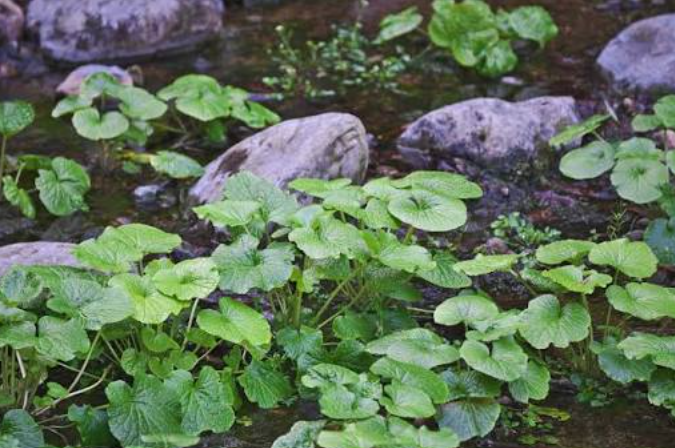
Wasabi is a slow-growing herbaceous perennial, typically reaching somewhere between 8 inches and 2 feet in height, with broad, heart-shaped, glossy green leaves held on long petioles rising directly from the base of the plant. Its small white flowers appear in loose clusters, consistent with the simple, 4-petaled flower structure typical across the broader mustard family. Unlike most of its mustard-family relatives, though, wasabi behaves somewhat like an aquatic or semi-aquatic plant, a genuinely unusual trait within Brassicaceae that reflects its evolutionary origin alongside running mountain water rather than ordinary garden soil.
The part of the plant actually used in cooking is its rhizome, a thick, knobby, pale green, cylindrical modified stem that grows mostly at or just beneath the surface rather than deep underground. That rhizome is traditionally grated fresh, just before serving, on a specialized sharkskin grater called an oroshigane, since fresh-grated wasabi loses its distinctive aroma and heat remarkably quickly once exposed to air.
Native Range and Habitat
Wasabi is native to Japan, the Korean Peninsula, and the Russian island of Sakhalin, and in the wild it grows specifically along the beds of cold mountain streams within shaded forest valleys. That specific habitat, sometimes referred to in Japanese as sawa, meaning mountain stream, is defined by a fairly narrow combination of constant cool temperatures, high humidity, dappled shade, and a steady flow of clean, mineral-rich water.
According to Britannica’s entry on wasabi, commercial wasabi cultivation within Japan is concentrated in just a handful of regions capable of reliably replicating those conditions, most notably Shizuoka Prefecture, particularly the Izu Peninsula, along with Iwate and Nagano Prefectures. Outside Japan, wasabi has also been successfully cultivated in parts of New Zealand and in specific high-elevation regions of China, generally between about 1,500 and 2,600 meters, where cool mountain conditions offer a workable substitute for wasabi’s native Japanese habitat. Researchers studying wasabi grown in 2 separate Chinese growing regions found measurable differences in the plant’s chemical composition depending on elevation and local growing conditions, a useful reminder that even within successfully cultivated populations, genuine wasabi isn’t a perfectly uniform crop from one location to the next.
Why Wasabi Is So Difficult to Grow
Wasabi has a genuine reputation as one of the hardest commercial crops to grow successfully anywhere in the world, and that reputation is well earned. The plant demands a remarkably narrow temperature range, generally cited as roughly 46 to 70 degrees Fahrenheit, and it goes into genuine heat stress above about 80 degrees, a tolerance window considerably tighter than almost any other widely cultivated crop.
Beyond temperature, wasabi needs consistent partial to deep shade, typically 50 to 70 percent shade cover, along with constant access to clean, flowing water and rich, well-drained soil that still retains moisture reliably. Traditional Japanese cultivation methods grow the plant directly in shallow, gently sloped channels, often with a grade of just 1 to 4 percent, specifically engineered to keep a steady trickle of cold spring water moving past the plant’s roots at all times. The plant is also genuinely slow to mature, typically requiring somewhere around 18 months to 2 or more years of consistent, carefully managed growing conditions before the rhizome reaches a usable size, and it remains notably susceptible to aphids, caterpillars, leaf spot, root rot, rhizome rot, and petiole blight throughout that entire extended growing period. Even within a single growing operation, different cultivars of true wasabi are known to perform differently, which is part of why serious commercial growers in Japan often maintain more than one named variety rather than relying on a single genetic line.
The Price of the Real Thing
All of that difficulty translates directly into cost. Genuine wasabi rhizome can retail for well over 200 euros per kilogram, and in the United States true wasabi root is rarely available to ordinary retail consumers at all, generally reserved for high-end Japanese restaurants and a small number of specialty produce markets in major cities.
The economics of home cultivation make the math even clearer. One detailed grower’s cost breakdown found that an initial plant costing around 13 dollars, combined with roughly 18 months of careful, consistent attention to the plant’s demanding environmental needs, ultimately yields only about a quarter pound of rhizome, worth somewhere between 25 and 40 dollars at typical retail prices for that quantity. Put simply, growing wasabi at home is a genuinely interesting horticultural project, but it is not, under any realistic scenario, a way to save money compared to simply buying the finished product when it’s available at all. Anyone attracted to the idea is generally better off thinking of it as a long-term hobby with an edible payoff, rather than as a practical path to cheaper wasabi.
The “Fake Wasabi” Problem
Given the plant’s cost and limited availability, the vast majority of what’s served as wasabi outside Japan, and a considerable share of what’s served within Japan as well, is not genuine Eutrema japonicum at all. Instead, it’s typically prepared horseradish, Armoracia rusticana, an entirely different genus within the same broader Brassicaceae family, colored green with added dye to visually mimic true wasabi’s natural color.
Both plants owe their characteristic sharp, sinus-clearing heat to isothiocyanates, a class of pungent compounds the two genuinely do share, which is part of why the substitution works reasonably well for most casual diners. But the flavors aren’t identical: horseradish tends to deliver a more one-dimensional, straightforwardly hot sensation, while genuine wasabi is often described as offering a more complex, slightly sweeter, more fleeting heat that fades faster than horseradish’s lingering burn. One of the most reliable ways to spot the difference at a glance is color, since real wasabi is naturally green on its own, while the horseradish substitute is naturally white and owes its familiar pale green hue entirely to added coloring.
Health-Related Compounds
Beyond its culinary reputation, wasabi has drawn genuine scientific interest for the specific glucosinolates and their breakdown products found concentrated in its rhizome and other plant tissues. Research comparing wasabi grown in different producing regions has found measurable variation in these compounds and in the plant’s overall antioxidant activity depending on where and how it was cultivated.
That research remains a developing area of plant science rather than settled medical guidance, and the modest quantities of wasabi typically consumed at a meal are unlikely to deliver these compounds at a scale comparable to a dedicated supplement. A peer-reviewed study published in Frontiers in Plant Science specifically examined how these compounds varied not just by growing region but by which part of the plant was analyzed, finding meaningful differences between the rhizome and the plant’s other tissues. It’s a genuinely interesting area of ongoing study, but not yet, and not currently marketed as, a basis for any specific health claim.
Growing Considerations
If you want to attempt growing wasabi yourself, success depends on replicating its native streamside habitat as closely as your setup allows. That means consistent partial to deep shade, achievable with shade cloth or placement beneath a large deciduous tree, combined with rich, loose, well-draining soil, cool temperatures within that narrow 46 to 70 degree range, and, ideally, a constant source of clean, moving water rather than standing, stagnant moisture.
Wasabi is generally hardy across USDA zones 7 through 10, though the specific microclimate you can provide matters considerably more than the broad hardiness zone alone. Seeds benefit from an overnight soak in distilled water to soften their outer coating before planting, though many growers instead start with rhizome divisions from an established plant, which tend to establish more reliably than seed. Given the plant’s considerable susceptibility to pests and disease, consistent monitoring throughout its long, 18-month-plus maturation period is genuinely essential rather than optional. Containers offer one practical way to keep closer control over soil moisture, drainage, and temperature than an open garden bed typically allows, and they make it considerably easier to move a struggling plant into better shade or a cooler spot if conditions shift unexpectedly.
The Bottom Line
Wasabi is a plant defined almost entirely by the gap between its enormous culinary reputation and the genuine rarity of anyone actually tasting the real thing. Its demanding, narrow set of environmental requirements, cool temperatures, constant shade, and endlessly flowing clean water, make it one of the most difficult crops in the world to grow commercially, and that difficulty is exactly why the pale green paste served at most sushi counters has likely never come within a thousand miles of an actual wasabi rhizome.