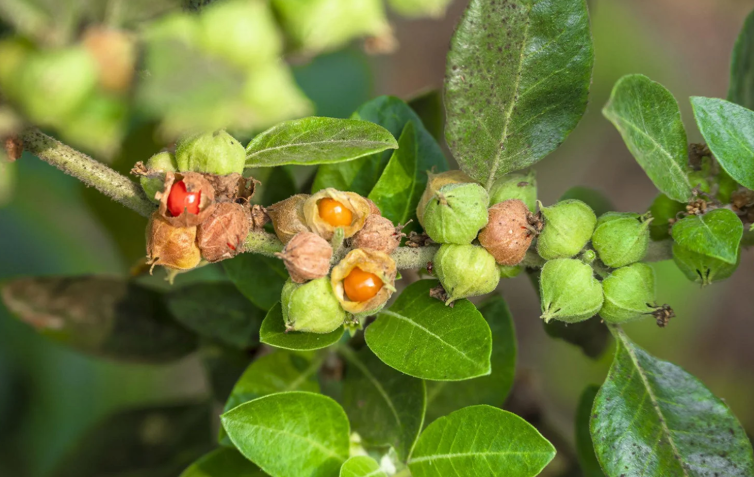
Ashwagandha is the common name most often applied to Withania somnifera, a small evergreen shrub in the nightshade family that’s been used in Ayurvedic medicine for thousands of years. But “ashwagandha” sits within a larger genus, Withania, which Kew’s Plants of the World Online currently recognizes as containing 19 accepted species, while other published reviews put the figure closer to 23 to 26 depending on how certain regional populations are classified.
Of that considerable genus-wide diversity, only 2 species are found growing in India at all: Withania somnifera itself and its close relative Withania coagulans. The rest of the genus is scattered thinly across North Africa, the Canary Islands, the Middle East, and the wider Mediterranean, and most of those other species remain poorly studied compared to the 2 that have found real economic and medicinal use on the Indian subcontinent.
Beyond the wild species themselves, decades of agricultural research in India have produced a genuinely large number of distinct cultivated varieties of true ashwagandha. Researchers tracking genetic diversity in the crop report that approximately 15 commercial cultivars have been developed and released by Indian research institutes and universities to meet rising domestic and global demand, each bred for traits like higher yield, specific root size, or resistance to common pests and diseases.
Market estimates for the ashwagandha industry vary enormously depending on which research firm is doing the counting, with one analysis placing the global market at roughly $0.76 billion in 2025 and projecting growth to $1.18 billion by 2030, while other reports cite figures an order of magnitude higher. That inconsistency is itself worth knowing before treating any single market statistic as settled fact. What follows covers 5 different types of ashwagandha plants: the true, economically significant wild species, and 3 of the most well-documented cultivated varieties bred from the primary species.
True Ashwagandha (Withania somnifera)
True ashwagandha, scientifically Withania somnifera, is the species virtually everyone means when they say “ashwagandha,” a short, woody, evergreen shrub typically growing 1.5 to 5 feet tall with grey-green downy leaves, small greenish-yellow flowers, and bright orange-red berries enclosed in a papery husk. Its long, tuberous root is the primary part used medicinally, and its Sanskrit name translates to “smell of the horse,” a direct reference to that root’s distinctive odor.
It thrives in dry, stony soil in full sun to partial shade, reflecting its native adaptation to the drier regions of India, the Middle East, and North Africa. Its considerable commercial and medicinal importance has made it the overwhelming focus of ashwagandha cultivation, research, and the global supplement industry as a whole.
Withania coagulans
Withania coagulans, also called paneer doddi or ashutosh booti, is the second economically significant Withania species found in India, genuinely distinct from true ashwagandha in both appearance and traditional use. Rather than being valued primarily for its root, this species is historically prized for its berries, which contain an enzyme capable of curdling milk, a property that’s given rise to its common name paneer doddi, roughly translating to “cheese berry.”
It thrives in similarly dry, well-drained conditions to its better-known relative. Its traditional use in Ayurvedic and Unani medicine, along with its unusual milk-clotting property, has kept it in active cultivation and research alongside true ashwagandha, even though the 2 species serve genuinely different purposes.
Jawahar Ashwagandha-20
Jawahar Ashwagandha-20, commonly abbreviated JA-20, is one of the most widely grown commercial cultivars of true ashwagandha, developed and released for Indian farmers specifically seeking a high-yielding, short-statured plant. Its compact growth habit makes it particularly well suited to high-density planting, allowing more plants to be grown per unit of field area than a taller, more sprawling cultivar would allow.
It’s cultivated primarily in Madhya Pradesh, one of India’s major ashwagandha-growing states. Its combination of manageable size and reliable yield has made it a genuine commercial standard among Indian ashwagandha farmers.
Poshita
Poshita is a high-yielding ashwagandha cultivar released by CSIR-CIMAP, one of India’s leading medicinal and aromatic plant research institutes, developed specifically to improve root yield and the concentration of withanolides, the steroidal lactone compounds considered responsible for much of the plant’s medicinal activity. Its genetic improvement over older, unselected farm populations reflects decades of dedicated breeding work.
It’s grown under similar dry, well-drained conditions to the wild species it was developed from. Its improved withanolide content has made it a genuinely valuable cultivar specifically for growers supplying the pharmaceutical and nutraceutical extraction market.
Rakshita
Rakshita is another commercial ashwagandha cultivar released by CSIR-CIMAP, developed with a particular emphasis on disease resistance alongside reliable yield, a genuinely practical breeding priority given how much crop loss plant disease can cause in a commercial ashwagandha field. Its name, meaning roughly “protected” in Sanskrit, reflects that specific breeding focus.
It’s grown under the same general dry-climate conditions favored by true ashwagandha. Its disease-resistant traits have made it a practical choice for growers in regions where fungal or other pathogen pressure has historically reduced yields in older, unimproved varieties.