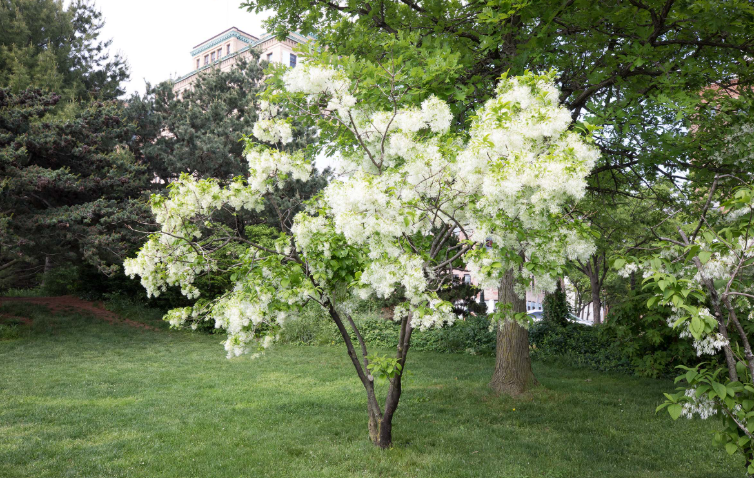
Fringetree gets its common name, and its scientific genus name Chionanthus, from the Greek words for snow and flower, a fitting description for a tree that covers itself in delicate, fringe-petaled white blooms each spring. It belongs to the olive family, the same family that includes ash trees and lilacs, and that relationship has turned out to matter more than most gardeners would expect.
The American species is native to 22 U.S. states and Washington, D.C., ranging as far north as New York, as far south as central Florida, and as far west as Texas, and it’s hardy across USDA zones 3 to 9. It’s a genuinely slow grower, typically adding just 6 to 10 inches of height per year, and a mature specimen usually tops out around 30 feet, making it one of the more patient but ultimately manageable small flowering trees available.
The olive family connection turned out to be a real vulnerability. In 2014, researchers discovered white fringetrees in Ohio hosting infestations of the emerald ash borer, the same invasive beetle that has devastated ash trees across North America, and it has since been found attacking fringetrees in Illinois, Indiana, and Pennsylvania as well. Its Asian relative, Chinese fringetree, has not shown the same vulnerability, likely because it co-evolved alongside the beetle in its native range and built up defenses over a much longer timescale.
The genus contains somewhere between 100 and 150 species worldwide, the vast majority tropical species from Asia, the Pacific, and Madagascar that are rarely if ever cultivated or known by the English name fringetree. What follows covers 5 types of fringetrees actually established in horticulture: the 3 recognized species grown under that name, and 2 of the most widely available named cultivars bred from them.
White Fringetree
White fringetree, also called American fringetree, Grancy Greybeard, or old man’s beard, is native to the eastern and southeastern United States, its drooping, fragrant, 6 to 8 inch flower panicles opening in spring right alongside its emerging leaves. It carries an official conservation status of least concern, though its increasing vulnerability to the emerald ash borer is a genuine and growing concern for its long-term health.
It thrives in full sun to partial shade and moist, well-drained soil, tolerating a range of conditions once established, and its flowers form on old wood, which should guide any pruning. Its slow growth and modest mature size have made it a longtime favorite as a specimen tree or a showy understory planting.
Chinese Fringetree
Chinese fringetree is native to China, Korea, and Japan, its foliage noticeably darker, glossier, and more leathery than the American species, with flower petals that are rounder and less feathery in appearance. Unlike its American relative, it has shown no vulnerability to the emerald ash borer, a real practical advantage for anyone planting a fringetree in a region where that pest is active.
It thrives in full sun to partial shade and medium moisture, well-drained soil, and it’s most often grown as a large, multi-stemmed, rounded shrub reaching 10 to 20 feet, though it can be trained into a small tree up to 30 to 40 feet. Its fluffy white flower clusters mature into small, blueberry-like fruit, and its dark green summer foliage turns a bright yellow in fall.
Pygmy Fringetree
Pygmy fringetree is a rare species found only in a small area of central Florida, genuinely distinct from white fringetree despite some past taxonomic debate over how separate the two truly are. Its endangered status in the wild makes it far less commonly available in cultivation than either of its more widely grown relatives.
It shares the same general white, fringe-petaled flower structure as its relatives, scaled to the compact, shrubby habit that gives the species its common name. Its considerable rarity has made habitat protection, rather than home garden cultivation, the more meaningful path toward its long-term survival.
Emerald Knight
Emerald Knight is a named cultivar of white fringetree, raised before 2009 by Brian Upchurch of Highland Creek Nursery in North Carolina, selected for an upright habit and long, dark green, glossy leaves. Because it’s a male selection, it produces no fruit at all, a genuine advantage for anyone who wants the spring flower display without any post-bloom litter.
It thrives in full sun to partial shade and moist, well-drained soil, growing 15 to 20 feet tall, somewhat narrower than the species itself. Its dense flower coverage and fruitless habit have made it one of the most frequently recommended fringetree cultivars available today.
Tokyo Tower
Tokyo Tower is a named cultivar of Chinese fringetree, brought to the United States from Japan by Harald Neubauer of Hidden Hollow Nursery in Tennessee, and recognized in 2026 with a Pennsylvania Horticultural Society Gold Medal. Its narrow, upright, columnar form sets it clearly apart from the wide-spreading habit typical of the straight species.
It thrives in full sun to partial shade and medium moisture soil, reaching just 12 to 15 feet tall with a spread of only 4 to 6 feet, making it a practical choice for a smaller planting space or a street tree setting. Its attractive tan and gold exfoliating bark adds a second season of interest once its white flower clusters have finished for the year.
Key Takeaways
- Fringetrees belong to the genus Chionanthus and are known for their distinctive, fringe-like flowers that appear in spring.
- Different fringetree species vary in size and growth habit, ranging from compact shrubs to small ornamental trees.
- Their flowers are usually white and highly distinctive, with long, narrow petals that give the trees a soft, fringed appearance.
- Foliage varies between species, but many fringetrees have broad, glossy green leaves that provide attractive summer interest.
- Female trees can produce small fruits, which may turn dark blue or purple when mature and provide food for birds.
- Fringetrees are valued as ornamental plants, particularly as specimen trees in gardens, woodland settings, and residential landscapes.
- Species identification can require close observation, especially of leaf shape, flower structure, fruit, bark, and the tree’s overall growth habit.