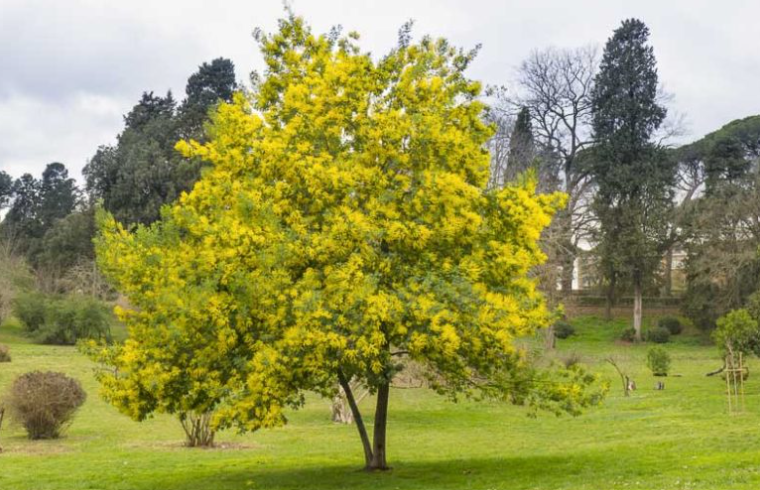
With well over 1,000 wattle species native to Australia, no single list could cover them all, but a relatively small number of species account for most of what people actually encounter, whether that’s a golden roadside shrub in spring, a tannin-producing plantation tree, or a gnarled survivor scattered across the red desert interior. The species below were chosen because each is genuinely well documented and distinct from the others, spanning coastal, alpine, arid, and rainforest-edge habitats.
Wattles differ enormously in size, from towering forest trees to low, spreading shrubs, and in where they’ve ended up growing, since several of Australia’s most widely planted ornamental wattles have also become serious invasive weeds overseas. What follows covers 26 types of wattle tree.
Golden Wattle
Golden wattle is Australia’s official national floral emblem, its profuse, fragrant, golden-yellow flower balls appearing on an evergreen shrub or small tree each spring. Native to South Australia, Victoria, and New South Wales, it grows in forest, woodland, and open scrubland.
It thrives in full sun and well-drained soil, tolerating a range of conditions once established. Despite its native status, golden wattle has become locally invasive in Western Australia’s Perth district, well outside its natural range.
Silver Wattle
Silver wattle, also called blue wattle or mimosa, is native to southeastern mainland Australia, its finely divided, silvery-grey foliage and masses of small yellow flowers making it one of the most recognizable wattles in cultivation. The Australian National Botanic Gardens notes that its bark has long been harvested commercially for tannin used in leather production.
It thrives in full sun and moist, well-drained soil, growing quickly into a substantial small tree. Outside Australia it has become a significant invasive species, classified as a Category 1 weed requiring eradication in South Africa’s Western Cape and naturalizing as far afield as California, the Mediterranean, and the Black Sea coast of Russia.
Black Wattle
Black wattle, also called green wattle, is a fast-growing tree valued commercially for the tannin extracted from its bark, historically used to cure and preserve leather on a large scale. It commonly hybridizes with the closely related Cootamundra wattle, and the resulting hybrids tend to be more sensitive to insect galls than either parent species.
It thrives in full sun and a range of soil types, growing rapidly enough to have supported entire commercial tannin plantations overseas. That same vigor has made it an aggressive invasive species in parts of South Africa, where it has spread well beyond its original plantation boundaries.
Blackwood
Blackwood is a substantial wattle valued less for its flowers than for its timber, which is prized by furniture makers for its rich color and fine grain. Its bark, like several other wattle species, has also seen historical use in tanning.
It thrives in full sun to partial shade and moist, well-drained soil, growing into one of the larger and more long-lived trees in the genus. Its reputation as a quality timber species has kept it in active commercial cultivation well beyond its natural Australian range.
Cootamundra Wattle
Cootamundra wattle is named for the district around Cootamundra, New South Wales, where it occurs naturally, and it’s instantly recognizable by its fine, feathery, blue-grey foliage and weeping branches covered in golden flowers. A purple-foliaged form, sold as ‘Purpurea’, has become especially popular in cultivation.
It thrives in full sun and well-drained, slightly acidic soil, growing quickly but living only around 30 years. Its considerable ornamental appeal has driven widespread planting well outside its native range, and it has since become invasive in parts of southern Africa, the southwestern United States, and even other parts of Australia, where it hybridizes with the rare, endangered Sydney Basin species it grows alongside.
Golden Wreath Wattle
Golden wreath wattle, also called coojong or orange wattle, is a small tree native to Western Australia, tolerant of a remarkably wide range of soil conditions and long used in revegetation projects for exactly that adaptability. Its rounded, golden flower heads appear in dense clusters along arching branches.
It thrives in full sun and tolerates poor, sandy soil that would challenge many other trees. That same adaptability has worked against it overseas, where it’s listed as an invasive alien plant in South Africa’s Cape Floristic Region, displacing native vegetation partly by altering the natural fire regime.
Mulga
Mulga is one of the most iconic trees of the Australian arid interior, its tough, narrow, silvery phyllodes and deep root system reflecting genuine adaptation to some of the driest conditions any wattle tolerates. Its foliage has long been used as emergency livestock fodder during drought.
It tolerates extreme drought and poor, rocky soil, thriving in exactly the harsh outback conditions few other trees could survive. Its widespread presence across central Australia, documented by the Wattle Day Association, has made entire “mulga country” landscapes named for the tree itself.
Myall
Myall, also called weeping myall, is a graceful inland tree with distinctive drooping, silvery-grey foliage that gives it a genuinely willow-like appearance despite growing in some of the driest parts of the continent. Its wood is notably fragrant and has traditionally been valued for small crafted objects.
It tolerates heavy clay soil and periodic drought, thriving in the inland floodplains and woodlands it naturally occupies. Its considerable drought tolerance and distinctive weeping form have also made it a valued specimen tree in dry-climate gardens.
Brigalow
Brigalow is a significant wattle that once dominated vast stretches of inland Queensland and northern New South Wales, forming an entire named ecological community, brigalow scrub, now recognized as critically endangered following extensive land clearing. Its narrow, sickle-shaped phyllodes and suckering growth habit let it form dense, uniform stands.
It tolerates heavy clay soils and periodic dry conditions, thriving in the same cracking clay country its native range is known for. Its dramatic historical decline has made remaining brigalow stands a genuine conservation priority across its former range.
Queensland Silver Wattle
Queensland silver wattle, also called Mount Morgan wattle, is a popular ornamental tree with soft, silvery, rounded phyllodes and large, fragrant, ball-shaped golden flower clusters. Its considerable ornamental appeal has made it a longtime nursery favorite well beyond its native Queensland range.
It thrives in full sun and well-drained soil, tolerating a range of conditions once established. Its widespread cultivation has also led it to naturalize and become troublesome in some regions outside its native range.
Snowy River Wattle
Snowy River wattle is a suckering shrub native to the mountainous Snowy River region, its narrow, blue-grey phyllodes and bright yellow, ball-shaped flowers making it a popular ornamental choice specifically for its ability to form dense colonies from spreading root suckers. That same suckering habit has occasionally made it troublesome outside carefully managed garden settings.
It thrives in full sun and well-drained soil, tolerating considerable cold given its alpine origins. Its ability to spread and form thickets has made it valued for erosion control on suitable sites.
Knife-leaf Wattle
Knife-leaf wattle is instantly recognizable by its distinctive triangular, blue-grey phyllodes, shaped almost exactly like small knife blades, arranged along its arching branches. Its considerable ornamental novelty, driven almost entirely by that unusual foliage shape, has made it a popular garden choice.
It thrives in full sun and well-drained soil, tolerating drought once established. Its cultivation well beyond its native range has occasionally led to it becoming locally troublesome in some regions.
Sydney Golden Wattle
Sydney golden wattle is a coastal species native to eastern Australia, its elongated phyllodes and bright yellow, rod-shaped flower spikes making it a common sight along the dunes and headlands it naturally favors. Its considerable salt and wind tolerance reflects genuine adaptation to that exposed coastal habitat.
It thrives in full sun and sandy, well-drained soil, tolerating salt spray better than many other wattle species. Its vigor and coastal hardiness have made it invasive in several regions outside Australia, including parts of South Africa and Portugal.
Sydney Green Wattle
Sydney green wattle, also called early black wattle for its winter flowering, well ahead of similar species in the same region, is a tall tree with smooth to fissured dark bark and considerable commercial history as a tannin source. It’s frequently difficult to distinguish from naturalized populations near its native range, since it has been so extensively planted there.
It thrives in full sun and a range of soil types, growing into a substantial tree over 2 or 3 decades. Its early, reliable winter bloom has made it a valued nectar source when few other wattles are yet in flower.
Prickly Moses
Prickly moses is a spiny, shrubby wattle with whorled, needle-like phyllodes arranged in distinctive rings along the stem, giving the plant a genuinely prickly texture unlike the softer foliage of many other wattles. Its small, pale yellow flowers appear in short spikes rather than the rounder heads more common elsewhere in the genus.
It tolerates a range of soil conditions and full sun to partial shade, thriving with minimal care once established. Its dense, spiny growth has made it valued as protective habitat for small birds seeking shelter from predators.
Sandhill Wattle
Sandhill wattle, also called umbrella bush, is among the most widespread wattle species in Australia, found across a remarkable range of habitats from coastal sand dunes to inland salt lake margins and floodplains. Its considerable ecological flexibility has made it a genuine indicator species in several distinct plant communities.
It tolerates poor, sandy soil and considerable drought, thriving in exactly the harsh, exposed conditions its widespread range reflects. Its long flowering period, extending from May through November in much of its range, provides an unusually extended nectar source for local wildlife.
Coast Myall
Coast myall is a coastal and near-coastal tree with distinctive silvery-grey, sickle-shaped phyllodes, though it carries a genuine hazard worth knowing, since its foliage is toxic to grazing livestock. That toxicity sets it apart from most of its wattle relatives, which are broadly considered safe fodder or simply unpalatable rather than dangerous.
It tolerates a range of coastal soil conditions and salt exposure, thriving in the exposed habitat its native range provides. Its toxicity has made careful management a genuine necessity on any grazing property where it grows.
Gidgee
Gidgee is a distinctive small tree of the arid inland, its dark, rough bark and dense canopy providing rare shade in the harsh landscapes it inhabits. The tree is notorious among people who know it for the strong, distinctive odor its foliage releases, particularly noticeable before rain.
It tolerates extreme heat, drought, and poor soil, thriving in exactly the harsh outback conditions few other trees survive. Its dense wood and considerable durability have made it valued for fence posts and other outdoor uses in the regions where it grows.
Waddywood
Waddywood is among the rarest and most remarkable wattles in Australia, an extraordinarily slow-growing tree found in a handful of isolated, ancient stands in the country’s arid center. Its considerable age, with some individual trees estimated at many centuries old, has made it a genuine botanical curiosity.
It tolerates extreme drought and heat, thriving in some of the most inhospitable conditions any tree on this list survives. Its rarity and isolated distribution have made conservation of its few remaining stands a genuine priority.
Mimosa Bush
Mimosa bush is a fragrant, thorny shrub found across a considerable pantropical range, its exact native distribution debated among botanists given how long it’s been cultivated and spread by people. Its intensely sweet-scented yellow flower balls have made it a longtime favorite in perfumery.
It tolerates poor, dry soil and full sun, thriving with minimal care once established. Its considerable fragrance and ornamental appeal have driven its cultivation and naturalization across warm regions worldwide, well beyond wherever its original native range actually was.
Flinders Ranges Wattle
Flinders Ranges wattle is native to South Australia’s rugged Flinders Ranges, its fine, weeping, blue-green foliage and profuse pale yellow flowers making it a popular choice for a low-water ornamental garden. Its considerable drought tolerance reflects genuine adaptation to the arid ranges it calls home.
It thrives in full sun and well-drained soil, tolerating considerable neglect once established. Its graceful, weeping form has made it a favorite alternative to some of the more upright, structural wattle species.
Fringed Wattle
Fringed wattle is a Queensland native valued for its notably long flowering period and attractive, slightly weeping form, its ball-shaped golden flowers appearing over a considerably extended season compared to many other ornamental wattles. Its fine foliage adds a soft textural quality to a mixed native garden bed.
It thrives in full sun to partial shade and well-drained soil, tolerating a range of conditions once established. Its extended bloom time has made it a genuinely reliable nectar source across a longer stretch of the year than many shorter-flowering relatives.
Ovens Wattle
Ovens wattle is named for the Ovens River region of southeastern Australia, its distinctive triangular phyllodes and cascading, weeping branch habit giving it a genuinely graceful, almost willow-like silhouette unusual among wattles. Its considerable cold tolerance reflects its origin in the cooler, higher-elevation parts of its native range.
It thrives in full sun and well-drained soil, tolerating frost considerably better than many other ornamental wattle species. Its cascading form has made it a popular choice for training over a wall or retaining structure.
Cedar Wattle
Cedar wattle, also called mountain cedar wattle, is among the taller ornamental wattles commonly grown, its considerable height and relatively fine, fern-like foliage giving it a genuinely elegant presence in a larger garden setting. Its rapid growth has made it a popular quick-establishing screen or shade tree.
It thrives in full sun to partial shade and moist, well-drained soil, growing considerably faster than many longer-lived tree species. Its substantial mature size means it needs real space to reach its full, graceful potential.
Deane’s Wattle
Deane’s wattle is a shrubby, multi-stemmed species native to inland New South Wales and Queensland, its fine, needle-like phyllodes and pale cream to yellow flower spikes giving it a softer, more delicate appearance than many of the region’s other inland wattles. Its considerable tolerance for a range of soil types has made it a reliable presence across a genuinely wide native distribution.
It tolerates poor soil and periodic drought, thriving in the inland woodland conditions its native range provides. Its dense, twiggy growth has made it valued as shelter and habitat for small native birds.
Currawong
Currawong is a lesser-known inland wattle species, its narrow phyllodes and pale, sparse flower heads reflecting genuine adaptation to the drier woodland habitats across its native range in eastern Australia. It remains far less commonly cultivated than many of its more ornamental relatives.
It tolerates poor soil and considerable drought, thriving in the same inland conditions its wild range reflects. Its relative obscurity outside specialist native plant circles hasn’t diminished its ecological role within the woodland communities it naturally occupies.
Key Takeaways
- Wattle trees belong mainly to the Acacia genus, which includes hundreds of species native to Australia and other parts of the world.
- Australian wattles vary greatly in size and form, ranging from small shrubs to large trees with spreading canopies.
- Many wattles are recognized by their yellow flowers, although flower color, shape, and flowering season vary between species.
- Their foliage can differ considerably, with some species having true-looking leaves while others have flattened leaf-like structures called phyllodes.
- Wattles are important to Australian ecosystems, providing food and shelter for wildlife and contributing to soil improvement through their nitrogen-fixing relationships.
- Different wattle species suit different conditions, including dry inland regions, coastal areas, forests, and urban landscapes.