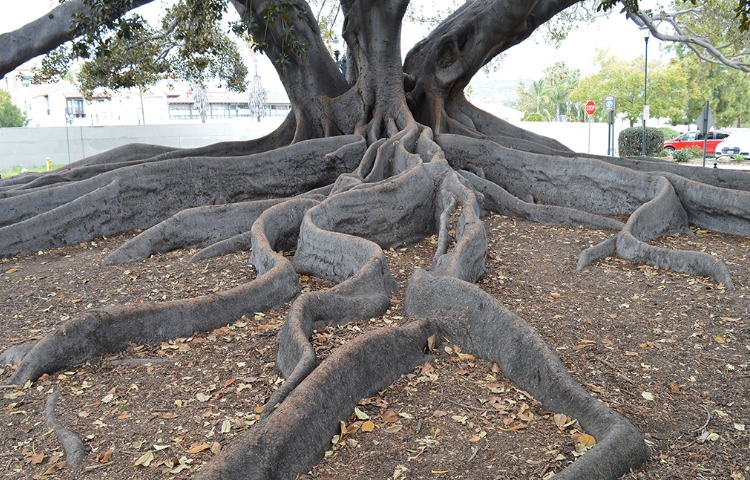
The Moreton Bay fig tree is a massive evergreen native to eastern Australia, instantly recognizable by the huge, wall-like buttress roots that fan out from its trunk like frozen ripples. In the wild it begins life as a strangler fig, germinating high in the canopy of another tree before its roots ever touch soil, yet in cities from Sydney to Santa Barbara it’s grown into one of the most beloved shade trees around.
Its common name comes from Moreton Bay, a stretch of coast near Brisbane, Queensland, though the tree’s natural range extends far beyond that single bay. Few trees pack as much biological strangeness, an entire life built around a single species of wasp, into something that also functions as a perfectly ordinary park tree.
This guide covers the tree’s classification, its unusual life cycle, how to identify it, its native range, its history in California, and what it takes to grow one.
Sydney has its own famous specimens too, and huge old figs line the harbor foreshore at the Royal Botanic Garden and the Domain, where they’ve stood for well over a century and are treated as genuine civic landmarks in their own right.
Botanical Classification
The Moreton Bay fig, scientifically Ficus macrophylla, belongs to the mulberry family and to the same genus as the common edible fig, the Indian banyan, and the rubber tree. It’s often called the Australian banyan, a name that reflects the broader use of “banyan” for any strangler fig capable of growing into a wide, multi-trunked giant, rather than one specific species.
Botanists recognize 2 forms within the species: a free-standing form native to the Australian mainland, and a distinct columnar form found only on Lord Howe Island, an isolated volcanic remnant off the New South Wales coast. That island population is genetically and physically separate enough to warrant its own scientific name, even though both forms share the same basic biology.
The Strangler Fig Life Cycle
In its native rainforest, a Moreton Bay fig rarely starts life in the ground. A bird or fruit bat eats one of its figs and deposits the seed high in the canopy of another tree, where it germinates as an epiphyte, a plant growing on another plant without touching the earth at all. From that perch, the young fig sends roots downward, sometimes for years, until they finally reach the soil.
Once rooted, those descending roots thicken and fuse around the host tree’s trunk, eventually forming the dramatic, wall-like buttresses the species is famous for. Over decades the host tree can be shaded out and gradually killed, leaving the fig standing as an apparently freestanding giant, a hollow lattice of fused roots where the original tree once stood. Trees planted deliberately in gardens skip this entire process, since a seedling planted directly in the ground never needs a host tree to begin with.
Fig Wasp Pollination
Every fig species depends on a single, dedicated species of wasp for pollination, and the Moreton Bay fig is no exception. Its partner is a tiny agaonid wasp, and the relationship is what biologists call an obligate mutualism: the fig can only be pollinated by this one wasp species, and the wasp can only reproduce inside this one fig species’ fruit.
A female wasp squeezes into a fig’s tiny opening, pollinating flowers packed inside and laying her eggs before dying inside the very fruit she pollinated. Her offspring later emerge, mate, and the newly fertilized females fly off carrying pollen to start the cycle again in another fig. That single-species dependency is also why the tree can only spread to a new region if its specific wasp manages to arrive too, something that has happened accidentally in Hawaii and New Zealand, where introduced or accidentally transported wasps have allowed previously sterile ornamental fig trees to begin reproducing on their own.
Identifying Characteristics
Beyond the signature buttress roots, Moreton Bay fig has large, glossy, dark green leaves, oval to oblong in shape, with a leathery texture typical of a rainforest tree adapted to heavy rain and strong light. New growth often emerges with a coppery or reddish tinge before darkening.
The fruit is a fig in the true botanical sense, a syconium, meaning the flowers are held entirely inside a fleshy, hollow structure rather than exposed on the outside like a typical flower. Moreton Bay fig fruits are small, only about a centimeter or two across, ripening from green to purple, and while technically edible they’re valued more by fruit-eating birds and bats than by people. A mature tree can be enormous. The Australian National Botanic Gardens database records the tallest confirmed specimen at just over 70 meters, and Australian trees are often reported spreading their crowns 30 meters or more across.
Native Range and Habitat
The species is native to the eastern coast of Australia, from the Wide Bay-Burnett region of central Queensland south to the Illawarra region of New South Wales, along with an isolated population on Lord Howe Island far out in the Tasman Sea. Within that range it grows in subtropical, warm temperate, and dry rainforest, often as an emergent tree whose crown rises above the surrounding canopy, particularly along watercourses on rich alluvial soil.
That native range spans a considerable stretch of coastline and climate, which helps explain why the species has proven so adaptable to cultivation in other warm regions of the world.
A History in California
Moreton Bay figs arrived in Southern California in the 1870s, part of a broader wave of interest in Australian trees during a period when horticulturists believed the climates of coastal Australia and coastal California were similar enough to make the exchange worthwhile. Several of the era’s plantings have become genuine local landmarks.
Santa Barbara’s most famous specimen, standing near the city’s Amtrak station, was reportedly planted in 1876 from a seedling given by an Australian sailor to a local girl. It was designated a historic landmark in 1970, and by some measurements its canopy has spread further than any other Moreton Bay fig in North America. Los Angeles has its own historic specimens too, including trees planted around the old city plaza in 1875 as part of an early civic beautification effort, one of which still stands at a church in the Palms neighborhood as a designated Historic-Cultural Monument. According to the Oregon State University Landscape Plants database, the tree has also become common in Hawaii and northern New Zealand, where it has since naturalized after its pollinator wasp arrived.
Landscape Uses and Growing Considerations
Moreton Bay fig is planted as a park tree, a street tree, and a specimen shade tree wherever a frost-free, warm climate allows it, since it’s hardy only to about USDA zone 9 and cannot tolerate hard freezes. It wants full sun and thrives especially well along a watercourse or in deep, rich soil, echoing the alluvial riverbanks it favors in the wild.
Regular watering during establishment helps a young tree develop the deep root system it needs before it can handle the drier spells a mature specimen tolerates comfortably. Its scale is the single biggest consideration before planting one. A tree that can eventually spread its canopy 30 meters or more, and send buttress roots outward with equal enthusiasm, needs genuinely open space to avoid conflict with foundations, sidewalks, and underground pipes. Those same aggressive surface roots, which make the tree so visually striking, are also why so many urban Moreton Bay figs have needed protective root barriers or, in some cases, generous fenced-off root zones to keep them from buckling pavement.
Pests and Invasiveness
Like most figs, Moreton Bay fig can be affected by scale insects, mealybugs, spider mites, and root-knot nematodes, along with occasional fungal and bacterial leaf spots and twig dieback. None of these problems are usually severe on an established, well-sited tree, and healthy, deeply rooted specimens generally shrug off minor pest pressure without lasting damage.
The bigger long-term concern in some regions is the tree’s capacity to spread once its pollinator wasp becomes established outside Australia. In Hawaii, where the wasp was deliberately introduced in 1921, the tree has since begun reproducing on its own and spreading into new areas, a pattern land managers now watch closely given how difficult an established strangler fig can be to remove once it takes hold, whether in a garden bed or, worse, wrapped around another tree in a native forest.
The Bottom Line
Moreton Bay fig is a tree of real contradictions, a rainforest strangler that kills its host tree in the wild, yet a beloved, entirely peaceful shade tree in the parks and streets where people plant it directly. Give it room, warmth, and rich soil, and it will reward you with a canopy, and a set of roots, unlike almost anything else you could plant.