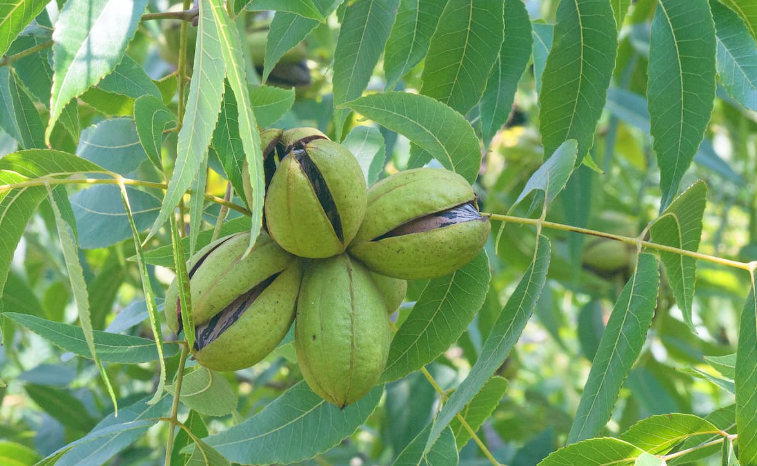
The pecan tree is the largest of the hickories and the only major nut crop native to North America, growing wild in the Mississippi River floodplain and in the river bottomlands of Texas and northern Mexico. It thrives in the long, hot summers and moderately cool winters of that region, and its name comes from an Algonquian word meaning a nut too hard to crack by hand.
Pecans are a big business in the United States. In 2023, according to the USDA’s National Agricultural Statistics Service, American growers harvested 271 million pounds of pecans from 441,000 bearing acres, worth about $460 million, at an average yield of 616 pounds per acre. New Mexico led the country that year with 100 million pounds, ahead of Georgia at 88.3 million, and the United States produces nearly 80 percent of the world’s pecans.
Almost all of that crop comes from named, grafted trees rather than wild ones, with improved varieties making up 95 percent of U.S. production in 2023. The practice traces back to 1846, when an enslaved gardener named Antoine at Oak Alley Plantation in Louisiana grafted an improved pecan that later became known as Centennial. Grafted trees start bearing at 6 to 8 years of age, though full production often takes about 10 years.
All pecan trees belong to a single species, so the 21 “types” below are named cultivars, each with its own parentage, nut size, ripening date, and pollination pattern. Pecans are wind pollinated, and cultivars flower in one of two patterns, called Type I (pollen shed first) and Type II (female flowers receptive first), so orchards mix compatible types. The University of Georgia Extension’s pecan variety guide and the New Mexico State University cultivar guide describe these varieties in far more detail. What follows covers 21 types of pecan trees.
Stuart
Stuart is one of the oldest and best known pecan cultivars, a seedling selection dating to 1886, and University of Georgia Extension credits it with helping form the Georgia pecan industry. It produces a large nut that matures early in the season, and mature trees can be very productive.
It is a Type II tree that takes a long time to come into production, and nut quality can be marginal, with poorly filled kernels in some years. Yellow aphids like it, and although it is scab susceptible, the disease is easier to control on Stuart than on Desirable.
Desirable
Desirable is a cross of Success and Jewett and has long set the standard for quality in the Southeast, producing large, well-filled nuts and many mammoth halves. It is a Type I tree that naturally thins its own clusters to 2 or 3 nuts each, which helps it produce consistent crops year after year.
It is the main cultivar in most commercial Georgia orchards, but it is probably the most scab-susceptible cultivar still grown in the Southeast. Georgia specialists note that it once had good resistance, and that the scab fungus has adapted to it over time, so it needs a full season of fungicide protection.
Elliott
Elliott is a seedling selection that produces a small, teardrop-shaped nut of very high quality, with plump, perfect halves. Its excellent scab resistance led University of Georgia Cooperative Extension to recommend it for orchard planting in the early 1960s, and it is still widely planted.
It is a Type II tree that bears alternately but keeps its nut quality in heavy crop years. It is susceptible to late spring freezes, so it should not be planted in north Georgia or in low spots, and young trees are slow to come into production.
Sumner
Sumner is a seedling of Schley that has been in Georgia’s Coastal Plain experimental orchards since 1940, and it was first recommended for Georgia by Ray Worley. It produces relatively large nuts of moderate quality, and it has fairly regular production once mature.
It is a Type II tree with a very late harvest, averaging October 29, which is a major drawback. It has historically been very scab resistant, but susceptibility has recently been reported in some locations, and black pecan aphids often attack it first.
Cape Fear
Cape Fear is a seedling of Schley that is precocious, meaning it begins bearing at an early age, and it produces well-filled nuts with attractive golden kernels while young. It is a Type I tree that was valued for its good scab resistance in most locations.
Its downsides are that it tends to overload as it matures, which drops the kernel percentage and pushes it into alternate bearing. Its scab resistance has been overcome in some orchards, and it seems to be more prone to bacterial leaf scorch.
Oconee
Oconee is a cross of Schley and Barton that combines large nuts with high kernel quality, and it is an excellent sheller that produces a large percentage of intact halves. It is a Type I tree with an early harvest, averaging around October 12.
It is scab susceptible and needs a good spray program, and black aphids favor it. Georgia researchers noticed its performance declined when trees began shading each other, so orchards need to be thinned promptly.
Forkert
Forkert is a cross of Success and Schley, and its outstanding feature is nut quality, averaging 58 percent kernel in Tifton, Georgia trials. The nuts are large at about 53 per pound, with a thin, rather bumpy shell that is easy to crack, which makes it a favorite for the in-shell market.
It is a Type II tree that ripens around October 19, about the same time as Stuart. It is scab susceptible, though a standard spray program controls it, and it must be monitored for black aphids.
Excel
Excel was discovered as a seedling tree on a pecan farm near Blackshear, Georgia, and was patented and distributed by Andy Clough, who runs a nursery on his farm. It produces a large nut similar in size to Desirable, with a bright golden kernel that holds its color well in storage.
It is a Type II tree, and it is one of the few large-nut cultivars with high resistance or immunity to scab so far. Georgia specialists recommend it only for trial, since scab resistance often breaks down once a new cultivar is widely planted, and its thick shell limits the kernel percentage to around 50.
Caddo
Caddo is a cross of Brooks and Alley and is among the highest-yielding varieties University of Georgia has tested. It is precocious, but unlike most precocious cultivars it stays productive as a mature tree without swinging into extreme alternate bearing.
Its nuts are medium sized at about 67 per pound, with a slender golden kernel and 54 percent kernel. It is a Type I tree that ripens early, around October 11, and it is scab susceptible but controllable with a standard spray program, though black aphids favor it.
Kiowa
Kiowa is a cross of Mahan and Desirable and was one of the large-nut varieties released during the early era of USDA breeding, when pecans were bred primarily for size. It is a precocious Type II tree whose nuts are slightly larger than Desirable’s.
It tends to overbear as a mature tree, which hurts kernel quality in heavy years, and its nuts are strongly attached to the stem, making them difficult to shake off. Georgia specialists do not normally recommend it, but it remains one of the common commercial varieties in Texas.
Pawnee
Pawnee is a cross of Mohawk and Starking Hardy Giant from the USDA breeding program, released in 1984. Its most outstanding feature is a large nut, around 51 to 58 per pound, combined with very early maturity in mid-to-late September, weeks ahead of traditional Western varieties.
It is a Type I tree that earns a price premium on the early market. Its serious weakness is scab, since in 2004 and 2005 Georgia trials Pawnee showed more scab damage than Desirable planted next to it, so Georgia specialists do not recommend it where scab pressure is high.
Byrd
Byrd is a cross of Pawnee and Wichita and was the first variety released from the University of Georgia’s breeding program, which Dr. Darrell Sparks started in 1989. It is one of the very few cultivars with a large nut and a very early harvest, ripening in mid-to-late September, about a week after Pawnee.
It is a Type I tree with a very thin shell and a high percent kernel, and it appears less scab susceptible than Pawnee. It is precocious and loads up with nuts, so it needs summer crop thinning to avoid strong alternate bearing, and it should be expected to need full-season fungicide protection.
Kanza
Kanza is a cross of Major and Shoshoni, made in 1955 by the USDA breeding program and released in 1996. It was released for its productivity, quality, disease resistance, and cold tolerance, and it produces a small, attractive, round kernel so similar to Elliott’s that the nuts can be hard to tell apart.
It is a Type II tree that ripens early and has shown excellent scab resistance, though it has not been widely grown in the South. Georgia specialists recommend it as a replacement for Elliott in north Georgia, where Elliott is damaged by late spring freezes, and its early, small nuts are vulnerable to birds and squirrels when only a few trees are planted.
Lakota
Lakota is a cross of Mahan and Major, made in 1964 and released in 2007 cooperatively by the USDA breeding program and Kansas State University. It produces medium-sized nuts of high quality, with a light kernel color and 57 to 62 percent kernel.
It is a Type II tree that ripens about two weeks after Pawnee, which makes it a good candidate for cooler, shorter-season areas. It is susceptible to overbearing, which can lead to severe alternate bearing, and Georgia specialists suggest planting only small trial blocks until it has been tested further.
Lipan
Lipan is a cross of Cheyenne and Pawnee, made in 1986 and released in 2011, and New Mexico State University describes it as the newest USDA cultivar in their guide. Its nuts are quite large, at 44 to 46 per pound on young trees, with 53 to 55 percent kernel.
It is a Type I tree that ripens about two weeks after Pawnee. It is a promising cultivar, but little is known yet about how it will perform under southwestern growing conditions, and it remains to be seen whether nut size holds as the trees age.
Sioux
Sioux is a cross of Schley and Carmichael, and Texas A&M specialists rank it among the named cultivars with the best eating quality. It is a Type II tree with smooth kernels, and it is one of the common commercial varieties grown in Texas.
It also makes an attractive tree that needs little training, and Texas A&M recommends it as one of the best pecans for homeowners. That combination of flavor and good looks has kept it popular in yards as well as orchards.
Nacono
Nacono is a cross of Cheyenne and Sioux, made in 1974 and released in 2000. It produces a very large, extremely high-quality nut, at 43 to 44 per pound with 56 to 57 percent kernel and a light kernel color.
It is a Type II tree with a higher yield potential than Pawnee, but nuts on young trees are susceptible to suture split. It ripens relatively late and is very susceptible to yellow and black-margined aphids, so it is best suited to areas with a long growing season.
Cheyenne
Cheyenne is a cross of Clark and Odom from the USDA breeding program, released in 1970. Its medium-sized nuts, about 55 to 60 per pound, have a distinctive wrinkled kernel that is light and golden with high oil content and excellent flavor.
It is a Type I tree that is highly productive and precocious, but it has fruit-set problems and a tendency toward severe alternate bearing. New Mexico State University says it has fallen out of favor for commercial orchards in the West, although Texas A&M lists it, along with Wichita, as a mainstay of the commercial industry in Central and South Texas.
Wichita
Wichita is a cross of Halbert and Mahan, made in 1940 by the USDA breeding program and released in 1959. It is a Type II tree that is the most common pollinizer in New Mexico orchards planted mainly to Western, and it is a main cultivar in Arizona, California, and the Mexican state of Sonora.
It is precocious, bearing its first crop 5 or 6 years after planting, and very prolific at maturity, with nuts of 50 to 62 per pound and 56 to 62 percent kernel. Its branches tend to be weak, it is highly susceptible to zinc deficiency, and it tends to overbear.
Western
Western, also sold as Western Schley, is a seedling selection from San Saba County, Texas, introduced in 1924, and despite the name it is unrelated to the cultivar called Schley. More acres in New Mexico and neighboring west Texas are planted to Western than any other cultivar, and it has been called the backbone of the New Mexico pecan industry.
It is a vigorous Type I tree that begins producing in its sixth or seventh year and is nicknamed the “workhorse” of the West because it is a reliable, heavy producer. It is much less susceptible to zinc deficiency than many cultivars, but its nuts mature late, in late October or early November, so early freezes can leave nuts stuck in the shuck.
Burkett
Burkett is a native selection from Callahan County, Texas, introduced in 1911, meaning it was picked from a wild tree rather than bred. It is a Type II tree with a naturally symmetrical, spreading crown, and it is popular in New Mexico as a landscape tree and in home orchards.
Its nuts are large, at 45 to 60 per pound, and very round, with excellent flavor and kernels that come out easily in halves. The kernels have dark freckles, yields are only mediocre by commercial standards, and black pecan aphids like it, so it is more often used as a source of rootstock seed than for commercial shelling nuts.
Key Takeaways
- Pecan trees include numerous cultivars and varieties, each with differences in nut size, shell thickness, kernel quality, growth habit, and harvest time.
- Popular varieties include Pawnee, Desirable, Stuart, Elliott, Choctaw, Kanza, and Caddo, among others.
- Pecan varieties differ in their pollination behavior, so growing compatible varieties together can improve nut production.
- Most pecan trees require full sun, deep soil, good drainage, and adequate moisture to develop properly and produce nuts.
- The best variety depends on factors such as climate, growing season, disease pressure, tree size, and the desired harvest period.
- Pecan trees can become very large and long-lived, so they need plenty of space when planted in orchards or home landscapes.
- Nut characteristics vary considerably, including nut size, shell thickness, kernel percentage, flavor, and ease of cracking.
- Understanding the differences between pecan varieties makes it easier to choose trees suited to a particular region, orchard, or home garden.