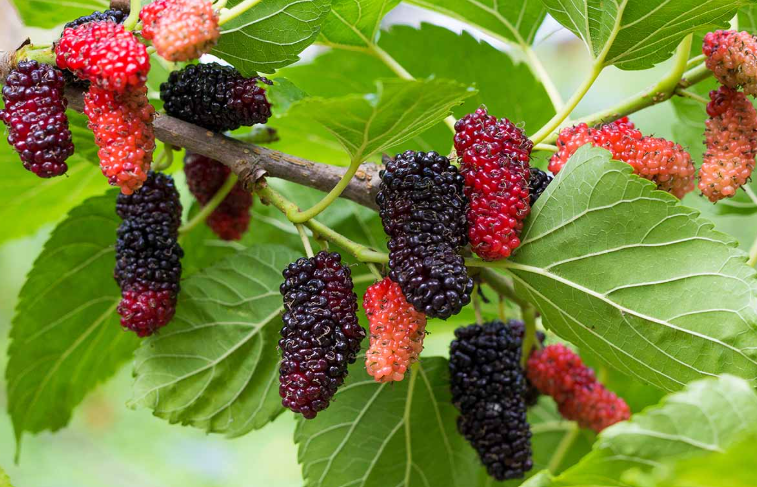
Mulberry trees are among the oldest cultivated trees in the world, grown for thousands of years for their sweet, dark berries and for their leaves, which are the preferred food of silkworms. The tree has shaped trade, farming, and even legislation, and it now grows on nearly every inhabited continent.
The name covers a group of related trees rather than a single plant. Three species dominate: the white mulberry from China, the red mulberry native to eastern North America, and the black mulberry from western Asia, along with many hybrids and cultivars. Fruit color is not a reliable guide to the species, since a single tree can bear berries ranging from white to nearly black.
Mulberries are also a story of unintended consequences. Introduced to North America partly to start a silk industry that never took hold, the white mulberry escaped, spread widely, and now hybridizes so heavily with the native red mulberry that the native tree is listed as endangered in Ontario.
This article covers the main species, the history of silk, the fruit and its nutrition, and how to choose and grow a mulberry tree without ending up with a messy or allergy-triggering one.
The Three Main Mulberry Species
White mulberry is native to China and is the species behind the world’s silk industry. It is a small to medium tree that grows up to about 50 feet, with glossy, smooth leaves and fruit that can be white, pink, lavender, or black. The fruit is typically sweet but mild, and this is the most widely planted mulberry in the world.
Red mulberry is native to eastern North America and usually grows taller than white mulberry, up to about 70 feet in natural settings. Its leaves are larger, dull and rough on top, and hairy underneath, and it prefers rich, moist soil and partial shade, while white mulberry will grow in poor soil and full sun. The University of Florida notes that the Iroquois mashed, dried, and stored the fruit to make warm sauces, the Timucua of northeast Florida made dyes from the fruit, leaves, and twigs, and the Seminoles used the branches to make bows.
Black mulberry is native to western Asia and the Middle East and is generally the smallest of the three. Many people consider its intensely flavored, sweet-tart, almost black fruit the best of any mulberry. The UF/IFAS Gardening Solutions mulberry guide covers all three species from a home grower’s point of view.
Silk and the History of the White Mulberry
Silk production began in China, where white mulberry has been cultivated to feed silkworms for more than 4,000 years. The secret was so closely guarded that smuggling silk out of the country was reportedly punishable by death, and it was centuries before the knowledge spread to the rest of the world.
Europeans and colonists were determined to break that monopoly. White mulberry was introduced to what is now the United States several times from the early 1600s, and in 1624 the Virginia legislature required every male resident to plant at least 4 white mulberry trees to promote a domestic silk industry. In the 1830s, hopes of a silk boom set off a horticultural craze known as “mulberry mania” across the eastern states, according to the U.S. Forest Service’s fire effects database.
Connecticut became the center of the American effort. According to Connecticut History, the state was producing three times as much silk as any other state by 1840, and in one town alone, Mansfield, three-quarters of households were involved in silk production in 1825. The boom did not last, though. The Forest Service reports that white mulberry plantations in the Northeast were killed by cold winters and those in the South by disease, which ended the planting craze.
A Native Tree Under Pressure
The silk industry disappeared, but the trees stayed. White mulberry produces large amounts of fruit and seed, adapts to many environments, and readily invades forest edges and open areas, and in North America it has few natural predators or diseases to hold it back.
The larger problem is that white and red mulberry are interfertile and often grow side by side. Hybrids disproportionately show white mulberry traits, and because white mulberries far outnumber the native trees, the red mulberry’s gene pool is being steadily diluted. Researchers at the University of Toronto Scarborough report that the native red mulberry is now listed as endangered in Canada, and it is also considered rare or threatened in parts of the United States, including Michigan.
Telling the two apart is a practical skill for anyone with a mulberry in the yard. White mulberry leaves are glossy and smooth, while red mulberry leaves are rough on top and softly hairy underneath, and red mulberry generally grows taller and prefers shadier, richer sites.
Mulberry Fruit and Nutrition
A mulberry looks like a single berry but is actually an aggregate of many tiny fruits clustered around a central axis, much like a blackberry. Each fruit is roughly an inch long and can range from white and pink to deep purple-black, and the darkest berries get their color from anthocyanins, the same pigment family found in blueberries and red cabbage.
Per 100 grams, raw mulberries contain about 43 calories, according to USDA-based nutrition data, along with roughly 36 milligrams of vitamin C, about 40 percent of the current daily value. They also supply about 1.85 milligrams of iron, which is unusually high for a berry. A one-cup serving of about 140 grams contains around 60 calories and 51 milligrams of vitamin C.
You rarely see fresh mulberries at the grocery store for a simple reason. According to the University of California Agriculture and Natural Resources, the fruit of the fruiting varieties cannot be kept long or shipped well, which is why most people eat mulberries straight from a backyard tree, or buy them dried. Dried mulberries are much sweeter and more calorie-dense than fresh ones, since drying concentrates the sugar.
In the kitchen, ripe mulberries are eaten fresh, baked into pies and crumbles, cooked into jam, steeped for tea, and fermented into wine. Their flavor is milder and more delicate than a blackberry’s, and they stain hands and clothing easily, so it is worth wearing old clothes when picking them. Some early studies have looked at mulberry fruit and leaf extracts for blood sugar and cholesterol, but the research is still preliminary, and mulberries are best treated as a nutritious fruit rather than a treatment for any condition.
Also Read: Different Types of Mulberry Trees
Other Uses for Mulberry
The leaves are far more valuable than the fruit in many parts of the world, since they remain the standard food for silkworms in commercial silk production. In some regions, farmers also feed leftover leaves to cattle, and the wood, which is hard and shock resistant, has been used for fence posts, woven baskets, and silkworm trays.
Wildlife is another draw, since songbirds flock to a fruiting mulberry, and the tree can be a lively spot for birdwatching in early summer. Gardeners who want to keep the berries for themselves often spread a sheet under the branches and shake the ripe fruit loose, or cover the tree with netting, because birds are less attracted to white-fruited types than to dark ones.
Mulberry also has a role as a shade tree. The University of California notes that the fruitless white mulberry selections make excellent shade trees and do well in the desert, and that they can take some drought once established. It should not be confused with paper mulberry, a related but different tree that is grown for its bark fiber.
Growing a Mulberry Tree
The first choice is between a fruiting and a fruitless tree, and it matters more than most gardeners realize. Fruiting mulberries can be messy, since the ripe berries stain patios, driveways, and cars, and many fruitless mulberries are male clones that produce no fruit but plenty of pollen. Only male trees produce pollen, which is a well-known allergen, and some cities in the desert Southwest, including Phoenix, Las Vegas, and El Paso, have banned planting male mulberries. Female-only trees, by contrast, are considered very low in allergy potential.
Most fruiting cultivars sold in nurseries are female-only and set fruit without needing a second tree. Popular choices include ‘Illinois Everbearing’, which is reported to tolerate temperatures down to about minus 25 degrees Fahrenheit, ‘Dwarf Everbearing’, which stays around 8 to 12 feet tall and grows well in containers, and ‘Pakistan’, a low-chill variety suited to warm zones 9 and 10. Fruitless shade cultivars include ‘Bellaire’, ‘Chaparral’, ‘Hempton’, and ‘Urban’. Trees grown from seed can take 5 to 10 years to fruit, so a named grafted variety is the better bet if you want berries sooner.
Mulberries do best in full sun and adapt to a wide range of soils. Prune mature trees only to remove dead, damaged, or crossing branches, since large pruning wounds are slow to heal. Wear gloves when working with the tree, because the milky sap can cause skin rashes in some people, and check with your local extension office before planting, since white mulberry is invasive in many areas. The Woody Invasives of the Great Lakes Network has a helpful guide to distinguishing white mulberry from look-alike species, and the University of California’s fruitless mulberry guide covers the shade tree side of the story.
Key Takeaways
- Mulberry trees are deciduous fruit trees grown for their sweet, berry-like fruits and attractive foliage.
- Common mulberry species include red mulberry, white mulberry, and black mulberry, which differ in fruit color, growth habit, and native range.
- Mulberries can grow in a range of soils but generally perform best in well-drained soil with adequate sunlight.
- The fruits are enjoyed by birds, wildlife, and people and can be eaten fresh or used in jams, desserts, and other foods.
- Mulberry trees can become fairly large, so their mature size and spreading roots should be considered when choosing a planting location.
- Many mulberry trees are relatively hardy and adaptable, making them suitable for a variety of climates.
- Mulberries can be propagated from seeds, cuttings, or grafting, depending on the species and growing objectives.
- Regular pruning can help manage the tree’s size, shape, and fruit-bearing branches, particularly in smaller gardens.