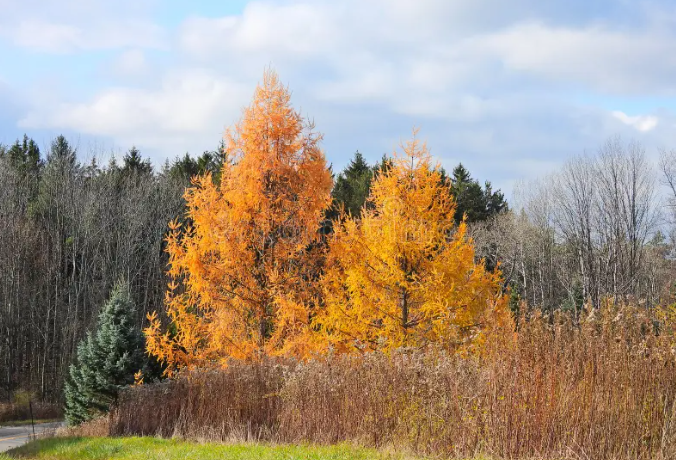
Tamarack, also called eastern larch, is a deciduous conifer, which means it bears cones and needles like a pine but drops all of its needles each autumn. Its soft, bright green needles are about an inch long and grow in tufts on short spur shoots, and they turn golden yellow before falling. It is the only conifer in Minnesota that sheds all its needles every year, and its common name comes from an Algonquian word meaning “wood used for snowshoes.”
The tree is native to a huge swathe of northern North America, from the eastern Yukon and Northwest Territories east to Newfoundland, and south into the northeastern United States as far as Maryland and west to Minnesota. It typically grows 40 to 80 feet tall, is hardy in zones 2 to 5, and thrives in cold, wet ground where few other trees can survive. Tamarack is one of only 3 larch species native to North America, in a genus of roughly 10 species found across the cool northern hemisphere.
Tamarack has faced serious insect pressure in recent decades. The Minnesota Department of Natural Resources reports that the state was in its 25th consecutive year of eastern larch beetle outbreak in 2025, with more than 1 million acres of forest tamarack affected, compared with 54,000 acres of mortality recorded between 2001 and 2006. In Alaska, an outbreak of larch sawfly between 1999 and 2004 hit an estimated 600,000 to 700,000 acres, with mortality of 80 percent or more in defoliated stands.
Tamarack is a single species with no recognized natural varieties, and only a handful of named cultivars exist, so the 15 entries below cover the true cultivars, the main growth forms found in nature, and the closest larch relatives that are often planted or confused with it. The University of Minnesota Extension’s tamarack profile documents the tree’s identification, range, and landscape use in more detail than a general overview can. What follows covers 15 types of tamarack tree.
Blue Sparkler
Blue Sparkler is a dwarf tamarack cultivar with dense, upright branching and needles that start pale blue and age to grey-blue over the season. It was selected in 1985 as a witch’s broom seedling by Dr. Sidney Waxman at the University of Connecticut, and water droplets held in the needle axils sparkle in the sun, which gave the plant its name.
It grows only about 3 to 4 inches a year, reaching roughly 3 feet tall and 30 inches wide after 10 years. It is sometimes wrongly sold as a Japanese larch cultivar, so it is worth checking the label before buying.
Deborah Waxman
Deborah Waxman is a broadly upright dwarf tamarack with dense, semi-upright branching and soft blue-green needles. Dr. Sidney Waxman selected it in 1988 from seedlings in the University of Connecticut’s trial beds and named it after his daughter.
It bears showy rosy new cones in spring and turns coppery gold in autumn. Published growth rates vary, with the American Conifer Society giving about 3 feet tall and wide after 10 years and Cornell’s woody plants database giving up to 5 feet tall and 3 feet wide.
Lanark
Lanark is a dwarf tamarack cultivar that the University of Connecticut plant database describes as growing very low and wide. Like several other named tamaracks, it comes from the selection work of Dr. Sidney Waxman, though little detailed published information exists about it.
It is best suited to a rock garden or the front of a bed where its low, spreading form can be appreciated. It needs full sun and consistently moist soil, and it turns yellow in autumn like the species.
Newport Beauty
Newport Beauty is a miniature tamarack cultivar that probably never exceeds 2 feet tall and wide, making it the smallest of the named forms. It is one of the four tamarack cultivars listed by both the University of Connecticut and Cornell University.
Its tiny size makes it a good candidate for a trough garden, a large container, or a dwarf conifer collection. It needs cool conditions and steady moisture, and it colours to gold before dropping its needles for winter.
Lowland Tamarack
Lowland tamarack is not a formal variety but the growth form most people picture, a slender tree growing in bogs, fens, and swamps across the northern forest. It is commonly the first forest tree to invade filled-in lake bogs, and it can survive flooding partly because of its ability to grow adventitious roots.
Trees on these cold, waterlogged sites grow slowly and often stay small for their age. They are very well suited to wet garden spots and rain gardens where most conifers would rot.
Upland Tamarack
Upland tamarack describes trees growing on better-drained mineral soils rather than in bogs. They are less common in the wild than their lowland counterparts, but in cultivation they often grow faster because the soil is richer and less waterlogged.
Tamarack has long been considered a light-loving tree, though a 2022 University of Minnesota study found understory saplings between 9 and 82 years old, suggesting it may tolerate shade better than once believed. Even so, it grows best in full sun and steady moisture.
Alaskan Larch
Alaskan larch is the name for tamarack populations in Alaska, which were once considered a separate variety or even a species. Current research shows their variation in cones and needles is too gradual to justify separate recognition.
These northern stands have faced serious insect damage, with a larch sawfly outbreak between 1999 and 2004 affecting an estimated 600,000 to 700,000 acres. That history makes them a useful reminder of how vulnerable single-species larch stands can be.
Western Larch
Western larch is a distinct species native to the northern Rocky Mountains and the Pacific Northwest, and it is the largest of the North American larches, often exceeding 100 feet in height. Mature trees have thick, fire-resistant bark, which helps them survive the wildfires that sweep through their mountain forests.
It is a much larger tree than tamarack and needs a lot of space, so it suits big properties rather than small gardens. It thrives in full sun and deep, well-drained soil, and it turns a brilliant gold in autumn.
Subalpine Larch
Subalpine larch is a slow-growing species found near the treeline in the mountains of the Pacific Northwest and southern Canada, where it endures harsh winds and deep snow. It can live for many centuries, and its golden autumn colour draws hikers to high-elevation larch stands each fall.
It is very difficult to grow at low elevations, since it needs cold winters, cool summers, and excellent drainage. It is generally best left to specialist collectors and mountain-climate gardens.
European Larch
European larch is native to the mountains of central Europe, including the Alps and Carpathians, and was introduced to Britain in the 17th century. It has been widely planted for timber and is one of the parents of the hybrid Dunkeld larch.
It is a larger and generally faster-growing tree than tamarack, and it prefers drier, well-drained soil. It does well in milder climates than tamarack, though it is still hardy to cold winters.
Japanese Larch
Japanese larch is native to the mountains of central Honshu and is one of the most widely planted larches in commercial forestry, prized for its fast growth. It has been extensively felled in parts of Britain and Ireland due to the disease known as sudden larch death.
Two tamarack cultivars, Blue Sparkler and Deborah Waxman, are sometimes wrongly listed as Japanese larch cultivars, which makes it easy to confuse the two species. Japanese larch generally prefers well-drained soil and does not tolerate waterlogging as well as tamarack does.
Siberian Larch
Siberian larch is native to a vast area of Siberia and parts of northern Russia, Kazakhstan, and Mongolia, where it forms extensive forests in bitterly cold climates. It is one of the most cold-hardy trees in the world.
It is a taller, faster-growing tree than tamarack and is widely used for timber. It thrives in full sun and moist but well-drained soil, and it needs a genuinely cold climate to grow well.
Dahurian Larch
Dahurian larch is native to eastern Siberia, northeastern China, and Mongolia, where it dominates large stretches of the far-eastern taiga. It can grow in permafrost-affected soils, thanks to a shallow, spreading root system that stays above the frozen layer.
It is extremely cold-hardy and is sometimes grown as a landscape tree in very cold regions. It needs full sun and moist soil, and it does not tolerate hot, humid summers well.
Hybrid Larch
Hybrid larch, often called Dunkeld larch, is a cross between European and Japanese larch that arose in the early 1900s at Dunkeld in Scotland. It has been widely planted in British forestry because of its vigorous growth.
It is a fast-growing tree that suits large properties and woodlands rather than small gardens. Like other larches, it prefers full sun and well-drained soil, and it drops its needles each autumn after turning gold.
Golden Larch
Golden larch is not a true larch but a separate deciduous conifer from eastern China, often grown alongside larches for its brilliant golden autumn colour. It is included here because it is frequently sold and described as a kind of larch, though it belongs to a different genus.
It grows slowly and tolerates warmer, more humid summers than tamarack and its true larch relatives. It needs full sun and well-drained, slightly acidic soil, and it is a good choice where tamarack would struggle with the heat.
Key Takeaways
- Tamarack, also called Eastern larch, is a deciduous conifer that loses its soft, needle-like foliage each autumn.
- It is native to northern North America, particularly Canada and the northern United States, where it commonly grows in cold, wet environments.
- The tree develops bright green needles in spring and summer that turn yellow before falling in autumn.
- Tamarack is highly cold-hardy and can tolerate extremely low winter temperatures, making it suitable for northern climates.
- It typically grows in moist, acidic soils, including bogs, swamps, and poorly drained areas, although it can grow in other conditions when moisture is adequate.
- Mature trees can become large, making them useful as specimen trees, wildlife habitat, and naturalized landscape plantings.
- Tamarack provides food and shelter for various wildlife species, while its seeds are eaten by birds and small mammals.
- Although it is a conifer, its annual loss of needles makes it different from evergreen trees such as spruce, fir, and pine.