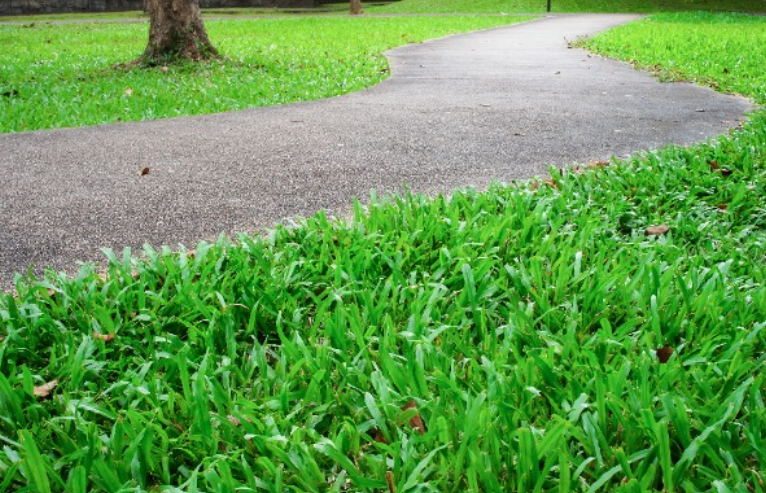
True carpetgrass, the genus Axonopus, is a genuinely small group, and it’s worth saying plainly upfront: there isn’t a sprawling world of named carpetgrass cultivars the way there is for bermudagrass or zoysia, which have entire breeding programs dedicated to producing new varieties every few years. Carpetgrass has never attracted that kind of commercial investment, so the honest answer to “how many types of carpetgrass are there” is closer to a handful of true species than 21.
To build a genuinely useful list at that number, this one spans 3 different categories, and each entry says plainly which one it belongs to. The first group covers the real Axonopus species and documented ornamental forms. The second covers other true turfgrasses that carry “carpet grass” as a regional or international alternate name, since St. Augustine grass, for instance, is sometimes marketed under that exact name outside the United States. The third and largest group covers non-grass groundcovers commonly searched and sold as a “carpet grass alternative,” plants that create the same dense, walkable mat without being a grass at all.
None of that makes the non-grass entries any less useful if a genuine lawn substitute is actually the goal, but it’s a meaningfully different plant category than true carpetgrass, and worth knowing the difference before buying seed or plugs under a name that doesn’t mean what it seems to. The University of Florida IFAS Extension’s turfgrass publications cover true carpetgrass species in more agronomic detail than most consumer sources. What follows covers 21 plants connected to the “carpet grass” name, spanning true species, alternate names, and honest lawn-alternative substitutes.
Common Carpetgrass
Common carpetgrass, botanically Axonopus fissifolius, is the most widely recognized true carpetgrass species, forming a coarse, spreading turf via above-ground stolons in wet, low-fertility soil where more demanding turf species struggle. Its tall, forked seed heads are a distinctive identifying feature once the plant flowers.
It tolerates poor drainage and low fertility better than almost any other common turf species, making it a practical, low-input choice for a genuinely difficult, soggy site.
Broadleaf Carpetgrass
Broadleaf carpetgrass, Axonopus compressus, is a closely related but distinct true carpetgrass species, sharing the same wet-soil tolerance and coarse texture as common carpetgrass with a somewhat broader leaf blade. It’s the more commonly cultivated of the 2 species in tropical and subtropical regions worldwide.
It spreads via stolons at a pace considerably slower than bermudagrass or St. Augustine, meaning a new planting takes real patience before it fills in completely.
Tropical Carpetgrass
Tropical carpetgrass, Axonopus scoparius, is a less commonly cultivated true carpetgrass species found primarily in tropical Central and South America, sharing its relatives’ preference for consistently moist, poorly drained soil. It’s considerably less documented in North American turf literature than the 2 more common Axonopus species.
Its use remains largely regional, more common as a pasture and forage grass in its native range than as a deliberately planted ornamental lawn species.
Variegated Carpetgrass
Variegated carpetgrass is a documented ornamental form of broadleaf carpetgrass, its leaves striped with cream or white variegation rather than the plain green typical of the wild species. It’s grown primarily as a specialty groundcover in tropical landscaping rather than a conventional mowed lawn.
Its variegated foliage is noticeably slower-growing and less vigorous than the plain green species, a common tradeoff with variegated forms of many plants.
Dwarf Carpetgrass
Dwarf carpetgrass, sometimes called cowgrass in parts of Southeast Asia, is a naturally compact form of broadleaf carpetgrass staying considerably shorter than the standard species. Its low, tidy growth habit requires less frequent mowing to maintain a neat appearance.
It shares the species’ preference for moist, humid, tropical growing conditions, performing considerably better in that climate than in a drier or more temperate one.
Centipedegrass
Centipedegrass, while not a true Axonopus species, forms a low, dense, carpet-like mat via slow-spreading stolons that has occasionally earned it a loose “carpet grass” description in casual lawn marketing. Its naturally pale, lime-green color is normal rather than a sign of poor health.
It requires considerably less fertilizer and mowing than most other warm-season turf options, part of what’s made it a popular low-maintenance Southern lawn choice under whatever name it’s marketed with.
St. Augustinegrass
St. Augustinegrass is sometimes sold and marketed internationally under the name carpet grass, particularly outside the United States, even though it’s a genuinely distinct species from true Axonopus carpetgrass. Its broad, blunt-tipped blade and thick, spongy texture form the same kind of dense, walkable mat the “carpet” name implies.
It tolerates considerably more shade than true carpetgrass, giving it a real practical advantage in a wooded lot despite the naming overlap.
Zoysiagrass
Zoysiagrass is occasionally marketed under regional names emphasizing its dense, carpet-like turf, since its fine to medium texture and tight growth habit genuinely produce a mat similar in feel to true carpetgrass once established. It’s a botanically distinct genus from Axonopus despite the naming overlap in some markets.
It establishes and spreads more slowly than true carpetgrass, though its finished turf is generally considered more refined and attractive by most lawn standards.
Kikuyugrass
Kikuyugrass forms an aggressively spreading, dense mat that’s occasionally described using “carpet” language in casual marketing, given how thoroughly it covers ground once established. It’s an entirely different genus from true Axonopus carpetgrass, native to East Africa rather than the American tropics.
Its vigorous spread can become a genuine problem in an adjacent garden bed, a more aggressive growth habit than true carpetgrass typically displays.
Bermudagrass
Bermudagrass forms an extremely dense, tightly woven turf that some regional marketing has loosely described in carpet-like terms, despite bermuda belonging to an entirely different genus than true Axonopus carpetgrass. Its fine texture and rapid spread produce one of the tightest, most uniform lawns of any common turf species.
It needs full sun and tolerates none of the wet, poorly drained conditions that true carpetgrass actually thrives in, making the 2 grasses suited to opposite ends of the drainage spectrum.
Buffalograss
Buffalograss forms a low, dense, naturally carpet-like turf that needs dramatically less water and mowing than nearly any other common turf species, a trait that’s occasionally drawn loose “carpet grass” language in low-water lawn marketing. It belongs to its own distinct genus, entirely unrelated to true Axonopus carpetgrass.
It requires full sun and thrives specifically in the drier climate of the Great Plains and Southwest, the near-opposite growing conditions from the wet, humid environment true carpetgrass actually prefers.
Dichondra
Dichondra isn’t a grass at all, it’s a broadleaf, clover-like groundcover often marketed as a genuine lawn alternative under language emphasizing its dense, carpet-forming growth habit. Its small, rounded, kidney-shaped leaves create a soft, uniform mat that reads as grass-like from a short distance.
It tolerates less foot traffic than most true turf species and prefers a mild, frost-free climate to perform at its best.
Irish Moss
Irish moss isn’t a moss or a grass, it’s a low, cushion-forming flowering plant frequently sold as a “grass carpet” alternative for a rock garden or stepping-stone path. Its tiny, densely packed leaves create a uniform, moss-like texture that reads as a soft green carpet from above.
It tolerates light foot traffic and prefers consistently moist, well-drained soil, struggling in genuine drought or intense summer heat.
Scotch Moss
Scotch moss is a golden-foliage form of the same species as Irish moss, sharing its dense, cushion-forming, carpet-like growth habit with a distinctly chartreuse color instead of the standard green. It’s often planted alongside true Irish moss for color contrast in the same bed.
It shares Irish moss’s moisture needs and light traffic tolerance, performing best in a cooler climate than the hottest parts of the country typically offer.
Corsican Mint
Corsican mint forms an extremely low, dense, fragrant mat popular as a lawn alternative between stepping stones, releasing a strong minty scent when stepped on or brushed against. Its tiny leaves create a genuinely carpet-like texture despite belonging to the mint family rather than any grass relative.
It’s notably tender and struggles with both drought and heavy foot traffic, better suited to a small accent area than a full lawn replacement.
Elfin Thyme
Elfin thyme, a compact creeping thyme cultivar, forms a dense, low, fragrant mat frequently marketed as a genuine lawn substitute for a low-traffic area. Its tiny leaves and small purple flowers create a carpet-like effect that tolerates considerably more drought than most other lawn alternatives on this list.
It handles light foot traffic reasonably well once established, releasing a pleasant herbal scent when walked on.
Blue Star Creeper
Blue star creeper forms a low, dense mat studded with small blue star-shaped flowers throughout the growing season, popular as a lawn alternative between pavers or in a low-traffic garden path. It’s not related to any grass species, belonging instead to the bellflower family.
It tolerates light foot traffic and part shade better than several other lawn-alternative groundcovers on this list, giving it more placement flexibility.
Creeping Speedwell
Creeping speedwell forms a low, spreading mat of small leaves and delicate blue flowers, sometimes planted as a flowering lawn alternative in a low-traffic area. It belongs to the plantain family, entirely unrelated to any true grass species.
It spreads readily in consistently moist soil and tolerates a range of light conditions from full sun to partial shade.
Microclover
Microclover forms a dense, low mat that’s increasingly blended into or planted as an outright substitute for a traditional lawn, tolerating drought, poor soil, and even dog urine considerably better than most true turfgrass. It’s a legume rather than a grass, fixing its own nitrogen as it grows.
It handles moderate foot traffic reasonably well and stays green through dry stretches that would brown out a conventional lawn without supplemental water.
Mazus
Mazus forms a low, spreading mat of small leaves and delicate purple or white flowers, popular as a lawn alternative for a shaded or partly shaded area where turfgrass often struggles. It belongs to its own distinct plant family, unrelated to any grass.
It tolerates light foot traffic and consistently moist soil, performing best in a cooler climate rather than intense summer heat.
Silver Carpet
Silver carpet, botanically Dymondia margaretae, forms a tight, silvery-green mat of narrow leaves, marketed specifically as a genuine grass lawn alternative for a dry, sunny climate. Its distinctive silver coloring and drought tolerance set it apart from the greener groundcovers on this list.
It tolerates light foot traffic and considerable drought once established, reflecting its native South African origin in dry, sun-baked terrain.
Key Takeaway
Different types of carpet grass are useful for lawns and landscapes where a low-growing, spreading turf is desired. Carpet grasses vary in leaf texture, growth habit, color, climate tolerance, and ability to handle moisture, shade, and foot traffic, making some varieties more suitable for particular conditions than others.
Choosing a carpet grass depends on the local climate, soil type, sunlight, drainage, moisture levels, and intended use. Some types perform well in warm, humid conditions and moist soils, while others may tolerate different levels of shade or dry periods. Understanding these characteristics can help gardeners select a variety that matches their growing environment.
With proper selection and maintenance, carpet grass can provide dense ground coverage and help create an attractive lawn. Regular mowing, appropriate watering, fertilization, and attention to drainage can support healthy growth, while monitoring its spreading habit can help keep it within the desired area.