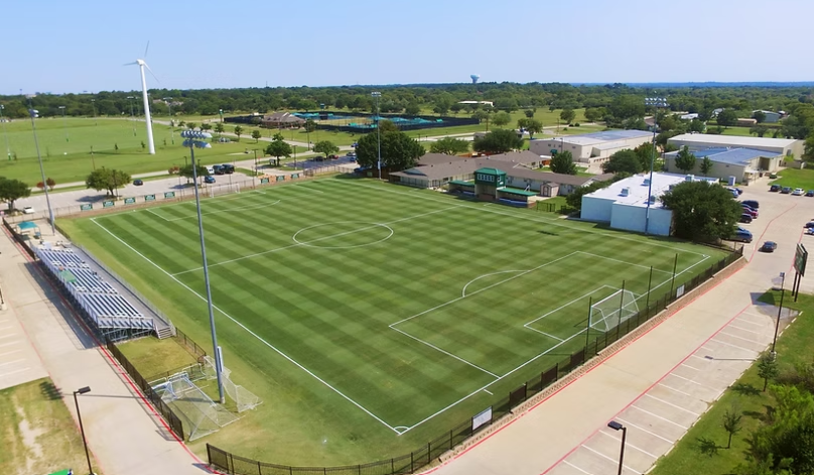
Athletic fields live under a genuinely different set of pressures than a single-sport stadium. A high school or municipal park complex often hosts soccer, lacrosse, field hockey, and football on the exact same rectangle of turf across a single season, and each sport wears the grass down in a different pattern. Soccer and lacrosse spread wear fairly evenly across the whole field as players run the full width and length, while football concentrates damage between the hash marks. A grass that recovers well from one kind of wear doesn’t always recover as well from the other, which is part of why a genuinely multi-sport field calls for a somewhat different selection than a dedicated football stadium would.
Budget is the other major difference. A professional or major college stadium can afford sprigged premium hybrid bermudagrass and a dedicated grounds crew managing it daily, but most school districts and park systems are working with a fraction of that budget across far more total acreage of turf. That’s exactly why seeded bermudagrass cultivars matter so much more at this level than they do in premium stadium turf: seed is dramatically cheaper to establish across a large multi-field complex than sprigs or sod, even if the resulting turf isn’t quite as dense or fast-recovering as the very best hybrid options.
Climate still splits the decision the same way it does for any turf project, warm-season species dominating the South and cool-season species holding the North, with a transition zone in between relying on overseeding to bridge the gap. Michigan State University’s turfgrass science program is one of the leading research centers studying athletic field performance specifically, and its variety trial data is a useful reference point for anyone managing a real multi-sport facility. What follows covers 18 grasses that perform well on athletic fields, weighted toward options that make sense at a realistic school or park budget.
Common Bermudagrass
Common bermudagrass remains the most widely used turf on budget-conscious athletic fields across the South, tolerating heat, drought, and heavy traffic at a fraction of the establishment cost of a premium hybrid. Its aggressive spread via both stolons and rhizomes lets it recover from wear reasonably well even without intensive management.
It doesn’t match a premium hybrid’s density or recovery speed, but for a multi-field school or park complex where budget realistically constrains every acre, it remains a genuinely practical default choice.
Riviera Bermudagrass
Riviera is a seeded bermudagrass cultivar specifically bred to offer sports-turf-quality performance without requiring the more expensive sprigging or sodding process premium hybrids typically need. That seeded establishment makes it considerably more affordable to install across a large multi-field complex than a comparable sprigged hybrid.
It offers meaningfully better density and wear tolerance than common bermudagrass while staying accessible to a realistic athletic field budget, positioning it as a genuine middle-ground option.
Yukon Bermudagrass
Yukon is a cold-hardy, seeded bermudagrass cultivar developed to extend bermudagrass’s usable range into cooler transition-zone climates while keeping the same affordable seed-based establishment as Riviera. Its cold tolerance has made it a popular choice for school districts near the northern edge of bermudagrass’s traditional range.
It shares Riviera’s practical cost advantage over sprigged hybrids, making it a reasonable choice for a multi-field complex that needs bermudagrass’s summer durability without a stadium-level turf budget.
Tifway 419 Bermudagrass
Tifway 419 remains the standard premium hybrid bermudagrass where budget allows, offering superior density, texture, and recovery speed compared to seeded cultivars like Riviera or Yukon. It’s more commonly reserved for a single flagship field within a larger athletic complex rather than used across every field on a property.
Its higher establishment and maintenance cost is the real tradeoff for that improved performance, which is exactly why most multi-field complexes mix premium and budget turf types across different fields based on actual usage level.
Zoysiagrass
Zoysiagrass tolerates the even, whole-field wear pattern typical of soccer and lacrosse reasonably well once it’s fully established, forming a dense turf that resists divoting better than some faster-growing alternatives. Its slower establishment is a genuine drawback for a new athletic field needing to open for play on a tight timeline.
Its lower water and fertilizer needs compared to bermudagrass have made it appealing for park systems trying to reduce long-term input costs across multiple fields.
Meyer Zoysia
Meyer is a widely available zoysia variety with reasonably good cold tolerance for the species, making it a viable choice for an athletic field in a climate too cold for reliable bermudagrass performance. It forms a dense, medium-textured turf once mature.
Its slow recovery from heavy wear makes it a better match for a lower-intensity multi-sport field than one hosting back-to-back games across an entire season.
Empire Zoysia
Empire establishes faster than many other zoysia varieties, a genuine practical advantage for an athletic field that can’t afford the multi-year wait some finer zoysia types require before reaching full density. It tolerates heat and humidity well in warmer climates.
It still recovers from heavy wear more slowly than bermudagrass, positioning it as a reasonable option for a field with moderate rather than constant year-round use.
Bahiagrass
Bahiagrass shows up regularly on large park and recreation complexes given its tolerance for poor soil, drought, and minimal fertility input across acres of turf that would be expensive to maintain more intensively. Its deep taproot lets it survive dry stretches that would stress more input-hungry turf species.
Its wear tolerance is genuinely modest compared to bermudagrass, making it a better fit for a casual recreational field than a heavily scheduled competitive venue.
Centipedegrass
Centipedegrass occasionally appears on lower-budget athletic fields specifically for its minimal fertility needs, though its wear tolerance is modest compared to bermudagrass or zoysia. It performs best on a field seeing lighter, less frequent use.
Its slow growth and recovery rate make it a poor match for a field hosting multiple sports and constant scheduling, better reserved for a supplementary or practice field with lower overall demand.
Kentucky Bluegrass
Kentucky bluegrass remains the standard cool-season choice for a northern athletic field, spreading by rhizome in a way that helps it repair worn patches between games better than a purely bunch-type grass. Its cold tolerance holds up reliably through harsh winters that would kill warm-season alternatives outright.
It’s rarely used alone on a heavily scheduled multi-sport field, since its recovery speed on its own falls short of what a busy athletic complex typically needs.
Perennial Ryegrass
Perennial ryegrass germinates and establishes fast enough to make it genuinely useful for repairing worn patches on an athletic field mid-season, a real practical advantage over slower cool-season species. It’s commonly overseeded directly onto goal mouths and other heavily worn areas between games.
Its relatively short lifespan on its own means a field relying entirely on ryegrass will thin considerably within a couple of years, which is why it’s typically paired with a longer-lived species rather than used as the sole turf type.
Turf-Type Tall Fescue
Turf-type tall fescue offers solid heat and drought tolerance for a cool-season grass, making it a reasonable component of an athletic field seed mix in a climate with genuinely hot summers alongside cold winters. Its bunch-type growth means bare spots need reseeding rather than filling in on their own.
It handles moderate wear reasonably well, though it lags behind Kentucky bluegrass’s self-repairing ability in an area seeing truly heavy, repeated traffic.
Cool-Season Triple Mix
A blended seed mix combining Kentucky bluegrass, perennial ryegrass, and turf-type tall fescue is one of the most common choices for a real-world athletic field budget, spreading risk across 3 species with different strengths rather than betting everything on one. The ryegrass establishes quickly, the fescue adds heat and drought tolerance, and the bluegrass provides longer-term self-repair.
This kind of blended approach also improves disease resistance overall, since a pathogen that hits one species hard is less likely to wipe out the entire field at once.
Annual Ryegrass
Annual ryegrass is sometimes used as a genuinely temporary fix for a badly worn school or park field that needs some green cover quickly, without any expectation that the grass will persist past a single season. It germinates faster than nearly any other option on this list.
It’s not a real long-term solution, and relying on it repeatedly instead of addressing the underlying wear and drainage problems on a field usually just delays a more substantial renovation that’s eventually needed anyway.
Fine Fescue
Fine fescue occasionally appears in a shaded practice field or a lower-traffic corner of a larger athletic complex, tolerating shade and poor soil better than most other options on this list. It doesn’t hold up to heavy foot traffic at all, which limits its use to genuinely low-demand areas.
It’s best reserved for a practice or overflow field with light, occasional use rather than anywhere hosting regular competitive games.
Bermudagrass Overseeded with Ryegrass
Overseeding a bermudagrass athletic field with ryegrass each fall extends usable playing season and green color into cooler weather, a practical approach for a transition-zone school or park system running fall sports well into cold weather. The bermudagrass handles summer wear while the ryegrass carries the field through the cooler months.
Managing that transition each spring takes real attention from whoever maintains the field, since timing the ryegrass die-off against the bermudagrass green-up affects playing surface quality for weeks on either side of the changeover.
Sand-Based Athletic Field System
A sand-based field, built with a specially engineered sand root zone rather than native soil, drains dramatically faster than a conventional field, letting play resume within hours of a heavy rain rather than days. Bermudagrass or a cool-season blend can be grown on top of that sand base depending on climate.
The construction cost is considerably higher than a conventional soil-based field, which is why sand-based systems tend to show up on flagship venues within a larger athletic complex rather than across every field a school or park district maintains.
Seashore Paspalum
Seashore paspalum offers genuine salt tolerance for a coastal park or school complex irrigated with brackish water, a situation that rules out most other turf options for that specific property. It forms a dense, fine-textured surface with wear tolerance comparable to a well-maintained bermudagrass field.
Its specialized fertility and management requirements mean it’s typically chosen only where salt tolerance is a genuine, unavoidable necessity rather than picked for its own sake on an ordinary inland athletic field.
Key Takeaways
The best grass for athletic fields should provide a dense, durable playing surface that can withstand frequent foot traffic and recover from regular use. The right choice depends on factors such as climate, soil type, sunlight, drainage, irrigation, and the type and frequency of sporting activities.
Different grasses offer varying levels of wear tolerance, recovery, drought resistance, and seasonal performance. Warm-season grasses can be suitable for warmer regions, while cool-season grasses may perform better in cooler climates. Strong root development and good drainage are also important for maintaining a stable and resilient surface.
Selecting a grass that matches the field conditions and expected level of use can make maintenance more manageable. Regular mowing, watering, fertilization, aeration, and timely repair of worn areas can help maintain healthy turf and a consistent playing surface throughout the sporting season.