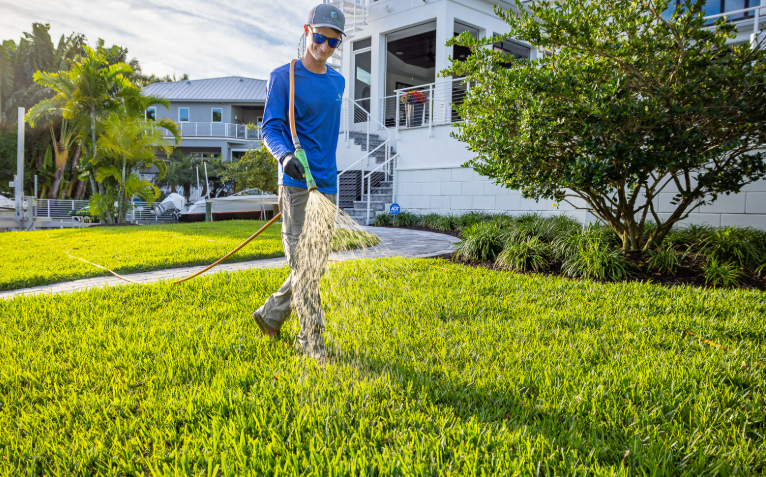
Florida lawns live under a different set of rules than lawns almost anywhere else in the country. The combination of sandy soil, intense heat, heavy summer rain, and a frost-free (or nearly frost-free) growing season for most of the state rules out the cool-season grasses that dominate lawns up north. Kentucky bluegrass and perennial ryegrass simply melt in Florida’s humidity. Instead, the state runs almost entirely on warm-season turf, grasses built to handle heat, sandy soil, and long growing seasons, with the tradeoff that most of them go dormant and brown out during any rare winter cold snap.
Shade tolerance is the other defining issue for a Florida yard, since so many properties sit under live oaks, pines, or palms that cast dense, year-round shade. St. Augustinegrass built its reputation here specifically because it tolerates shade better than nearly any other warm-season turfgrass, which is why it covers the overwhelming majority of Florida residential lawns despite needing more water and fertilizer than some of its lower-maintenance rivals. Bahiagrass and centipedegrass take the opposite approach, trading shade tolerance for genuinely low input needs, which is why they show up so often on rural properties, pastures, and yards where homeowners want something that survives on rainfall alone.
The University of Florida’s Institute of Food and Agricultural Sciences maintains the most detailed, regionally specific turfgrass variety trials in the state, and its Florida Lawn Handbook is worth checking before choosing sod, since chinch bug resistance, cold tolerance, and salt tolerance can vary meaningfully between varieties of the exact same species. What follows covers 21 grasses that do well across Florida, grouped by the tradeoffs each one is actually built around.
St. Augustinegrass
St. Augustinegrass is the default Florida lawn grass, prized for shade tolerance that beats nearly every other warm-season turf option and a thick, carpet-like texture that fills in quickly. It spreads by above-ground stolons, which makes repair and establishment relatively fast compared to bunch-type grasses.
It needs more water and fertilizer than bahiagrass or centipedegrass, and it’s genuinely susceptible to chinch bugs, a pest that’s driven much of the newer variety development within the species.
Floratam St. Augustine
Floratam has been the most widely planted St. Augustine variety in Florida for decades, valued for vigorous growth and reasonable resistance to chinch bugs when it was first released. Its resistance has eroded over time as chinch bug populations adapted, and newer varieties now often outperform it on pest resistance.
It has notably poor shade tolerance for a St. Augustine variety, doing best in full sun despite the species’ overall shade-friendly reputation.
Palmetto St. Augustine
Palmetto is one of the more shade-tolerant St. Augustine varieties available, holding color and density in conditions that thin out Floratam within a season or two. It also shows better cold tolerance than some other varieties, a genuine advantage in North Florida.
Its finer texture and slightly lower growth habit make it a popular choice where a more refined lawn appearance matters.
Seville St. Augustine
Seville is a dwarf St. Augustine variety with a finer leaf texture and lower growth habit than Floratam, requiring more frequent mowing to keep it looking tidy. It tolerates shade reasonably well and has become a popular choice in South Florida landscaping.
It’s more cold-sensitive than several other St. Augustine varieties, limiting its reliability in the northern part of the state.
Bitterblue St. Augustine
Bitterblue is an older St. Augustine variety with a finer texture and better cold tolerance than Floratam, historically popular before newer varieties took over much of the market. It still performs reasonably well in shade.
It’s less commonly available today than more recently developed varieties, though it remains a solid option where it can still be sourced.
CitraBlue St. Augustine
CitraBlue is a newer University of Florida-developed variety bred for a distinctive blue-green color, dense growth, and notably strong shade tolerance even compared to other St. Augustine types. It was also selected for improved resistance to certain diseases affecting older varieties.
Its relatively recent release means long-term performance data is still accumulating compared to decades-old standards like Floratam.
Captiva St. Augustine
Captiva is a dwarf, fine-textured St. Augustine variety developed with improved resistance to southern chinch bugs, addressing one of the species’ most persistent problems. Its low, dense growth habit gives it a manicured appearance without excessive mowing.
It performs well in South Florida’s climate and has become a popular choice for homeowners specifically seeking chinch bug resistance.
Delmar St. Augustine
Delmar is a compact, cold-tolerant St. Augustine variety bred with North Florida and Panhandle conditions in mind, where winter temperatures occasionally challenge less hardy varieties. Its dwarf growth habit keeps mowing frequency reasonable.
It’s a solid choice specifically for the parts of the state where a hard freeze is a real annual possibility rather than a rare event.
ProVista St. Augustine
ProVista is a University of Florida-developed variety engineered for tolerance to a specific class of herbicides, allowing broadleaf weeds to be controlled in an established lawn without damaging the turf itself. That herbicide tolerance is its defining feature rather than any dramatic difference in appearance from other St. Augustine types.
It offers a genuinely useful weed-management option for a lawn that’s struggled with broadleaf weeds under traditional St. Augustine care.
Bahiagrass
Bahiagrass is the low-maintenance workhorse of Florida turf, tolerating poor, sandy soil, drought, and general neglect better than any St. Augustine variety. It spreads by short rhizomes and produces a distinctive tall seed head that some homeowners find unsightly between mowings.
Its shade tolerance is genuinely poor, making it a full-sun grass rather than a fit for a heavily wooded lot.
Argentine Bahiagrass
Argentine bahiagrass has a broader, darker green leaf blade than Pensacola bahiagrass, giving it a somewhat more attractive appearance for residential use while retaining the species’ low-input reputation. It’s the more commonly sodded bahiagrass type for home lawns.
It still produces the same tall seed stalks typical of the species, requiring more frequent mowing during peak seed production in summer.
Pensacola Bahiagrass
Pensacola bahiagrass has a finer leaf texture than Argentine but is more commonly used for pasture and roadside plantings than manicured residential lawns. It shares the species’ excellent drought tolerance and minimal fertility needs.
It’s a practical rather than an aesthetic choice, valued for toughness on a large or low-budget property rather than polish.
Zoysiagrass
Zoysiagrass sits between St. Augustine and bahiagrass in most respects, offering better shade tolerance than bahia with lower water and fertilizer needs than St. Augustine. It forms a dense, fine-to-medium textured turf that many homeowners find more attractive than either alternative.
It establishes and spreads more slowly than St. Augustine, meaning a new zoysia lawn takes longer to fill in completely.
Empire Zoysia
Empire is a coarser-textured zoysia variety bred for faster establishment than many other zoysia types, addressing one of the species’ main drawbacks. It tolerates Florida’s heat and humidity well.
Its faster fill-in rate makes it a more practical choice than finer zoysia varieties for anyone not wanting to wait multiple seasons for a complete lawn.
Icon Zoysia
Icon is a zoysia variety selected for improved shade tolerance and disease resistance compared to older zoysia types, positioning it as a genuine St. Augustine alternative for a partly shaded yard. It maintains good density under conditions that would thin out many other zoysia varieties.
It requires the same patience during establishment typical of zoysia generally, filling in more slowly than St. Augustine.
Conclusion
Choosing the best grass for a Florida lawn depends on factors such as the region, soil type, sunlight, rainfall, and available irrigation. Warm-season grasses are generally well suited to Florida’s climate because they can tolerate the state’s heat and remain active through much of the year.
Different grass varieties have varying levels of drought tolerance, shade tolerance, salt tolerance, and maintenance needs. Considering these characteristics, along with the specific conditions of the lawn, can help homeowners select a grass that establishes well and remains healthy throughout the growing season.
With proper planting and regular care, Florida lawns can remain dense and attractive despite the state’s heat and periods of heavy rainfall. Appropriate mowing, watering, fertilization, and soil management can help the selected grass develop strong roots and maintain healthy growth over time.