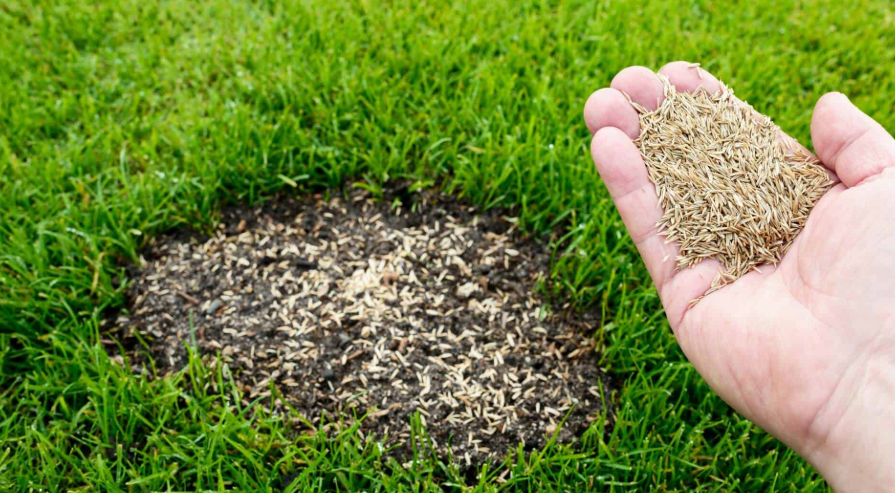
A lot of overseeding advice out there gets one thing backward: seeding whatever’s convenient into whatever’s already growing, rather than checking if the two actually get along. Turf-type tall fescue is a good example of how this goes wrong. Plenty of lawn care companies recommend it as a general-purpose overseed for a thinning lawn, but several university turf programs specifically advise against overseeding it into an existing Kentucky bluegrass lawn, since tall fescue grows in individual bunches rather than spreading by rhizome. Scatter it thin across a bluegrass lawn and you don’t get a thicker, more uniform stand, you get scattered clumps of coarser grass poking up through the bluegrass for years.
The right overseed choice really depends on what you’re trying to fix. Thickening a thinning cool-season lawn calls for a seed that matches or complements what’s already there. Getting winter color on a dormant warm-season lawn in the South calls for something completely different, a fast, temporary grass that’ll die out on its own once the warm-season grass wakes back up in spring. And a genuinely bare, damaged patch calls for whatever germinates fastest, even if that’s not the grass you actually want in the long run.
The University of Maryland Extension’s grass seed guide breaks down the difference between a mixture, which combines multiple species, and a blend, which combines multiple cultivars of the same species, a distinction worth understanding before reading a seed bag label. What follows covers 21 of the best grass seed options for overseeding, organized by what job each one is actually suited for.
Kentucky Bluegrass
Kentucky bluegrass spreads by rhizome, giving it a genuine ability to fill in bare and thinning spots on its own once it’s established, which makes it one of the better overseed choices for an existing bluegrass lawn. It’s also the most widely used lawn species across much of the northern United States, so it’s usually already what you’re trying to thicken up.
Seed at 3 to 5 pounds per 1,000 square feet when overseeding, and expect slower establishment than ryegrass, since bluegrass simply germinates less quickly.
Perennial Ryegrass
Perennial ryegrass germinates faster than almost any other cool-season grass, which makes it genuinely useful for thickening a lawn quickly, but it’s also a bunch-type grower that won’t spread to fill bare spots the way bluegrass will. It’s commonly blended with Kentucky bluegrass specifically because the 2 species share a similar texture and color.
Keep it under 50 percent of any seed mixture by weight, since seeding it too heavily lets it dominate early only to die out within 2 or 3 years, leaving the same bare spots you started with.
Turf-Type Tall Fescue
Turf-type tall fescue germinates relatively quickly and holds up to heat, drought, and traffic better than Kentucky bluegrass, but it’s a poor overseed choice for an existing bluegrass lawn specifically because it grows in individual bunches rather than spreading. It works considerably better overseeded into an existing stand that’s already mostly tall fescue.
If it’s used at all in a mixed lawn, it needs to make up at least 80 percent of the total seed by weight, or the clumping habit will show as unsightly patches.
Chewings Fescue
Chewings fescue is one of the more shade-tolerant fine fescues, a useful overseed choice specifically for thickening the shaded portions of an existing lawn where sun-loving species have thinned out. It blends well into a broader fine fescue mixture rather than needing to be seeded alone.
It still needs at least a couple hours of direct sun daily, since no cool-season grass, including this one, will hold up in genuinely deep shade.
Creeping Red Fescue
Creeping red fescue spreads slowly by rhizome, giving it a mild self-repairing ability that bunch-type fine fescues lack, useful for overseeding a shaded, thinning lawn bed. It’s commonly paired with Chewings fescue and hard fescue in a combined fine fescue blend.
It prefers drier soil and doesn’t tolerate standing water, so it’s a poor overseed choice for a consistently soggy shaded spot.
Hard Fescue
Hard fescue is widely considered the best-performing fine fescue for a low-maintenance, shaded overseed, tolerating poor soil and infrequent care better than its fine fescue relatives. It’s a strong choice for filling in thin patches under trees where a sunnier species has already failed.
It doesn’t hold up to foot traffic, so it’s a poor overseed pick for a shaded area that also happens to see regular use.
Sheep Fescue
Sheep fescue rounds out the fine fescue group, generally included at a smaller percentage within a broader fine fescue blend rather than seeded on its own. It shares its relatives’ shade tolerance and low input needs.
It’s a reasonable component of a shaded overseed mix but rarely the primary species chosen for the job.
Endophyte-Free Perennial Ryegrass
Endophyte-free perennial ryegrass matters specifically if livestock will ever graze the area being overseeded, since the endophyte fungus that improves the grass’s pest resistance is toxic to grazing animals in high concentrations. For a purely ornamental home lawn it’s less critical, but it’s the right choice for anything doubling as pasture.
It shares standard perennial ryegrass’s fast germination and short lifespan, generally fading out within a few years regardless of the endophyte status.
Novel-Endophyte Tall Fescue
Novel-endophyte tall fescue offers the same pest-resistance benefit as standard endophyte-infected tall fescue without the toxicity risk to grazing animals, using an endophyte strain bred specifically to avoid that problem. It’s the recommended overseed choice for any tall fescue pasture area accessible to livestock, particularly pregnant mares.
For a strictly ornamental lawn with no grazing animals involved, this distinction matters less, though the improved pest resistance is a genuine bonus either way.
Kentucky 31 Tall Fescue
Kentucky 31 is an older, coarser tall fescue variety historically used more in pastures than residential lawns, and it’s specifically not recommended for overseeding any pasture grazed by pregnant mares given its naturally occurring toxic endophyte. For lawn use, modern turf-type tall fescue cultivars offer a finer texture and better appearance.
It’s worth knowing the name mainly to avoid it, since most current lawn overseeding guidance favors newer, improved turf-type cultivars instead.
Annual Ryegrass
Annual ryegrass germinates about as fast as any grass seed available, which is exactly why it remains the classic choice for overseeding a dormant warm-season lawn for winter color. It’s genuinely not meant to last, dying out on its own as temperatures rise the following spring.
It’s coarser in texture than perennial ryegrass and doesn’t blend into a permanent lawn well, so it’s a poor choice for anything beyond a temporary winter overseed.
Intermediate Ryegrass
Intermediate ryegrass splits the difference between annual and perennial ryegrass, offering somewhat finer texture and slightly longer persistence than straight annual rye while still transitioning out reliably once warm-season grass resumes growth. It’s a reasonable middle option for winter overseeding where a slightly nicer appearance matters.
It still won’t persist as a permanent lawn grass, so treat it the same way as annual rye: useful for the season, not a long-term fix.
Orchardgrass
Orchardgrass is more commonly used in pasture overseeding than residential lawns, valued for its quick establishment and reasonable persistence in a forage mix. It’s not a typical home lawn choice but shows up regularly in agricultural overseeding recommendations.
Its coarse texture and clumping growth habit make it unsuitable for a residential lawn overseed, better reserved for pasture and forage use specifically.
Common Bermudagrass Seed
Common bermudagrass seed is a reasonable option for overseeding thin spots in an existing warm-season bermuda lawn during the growing season, filling in bare patches with the same species already present. It establishes readily in full sun and warm soil temperatures.
It won’t do anything useful seeded into a cool-season lawn or during the wrong time of year, since it needs consistently warm soil to germinate at all.
Improved Hybrid Bermudagrass Seed
Improved hybrid bermudagrass seed blends offer better color, density, and disease resistance than common bermudagrass, a worthwhile upgrade when overseeding a bermuda lawn that’s been thinning for reasons beyond simple wear. Some hybrid types are seed-propagated rather than requiring sod or sprigs.
Like common bermuda, it needs warm soil and full sun to establish, making it a warm-season-only overseeding option.
Tall Fescue and Kentucky Bluegrass Mix
A mixture of roughly 90 to 95 percent tall fescue and 5 to 10 percent Kentucky bluegrass is a commonly recommended overseeding blend, since the small bluegrass component helps the stand recover from injury via its spreading rhizomes while tall fescue provides the bulk of the drought and heat tolerance. It’s a solid general-purpose overseed for an already tall-fescue-dominant lawn.
This ratio matters: too much bluegrass and it can eventually crowd out the tall fescue into scattered bunches, undermining the whole point of the mix.
Kentucky Bluegrass and Perennial Ryegrass Mix
A blend of Kentucky bluegrass and perennial ryegrass, generally seeded at 6 to 8 pounds per 1,000 square feet, combines the ryegrass’s fast germination with the bluegrass’s longer-term self-repairing ability. It’s a genuinely popular overseed choice for a bluegrass lawn that needs quicker visible results than bluegrass alone would provide.
Keep the ryegrass percentage modest, since seeding it too heavily risks it out-competing the bluegrass early on, only to leave gaps once the ryegrass naturally declines.
Sun and Shade Fine Fescue Blend
A combined fine fescue blend, typically mixing hard fescue, Chewings fescue, and creeping red fescue, is specifically formulated for overseeding a lawn with mixed sun and shade conditions where no single fine fescue species performs ideally everywhere. Each species in the blend covers slightly different site conditions.
It remains a lower-traffic option overall, better suited to a lawn valued more for appearance than for standing up to heavy use.
Fine Fescue and Tall Fescue Mix
A mix combining fine fescue with turf-type tall fescue is a practical overseeding choice for a lawn with meaningfully shaded areas, since fine fescue handles the shade while tall fescue covers the sunnier portions. It’s a genuinely useful compromise where a single species can’t handle the full range of light conditions across one yard.
The exact ratio matters less here than with a tall fescue and bluegrass mix, since the 2 fescue types are compatible in texture and don’t compete for dominance the way bluegrass and tall fescue can.
Zoysiagrass Seed
Zoysiagrass seed is a slower-establishing option for overseeding an existing zoysia lawn, since the species as a whole is notably slow to fill in compared to bermudagrass. Patience matters more here than with almost any other warm-season overseeding option.
It needs warm soil and consistent moisture during establishment, with visible results taking considerably longer than a comparable bermudagrass overseed.
Buffalograss Seed
Buffalograss seed works well for overseeding a thin, native buffalograss lawn, particularly in the low-water regions of the Great Plains and Southwest where the species is already the dominant regional turf choice. It establishes best in full sun and doesn’t require the intensive care most other overseeding projects call for.
It’s a poor fit for overseeding into any other established turf species, since it competes poorly against denser, more aggressive grasses already occupying the same space.
Conclusion
Choosing the right grass seed for overseeding an existing lawn depends on the existing grass type, local climate, soil conditions, sunlight, and the lawn’s overall condition. Using a compatible grass species or blend can help new seedlings establish without creating an uneven appearance or competing with the established turf.
Proper preparation is also important for successful overseeding. Mowing the lawn appropriately, improving seed-to-soil contact, distributing the seed evenly, and providing adequate moisture during germination can all encourage better establishment. The timing should also match the growing season of the selected grass.
With the right seed and proper preparation, overseeding can help improve lawn density and fill thin or bare areas. Regular mowing, appropriate watering, and good soil care after germination can help the new grass develop into a healthier and more uniform lawn over time.