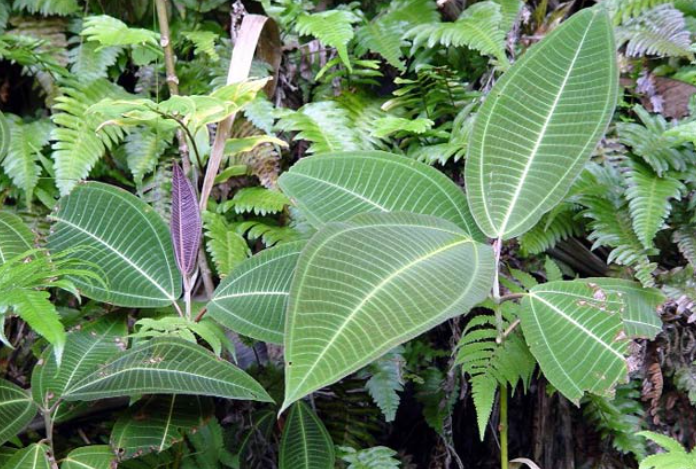
Invasive plants in Hawaii pose a uniquely severe threat given the islands’ extreme isolation, since native Hawaiian plants evolved for millions of years with almost no outside competition, leaving them with few defenses against aggressive newcomers. According to research published through the University of Hawaii Economic Research Organization, miconia has earned the nicknames “green cancer of Tahiti” and “purple plague of Hawaii,” and after a single specimen was introduced to a botanical garden in 1937, the plant went on to cover 65% or more of Tahiti’s main island in dense, monotypic stands.
The scale of miconia’s reproductive output helps explain how that kind of takeover happens so quickly. According to the Oahu Invasive Species Committee, a single mature miconia tree can produce up to 9 million seeds in a year, with those tiny, sand-grain-sized seeds remaining viable in the soil for 18 years or more, building an enormous seed bank that makes long-term eradication extraordinarily difficult even after visible plants are removed. The same UHERO research estimated that an unchecked miconia invasion on Oahu alone could reduce groundwater recharge enough to generate economic losses of 137 million dollars per year.
Miconia isn’t an isolated case, and according to Hawaii Ecosystems at Risk, a University of Hawaii-affiliated project, several other invasive plants on this list, including strawberry guava and Australian tree fern, have become common enough that remote sensing technology is now being tested specifically to locate them in hard-to-reach forested areas. What follows covers 24 invasive plants in Hawaii, along with where each one grows and the data behind its spread.
Miconia
Miconia produces enormous, velvety leaves reaching over 3 feet long, dark green with pale veins on top and vivid purple underneath, on a tree capable of reaching 50 feet tall. It was introduced to Hawaii as a garden ornamental in 1961 and spread further as plant enthusiasts shared cuttings, only for its invasive potential to become fully apparent decades later.
It’s found in scattered, actively managed infestations across several Hawaiian islands, with invasive species committees treating it as a top target given its documented capacity to form a dense forest canopy that eliminates nearly all native understory plants beneath it. Its shallow root system also increases the risk of landslides on the steep, wet slopes where it typically establishes.
Strawberry Guava
Strawberry guava forms dense, shade-casting thickets supported by a mat of surface feeder roots so thick that few other plants can coexist alongside it. Its success as an invader comes from prolific fruiting, aggressive vegetative growth, and possibly the release of chemicals from its leaves that suppress the growth of competing plants.
It’s established throughout forested areas on every major Hawaiian island, often spreading fastest in sites already disturbed by feral pigs that eat and disperse its fruit. It poses a major threat to Hawaii’s rare endemic flora and fauna in the parks and preserves where it has become established.
Fountain Grass
Fountain grass produces arching clumps of narrow foliage topped with fluffy, pink-tinged seed heads, an ornamental grass whose extremely flammable dry foliage has made it a serious wildfire concern on the drier sides of several Hawaiian islands. Its drought tolerance lets it thrive in exactly the arid lava landscapes where fire risk is already elevated.
It’s established throughout dry, lower-elevation areas of the Big Island and other islands, often found colonizing recent lava flows before native vegetation has a chance to establish.
Kahili Ginger
Kahili ginger produces tall spikes of fragrant, brilliant yellow and orange flowers on a robust perennial that spreads aggressively through thick underground rhizomes. Its striking, showy blooms made it a popular ornamental long before its capacity to form dense monocultures in native forest was recognized.
It’s established throughout wet, forested areas across several Hawaiian islands, forming dense stands that block light and outcompete native understory plants in exactly the moist habitat those species depend on.
Australian Tree Fern
Australian tree fern produces a tall, trunk-like stem topped with a crown of large, arching fronds, spreading via wind-dispersed spores that can travel considerable distances into undisturbed native forest. Its shade-tolerant growth allows it to establish beneath an existing forest canopy rather than requiring open, disturbed ground.
It’s established throughout wet forest areas on several islands, increasingly targeted using remote sensing technology specifically because its distinctive shape and location deep in remote forest make it difficult to detect through traditional ground surveys.
Albizia
Albizia produces feathery, fern-like compound leaves on one of the fastest-growing trees in the world, capable of adding many feet of height in a single year. Its extremely brittle wood makes mature trees prone to dropping large limbs or toppling entirely during storms, a genuine hazard to structures and people beneath it.
It’s established throughout lower-elevation forests on several islands, often forming a dense canopy over other invasive species, including miconia, that makes aerial detection surveys considerably more difficult.
Christmas Berry
Christmas berry, also called Brazilian pepper, produces clusters of small white flowers followed by bright red berries that ripen around the winter holidays, giving the plant its common name. It belongs to the same plant family as poison ivy, and sensitive individuals can develop skin irritation or respiratory symptoms from handling it.
It’s established throughout dry to moderately wet lowland areas across the islands, forming dense thickets that displace native coastal and dryland vegetation.
Ivy Gourd
Ivy gourd produces a fast-growing, twining vine capable of smothering shrubs, trees, and fences within a single growing season, spreading via both seed and vegetative root fragments. Its small, cucumber-like fruit is edible in some cultures, which has occasionally complicated public efforts to discourage its cultivation.
It’s established throughout disturbed, sunny areas on several islands, capable of forming a dense blanket over anything in its path.
Banana Poka
Banana poka produces a vigorous, climbing passionflower vine with pink flowers and elongated, banana-shaped edible fruit, native to South America and introduced as an ornamental and fruit crop. Its dense growth can completely smother the native forest canopy it climbs over, blocking light from everything beneath it.
It’s established throughout upland forest areas, particularly on the Big Island, where its weight can eventually collapse the very trees it depends on for support.
Firebush
Firebush, also called firetree, produces small, waxy fruit on a nitrogen-fixing tree that alters soil chemistry in ways that favor its own spread and disadvantage native plants adapted to Hawaii’s naturally nitrogen-poor volcanic soil. Birds readily eat and disperse its abundant fruit into new areas.
It’s established throughout disturbed forest and former pasture land on several islands, particularly noticeable as one of the first trees to colonize recent volcanic terrain.
Molasses Grass
Molasses grass produces a sticky, sweet-smelling foliage that gives the plant its common name, forming dense mats that carry fire readily across otherwise sparse volcanic landscapes. Its presence has been linked to increased wildfire frequency and intensity in the dry areas where it establishes.
It’s established throughout lower-elevation dry areas on several islands, often found alongside fountain grass in the same fire-prone landscape.
Java Plum
Java plum produces glossy, leathery leaves and clusters of small, dark purple fruit that stain sidewalks and driveways wherever fallen fruit accumulates in quantity. Birds and mammals readily eat and disperse the fruit, allowing the tree to establish across a broad range of habitat types.
It’s established throughout lowland and mid-elevation forest areas across the islands, forming a dense canopy that outcompetes native trees in disturbed woodland.
Koster’s Curse
Koster’s curse produces small, hairy, oval leaves and tiny purple flowers on a shrub capable of forming dense, impenetrable thickets in shaded understory habitat. A single plant can produce enormous quantities of seed dispersed by birds, allowing rapid colonization of intact native forest.
It’s established throughout wet forest areas on several islands, considered one of the most damaging invasive shrubs given how completely it can displace native understory vegetation.
Silky Oak
Silky oak produces fern-like, deeply divided leaves and striking clusters of golden-orange flowers, an Australian tree popular as an ornamental and street tree before its invasive seeding into surrounding forest became apparent. Its abundant, lightweight, wind-dispersed seeds allow a single planted tree to colonize a considerable surrounding area.
It’s established throughout disturbed forest and roadside areas across several islands, particularly along older plantation roads where it was once deliberately planted.
Common Guava
Common guava produces sweet, aromatic fruit on a shrubby tree that spreads readily via bird- and pig-dispersed seed into disturbed and undisturbed habitat alike. Its dense, thicket-forming growth can crowd out native shrubs in lowland and mid-elevation forest.
It’s established throughout lowland and mid-elevation areas across the islands, often found growing alongside its close relative strawberry guava in the same disturbed habitat.
Lantana
Lantana produces clusters of small, multicolored flowers on a spiny, sprawling shrub that forms dense thickets in dry to moderately moist habitat. Its foliage and unripe berries are toxic to livestock, and its dense growth crowds out native dryland plants.
It’s established throughout dry to moderate lowland areas across the islands, tolerating poor soil and drought considerably better than most native dryland species it displaces.
Glory Bush
Glory bush, a relative of miconia in the same notoriously invasive plant family, produces velvety leaves and showy purple flowers that made it a popular ornamental before its capacity to spread into native forest was recognized. Its seeds are dispersed readily by birds into undisturbed habitat.
It’s established in scattered wet forest locations across several islands, targeted by the same invasive species committees working to control its more notorious relative miconia.
Autograph Tree
Autograph tree produces thick, glossy leaves durable enough that carved messages remain visible on the surface for months, giving the plant its common name. It often begins life as an epiphyte high in a host tree’s branches before eventually sending roots to the ground.
It’s established throughout lowland and coastal forest areas across several islands, capable of overtopping and eventually replacing the native trees it initially grows upon.
Pampas Grass
Pampas grass produces large, plume-like flower heads atop dense clumps of sharp-edged foliage, an ornamental grass that spreads via enormous quantities of wind-dispersed seed. Its sharp leaf edges can cause genuine cuts to skin, a hazard beyond its invasive spread.
It’s established in scattered upland locations across several islands, favoring the cooler, higher-elevation habitat that more closely resembles its native South American range.
Yellow Himalayan Raspberry
Yellow Himalayan raspberry produces thorny canes and sweet yellow fruit on a vigorous shrub that forms dense thickets in disturbed forest and pastureland. Birds and pigs readily eat and disperse its fruit, spreading the plant into new areas.
It’s established throughout upland forest and former pasture areas on several islands, particularly the Big Island, where dense thickets have displaced native understory vegetation.
Octopus Tree
Octopus tree, also called umbrella tree, produces large, glossy, umbrella-shaped compound leaves and distinctive spikes of red flowers, often beginning life as an epiphyte before sending roots to the ground and overtaking its host. Its seeds are readily spread by birds into gutters, tree crotches, and other elevated locations.
It’s established throughout urban and forest edge habitat across several islands, frequently found sprouting in unlikely elevated locations well away from any deliberate planting.
Melaleuca
Melaleuca, also called paperbark, produces distinctive white, bottle-brush flowers and thick, papery, peeling bark on a tree that thrives in wet, poorly drained soil. Its oils burn extremely hot when dry, creating a wildfire hazard wherever dense stands have established.
It’s established in scattered wetland areas on several islands, forming dense stands that displace native wetland vegetation in exactly the habitat few other invasive trees can tolerate.
Ironwood
Ironwood, also called Australian pine despite belonging to a flowering tree rather than a true conifer, produces slender, drooping, pine-needle-like branches on a fast-growing tree widely planted as a coastal windbreak. Its shallow root system makes mature trees prone to toppling during storms, and its dense shade prevents native coastal vegetation from establishing beneath it.
It’s established throughout coastal areas on several islands, where its needle litter and dense canopy have displaced native strand vegetation along popular beaches.
African Tulip Tree
African tulip tree produces large, cup-shaped, brilliant orange-red flowers on a fast-growing tropical tree that spreads readily via wind-dispersed, winged seeds. Its striking flower display made it a popular ornamental long before its capacity to escape cultivation into surrounding forest was recognized.
It’s established throughout lowland and mid-elevation forest areas across several islands, forming a dense canopy that shades out native forest regeneration beneath it.
Conclusion
Invasive plants in Hawaii can spread through forests, grasslands, wetlands, agricultural areas, roadsides, and other habitats. They may compete with native plants for sunlight, water, nutrients, and space, while some species can also change habitats and affect native wildlife.
Learning to identify invasive plants is an important step in limiting their spread. Early detection and regular monitoring can help find new populations before they become firmly established, while appropriate management can reduce their impact on Hawaii’s native vegetation and ecosystems.
Protecting Hawaii’s unique natural environments requires continued attention from landowners, gardeners, conservation groups, and local communities. Choosing non-invasive plants, preventing the movement of seeds and plant material, and managing established populations can help protect native species and maintain healthy ecosystems across the islands.