Invasive plant species in Tennessee are legally regulated on a notably small, precise scale compared to some neighboring states, and according to the Tennessee Department of Agriculture, the state’s Pest Plant Rule regulates the transport and sale of just 13 plant species across 9 different genera. That list includes purple loosestrife, tropical soda apple, Chinese privet, European privet, cogongrass, Amur honeysuckle, bush honeysuckle, Bell’s honeysuckle, multiflora rose, autumn olive, thorny olive, giant salvinia, and tropical spiderwort, a considerably shorter roster than the 112 species covered by the broader Federal Noxious Weed List that also applies within the state.
One of those 13 species has become an urgent, current tracking priority. According to the Tennessee Invasive Plant Council, state officials discovered new cogongrass patches in 7 separate counties during 2024 alone, spanning Hardeman and McNairy in West Tennessee and Anderson, Cumberland, Fentress, Knox, and Morgan counties in East Tennessee, prompting multiple state and federal agencies to coordinate staff training in identification and eradication response.
Not every problem plant in Tennessee makes the state’s short legal list, and according to the University of Tennessee Institute of Agriculture, the Tennessee Department of Agriculture actually receives more complaints about invasive bamboo than any other plant in the state, since running species spread aggressively through underground rhizomes capable of damaging home foundations, driveways, and even swimming pools. What follows covers 30 invasive plant species in Tennessee, along with where each one grows and the data behind its spread.
Purple Loosestrife
Purple loosestrife produces tall spikes of vivid magenta-purple flowers each summer, one of just 13 species whose transport and sale is directly regulated under Tennessee’s Pest Plant Rule. A single mature plant can produce well over a million seeds in a season, an output that has allowed it to overwhelm native wetland vegetation across large areas.
It grows throughout marshes and wetland margins statewide, forming dense monocultures that crowd out the native plants waterfowl depend on.
Tropical Soda Apple
Tropical soda apple produces spiny stems and leaves along with round, yellow fruit resembling a small, mottled tomato, regulated under Tennessee’s Pest Plant Rule given the severity of its impact on grazing land. Cattle and wildlife readily eat the ripe fruit and pass the seeds unharmed through their digestive systems.
It grows in scattered locations throughout Tennessee’s cattle-ranching regions, where a single untreated infestation can spread across hundreds of acres within a few growing seasons.
Chinese Privet
Chinese privet produces small white flower clusters and dark berries on a dense, twiggy shrub, one of 2 privet species specifically named in Tennessee’s Pest Plant Rule. Birds readily eat and disperse its berries well beyond any original planting.
It grows throughout wooded areas and disturbed ground across much of Tennessee, forming dense understory thickets that few native shrubs can successfully compete against.
European Privet
European privet closely resembles its Chinese relative in small white flowers and dark berries, regulated alongside it under Tennessee’s Pest Plant Rule given nearly identical invasive behavior. Its dense, twiggy growth habit made both privet species enormously popular hedging plants for decades.
It grows throughout residential and disturbed areas across Tennessee, forming dense thickets in forest understories once it escapes cultivation.
Cogongrass
Cogongrass forms dense mats of coarse, upright grass that exclude nearly all other vegetation, and it’s one of the most closely watched species on Tennessee’s Pest Plant Rule given its recent, rapid spread. New patches were confirmed in 7 Tennessee counties during 2024 alone, spanning both the western and eastern parts of the state.
It grows in scattered but actively monitored infestations statewide, and its extremely flammable foliage creates a serious wildfire hazard wherever it establishes.
Amur Honeysuckle
Amur honeysuckle leafs out earlier in spring and holds its leaves later into fall than most native shrubs, one of 3 bush honeysuckle species specifically regulated under Tennessee’s Pest Plant Rule. Its abundant red berries are readily eaten and spread by birds into surrounding natural areas.
It grows throughout woodland edges and disturbed areas statewide, often forming dense understory thickets that block light from native tree seedlings.
Bush Honeysuckle
Bush honeysuckle, referring to Morrow’s honeysuckle under Tennessee’s regulatory naming, closely resembles its Amur relative in small white, fading-to-yellow flowers and prolific red berries. Both species readily hybridize where their ranges overlap, complicating precise field identification.
It grows throughout woodland edges and disturbed areas across much of Tennessee.
Bell’s Honeysuckle
Bell’s honeysuckle, a hybrid between Amur and Tatarian honeysuckle, combines traits from both parent species and is specifically named as its own regulated species under Tennessee’s Pest Plant Rule. Its hybrid vigor can make it even more difficult to distinguish and control than either parent species alone.
It grows throughout woodland edges and disturbed ground across Tennessee, commonly found growing alongside its 2 parent species.
Multiflora Rose
Multiflora rose produces arching, thorny canes lined with clusters of small white flowers, regulated under Tennessee’s Pest Plant Rule despite once being recommended by conservation agencies for erosion control and living fences. A single mature shrub can produce close to 500,000 seeds in a year.
It grows throughout pastures, fence rows, and forest edges statewide.
Autumn Olive
Autumn olive produces bright green leaves that are distinctively silver underneath, with strongly fragrant cream to pale yellow flowers each spring, one of 2 olive-family species named in Tennessee’s Pest Plant Rule. Because it fixes atmospheric nitrogen through its root system, it can alter soil chemistry in ways that favor its own continued spread.
It grows throughout old fields and disturbed ground statewide.
Thorny Olive
Thorny olive, also called silverthorn, produces small, fragrant, silvery-white flowers in fall on an evergreen shrub regulated under Tennessee’s Pest Plant Rule alongside its close relative autumn olive. Its dense, spiny growth made it a popular privacy hedge before its invasive spread became apparent.
It grows throughout much of Tennessee, forming dense thickets along forest edges and disturbed ground.
Giant Salvinia
Giant salvinia produces small, floating, hairy leaves that form dense mats capable of covering an entire pond or slow-moving waterway within weeks, regulated under Tennessee’s Pest Plant Rule given its severe impact on aquatic ecosystems. Its mats can grow thick enough to block sunlight to submerged native plants entirely.
It’s found in scattered infestations in Tennessee’s warmer waterways, spreading readily whenever fragments are transported on boats or other equipment.
Tropical Spiderwort
Tropical spiderwort, also called Benghal dayflower, produces small blue-purple flowers on a sprawling agricultural weed regulated under Tennessee’s Pest Plant Rule given its resistance to many common herbicides. Its rapid growth and difficult control profile have made it a genuine concern for row-crop farmers.
It’s found in scattered agricultural fields across Tennessee, particularly problematic in cotton and soybean production.
Kudzu
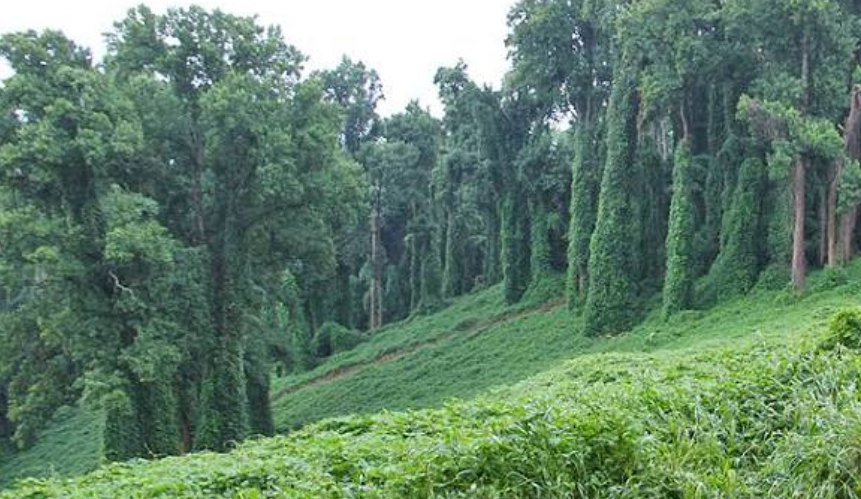
Kudzu produces large, 3-lobed leaves on vigorous vines capable of growing 60 to 100 feet in a single season. Its massive underground tubers store enough energy to let the vine regrow persistently even after years of cutting and herbicide treatment.
It grows throughout much of Tennessee, smothering trees, structures, and utility poles beneath its dense growth.
Musk Thistle
Musk thistle produces spiny, deeply lobed leaves and a large, nodding purple flower head, cited by Tennessee agriculture officials as an example of an introduced species with few natural controls to keep its growth in check. A single plant can produce over 10,000 seeds in a season.
It grows throughout pastures and roadsides across Tennessee.
Japanese Honeysuckle
Japanese honeysuckle produces fragrant, tubular white flowers that fade to yellow, growing on an aggressively twining, semi-evergreen vine capable of smothering shrubs and small trees entirely. Its vigorous, nearly year-round growth makes it one of the more difficult invasive vines to control through cutting alone.
It grows throughout much of Tennessee, forming dense blankets over understory vegetation.
Tree of Heaven
Tree of heaven produces large, compound leaves and grows remarkably fast even by invasive tree standards, with root sprouts capable of reaching several feet in their very first year alone. It also serves as the preferred host plant for the invasive spotted lanternfly, first confirmed in Tennessee’s Davidson County in 2023.
It grows throughout much of Tennessee, particularly along roadsides and disturbed urban lots.
Japanese Knotweed
Japanese knotweed produces hollow, bamboo-like stems that can push through cracks in pavement and foundations as a colony expands, spreading through an extensive underground rhizome network. Even a small fragment of rhizome left in the soil can regenerate an entirely new colony.
It grows in scattered infestations in parts of Tennessee, particularly along disturbed urban lots and waterways.
Oriental Bittersweet
Oriental bittersweet produces a woody, twining vine capable of climbing 60 feet or more into a tree canopy, eventually girdling and killing its host. Its bright orange-yellow seed capsules split open in fall to reveal striking red seeds, a display that’s ironically helped spread the vine further.
It grows throughout forest edges and disturbed woodland across Tennessee.
Japanese Barberry
Japanese barberry produces small, oval leaves and bright red berries on a dense, spiny shrub originally valued for its ornamental foliage. Research has linked dense barberry thickets to higher populations of ticks carrying Lyme disease.
It grows throughout woodlands and forest edges across much of Tennessee.
English Ivy
English ivy is an evergreen climbing and groundcover vine that spreads via both seed and rooting stems, planted for decades as low-maintenance landscaping before its invasive woodland behavior became widely recognized.
It grows throughout much of Tennessee as both a cultivated groundcover and an escaped woodland invasive, forming a dense mat capable of smothering garden perennials and entire mature trees alike.
Wintercreeper
Wintercreeper is an evergreen, woody vine with aerial roots that let it climb into tree canopies, forming dense carpets on the forest floor that can overtop and shade out the trees it grows beneath.
It grows throughout residential landscapes and adjacent woodlands statewide, having escaped widely from ornamental groundcover plantings.
Callery Pear
Callery pear, widely sold under ornamental cultivar names including Bradford pear, produces abundant white spring flowers followed by small, hard fruit that birds readily eat and disperse into surrounding natural areas. Its thorny, fast-growing wild seedlings form dense thickets in old fields.
It’s an increasingly documented concern throughout Tennessee, prompting several neighboring states to begin restricting its sale.
Garlic Mustard
Garlic mustard produces small clusters of white, 4-petaled flowers atop a biennial plant whose roots release chemicals into the surrounding soil that actively suppress the germination of nearby native plants.
It grows throughout wooded areas across much of Tennessee, threatening spring ephemerals that can’t compete with its early, aggressive growth.
Chinese Wisteria
Chinese wisteria produces long, cascading clusters of fragrant purple flowers on an aggressively twining, woody vine capable of girdling and eventually killing mature host trees. Its vigorous growth and abundant seed production have made it a significant forest health concern.
It grows throughout much of Tennessee, forming dense canopies over native trees that can collapse entire sections of forest under the vine’s accumulated weight.
Running Bamboo
Running bamboo, according to the Tennessee Department of Agriculture, generates more homeowner complaints than any other plant in the state, spreading through underground rhizomes capable of damaging foundations, driveways, and swimming pools. Its aggressive spread often extends well beyond any originally planted boundary.
It grows in scattered plantings throughout Tennessee, commonly escaping into neighboring yards from an original ornamental screening planting.
Mimosa
Mimosa produces fern-like leaves and fragrant pink summer flowers on a small tree that’s remained an ornamental favorite for decades despite documented invasiveness. It’s difficult to remove once established given its long-lived seeds and vigorous resprouting ability.
It grows throughout disturbed habitat across Tennessee, particularly old fields, stream banks, and roadsides.
Chinese Tallow Tree
Chinese tallow tree, sometimes called the popcorn tree for its waxy white seeds, was introduced first as a seed oil crop before spreading further as a popular ornamental. Birds eat its seeds and disperse them widely.
It grows in scattered locations throughout western Tennessee, capable of converting open ground into dense tallow forest within about a decade.
Princess Tree
Princess tree, also called paulownia, produces enormous, velvety, heart-shaped leaves and fragrant lavender spring flowers on one of the fastest-growing trees in temperate climates, capable of reaching 15 feet in its first year.
It grows throughout much of Tennessee, commonly found colonizing recently cleared or disturbed ground.
Common Buckthorn
Common buckthorn leafs out earlier in spring and holds its leaves later into fall than most native trees, giving it a considerable competitive advantage over the forest species it displaces. Its small, dark berries have a noticeable laxative effect on the birds that eat them.
It grows in scattered woodland locations across parts of Tennessee, forming dense understory thickets that shade out native tree seedlings.
Conclusion
Invasive plant species in Tennessee can spread across forests, wetlands, fields, roadsides, gardens, and other habitats. They may compete with native plants for sunlight, water, nutrients, and space, while some species can also alter the structure of natural communities.
Learning to identify invasive plants is an important step in managing them. Early detection and regular monitoring can help prevent new infestations from becoming established and make control efforts more manageable. Different plants may require different approaches depending on their location and growth habits.
Protecting Tennessee’s native vegetation requires continued attention from landowners, gardeners, conservation groups, and local communities. Preventing the spread of seeds and plant material, choosing non-invasive plants, and responding to new infestations can help maintain healthy and diverse ecosystems throughout the state.