Invasive plant species in Colorado are managed through a genuinely well-organized 4-tier system, and according to the Colorado Department of Agriculture, the state’s Noxious Weed Act sorts regulated species into List A, List B, List C, and an unregulated Watch List, with management requirements that scale directly to how established and how threatening each species already is. List A carries the strictest standard of all, requiring complete eradication statewide wherever the plant is found, and under the Act, simply allowing a List A species to produce seed or reproduce is itself considered a violation.
List B tells a more complicated story, and according to LegalClarity’s analysis of the state’s weed law, it’s the largest category with roughly 35 species, including familiar names like Canada thistle, spotted knapweed, leafy spurge, Russian olive, Dalmatian toadflax, and musk thistle, and the required management goal for each one can genuinely differ from county to county. A species targeted for full eradication in one county, where it’s just beginning to establish, might only require containment or suppression in a neighboring county where it’s already become widespread and eradication is no longer realistic.
According to Colorado State University Extension, effective weed control in the state depends on matching the right method, whether manual, cultural, biological, or chemical, to the specific reproductive strategy of the plant in question, since a weed with an extensive taproot responds to very different treatment than one spreading through seed alone. It’s also worth noting that Colorado’s noxious weed list tracks some genuinely unusual entries, including naturally occurring hybrid knapweed and hybrid toadflax that combine traits of 2 already-regulated parent species. What follows covers 30 invasive plant species in Colorado, along with where each one grows and the data behind its spread.
Hybrid Knapweed
Hybrid knapweed, a naturally occurring cross between spotted knapweed and diffuse knapweed, combines the thistle-like purple flower heads and allelopathic root chemistry of both parent species wherever they grow close enough together to interbreed. Its hybrid vigor can make it genuinely more difficult to distinguish and manage than either parent species growing on its own, since it doesn’t always display a clean intermediate set of identifying features.
It grows in scattered rangeland locations across Colorado wherever both parent knapweed species overlap, tracked specifically on the state’s noxious weed list given the added management complexity it introduces.
Hybrid Toadflax
Hybrid toadflax, a naturally occurring cross between yellow toadflax and Dalmatian toadflax, combines flower and leaf characteristics from both parents in ways that can complicate accurate field identification. Its presence on Colorado’s noxious weed list reflects growing recognition that hybridization between already-established invasive species can itself create new management challenges.
It grows in scattered locations throughout Colorado wherever both parent toadflax species have established populations close enough to cross-pollinate, and its intermediate root structure can make standard toadflax treatments less predictable.
Absinth Wormwood
Absinth wormwood produces finely divided, silvery-gray, aromatic foliage on a perennial historically cultivated for flavoring the notorious spirit that shares its name, though the wild form found in Colorado is grown for no such purpose. Its allelopathic chemistry suppresses the growth of neighboring plants, and livestock generally avoid grazing it given its notably bitter taste.
It’s classified as a List B noxious weed in Colorado, growing throughout disturbed pastures and roadsides statewide, spreading readily via both seed and root fragments left behind after incomplete removal.
Salt Cedar
Salt cedar, also called tamarisk and covering 3 closely related species regulated together under Colorado law, produces fine, scale-like foliage and small pink flowers on a shrub or small tree that consumes enormous quantities of water along the rivers and streams it invades. Its deep roots can draw down local water tables enough to measurably affect surrounding native vegetation, a genuine concern in a state where water scarcity is already a persistent management issue.
It grows along waterways throughout much of western and southeastern Colorado, forming dense stands that alter natural stream flow and increase soil salinity wherever it becomes established.
Canada Thistle
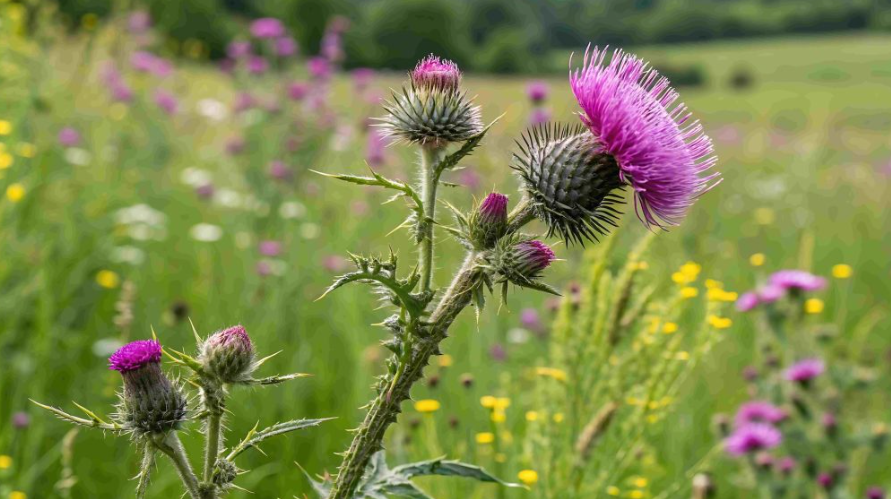
Canada thistle, despite its misleading common name, is native to Europe and parts of Asia rather than Canada, producing spiny-edged, deeply lobed leaves and small purple flower heads atop an extensive, far-reaching underground root system. A single root system can spread outward and colonize an entire field within a few growing seasons, and mowing alone often makes an infestation worse by stimulating even more vigorous root sprouting.
It’s classified as a List B noxious weed in Colorado, found throughout pastures, fields, and roadsides statewide, with management requirements that vary by county depending on how established it already is in a given area.
Spotted Knapweed
Spotted knapweed produces grayish-green, deeply divided leaves and thistle-like purple-pink flower heads ringed with distinctive black-tipped bracts that give the plant its common name. It releases an allelopathic compound from its roots that suppresses the germination and growth of neighboring plants, giving it a considerable competitive advantage over native rangeland species across much of the state.
It’s classified as a List B noxious weed in Colorado, found throughout rangeland and disturbed ground statewide, one of the more frequently cited examples of the category’s largest and most established members.
Leafy Spurge
Leafy spurge produces small, yellowish-green flower bracts on a deeply rooted perennial containing a milky, toxic sap capable of causing skin irritation and posing a genuine risk to grazing livestock. Its extensive root system, extending many feet into the soil, makes it one of the most economically damaging agricultural weeds found anywhere in Colorado’s rangeland.
It’s classified as a List B noxious weed statewide, growing throughout pastures and disturbed rangeland, capable of reducing usable grazing land by a significant margin wherever it becomes established.
Russian Olive
Russian olive produces narrow, silvery-gray leaves and small, hard, olive-shaped fruit on a shrub that reproduces both by seed and by root sprouting, with fruit readily dispersed by numerous bird species that help carry it well beyond its original planting site. Colorado Parks and Wildlife specifically notes that woody weeds like Russian olive and tamarisk often require different management tools than smaller herbaceous weeds, given their substantial size and root systems.
It’s classified as a List B noxious weed in Colorado, found throughout riverbanks and disturbed open ground statewide, where it forms dense stands that crowd out native streamside vegetation.
Dalmatian Toadflax
Dalmatian toadflax produces showy, snapdragon-like yellow flowers on a plant with broad, waxy, blue-green leaves that clasp directly around the stem, distinguishing it from its narrower-leaved relative yellow toadflax. Its deep, extensive root system and prolific seed production have made it one of the more persistent rangeland weeds found throughout the western part of the state.
It’s classified as a List B noxious weed in Colorado, growing throughout dry rangeland and roadsides, competing aggressively with native bunchgrass species for limited moisture.
Musk Thistle
Musk thistle produces spiny, deeply lobed leaves and a large, nodding purple flower head that droops noticeably to one side once fully open. A single plant can produce over 10,000 seeds in a season, most of which remain viable in the soil for several years, and it’s specifically named among the state’s most frequently cited List B species.
It grows throughout pastures and roadsides across Colorado, with biological control using specific weevil species increasingly used as a long-term management tool in heavily infested areas.
Yellow Toadflax
Yellow toadflax, also called butter and eggs, produces snapdragon-like yellow and orange flowers on a rhizomatous perennial capable of forming dense colonies that spread well beyond any original garden planting. Its extensive underground root system makes hand-pulling largely ineffective, since any root fragment left behind readily regenerates an entirely new plant.
It’s classified as a noxious weed in Colorado, growing throughout roadsides and disturbed fields statewide, frequently found alongside its more aggressive relative Dalmatian toadflax.
Diffuse Knapweed
Diffuse knapweed closely resembles spotted knapweed, distinguished by smaller white to pale purple flower heads and a distinctly branched, bushy growth habit that lets mature plants break off and tumble across open rangeland once dry. That tumbling growth habit scatters seed considerably further than a stationary plant ever could, helping the species colonize new ground rapidly.
It grows throughout dry rangeland across much of Colorado, competing directly with native bunchgrasses for limited moisture and soil nutrients.
Russian Knapweed
Russian knapweed produces small, urn-shaped purple-pink flower heads on a deeply rhizomatous perennial capable of forming dense, persistent colonies across grazed rangeland. Its extensive underground root system makes it notably more difficult to eliminate than either spotted or diffuse knapweed, since surface treatment alone rarely reaches deep enough to kill the entire root network.
It grows throughout rangeland and disturbed ground across Colorado, classified as a noxious weed given how effectively a single infestation can spread across an entire pasture.
Scotch Thistle
Scotch thistle produces enormous, spiny, silvery-gray leaves and a towering, heavily branched flowering stalk topped with large purple flower heads, capable of reaching heights that dwarf most other thistle species. Its imposing size and dense spines make it one of the more physically intimidating weeds found in Colorado’s rangeland, and its rapid seed production allows a single plant to seed a considerable surrounding area.
It grows throughout disturbed pastures and rangeland across parts of Colorado, classified as a noxious weed given its capacity to displace desirable forage across grazing land.
Bull Thistle
Bull thistle spends its first year as a spiny rosette before sending up a heavily branched, second-year flowering stalk topped with vivid purple-pink flower heads. Its dense covering of sharp spines runs along the leaf edges, stems, and even the bracts surrounding each flower, making the entire plant genuinely uncomfortable to handle without heavy gloves.
It grows throughout overgrazed pastures and disturbed roadsides across Colorado, thriving specifically in the compacted, nutrient-depleted soil created by heavy grazing pressure.
Plumeless Thistle
Plumeless thistle closely resembles musk thistle, distinguished by smaller, more upright purple flower heads and the absence of the feathery plume texture found on some related thistle species’ seed heads. It spreads aggressively through disturbed pastures, competing directly with more palatable forage plants for the same limited resources.
It grows throughout pastures and disturbed fields across parts of Colorado, classified as a noxious weed alongside its close relatives musk thistle and Scotch thistle.
Field Bindweed
Field bindweed produces small, white to pink, funnel-shaped flowers on a twining vine with a root system that can extend more than 20 feet deep and horizontally in every direction. That extensive root network makes it one of the most difficult weeds to fully eliminate once established, since even a small fragment left behind after cultivation can regenerate an entirely new plant.
It grows throughout fields, gardens, and disturbed ground across Colorado, classified as a noxious weed given how effectively its deep roots let it survive drought conditions that would kill most agricultural competitors.
Common Tansy
Common tansy produces flat clusters of small, button-like yellow flowers on an aromatic perennial that spreads through both seed and an extensive rhizome network. Its foliage can act as a skin irritant for sensitive individuals, and it’s toxic to livestock if consumed in significant quantity, adding a genuine grazing safety concern beyond its competitive spread.
It grows throughout roadsides and disturbed fields across parts of Colorado, forming dense colonies that crowd out native meadow vegetation.
Oxeye Daisy
Oxeye daisy produces the familiar white-petaled, yellow-centered daisy flower on a plant that spreads aggressively through both seed and shallow rhizomes once established in a meadow or pasture. Cattle generally avoid grazing it, letting it spread more freely in pastures than more palatable native forage growing alongside it.
It grows throughout meadows and roadsides across Colorado, often escaping from wildflower seed mixes into surrounding natural grassland where it can persist for many years once established.
Purple Loosestrife
Purple loosestrife produces tall spikes of vivid magenta-purple flowers each summer, a display so attractive that it was originally introduced to gardens before its aggressive wetland behavior became apparent. A single mature plant can produce well over a million seeds in a season, an output that has allowed it to overwhelm native wetland vegetation wherever it establishes in the state.
It grows in scattered wetland locations throughout Colorado, forming dense monocultures that crowd out the native plants waterfowl depend on for food and cover.
Myrtle Spurge
Myrtle spurge produces distinctive blue-green, fleshy leaves and small yellow-green flowers on a low, mounding perennial whose milky sap can cause serious skin and eye irritation on contact. It was widely sold as a drought-tolerant rock garden ornamental before its capacity to escape into surrounding dry, disturbed habitat became a recognized concern.
It grows in scattered locations across Colorado’s Front Range, classified as a List B noxious weed given its toxicity and its tendency to spread from residential plantings.
Common Burdock
Common burdock produces enormous first-year basal leaves before sending up a spiny, second-year flowering stalk topped with small, thistle-like purple flower heads that mature into the familiar hooked burs. Its hooked seed heads cling readily to livestock, wildlife, and clothing, an effective dispersal mechanism that’s helped the plant spread widely along trails and pasture edges.
It grows throughout fences, trails, and disturbed pasture edges across Colorado, classified as a noxious weed given its capacity to reduce wool and hide quality when burs become tangled in livestock coats.
Houndstongue
Houndstongue produces coarse, tongue-shaped leaves and small reddish-purple flowers on a biennial plant whose barbed seeds cling tenaciously to fur and clothing, an effective dispersal strategy that’s helped it spread widely across rangeland. It also contains toxic alkaloids capable of causing serious liver damage in livestock that graze on it repeatedly.
It grows throughout pastures and disturbed forest edges across much of Colorado, classified as a noxious weed given both its toxicity and its aggressive seed dispersal.
Cheatgrass
Cheatgrass produces fine, bristly seed heads on a cool-season annual grass that dries out and becomes extremely flammable earlier in the season than most native vegetation. Its early, aggressive germination lets it outcompete native seedlings for scarce spring moisture, and its dried foliage significantly increases wildfire risk across the dry rangeland where it establishes.
It grows throughout disturbed rangeland across much of Colorado, considered one of the more significant fire-risk weeds given how completely it can carpet open ground.
Poison Hemlock
Poison hemlock produces small white flowers in umbrella-shaped clusters atop a smooth, hollow stem marked with distinctive purple spots that darken as the plant matures. Every part of the plant is highly toxic if ingested by humans or livestock, and a single plant can produce tens of thousands of seeds in a season, more than enough to guarantee continued spread if a patch goes unmanaged.
It grows throughout roadsides, ditches, and disturbed fields across Colorado, commonly mistaken for its harmless look-alike Queen Anne’s lace despite the considerable difference in danger between the 2 plants.
Wild Caraway
Wild caraway produces small white flower clusters and finely divided, feathery foliage on a biennial plant that readily escapes cultivation into surrounding disturbed ground. Its aromatic seeds, prized in cooking, have occasionally led to confusion about whether the plant found growing wild is a beneficial herb or a genuine weed problem.
It grows in scattered locations across parts of Colorado, particularly near older agricultural plantings where it was once deliberately grown.
Common Mullein
Common mullein produces a tall flowering stalk rising from a large rosette of thick, fuzzy, gray-green leaves, completing its life cycle over 2 years before setting seed and dying back. A single plant can produce well over 100,000 seeds, remaining viable in the soil for decades, which helps explain its persistent, widespread presence across disturbed ground statewide.
It grows throughout roadsides and disturbed fields across Colorado, classified on the state’s List C, meaning control is recommended but not mandatory given how widely established the species already is.
Chinese Clematis
Chinese clematis, also called sweet autumn clematis, produces masses of small, fragrant white flowers on a vigorously twining vine capable of smothering shrubs and fences within just a few growing seasons. Its rampant self-seeding has surprised many gardeners who originally planted it for its attractive, low-maintenance fall bloom display.
It grows in scattered locations across parts of Colorado, escaping readily from ornamental plantings into surrounding fence lines and disturbed ground.
Giant Salvinia
Giant salvinia produces small, floating, hairy leaves that form dense mats capable of covering an entire pond or slow-moving waterway within weeks, blocking sunlight to everything growing beneath the surface. As a List A species in Colorado, any confirmed detection triggers an immediate eradication response given how severely the plant has damaged waterways in warmer states.
It’s found only in isolated, closely monitored locations in Colorado, where early detection has so far kept the species from establishing a larger foothold in the state’s waterways.
Eurasian Watermilfoil
Eurasian watermilfoil produces feathery, finely divided underwater foliage that can grow to the water’s surface and spread into thick floating mats, fragmenting easily enough that boat traffic has become a primary way the plant spreads between separate lakes. A single colony can eventually cover the surface of an entire small bay or shallow reservoir, crowding out native aquatic plants in the process.
It grows throughout lakes and reservoirs across parts of Colorado, considered one of the more widespread aquatic invasive plants found in the state’s recreational waterways.
Conclusion
Invasive plant species in Colorado can spread quickly and compete with native plants for water, nutrients, sunlight, and space. Learning to recognize these species is an important first step in protecting gardens, rangelands, forests, wetlands, and other natural habitats.
Early detection and appropriate control can help prevent invasive plants from becoming more difficult to manage. By monitoring affected areas, removing invasive growth responsibly, and choosing suitable native or non-invasive plants for landscaping, Colorado communities can help protect the state’s diverse plant life and ecosystems.