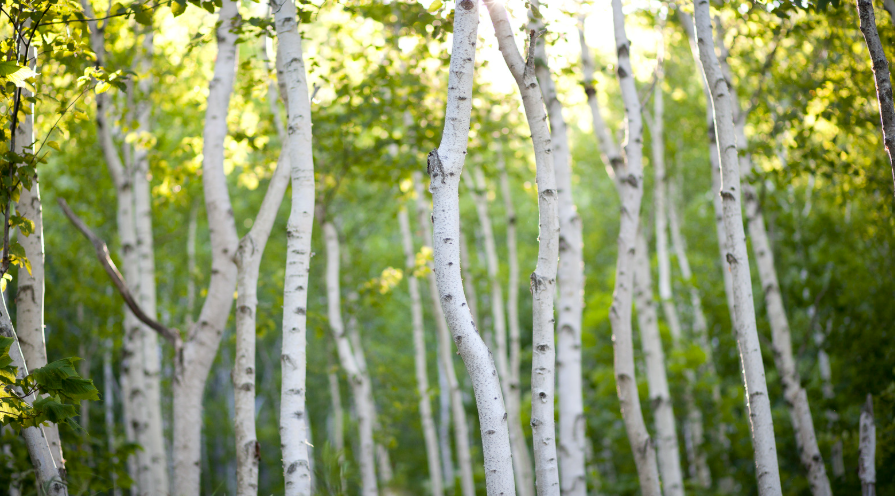
Trees with white bark aren’t simply showing off, and according to research on bark coloration, that pale color reflects sunlight in a way that helps a tree stay safely dormant longer during an early winter thaw rather than breaking dormancy prematurely and risking damage from the next hard frost. That function, called bark thermoregulation, is part of why white-barked trees dominate so many northern and high-elevation forests where sudden temperature swings are common.
Quaking aspen takes that adaptation a step further, and according to research published through Brigham Young University’s ScholarsArchive, aspen bark contains a thin, chlorophyll-rich layer capable of genuine photosynthesis, letting the tree quietly produce sugars through its trunk and branches even in winter after every leaf has dropped. According to Purdue University Extension’s ID That Tree program, paper birch achieves its own brilliant white color differently, through a chalky bark that peels and flakes away in papery sheets to reveal a light tan to bronze layer underneath.
Not every tree on this list is a pure, uniform white, and the color genuinely ranges from the brilliant, paper-white peel of a birch to the greenish-cream smoothness of an aspen to the simple chalky pallor found on a handful of less commonly discussed species. What follows covers 24 trees with white bark, along with where each one grows and the data behind its color.
Paper Birch
Paper birch produces brilliant, chalky-white bark that peels away in thin, horizontal, papery sheets, revealing a light tan to bronze layer underneath. According to Purdue University Extension, the species is common throughout the North Woods of northern Wisconsin and Michigan’s Upper Peninsula, identifiable by its alternating simple leaves and catkin flower structures.
It grows throughout the northern United States and Canada, thriving in the cold climates where its reflective bark provides a genuine survival advantage. Its peeling habit also sheds accumulated lichen and moss from the trunk, keeping the bark surface relatively clean compared to non-peeling species.
European White Birch
European white birch, also called silver birch, produces smooth, brilliant white bark marked with dark, diamond-shaped fissures that develop as the tree matures. Unlike paper birch, its bark peels less dramatically, staying more consistently smooth throughout much of the tree’s life.
It grows as a landscape tree throughout the northern United States, originally native to Europe and Asia before widespread cultivation abroad. Its slender, weeping branch habit has made it a popular ornamental choice distinct from the more upright form of its North American relative.
Gray Birch
Gray birch produces chalky white bark that doesn’t peel as readily as paper birch, marked with distinctive dark, triangular patches beneath each branch. Its bark tends toward a slightly grayer, less brilliant white than either paper birch or European white birch.
It grows throughout the northeastern United States, often one of the first trees to colonize abandoned fields and disturbed ground. Its relatively short lifespan and fast growth make it more of a pioneer species than a long-term forest fixture.
Himalayan Birch
Himalayan birch produces some of the whitest bark of any birch species, a brilliant, almost luminous surface that peels in thin horizontal strips similar to paper birch. Its exceptional color has made it a highly sought-after specimen tree for winter garden interest.
It grows as a landscape tree throughout much of the temperate United States, native to high-elevation forests of the Himalayas where intense winter sun makes reflective bark a genuine survival advantage. Its slender, upright form and vivid white trunk make it a popular focal point even in a small residential garden.
River Birch ‘Heritage’
River birch ‘Heritage’ is a cultivar bred specifically for its notably lighter, creamy-white exfoliating bark, distinct from the darker salmon-brown peel typical of the standard wild species. Its improved resistance to bronze birch borer has made it a more reliable choice than paper birch in warmer climates.
It grows as a landscape tree throughout much of the eastern and central United States, tolerating heat and humidity considerably better than the more northern-adapted white-barked birches. Its peeling curls of pale, papery bark provide multi-season visual interest even without leaves.
Quaking Aspen
Quaking aspen produces smooth, greenish-white to chalky bark that doesn’t peel, marked with dark, diamond-shaped scars where lower branches have naturally died off. According to research published through Brigham Young University’s ScholarsArchive, its thin outer bark conceals a genuinely photosynthetic layer, letting the tree produce sugars through its trunk even in the dead of winter.
It grows throughout much of the western and northern United States, often forming enormous interconnected clonal colonies that share a single root system across many acres. Its trembling leaves, which give the tree its common name, result from a uniquely flattened leaf stalk that flutters in the slightest breeze.
Also Read: Trees With Large or Long Seedpods
Bigtooth Aspen
Bigtooth aspen closely resembles quaking aspen in its smooth, pale bark, distinguished by an often slightly darker, more olive-toned cast and larger, more coarsely toothed leaves. Both species can be difficult to tell apart from bark alone without checking the leaves.
It grows throughout the northeastern and north-central United States, frequently found growing alongside quaking aspen in the same disturbed or recovering forest habitat. Its bark roughens and darkens near the base as the tree matures, similar to its close relative.
American Sycamore
American sycamore produces a distinctive mottled, camouflage-patterned bark, with the outermost brown layer flaking away in irregular patches to reveal creamy white bark beneath, especially high in the crown. That contrast between rough lower bark and smooth white upper branches makes a mature sycamore visible from a considerable distance in winter.
It grows throughout the eastern United States, favoring the rich, consistently moist soil found along rivers and streams. Its bark’s flaking pattern is thought to help the tree shed pollutants and accumulated buildup more effectively than a solid, unbroken bark surface would.
London Plane Tree
London plane tree, a hybrid closely related to American sycamore, produces the same mottled, flaking bark pattern that reveals pale, creamy-white patches beneath the outer brown layer. Its improved disease resistance compared to pure sycamore has made it a favorite street tree in cities worldwide.
It grows as a landscape and street tree throughout much of the temperate United States, tolerating urban pollution and compacted soil notably well. Its distinctive bark pattern makes it one of the most recognizable street trees in major cities from London to New York.
White Poplar
White poplar produces bark that starts smooth and pale gray-white on young trees before developing dark, diamond-shaped fissures with age, closely resembling aspen bark at a young stage. Its leaves carry a distinctive silvery-white, felted underside that flashes visibly whenever wind turns the foliage.
It grows in scattered locations throughout much of the United States, often escaping cultivation and spreading aggressively via root suckers. A single tree can send up new shoots many feet from the original trunk, gradually forming an entire grove of genetically identical clones.
Ghost Gum
Ghost gum produces some of the purest, most brilliant white bark of any tree in the world, a smooth surface that sheds its outer layer continuously rather than peeling in distinct sheets. Its striking white trunk has made it a favorite subject for painters and photographers throughout its native Australian range.
It grows as a specialty landscape tree in the warmest, most frost-free parts of the United States, including South Florida and Southern California. Its continuous bark-shedding habit keeps the trunk remarkably clean and pale even in dusty, exposed desert conditions.
Snow Gum
Snow gum produces bark that sheds in irregular patches, revealing a patchwork of cream, white, gray, and pale green underneath, similar in effect to a sycamore but considerably more colorful. Its twisted, gnarled growth habit at high elevations gives the tree a genuinely sculptural, weathered appearance.
It grows as a specialty landscape tree in mild, frost-tolerant regions of the United States, native to high-elevation forests of southeastern Australia. Its cold hardiness, unusual for a eucalyptus, allows it to survive winter conditions that would kill most other species in its genus.
Rainbow Eucalyptus
Rainbow eucalyptus produces bark that passes through a vivid sequence of colors as it sheds and regrows, beginning bright green before aging through blue, purple, orange, and finally maroon, with fresh green-to-white patches constantly emerging as older bark flakes away. That continuous, multicolored shedding cycle is what gives the tree its name and its striking, almost painted appearance.
It grows as a specialty landscape tree in South Florida, Hawaii, and other frost-free tropical regions of the United States. Its bark coloration is most vivid on young, actively growing sections of trunk, fading as that section ages and prepares to shed again.
Lemon-Scented Gum
Lemon-scented gum produces smooth, mottled bark that sheds to reveal pale cream to white patches beneath, releasing a distinctly citrus-like fragrance from its crushed leaves. Its tall, slender form and pale, dappled trunk make it a popular ornamental despite requiring a genuinely frost-free climate.
It grows as a landscape tree throughout South Florida, Southern California, and other frost-free regions of the United States. Its essential oil, extracted from the leaves, is used commercially in insect repellents and various fragranced products.
Chalk Maple
Chalk maple, and according to the North Carolina Extension Gardener Plant Toolbox, its species name is Latin for “white skin,” referring directly to the tree’s smooth, chalk-white mature bark. A mature tree typically reaches 25 to 30 feet tall, often developing multiple trunks with a rounded crown.
It grows as an understory tree throughout the southeastern United States, favoring the moist, rocky soil found along riverbanks, ravines, and bluffs. Its brilliant yellow-to-scarlet fall foliage color rivals its more famous relative sugar maple, despite the tree’s smaller overall stature.
Silver Maple
Silver maple produces smooth, silvery-gray bark on young trees that darkens and develops shaggy, peeling plates with age, losing much of its pale color over time. Its rapid growth rate has made it a popular, if short-lived, shade tree for homeowners wanting quick results.
It grows throughout the eastern and central United States, commonly found along rivers and floodplains where its tolerance for periodic flooding gives it an advantage. Its brittle wood and aggressive surface roots have made it a less popular choice for modern residential planting compared to sturdier shade tree alternatives.
Crape Myrtle ‘Natchez’
Crape myrtle ‘Natchez’ produces smooth, exfoliating bark in shades of cinnamon and light tan that peel away to reveal pale, creamy patches underneath, among the whitest bark of any commonly planted crape myrtle cultivar. Its bark provides significant multi-season interest well beyond the plant’s showy summer flower display.
It grows as a landscape tree throughout the southern United States, tolerating heat and drought considerably better than most other flowering ornamentals. Its smooth, mottled trunk becomes an increasingly prominent landscape feature as the tree matures and its lower branches are typically pruned away.
Whitebark Pine
Whitebark pine, despite its name, produces bark that’s typically light gray to whitish rather than a brilliant white, becoming more scaly and platy as the tree ages at the high elevations it favors. Its common name refers more to the overall pale impression of the tree from a distance than to any single brilliant white surface.
It grows in high-elevation forests throughout the western United States and Canada, often at the very edge of treeline where conditions are too harsh for most other conifers. Its seeds are an important food source for Clark’s nutcracker, a bird whose caching behavior helps disperse the tree’s seeds across the landscape.
Lacebark Elm
Lacebark elm produces distinctively mottled bark that flakes away in irregular puzzle-piece patches, revealing cream, orange, and gray-green tones underneath. That patchwork pattern, similar in principle to sycamore, gives the bark a genuinely decorative, almost camouflage-like quality year-round.
It grows as a landscape tree throughout much of the temperate United States, valued for its strong resistance to Dutch elm disease compared to native elm species. Its bark pattern becomes more pronounced and colorful as the tree matures over several decades.
Kousa Dogwood
Kousa dogwood produces mottled, exfoliating bark in patches of gray, tan, and cream, providing a subtler winter interest than the tree’s showy summer flowers and fall fruit. Its bark pattern becomes more pronounced on older specimens, adding a genuinely sculptural quality to a mature tree’s trunk.
It grows as a landscape tree throughout much of the temperate United States, generally more disease resistant than the native flowering dogwood it’s often planted alongside. Its bark, while not uniformly white, contributes meaningfully to the tree’s reputation as a genuine 4-season ornamental.
Whitebeam
Whitebeam produces smooth, pale gray bark, with its common name actually referring more to the striking silvery-white, felted underside of its leaves than to the bark itself. Its leaves flash a bright silver whenever wind turns them, an effect visible from a considerable distance.
It grows as a landscape tree in scattered locations throughout the temperate United States, native to Europe where it’s long been valued for its ornamental foliage. Its bright red berries, which follow inconspicuous white spring flowers, provide a valuable food source for birds in fall.
White Fir
White fir produces smooth, pale gray to whitish bark on younger trees, developing furrows and darker coloration only as the tree reaches full maturity after many decades. Its silvery-blue needles complement the pale bark, giving young trees an overall frosted appearance.
It grows throughout mountainous regions of the western United States, tolerating cold, high-elevation conditions considerably better than many other ornamental conifers. Its symmetrical, pyramidal form has made it a popular choice for use as a live Christmas tree.
Also Read: Trees With Purple Flowers
American Holly
American holly produces smooth, light gray to whitish bark that remains notably unbroken and consistent even as the tree ages, unlike the furrowed bark typical of most other evergreen trees. That smooth, pale trunk provides valuable winter interest alongside the tree’s better-known red berries and spiny evergreen leaves.
It grows throughout the eastern United States as both a native forest understory tree and a widely planted ornamental. Its dense, spiny foliage and pale bark together provide year-round structure in a landscape, remaining useful even where the tree’s berries fail to develop due to a lack of a nearby pollinator.
Corkbark Fir
Corkbark fir, a high-elevation variety of subalpine fir, produces distinctively pale, corky, whitish-gray bark considerably softer and thicker than the bark of most other conifers. That corky texture provides genuine insulation against the intense cold and fire exposure common at the high elevations where the tree grows.
It grows in mountainous regions of the southwestern United States, particularly Arizona and New Mexico, favoring the highest, coldest forest zones below treeline. Its silvery-blue needles and pale bark together make it a popular ornamental conifer in regions cold enough to support its growth.
Things to Remember
Trees with white bark can look remarkably similar from a distance, but their bark patterns, texture, and color can vary considerably. Some have smooth, bright-white bark, while others develop peeling layers, dark markings, or grayish patches as they mature. Looking at the leaves, branches, and overall tree shape can make identification more reliable.
The appearance of white bark can also change with age and growing conditions. Young trees may have smoother or lighter bark, while older specimens can develop rougher surfaces and darker markings. The season can provide additional clues, particularly when examining the tree’s leaves, flowers, fruits, or seed structures.
When identifying a tree with white bark, examine several features rather than relying on bark color alone. Pay attention to the bark texture and pattern, leaf shape, branching habit, and the environment where the tree is growing. Clear photographs of the trunk and foliage can also help you compare the tree with reliable identification resources.