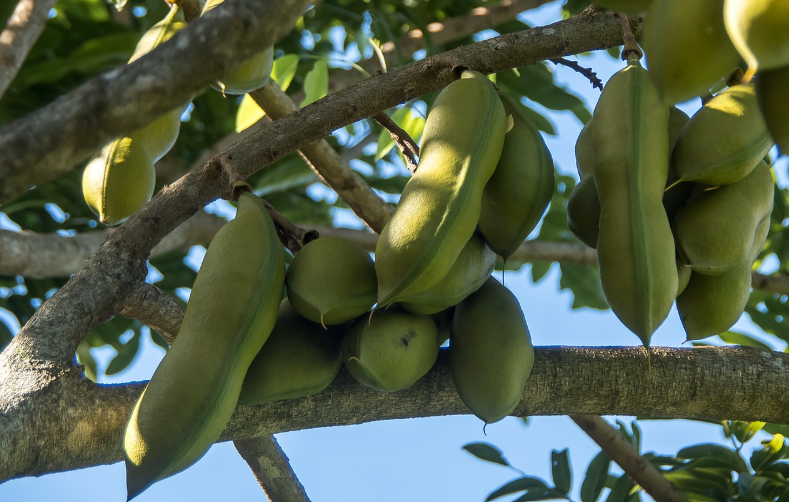
Trees with large seed pods produce some of the most visually dramatic fruiting structures in the entire plant kingdom, and according to University of Minnesota’s Campus Trees program, catalpa’s long, green, cigar-like seed pods can reach up to 22 inches, among the most distinctive of any tree grown in North America. That single species alone explains why the tree earned nicknames like cigar tree and Indian bean tree well before most people ever learned its proper botanical name.
Pod size in these trees isn’t just a curiosity, since according to the North Carolina Extension Gardener Plant Toolbox, catalpa pods mature to dark brown in fall and then split open lengthwise to release winged seeds, a structural design shared by many of the trees on this list despite their otherwise unrelated origins. Several entries here are members of the pea family specifically, a lineage that also produced the familiar garden bean and pea, just scaled up to a genuinely tree-sized structure.
Climate plays a significant role in exactly how large these pods get, and the most extreme examples on this list come from warm, tropical, or subtropical regions where trees have had an evolutionary incentive to produce oversized pods capable of dispersing far more seeds per fruiting event than a smaller pod ever could. A handful of these trees also carry a genuine safety caveat worth knowing before handling their seeds, since not every large pod on this list is safe to eat despite an outwardly bean-like appearance.
These trees span native North American river bottoms, African savannas, and tropical Asian and South American forests. What follows covers 21 trees with large seed pods, along with where each one grows and the data behind its fruit.
Catalpa
Catalpa produces long, slender, cylindrical seed pods that emerge green in summer before drying to dark brown by fall, giving the tree its common nicknames of cigar tree and Indian bean tree. According to the North Carolina Extension Gardener Plant Toolbox, southern catalpa’s pods reach up to 15 inches, while University of Minnesota’s Campus Trees program reports the related northern catalpa can produce pods up to 22 inches long.
It grows throughout the eastern and central United States, native to a small region near the confluence of the Mississippi and Ohio Rivers before spreading widely as a landscape tree. Its pods typically persist on the bare branches well into winter, splitting open lengthwise to release small, tufted, winged seeds.
Kentucky Coffeetree
Kentucky coffeetree produces thick, leathery, olive-brown pods that Ohio State University Extension’s BYGL program describes as 4 to 8 inches long and 1.5 to 2 inches wide, containing 3 to 5 large, hard seeds embedded in a gooey, gelatinous pulp. Early settlers roasted those seeds as a substitute for coffee, giving the tree its common name, though the raw seeds are considered toxic.
It grows throughout the eastern and central United States, and according to the Missouri Department of Conservation, its unusually large, tough seed pods may once have been an important food source for mastodons and other large mammals that have since gone extinct. Modern wildlife show little interest in the seeds, which is part of why the pods often persist on the ground unopened for months.
Honey Locust
Honey locust produces long, flat, twisting pods that can reach 12 to 18 inches, considerably longer than the pods of its close relative black locust. A sweet, edible pulp fills the space between the seeds inside each pod, historically eaten by both wildlife and livestock even though the hard seeds themselves pass through undigested.
It grows throughout the eastern and central United States, commonly found along river bottoms and disturbed ground where its pods twist into irregular corkscrew shapes as they dry. Thornless cultivars have become popular urban street trees, though the wild species itself is typically armed with substantial branched thorns.
Royal Poinciana
Royal poinciana produces flattened, woody seed pods that can reach up to 24 inches long, among the largest of any commonly cultivated flowering tree, with each stiff pod capable of holding as many as 50 seeds. Its brilliant clusters of red-orange summer flowers are what typically draws attention first, though the enormous seed pods that follow are just as visually striking once they mature.
It grows as a landscape tree throughout South Florida and other tropical and subtropical regions of the United States. Its dried pods are sometimes collected and used as percussion instruments in parts of its native range, since the loose seeds rattle audibly when shaken.
Carob Tree
Carob tree produces thick, leathery, dark brown pods reaching 4 to 12 inches long, filled with a sweet, edible pulp that’s long been processed into a chocolate substitute for people with cocoa sensitivities. Its seeds are also the original source of carob gum, a thickening agent still widely used in food manufacturing today.
It grows in warm, dry Mediterranean-type climates throughout California and other parts of the arid Southwest. A single mature tree can produce a substantial annual pod harvest, historically important enough that the seeds were once used as a standardized unit of weight, the origin of the modern carat.
Tamarind Tree
Tamarind tree produces thick, curved, brown pods ranging from 2 to 8 inches long, filled with a sticky, tangy-sweet pulp used extensively in cooking throughout South Asian, Latin American, and Caribbean cuisines. The pod’s brittle outer shell cracks easily by hand once fully ripe, revealing the fibrous pulp surrounding several hard seeds.
It grows as a landscape and fruiting tree throughout South Florida and other tropical regions of the United States. Its pulp is rich in tartaric acid, giving tamarind-based sauces and candies their distinctively sour edge compared to most other fruit-based condiments.
Sausage Tree
Sausage tree produces enormous, cylindrical, gray-brown pods that can reach 1 to 3 feet long and weigh up to 20 pounds, among the heaviest fruiting structures of any tree in the world. Despite the pod’s fruit-like appearance, it’s fibrous and generally inedible to humans, though elephants, baboons, and other African wildlife readily eat it.
It grows as a specialty landscape tree in South Florida and other frost-free tropical regions of the United States. Its massive pods dangle from long, rope-like stalks that can extend several feet from the branch, an adaptation that keeps the heavy fruit safely away from the trunk as it sways in the wind.
Baobab
Baobab produces large, oval, hard-shelled pods covered in a velvety fuzz, containing a dry, powdery pulp that’s exceptionally rich in vitamin C and has become popular as a modern superfood ingredient. A single pod can take up to 6 months to fully mature after the tree’s short-lived, night-blooming flowers are pollinated by bats.
It grows as a specialty landscape tree in the warmest, most frost-free parts of the United States, including South Florida and parts of Southern California. Its massive, water-storing trunk, capable of holding thousands of gallons, is at least as famous as the tree’s distinctive pods.
Jacaranda
Jacaranda produces flat, round, woody seed pods roughly 2 to 3 inches across, resembling a pair of castanets and persisting on the bare branches long after the tree’s famous purple flowers have dropped. The pods eventually split open to release dozens of thin, papery, winged seeds designed to drift on the wind.
It grows as a landscape tree throughout California, Arizona, and other warm, frost-free regions of the United States. Its dried pods are popular in floral and craft arrangements, valued for their unusual, sculptural shape long after the tree’s flowering season has ended.
Silk Floss Tree
Silk floss tree produces large, egg-shaped pods that split open to reveal a mass of white, cotton-like fiber surrounding the seeds, a fluffy material historically used to stuff pillows and life jackets. Its trunk is famously covered in stout, defensive spines, a stark contrast to the soft fiber produced inside its pods.
It grows as a landscape tree throughout South Florida, Southern California, and other frost-free regions of the United States. Its striking pink flowers, which appear before the pods develop, have made it an increasingly popular ornamental despite the tree’s somewhat intimidating spiny trunk.
Mimosa Tree
Mimosa tree, also called silk tree, produces flat, tan seed pods reaching 4 to 6 inches long that persist on the branches well into winter, rattling audibly in the wind long after the leaves have dropped. Each pod contains multiple flattened seeds capable of remaining viable in the soil for years.
It grows throughout much of the southern and eastern United States, having escaped widely from ornamental plantings into surrounding woodland edges. Its prolific pod and seed production is a major reason the tree has become classified as invasive in numerous states despite its continued popularity for its fragrant, pink, pom-pom flowers.
Golden Rain Tree
Golden rain tree produces distinctive papery, lantern-shaped seed capsules that start green before aging to a warm, parchment-like tan, each one containing several small, round black seeds. The capsules follow a showy display of small yellow summer flowers, giving the tree ornamental interest across 2 separate seasons.
It grows as a landscape tree throughout much of the temperate and warmer United States. Its inflated, balloon-like seed capsules are popular in dried floral arrangements, and a single mature tree can produce enough capsules to self-seed readily into surrounding disturbed ground.
Golden Shower Tree
Golden shower tree produces extraordinarily long, cylindrical, dark brown pods that can reach up to 2 feet in length, following the tree’s dramatic cascading clusters of bright yellow spring flowers. Inside, the pod is divided into dozens of small compartments, each holding a single seed embedded in a dark, sticky pulp with a notably unpleasant odor.
It grows as a landscape tree throughout South Florida and other tropical regions of the United States. Its pulp has a long history of traditional medicinal use in South Asia, though the seeds themselves are considered toxic if eaten in quantity.
Monkey Pod Tree
Monkey pod tree, also called rain tree, produces curved, dark brown pods reaching 4 to 8 inches long, filled with a sweet, licorice-scented pulp that monkeys and other wildlife readily eat in its native range. Its common name comes partly from that monkey-attracting pulp and partly from the tree’s habit of folding its leaflets closed before rain, an unusual, weather-sensitive adaptation.
It grows as a landscape shade tree in South Florida, Hawaii, and other frost-free tropical regions of the United States. Its enormous, umbrella-like canopy, often wider than the tree is tall, makes it one of the more dramatic shade trees planted in tropical landscapes.
Coral Tree
Coral tree produces long, narrow, constricted pods that can reach well over a foot in certain species, following the tree’s brilliant clusters of red-orange, coral-shaped flowers. The pods eventually split open to reveal a row of glossy, bright red or orange seeds, occasionally used decoratively in jewelry despite carrying mild toxicity.
It grows as a landscape and street tree throughout South Florida, Southern California, and other frost-free regions of the United States. Its dramatic flower and pod display, combined with a tolerance for poor, sandy coastal soil, has made it a popular choice for warm coastal landscaping.
Horse Chestnut
Horse chestnut produces round, spiky, green seed capsules that split open in fall to reveal 1 to 3 glossy, dark brown seeds known as conkers, historically used in a traditional British children’s game of the same name. Despite closely resembling an edible chestnut, the raw seeds are mildly toxic and generally unpalatable without extensive processing.
It grows as a landscape shade tree throughout much of the northern United States. Its spiny, softball-sized seed capsules can pose a genuine hazard underfoot once they begin dropping heavily each autumn, particularly on hard paved surfaces beneath a mature tree.
African Tulip Tree
African tulip tree produces large, boat-shaped seed pods reaching 8 to 10 inches long, splitting open lengthwise to release dozens of thin, papery, winged seeds designed to drift on the wind. Its dramatic clusters of bright orange-red, cup-shaped flowers typically draw more attention than the substantial pods that follow.
It grows as a landscape tree throughout South Florida, Hawaii, and other frost-free tropical regions of the United States. Its aggressive seeding and rapid growth have made it an invasive concern in several tropical regions where it’s escaped cultivation.
Guanacaste Tree
Guanacaste tree, sometimes called the ear pod tree, produces thick, curled, dark brown seed pods that twist into a shape closely resembling a human ear, typically 3 to 5 inches across. That distinctive coiled shape sets it apart from the straighter pods produced by most other large tropical trees.
It grows as a specialty landscape tree in South Florida and other frost-free tropical regions of the United States. Its massive, wide-spreading canopy, often broader than the tree is tall, makes it one of the most recognizable shade trees throughout its native Central American range.
Screw Bean Mesquite
Screw bean mesquite produces tightly coiled, spiral-shaped seed pods, typically 1 to 2 inches long, that resemble a small screw or corkscrew far more than a typical straight bean pod. That unusual, tightly wound shape makes it one of the easiest mesquite species to identify at a glance.
It grows throughout desert washes and streambanks across the arid Southwest, particularly Arizona, New Mexico, and Texas. Its coiled pods were historically ground into flour by Indigenous communities, providing a reliable food source in an otherwise harsh desert environment.
Honey Mesquite
Honey mesquite produces long, straight to slightly curved pods reaching 4 to 9 inches, filled with a sweet, edible pulp surrounding hard, drought-resistant seeds. Livestock and wildlife readily eat the pods, helping disperse the tough seeds across considerable distances.
It grows throughout arid rangeland across the southwestern United States, tolerating drought conditions that would kill most other trees outright. Its deep taproot, capable of reaching groundwater far below the surface, is part of why the species has proven so difficult to eradicate from grazing land where it’s considered invasive.
Black Locust
Black locust produces smooth, flat pods reaching 2 to 4 inches long, considerably shorter than the pods of its close relative honey locust, containing several small, hard, kidney-shaped seeds. Its fragrant white spring flowers are a significant early-season nectar source for bees, producing a distinctly flavored honey.
It grows throughout much of the eastern United States and has naturalized well beyond that range, spreading aggressively through both seed and root suckers. Every part of the tree besides the flowers is considered toxic, including the seeds contained within its otherwise unremarkable pods.
Things to Remember
Trees with large or long seedpods can be identified by more than just the size of their pods. Pay attention to the pod’s shape, color, texture, and how it hangs from the branches, along with the tree’s leaves, bark, flowers, and overall growth habit. These features can help distinguish between species with similar-looking seedpods.
Seedpods can also vary considerably as they mature. Some begin green and become brown or dark when dry, while others remain relatively soft or split open to release their seeds. The time of year when pods appear can provide another useful clue, especially when combined with the tree’s flowering period and the type of habitat where it grows.
When identifying a tree with large or long seedpods, examine the entire tree rather than relying on the pod alone. Clear photographs of the leaves, flowers, bark, and seedpods can make identification much easier. Once the species is confirmed, you can learn more about its growth requirements, landscape value, and whether its seeds are dispersed readily in your area.