Weeds with orange flowers are genuinely harder to find in number than weeds of almost any other color, since true orange is one of the rarer pigments in the plant world, produced by carotenoid compounds that show up far less often in wild, unselected populations than the anthocyanins responsible for purple, pink, and blue blooms. That scarcity is part of why this list leans more heavily on escaped garden ornamentals and orange-red or orange-yellow relatives than the more purely wild rosters built for other colors.
Several entries here also carry a genuine safety or ecological angle worth noting alongside their color, from a milkweed relative that can be lethal to pets if ingested to a native wildflower whose orange bracts are actually modified leaves rather than true petals. What follows covers 45 weeds with orange flowers, along with where each one grows and the data behind its bloom.
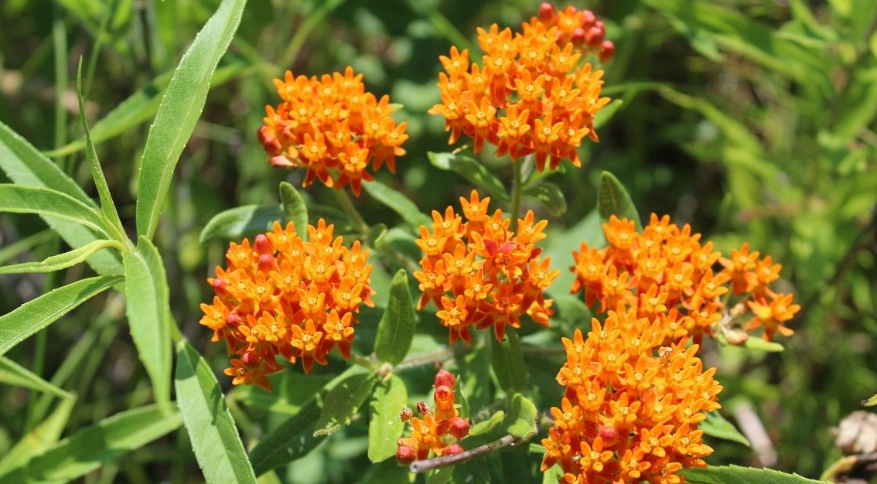
Butterfly Weed
Butterfly weed produces flat clusters of vivid orange flowers on a native milkweed relative that lacks the milky sap typical of most other milkweed species. A single plant can host dozens of monarch caterpillars over a season.
It grows throughout dry fields and prairies across most of the eastern and central United States, tolerating poor, sandy soil that would leave most other milkweeds struggling.
Orange Hawkweed
Orange hawkweed, also called devil’s paintbrush, produces clusters of vivid orange, dandelion-like flowers atop a hairy stem. It spreads aggressively via both seed and above-ground runners, forming a dense mat within just a couple of seasons.
It grows throughout meadows and disturbed ground across the northeastern United States and Canada, classified as a noxious weed in several states given how quickly it crowds out pasture forage.
Jewelweed
Jewelweed produces delicate, spurred orange flowers dotted with reddish spots, dangling from translucent, succulent stems along shaded streambanks. Its ripe seed pods burst open at the slightest touch, flinging seeds several feet, which is how it earned its other name, touch-me-not.
It grows throughout moist, shaded woodland edges across the eastern United States and Canada, and its crushed stem juice has long been used as a folk remedy for poison ivy rashes.
Orange Daylily
Orange daylily, also called ditch lily, produces trumpet-shaped orange flowers on a vigorous perennial that escaped cultivation so thoroughly it now lines roadside ditches nationwide. Each individual flower lasts only a single day, though a mature clump produces dozens in succession.
It grows throughout roadsides and old homesteads across most of the temperate United States, often marking the site of a long-vanished farmhouse decades after the structure itself is gone.
Trumpet Vine
Trumpet vine produces large, trumpet-shaped orange-red flowers on an aggressive, woody vine that climbs 30 to 40 feet using aerial rootlets. Hummingbirds visit it constantly through summer, drawn to its deep, nectar-rich blooms.
It grows throughout the eastern and southeastern United States, and its vigorous growth can eventually girdle and kill a smaller host tree over several years.
Indian Paintbrush
Indian paintbrush produces brilliant orange-red bracts, modified leaves rather than true petals, surrounding small, inconspicuous true flowers hidden within. It’s semi-parasitic, tapping into the roots of neighboring grasses for part of its water and nutrient supply.
It grows throughout prairies and open meadows across much of the western and central United States, and it rarely thrives in cultivation precisely because it depends on that host relationship to survive.
Tiger Lily
Tiger lily produces nodding orange flowers speckled with dark spots and sharply recurved petals, an escaped Asian ornamental that persists for decades around old homesites. It spreads readily via small bulbils that form in the leaf axils along its stem.
It grows in scattered naturalized populations throughout the eastern United States, and every part of the plant is toxic to cats, capable of causing fatal kidney failure even from a small amount of pollen.
Wood Lily
Wood lily produces upward-facing, spotted orange flowers on a slender native stem, distinguished from most other native lilies by its blooms pointing up rather than nodding downward. A single plant typically produces just a few flowers per season.
It grows in scattered dry woodlands and prairies across the northern United States and Canada, and its declining populations have made it a species of conservation concern in several states.
Turk’s Cap Lily
Turk’s cap lily produces nodding, deep orange flowers with strongly reflexed petals that curl back toward the stem, resembling the turban style that gives the plant its common name. A single stem can produce a dozen or more flowers in a good year.
It grows in moist meadows and woodland edges across the eastern United States, favoring the same rich, consistently damp soil that supports many other native lilies in the same habitat.
Canada Lily
Canada lily produces bell-shaped, spotted orange-yellow flowers dangling from a tall, whorled-leaf stem, among the more widespread native lilies in eastern North America. A mature plant can reach 3 to 5 feet tall.
It grows throughout moist meadows and woodland edges across the northeastern United States and Canada, and deer browsing has significantly reduced its populations in many areas where it was once common.
Blanketflower
Blanketflower produces daisy-like flowers banded in orange, red, and yellow, a native prairie perennial that readily self-seeds into disturbed roadsides well beyond an original planting. Its extended bloom period runs from early summer through the first frost.
It grows throughout prairies and disturbed ground across much of the central and western United States, tolerating drought and poor soil better than most other roadside wildflowers.
Chinese Trumpet Creeper
Chinese trumpet creeper closely resembles the native trumpet vine in its large, showy orange-red flowers and aerial-rootlet climbing habit. It’s sold widely as an ornamental despite its capacity to add substantial weight to a host tree over time.
It grows in scattered ornamental and escaped populations throughout the eastern United States, frequently confused with its native counterpart even by experienced gardeners.
Orange Agoseris
Orange agoseris, also called orange mountain dandelion, produces a single dandelion-like orange flower head atop a milky-sapped native rosette found in high-elevation meadows. Its flower color fades to a rusty pink as the bloom ages.
It grows throughout mountain meadows across the western United States, typically found at elevations too high for most other dandelion relatives to survive.
Crocosmia
Crocosmia, an escaped South African corm, produces arching sprays of vivid orange-red, trumpet-shaped flowers that hummingbirds visit readily throughout summer. It spreads via small offset corms that multiply steadily underground each year.
It grows in scattered naturalized patches throughout the Pacific Northwest and southeastern United States, capable of forming a dense colony within just a few growing seasons.
Calendula
Calendula, also called pot marigold, produces bright orange, daisy-like flowers on a self-seeding annual that readily escapes cultivation into nearby disturbed beds. Its petals are edible and have a long history of use in traditional herbal salves.
It grows as a garden escapee throughout temperate regions of the United States, tolerating cool spring and fall temperatures better than most other bright-flowered annuals.
Nasturtium
Nasturtium produces bright orange, spurred flowers on a sprawling annual vine that reseeds itself so readily it often persists as a volunteer weed. Both its peppery leaves and flowers are edible, commonly used as a garnish.
It grows as a garden escapee throughout temperate regions of the United States, and its seeds can be pickled as a substitute for capers.
Orange Cosmos
Orange cosmos produces daisy-like orange flowers on a fast-growing annual that self-seeds prolifically, often reappearing in the same garden bed for years. Its finely divided foliage gives the plant a light, airy appearance.
It grows as a garden escapee throughout temperate regions of the United States, favoring poor, lean soil over the rich beds most other annuals prefer.
Marigold
Marigold, in its orange-flowered forms, produces dense, ruffled blooms on a strongly scented annual that readily self-seeds into surrounding beds. Its pungent foliage is thought to deter several common garden pests, including nematodes in the soil.
It grows as a garden escapee throughout the United States, remaining one of the most widely planted companion flowers in home vegetable gardens.
Sneezeweed
Sneezeweed produces yellow-orange, drooping-petaled flowers with a raised central disk on a native wetland perennial. Its dried leaves were historically ground into a snuff that caused sneezing, giving the plant its common name.
It grows throughout wet meadows and stream banks across much of the eastern United States, tolerating consistently soggy soil that would rot the roots of most other perennials.
Mexican Sunflower
Mexican sunflower produces large, vivid orange, daisy-like flowers on a tall, fast-growing annual that reseeds readily once established. Its blooms are a significant late-season nectar source for migrating monarch butterflies.
It grows as a garden escapee throughout the southern and central United States, often reaching 6 feet tall by the end of a single growing season.
Orange Zinnia
Orange zinnia produces bright, long-lasting orange blooms on a heat-tolerant annual that self-seeds into surrounding beds far more readily than most gardeners expect. Its flowers remain colorful for weeks even in intense summer heat.
It grows as a garden escapee throughout temperate regions of the United States, and deadheading spent blooms extends its flowering season considerably.
California Poppy
California poppy produces satiny, cup-shaped orange flowers that close at night and on overcast days, a state wildflower that has naturalized well beyond its native range. Its blue-green, finely cut foliage stays attractive even when the plant isn’t in bloom.
It grows throughout disturbed roadsides across much of the western United States, and it’s illegal to pick in its native California under a long-standing state protection law.
Trumpet Honeysuckle
Trumpet honeysuckle, in its orange-red flowering forms, produces clusters of tubular blooms on a twining vine that climbs 10 to 20 feet. Hummingbirds visit it heavily from spring through fall.
It grows throughout the eastern United States, offering a genuinely non-invasive alternative to the aggressive Japanese honeysuckle sold at many nurseries.
Firecracker Vine
Firecracker vine produces small, tubular orange and red flowers along arching stems, a fast-growing annual that reseeds itself readily once established. Hummingbirds visit it heavily from midsummer through the first frost.
It grows as a garden escapee throughout the southern United States, capable of climbing 10 to 15 feet in a single growing season from seed.
Plains Coreopsis
Plains coreopsis produces daisy-like flowers banded in orange-red and yellow, a fast-growing native annual that readily colonizes disturbed prairie and roadside ground. A single plant can produce hundreds of seeds in a season.
It grows throughout prairies and roadsides across much of the central United States, commonly included in wildflower seed mixes for its reliable, colorful first-year bloom.
Orange Coneflower
Orange coneflower produces golden-orange, daisy-like flowers with a dark central cone on a native perennial that spreads aggressively via rhizomes. It’s closely related to black-eyed Susan, sharing a similarly coarse, hairy leaf texture.
It grows throughout meadows and roadsides across much of the eastern United States, favoring the moist soil that lets its rhizomes spread most freely.
Tropical Milkweed
Tropical milkweed produces clusters of vivid orange and yellow flowers on a popular garden milkweed that, unlike native species, doesn’t reliably die back in mild winters. That year-round persistence has been linked to disrupting normal monarch migration patterns in warm climates.
It grows as a garden perennial in the southern United States and as an annual elsewhere, and experts increasingly recommend cutting it back hard each fall specifically to counter that migration disruption.
Orange Wallflower
Orange wallflower produces clusters of fragrant, 4-petaled orange flowers on a short-lived perennial that readily self-seeds into rock walls and disturbed dry ground. Its flowers deepen in color as they age.
It grows as a garden escapee in scattered locations throughout the United States, favoring the same lean, well-drained soil found in a stone wall crevice.
Torch Lily
Torch lily, also called red hot poker, produces dramatic, torch-shaped flower spikes shifting from orange at the base to yellow at the tip. Its evergreen foliage in mild climates provides year-round structure between bloom cycles.
It grows as a garden escapee in mild coastal climates throughout the United States, and its unusually shaped blooms are a strong hummingbird draw.
Things to Remember
Weeds with orange flowers can be easy to notice, but identifying them requires more than looking at flower color. Different species can produce orange, reddish-orange, or orange-yellow blooms, so pay attention to the leaves, stems, flower shape, and overall growth habit when comparing plants.
Some orange-flowering weeds grow as small plants in lawns and gardens, while others become taller and spread through fields, roadsides, and disturbed areas. Their growth habits can vary considerably, so noting where the plant is growing and how it spreads can provide additional clues for identification.
When identifying a weed with orange flowers, compare several features rather than relying on color alone. Photographs of the flowers, leaves, and entire plant can make identification easier, particularly when combined with information about flowering time and habitat. Once the plant has been identified, you can decide whether it is simply unwanted or whether further control is necessary.