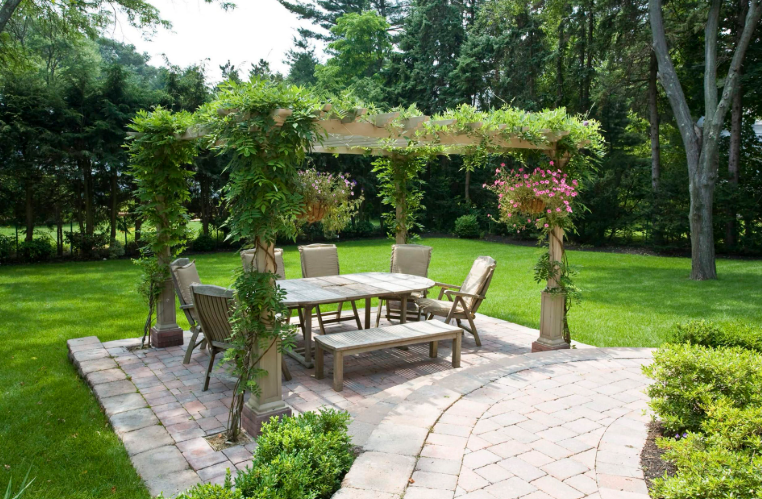
A pergola gives a vine something most garden structures can’t: a sturdy, elevated framework built specifically to be climbed rather than merely tolerated. According to University of Missouri Extension, growing grapes on an arbor combines fruit production, shade, and ornamental effects all at once, and vines trained this way generally produce less low-quality fruit than the same variety grown on a standard trellis, since the overhead framework lets clusters hang freely in better light and airflow.
That same overhead structure is exactly why some of the most vigorous vines available actually perform best on a pergola rather than a simple trellis or fence. According to Penn State Extension, a pergola is the most common training system used in commercial hardy kiwi plantings specifically because it accommodates the plant’s naturally high level of vigor, something a smaller structure would struggle to contain. Not every entry on this list needs that kind of heavy-duty support, though, and the range here runs from delicate annual vines suited to a single summer season to substantial, decades-lived woody plants that will eventually need real engineering behind them.
These vines span fruiting plants, fragrant flowering climbers, and fast annual cover crops suited to gardens across the United States. What follows covers 24 of the best vines for pergola coverage.
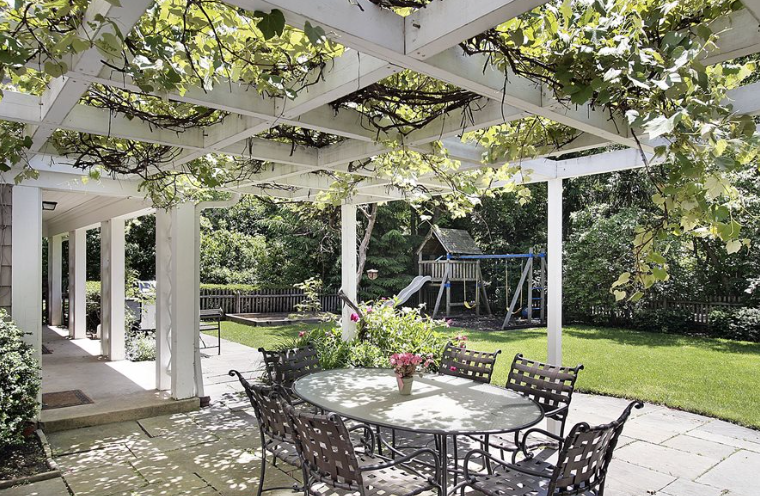
American Wisteria
American wisteria is native from Virginia to Texas, producing fragrant lilac-purple flower clusters 4 to 6 inches long each spring on a vigorous, woody, clockwise-twining vine well suited to a pergola’s sturdy overhead framework. Unlike its invasive Chinese and Japanese relatives, it flowers on new growth and stays considerably more manageable, though a mature specimen still benefits from the substantial support a pergola provides rather than a lighter trellis.
It grows throughout much of the eastern United States, requiring full sun for the best flower production and thriving for decades once established.
Climbing Hydrangea
Climbing hydrangea produces broad, lacy clusters of small white flowers on a slow-growing, self-clinging vine that attaches directly to wood or masonry using aerial rootlets. It tolerates more shade than most other flowering vines on this list, making it a reliable choice for the shadier side of a pergola, though it often takes several years to begin flowering after planting.
It grows as a garden perennial throughout temperate regions of the United States, eventually climbing 30 to 50 feet on a structure sturdy enough to support its considerable long-term weight.
Trumpet Vine
Trumpet vine is native to the eastern and southeastern United States, producing large, trumpet-shaped orange-red flowers that draw hummingbirds throughout summer on a vine capable of climbing 30 to 40 feet using aerial rootlets. Its vigor is exactly the trait that makes it well suited to a pergola rather than a lighter structure, though regular pruning keeps it from overwhelming a smaller framework entirely.
It grows throughout the eastern and southeastern United States, tolerating poor soil and heat better than most other flowering vines.
Coral Honeysuckle
Coral honeysuckle is native to the eastern United States, producing clusters of red-orange tubular flowers from late spring through fall on a twining, semi-evergreen vine that climbs 10 to 20 feet without the damaging rootlets or aggressive spread of invasive Japanese honeysuckle. Its lighter growth habit makes it a good choice for a smaller pergola section or in combination with a more vigorous neighboring vine.
It grows throughout the eastern United States, tolerating a range of soil types in full sun to partial shade.
Goldflame Honeysuckle
Goldflame honeysuckle produces clusters of pink and yellow tubular flowers on a moderately vigorous, non-invasive vine reaching 10 to 15 feet tall and spreading 3 to 6 feet in a single growing season. It attracts both hummingbirds and butterflies throughout its bloom period, though its canopy coverage stays relatively sparse compared to denser vines, making it a better fit for filtered shade than full privacy screening.
It grows as a garden perennial throughout USDA zones 5 through 9, performing best in full sun and well-drained soil.
Clematis
Clematis, particularly large-flowered hybrid types, produces enormous, showy blooms in shades of purple, pink, blue, and white on a vine that climbs by wrapping its leaf stalks around thin supports rather than twining its main stem. Its relatively lightweight growth habit makes it easy to combine with a second, more vigorous vine on the same pergola without one overwhelming the other.
It grows as a garden perennial throughout most of the temperate United States, generally preferring its roots kept cool and shaded even while its flowers reach for full sun above.
Climbing Rose
Climbing rose, including popular varieties like ‘New Dawn’ and ‘Golden Showers,’ produces repeat flushes of fragrant blooms throughout the growing season on long, arching canes that need to be manually trained and tied to a pergola’s framework rather than climbing on their own. Regular pruning and tying keep the canes organized along the structure, since roses lack the natural twining or clinging mechanisms found in true climbing vines.
It grows as a garden perennial throughout most of the temperate United States, typically reaching 8 to 15 feet depending on the specific variety.
Grape Vine
Grape vine, whether grown for table fruit or wine, is exceptionally well suited to pergola training, and according to University of Missouri Extension, plants are typically placed on both sides of the structure and trained to grow up and over toward the middle of the top. A mature vine requires a larger, taller structure than a standard trellis to provide adequate foliage cover, and heavy annual pruning, removing as much as 70 percent of the previous year’s growth in some systems, keeps the vine productive rather than overgrown.
It grows throughout most of the temperate United States, with specific varieties suited to different regional climates and disease pressures.
Passionflower
Passionflower, also called maypop, is native to the southeastern United States, producing intricate purple and white flowers throughout summer on a vigorous vine that spreads via underground runners and typically dies back to the ground each winter before regrowing the following spring. Its rapid, sprawling growth habit means it benefits from the sturdy, open framework a pergola provides rather than a delicate trellis.
It grows throughout the southeastern United States, also serving as a host plant for several native butterfly species.
Star Jasmine
Star jasmine is native to East Asia, producing small, intensely fragrant white star-shaped flowers on a versatile vine that can be trained as either a groundcover or a climber depending on how it’s supported. Draped over a pergola, its fragrance and dense, glossy foliage create a distinctly romantic, enclosed feeling that few other vines match, and it requires at least 8 hours of sunlight daily to produce its most abundant blooms.
It grows as a garden perennial throughout USDA zones 7 through 10, benefiting from some afternoon shade in the hottest climates.
Bougainvillea
Bougainvillea produces small true flowers surrounded by large, vividly colored papery bracts in shades of pink, purple, orange, and red, climbing 15 to 40 feet in warm, frost-free climates. Its sprawling, thorny canes need to be actively trained and tied to a pergola’s framework, and its vigorous growth makes it one of the more dramatic, high-impact choices available for a sunny, warm-climate structure.
It grows as a perennial vine throughout the southernmost United States and as a container plant elsewhere.
Mandevilla
Mandevilla produces large, glossy leaves and showy, trumpet-shaped flowers in shades of red, pink, and white, twining readily up a pergola post in warm weather. A mature plant typically reaches 8 to 10 feet where winter-hardy, though in cooler climates it’s commonly grown in a large container and brought indoors before the first frost.
It grows as a perennial vine in South Florida and other frost-free regions and as a warm-season container plant elsewhere.
Hardy Kiwi
Hardy kiwi, and according to Oregon State University Extension, vines can grow 15 feet wide and produce up to 100 pounds of fruit once established, requiring a substantial arbor or T-bar trellis tall enough to stand under for harvest. Both a male and female plant are needed for fruit production, and heavy pruning each winter, removing much of the previous season’s growth, keeps the vine productive rather than an unmanageable tangle.
It grows throughout much of the northern and Pacific Northwest United States, tolerating considerably colder winters than the fuzzy grocery-store kiwi it’s related to.
Sweet Pea
Sweet pea produces clusters of fragrant, ruffled flowers in a wide range of colors on a lightweight annual vine that climbs using delicate tendrils rather than twining stems. Its modest size and single-season lifespan make it a good option for filling in bare early-season sections of a pergola while slower, longer-lived vines are still becoming established.
It grows as a cool-season garden annual throughout temperate regions of the United States, generally performing best before summer heat sets in.
Black-Eyed Susan Vine
Black-eyed Susan vine produces cheerful, tubular orange and yellow flowers with a dark center, blooming continuously from summer through fall on a twining annual vine that typically reaches 6 to 8 feet in a single season. Its light, fast growth makes it a reliable option for quickly filling in a new pergola section during its first year, before more permanent perennial vines have had time to establish.
It grows as a garden annual throughout temperate regions of the United States.
Moonflower
Moonflower produces enormous, fragrant white flowers that unfurl at dusk and close again by midday, making it a striking choice for a pergola positioned over an evening seating area. A mature vine can climb 10 to 15 feet in a single season, often paired with morning glory so that flowers are open around the clock between the 2 plants.
It grows as a warm-season garden annual throughout temperate regions of the United States.
Crossvine
Crossvine is native to the southeastern United States, producing large, trumpet-shaped orange and yellow flowers in spring on a vine that climbs using adhesive tendrils, capable of reaching 30 to 50 feet on a sturdy pergola. Its evergreen to semi-evergreen foliage in mild climates provides year-round structure even outside its spring bloom period.
It grows throughout the southeastern United States, tolerating both full sun and partial shade.
Carolina Jessamine
Carolina jessamine is native to the southeastern United States, producing fragrant, bright yellow trumpet-shaped flowers in very early spring on an evergreen vine that can climb 10 to 20 feet. Its early bloom time gives a pergola color well before most other flowering vines have even leafed out for the season.
It grows throughout the southeastern United States, and every part of the plant is toxic if ingested.
Virginia Creeper
Virginia creeper is native to eastern North America, producing 5-leaflet compound leaves that turn a vivid red each fall on a self-clinging vine that attaches to wood using small adhesive discs rather than twining or thorns. Its brilliant autumn display makes it a valuable choice for a pergola that could use seasonal color beyond a single flowering period, though its vigorous growth requires occasional pruning to keep it from overtaking neighboring plants.
It grows throughout the eastern and central United States and Canada, capable of climbing 30 feet or more.
Boston Ivy
Boston ivy produces glossy, 3-lobed leaves that turn brilliant shades of red and orange each fall on a self-clinging vine well suited to covering the solid posts and crossbeams of a pergola rather than an open lattice. Its dense summer foliage provides substantial shade, and its adhesive tendrils grip smooth surfaces firmly enough that removal can be difficult once a vine is well established.
It grows throughout much of the temperate United States, tolerating urban pollution and a range of soil conditions.
Climbing Nasturtium
Climbing nasturtium produces bright, edible orange, yellow, and red flowers on a lightweight annual vine that scrambles readily over a pergola’s crossbeams using twisting leaf stems. Both its peppery flowers and rounded leaves are edible, making it a popular choice for an ornamental vine that doubles as a garnish for summer meals.
It grows as a garden annual throughout temperate regions of the United States.
Cup and Saucer Vine
Cup and saucer vine produces large, bell-shaped flowers that open pale green before deepening to rich purple, climbing 15 to 25 feet in a single season using coiling tendrils. Its remarkably fast growth rate makes it one of the quickest options on this list for covering a brand-new pergola in its very first year.
It grows as a garden annual throughout temperate regions of the United States.
Golden Hops
Golden hops produces large, deeply lobed, chartreuse-yellow leaves on a fast-growing perennial vine that dies back to the ground each winter before regrowing vigorously each spring. Its bright foliage color provides a striking contrast against darker-leaved companion vines, and a single plant can cover a substantial section of pergola within just one growing season.
It grows as a garden perennial throughout temperate regions of the United States, favoring full sun for its most vivid color.
Cypress Vine
Cypress vine produces small red trumpet-shaped flowers and delicate, feathery foliage on a fast-growing annual vine that readily reseeds itself once established in a garden bed. Its light, airy texture makes it a good complement to bolder-leaved vines elsewhere on the same pergola, filling gaps without visually competing with them.
It grows as a garden annual throughout temperate regions of the United States.
Further References
- Pergolas — Royal Horticultural Society (RHS) — Excellent reference for choosing vigorous climbers and rambling plants for pergolas, including climbing roses, clematis, honeysuckles, and other suitable climbers.
- Vines for Maryland Gardens — University of Maryland Extension — Explains different vine climbing methods and how to select vines for structures such as pergolas, arbors, and trellises.
- Vines That Shine: Screening Views While Adding Beauty — University of Missouri Extension — Discusses using ornamental vines on pergolas and other structures, with useful information on how different vines climb.
- Best Vining Plant for a Pergola — Ask Extension — Directly addresses pergola coverage and discusses grape vines, American bittersweet, Dutchman’s pipe, trumpet vine, wisteria, clematis, and climbing roses.
- Deciduous Vines for a Pergola — Ask Extension — Provides practical guidance on vines for creating summer shade over a pergola, including honeysuckle, grapes, trumpet vines, clematis, and silver lace vine.