Plants with green and red leaves fall into 2 genuinely different categories that are easy to conflate: cultivated ornamentals bred to display both colors simultaneously year-round, and a much larger group of native and landscape trees and shrubs that pass through a temporary green-and-red transition each autumn as chlorophyll breaks down and reveals or triggers the underlying red anthocyanin pigments. Both groups earn a spot on this list, though the seasonal group only shows the combination for a few weeks each year rather than continuously.
That fall-color mechanism is itself genuinely interesting, since many trees produce their red anthocyanin pigments fresh each autumn rather than simply unmasking a color that was there all along, using the pigment to help protect leaf tissue while the plant reclaims nutrients before dropping its leaves entirely. Cooler nights and bright sunny days tend to produce the most vivid red displays, which is why the same tree species can look dramatically different from one autumn to the next depending on the weather.
These plants span cultivated tropical houseplants, native North American forests, and widely planted landscape trees, with growth habits ranging from low groundcovers to towering shade trees. What follows covers 55 plants with green and red leaves, along with where each one grows and the data behind the coloring.
Poinsettia
Poinsettia is native to Mexico and Central America, and while its famous red color technically belongs to modified leaves called bracts rather than true leaves, the plant’s actual green leaves remain visible lower on the stem, creating a genuine green-and-red combination overall. A mature plant grown outdoors in frost-free climates can reach 10 feet tall.
It’s grown as a houseplant and holiday gift plant worldwide, requiring precise periods of uninterrupted darkness to trigger its colorful bract display each winter.
Croton ‘Red Iceton’
Croton ‘Red Iceton’ is a cultivar of Codiaeum variegatum, native to India, Malaysia, and the South Pacific, displaying narrow, twisted leaves combining bright red centers with green margins. A mature plant grown outdoors in frost-free climates can reach 4 to 6 feet tall.
It grows as a landscape shrub in South Florida and other frost-free regions and as a houseplant elsewhere.
Coleus ‘Wizard Scarlet’
Coleus ‘Wizard Scarlet’ is a cultivar derived from species native to Southeast Asia, displaying broad leaves with a bright red center surrounded by a distinct green margin. A mature plant typically reaches 1 to 1.5 feet tall in a single growing season.
It grows as a garden annual throughout temperate regions of the United States.
Caladium ‘Postman Joyner’
Caladium ‘Postman Joyner’ is a cultivar of a species native to South America, displaying large, heart-shaped leaves in a deep, solid red with a contrasting green margin and veining. A mature plant typically reaches 1 to 2 feet tall during the growing season.
It’s grown as a warm-season annual or houseplant throughout most of the United States, thriving in shaded, humid garden beds.
Caladium ‘Frieda Hemple’
Caladium ‘Frieda Hemple’ closely resembles ‘Postman Joyner’ in its combination of vivid red leaf centers and green margins, considered one of the most widely grown red caladium cultivars. A mature plant typically reaches 1 to 2 feet tall.
It grows as a warm-season annual or houseplant throughout most of the United States.
Amaranthus Tricolor ‘Aurora’
Amaranthus tricolor ‘Aurora’ is native to tropical Asia, displaying leaves marked with red, yellow, and green in a striking combination concentrated toward the top of the plant. A mature plant typically reaches 2 to 3 feet tall.
It grows as a garden annual throughout temperate regions of the United States.
Copper Plant ‘Firestorm’
Copper plant ‘Firestorm’ is a cultivar of Acalypha wilkesiana, native to Fiji and neighboring South Pacific islands, displaying leaves mottled in shades of red, orange, and green. A mature shrub typically reaches 3 to 4 feet tall.
It grows as a landscape shrub throughout South Florida and other frost-free regions.
Cordyline ‘Firebrand’
Cordyline ‘Firebrand’ is a cultivar native to Australia and the western Pacific islands, displaying long, arching leaves in a deep red with green undertones visible near the base. A mature plant typically reaches 3 to 6 feet tall.
It grows as a houseplant in temperate climates and as a landscape shrub in South Florida and other frost-free regions.
Neoregelia ‘Fireball’
Neoregelia ‘Fireball’ is a bromeliad hybrid derived from species native to Brazil, displaying a rosette of green leaves that flush a vivid red across the entire plant when grown in bright light. A mature rosette typically reaches under a foot across.
It’s grown as a houseplant and warm-climate landscape plant throughout the United States.
Red Anthurium
Red anthurium, in cultivars with vivid red spathes, is native to Colombia and Ecuador, and while the showy red portion is technically a modified leaf-like bract rather than true foliage, it’s held above the plant’s genuinely green, glossy leaves. A mature plant typically reaches 1 to 2 feet tall.
It’s grown as a houseplant and cut flower crop worldwide, requiring warm temperatures and high humidity.
Bougainvillea
Bougainvillea is native to South America, and much like poinsettia, its vivid red color belongs to papery bracts surrounding tiny true flowers, appearing alongside the plant’s ordinary green leaves on the same climbing branches. A mature vine can climb 20 feet or more in frost-free climates.
It grows as a landscape vine throughout the southern United States and as a container plant elsewhere.
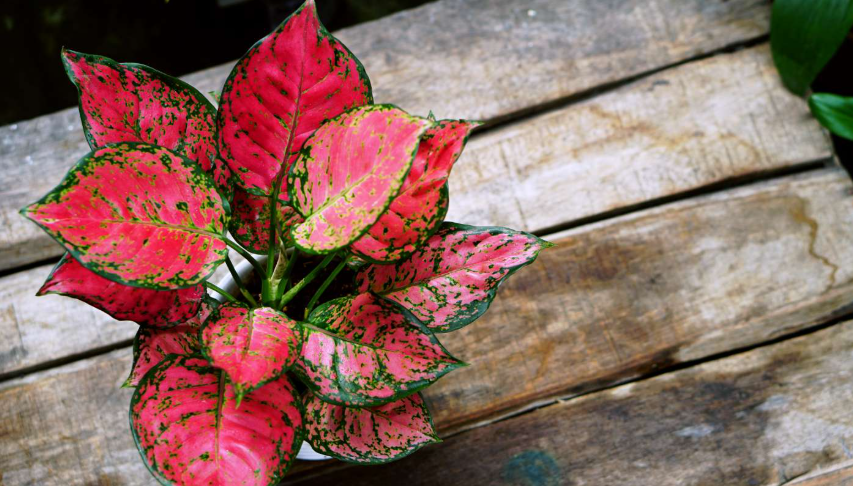
Red Aglaonema
Red Aglaonema, including cultivars like ‘Red Emerald,’ is native to the tropical forests of Southeast Asia, displaying broad leaves combining deep red coloring with green margins and midribs. A mature plant typically reaches 1 to 2 feet tall.
It’s grown as a houseplant worldwide, tolerating lower indoor light better than many other red-foliage plants.
Guzmania Bromeliad
Guzmania bromeliad, in cultivars with red bracts, is native to Central and South America, displaying a rosette of glossy green leaves topped with a cluster of vivid red bracts surrounding small true flowers. A mature rosette typically reaches 1 to 1.5 feet tall.
It’s grown as a houseplant worldwide, valued for its long-lasting colorful display.
Celosia ‘Fresh Look Red’
Celosia ‘Fresh Look Red’ is a cultivar of a plant native to tropical regions worldwide, displaying green foliage topped with dense, flame-shaped plumes of deep red. A mature plant typically reaches 1 to 1.5 feet tall.
It grows as a garden annual throughout temperate regions of the United States.
Red Hibiscus
Red hibiscus, in bronze-red leaf cultivars of the tropical species, is native to East Asia, displaying leaves combining green and reddish-bronze tones alongside large, showy red flowers. A mature shrub can reach 8 to 10 feet tall in frost-free climates.
It grows as a landscape shrub in South Florida and other frost-free regions and as a container plant elsewhere.
Red Maple
Red maple is native to eastern North America, typically found in a wide range of soil and moisture conditions, producing green summer foliage that transitions through brilliant red before dropping each fall. A mature tree can reach 40 to 70 feet tall.
It grows throughout the eastern United States and Canada, among the most widely planted native shade trees in the country.
Sugar Maple
Sugar maple is native to eastern North America, one of the most reliable and dramatic fall color performers of any tree species, its leaves turning vivid shades of orange and red each autumn as the growing season ends. A mature tree can reach 60 to 75 feet tall.
It grows throughout the northeastern United States and southeastern Canada.
Sweetgum
Sweetgum is native to the southeastern United States, producing star-shaped green leaves that turn a striking mix of red, purple, and yellow each fall, often with several colors appearing on the same tree simultaneously. A mature tree can reach 60 to 75 feet tall.
It grows throughout the southeastern and south-central United States.
Burning Bush
Burning bush, also called winged euonymus, is native to northeastern Asia, producing green summer foliage that turns an intensely saturated red each fall, among the most vivid of any commonly planted shrub. A mature shrub typically reaches 6 to 10 feet tall.
It grows as a landscape shrub across the northern and eastern United States, though it has become invasive in several states.
Flowering Dogwood
Flowering dogwood is native to the eastern United States, producing green summer leaves that turn a deep, wine-red each fall, alongside clusters of bright red berries. A mature tree typically reaches 15 to 25 feet tall.
It grows throughout the eastern United States, among the most popular native flowering trees in American landscaping.
Staghorn Sumac
Staghorn sumac is native to eastern North America, producing green, fern-like compound leaves that turn brilliant orange-red each fall. A mature shrub or small tree can reach 15 to 25 feet tall.
It grows throughout most of North America, thriving in poor, dry, rocky soil.
Virginia Creeper
Virginia creeper is native to eastern North America, its green summer leaves turning a vivid red each fall while its berries remain attached on distinctive bright red stems. A mature vine can climb 30 feet or more.
It grows throughout the eastern and central United States and Canada.
Poison Ivy
Poison ivy is native to North America, its green summer leaves shifting to shades of red and orange each fall, a color change that occurs regardless of the allergenic oil still present in the foliage. A mature plant can grow as a climbing vine or low shrub.
It grows throughout most of the United States and Canada.
Highbush Blueberry
Highbush blueberry is native to eastern North America, its green summer leaves turning a deep, wine-red each fall, adding ornamental value beyond its edible fruit. A mature shrub typically reaches 6 to 12 feet tall.
It grows throughout the eastern United States and Canada.
Oakleaf Hydrangea
Oakleaf hydrangea is native to the southeastern United States, its large, deeply lobed green leaves turning shades of deep red and burgundy each fall. A mature shrub typically reaches 6 to 8 feet tall.
It grows as a landscape shrub throughout the southeastern and eastern United States.
Fothergilla
Fothergilla is native to the southeastern United States, its green summer leaves turning brilliant shades of red, orange, and yellow, often displaying all 3 colors on the same shrub at once each fall. A mature shrub typically reaches 3 to 6 feet tall.
It grows as a landscape shrub throughout the eastern United States.
Virginia Sweetspire
Virginia sweetspire is native to the southeastern United States, its green summer leaves turning a rich burgundy-red each fall and often persisting into winter in milder climates. A mature shrub typically reaches 3 to 5 feet tall.
It grows as a landscape shrub throughout the southeastern and eastern United States.
Black Tupelo
Black tupelo, also called black gum, is native to eastern North America, among the earliest trees to change color each fall, its green leaves turning a brilliant scarlet-red weeks before most other species. A mature tree can reach 30 to 50 feet tall.
It grows throughout the eastern United States.
Sourwood
Sourwood is native to the southeastern United States, and according to the North Carolina Extension Gardener Plant Toolbox, certain cultivars like ‘Chameleon’ are specifically valued for their colorful fall foliage display, showing shades of red, purple, and yellow, while the species overall is known for consistently turning a deep, glossy red each fall. A mature tree can reach 25 to 60 feet tall.
It grows throughout the southeastern United States, particularly in the Appalachian region.
Red Chokeberry
Red chokeberry is native to eastern North America, its green summer leaves turning brilliant red each fall alongside clusters of bright red, persistent berries. A mature shrub typically reaches 6 to 10 feet tall.
It grows throughout the eastern United States and Canada.
Black Chokeberry
Black chokeberry closely resembles red chokeberry in its fall color transition from green to red, native to eastern North America, distinguished by its black rather than red fruit. A mature shrub typically reaches 3 to 6 feet tall.
It grows throughout the eastern United States and Canada.
Winged Sumac
Winged sumac is native to eastern North America, its green compound leaves turning a deep red each fall, distinguished from staghorn sumac by the winged ridges running along its leaf stems. A mature shrub can reach 15 to 20 feet tall.
It grows throughout the eastern and southeastern United States.
Sassafras
Sassafras is native to eastern North America, its green, variably lobed leaves turning shades of orange, red, and purple each fall, often with all 3 colors visible on the same tree. A mature tree can reach 30 to 60 feet tall.
It grows throughout the eastern United States.
Serviceberry
Serviceberry is native to North America, its green summer leaves turning shades of orange and red each fall, adding a second season of interest beyond its early spring flowers and edible summer fruit. A mature shrub or small tree can reach 15 to 25 feet tall.
It grows throughout most of the United States and Canada.
Witch Hazel
Witch hazel is native to eastern North America, its green summer leaves turning shades of yellow and red each fall, occasionally overlapping with its late-season flowering display. A mature shrub can reach 15 to 20 feet tall.
It grows throughout the eastern United States and Canada.
Arrowwood Viburnum
Arrowwood viburnum is native to eastern North America, its green summer leaves turning shades of red and purple each fall alongside clusters of blue-black berries. A mature shrub typically reaches 6 to 10 feet tall.
It grows throughout the eastern United States and Canada.
Red-Osier Dogwood
Red-osier dogwood is native to North America, its green summer leaves turning a reddish-purple each fall, complementing the shrub’s bright red winter stems. A mature shrub typically reaches 6 to 9 feet tall.
It grows throughout most of North America, favoring consistently moist soil.
Wild Ninebark
Wild ninebark, in its straight native green-leaved form rather than the many purple cultivars developed from it, is native to eastern North America, and according to the North Carolina Extension Gardener Plant Toolbox, the species displays fall color that shifts from green toward reddish tones as the season progresses. A mature shrub typically reaches 5 to 10 feet tall.
It grows throughout the eastern and midwestern United States, tolerating wet soil and urban conditions well.
Katsura Tree
Katsura tree is native to Japan and China, its heart-shaped green leaves turning shades of apricot, red, and yellow each fall, often releasing a scent compared to cotton candy as the leaves decompose. A mature tree can reach 40 to 60 feet tall.
It grows as a landscape shade tree throughout temperate regions of the United States.
American Persimmon
American persimmon is native to the eastern and central United States, its green summer leaves turning shades of yellow, orange, and reddish-purple each fall. A mature tree can reach 35 to 60 feet tall.
It grows throughout the eastern and central United States.
Black Cherry
Black cherry is native to eastern North America, its green summer leaves turning shades of yellow and red each fall. A mature tree can reach 50 to 80 feet tall.
It grows throughout the eastern United States and Canada.
Bearberry
Bearberry is native to northern North America, Europe, and Asia, its small, glossy, evergreen leaves shifting from summer green to a reddish-bronze tone through the cold winter months. A mature plant stays extremely low, generally under 6 inches tall.
It grows throughout the northern United States, Canada, and Arctic regions.
American Cranberry
American cranberry is native to North America, its small, evergreen leaves shifting from green to a bronze-red tone during the winter months. A mature vine stays low, trailing along the ground in wetland bogs.
It grows throughout the northeastern United States and Canada, cultivated commercially in bog conditions.
Smooth Sumac
Smooth sumac is native to North America, its green compound leaves turning a deep red each fall alongside clusters of fuzzy, deep red berries that persist through winter. A mature shrub or small tree can reach 10 to 20 feet tall.
It grows throughout most of North America.
American Cranberrybush Viburnum
American cranberrybush viburnum is native to the northern United States and Canada, its green summer leaves turning shades of red and purple each fall alongside clusters of translucent red-orange berries. A mature shrub reaches 8 to 12 feet tall.
It grows throughout the northern United States and Canada.
Winterberry Holly
Winterberry holly is native to eastern North America, its green summer leaves dropping in fall to reveal bright red berries held on otherwise bare branches through much of the winter. A mature shrub typically reaches 6 to 10 feet tall.
It grows throughout the eastern United States and Canada, favoring consistently moist soil.
Bridal Wreath Spirea
Bridal wreath spirea is native to eastern Asia, its green summer leaves occasionally turning shades of red and orange each fall, though less consistently vivid than many other flowering shrubs. A mature shrub typically reaches 6 to 8 feet tall.
It grows as a landscape shrub throughout temperate regions of the United States.
Wild Japanese Barberry
Wild Japanese barberry, in its straight green-leaved species form rather than the many purple cultivars bred from it, is native to Japan, its foliage turning shades of orange and red each fall. A mature shrub typically reaches 6 to 8 feet tall.
It grows as an invasive shrub throughout much of the eastern and midwestern United States.
Amur Maple
Amur maple is native to northeastern Asia, its green summer leaves turning a brilliant scarlet-red each fall, among the most reliably vivid red displays of any small landscape tree. A mature tree typically reaches 15 to 20 feet tall.
It grows as a landscape tree throughout the northern United States.
Paperbark Maple
Paperbark maple is native to central China, its green compound leaves turning shades of red and orange each fall, complementing the tree’s distinctive peeling, cinnamon-colored bark. A mature tree typically reaches 20 to 30 feet tall.
It grows as a landscape specimen tree throughout temperate regions of the United States.
Coral Bark Japanese Maple
Coral bark Japanese maple, botanically ‘Sango-kaku,’ is a cultivar of Acer palmatum, and according to Oregon State University’s Landscape Plants database, the species has proven remarkably variable in cultivation, with hundreds of named cultivars selected for differences in leaf color, form, and seasonal display. Its green summer leaves turn golden-yellow with red edges each fall, complementing the tree’s vivid coral-red winter bark. A mature tree typically reaches 20 to 25 feet tall.
It grows as a landscape specimen tree throughout temperate regions of the United States.
Franklin Tree
Franklin tree is native to Georgia and has been extinct in the wild since the early 1800s, with every cultivated specimen descended from seed collected along the Altamaha River by the Bartram family. According to Oregon State University’s Landscape Plants database, all plants in cultivation today trace back to those original Bartram collections, and the tree’s glossy green leaves turn striking shades of red, orange, and purple each fall, sometimes while the tree is still in bloom. A mature tree typically reaches 10 to 20 feet tall.
It grows as a rare landscape specimen tree throughout temperate regions of the United States.
Chinese Pistache
Chinese pistache is native to China, its green summer leaves turning a brilliant orange-red each fall, considered one of the most reliable fall color performers among landscape trees in warmer climates. A mature tree can reach 25 to 35 feet tall.
It grows as a landscape shade tree throughout much of the southern and western United States.
Doublefile Viburnum
Doublefile viburnum is native to China and Japan, its green summer leaves turning shades of deep red and burgundy each fall, following a spring display of showy white flower clusters arranged along the branches. A mature shrub typically reaches 8 to 10 feet tall.
It grows as a landscape shrub throughout temperate regions of the United States.
Further References
- Croton — North Carolina Extension Gardener Plant Toolbox — Covers numerous croton cultivars with green foliage combined with red, orange, pink, or burgundy markings, including ‘Petra’ and ‘Spirale’.
- Caladiums — University of Wisconsin–Madison Horticulture — Provides detailed information on caladium cultivars with combinations of green and red foliage, including ‘Postman Joyner’ and ‘Red Flash’.
- Caladium — North Carolina Extension Gardener Plant Toolbox — Useful for identifying caladiums with green, red, burgundy, and variegated leaves and explains their growing requirements.
- Castor Bean — University of Wisconsin–Madison Horticulture — Covers ornamental castor bean varieties with contrasting foliage colors, including green leaves with red or purple-red pigmentation.
- Croton — University of Wisconsin–Madison Horticulture — Describes several croton cultivars with green leaves marked by red, orange, pink, and purple tones, making it particularly useful for foliage identification.