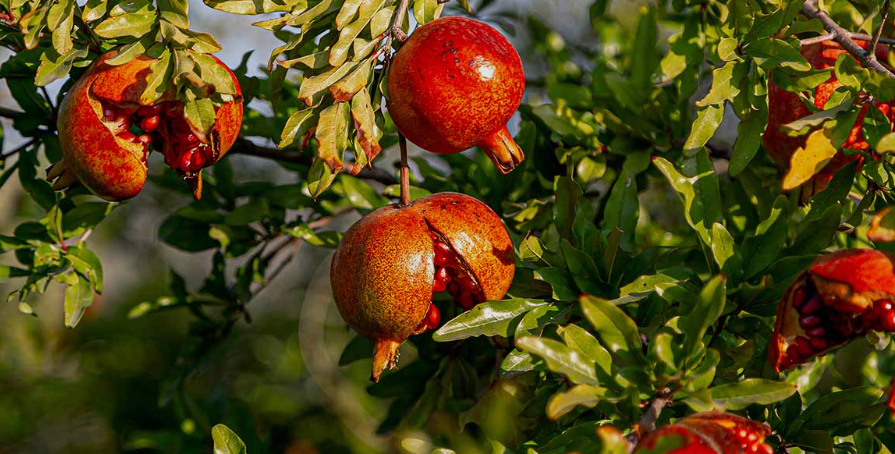
Types of pomegranates run to more than 500 named varieties, though only about 50 are widely grown. The fruit is one of the oldest in cultivation, native to the region from Iran to the Himalayas and farmed for at least 5,000 years. Its leathery rind encloses hundreds of juice-filled seed sacs called arils, which are the only part eaten.
World production figures are uncertain, since many countries do not report the crop separately. Older surveys put the total above 3 million metric tons from more than 300,000 hectares, and recent estimates run considerably higher. India is the largest producer at roughly 2.4 million tons a year, followed by China at about 1.6 million and Iran at about 1.1 million.
In the United States the crop is concentrated in one state. Colorado State University notes that California produces over 90% of American pomegranates, with 26,935 acres in 2012 and a crop valued at 115.4 million dollars. Spanish missionaries brought the fruit to California in 1769, and commercial growing began there in 1896.
Varieties differ far more than the supermarket suggests. Rind color ranges from yellow and pale pink to nearly black, and arils may be white, pink, red or deep purple. Flavor runs from very sweet to sharply sour, and seeds range from hard and woody to soft enough to swallow without noticing.
The 35 pomegranates below are grouped by region, starting with California varieties and moving through Central Asia, the Mediterranean, the Middle East and India. Each entry describes the fruit and then explains where and how it is grown.
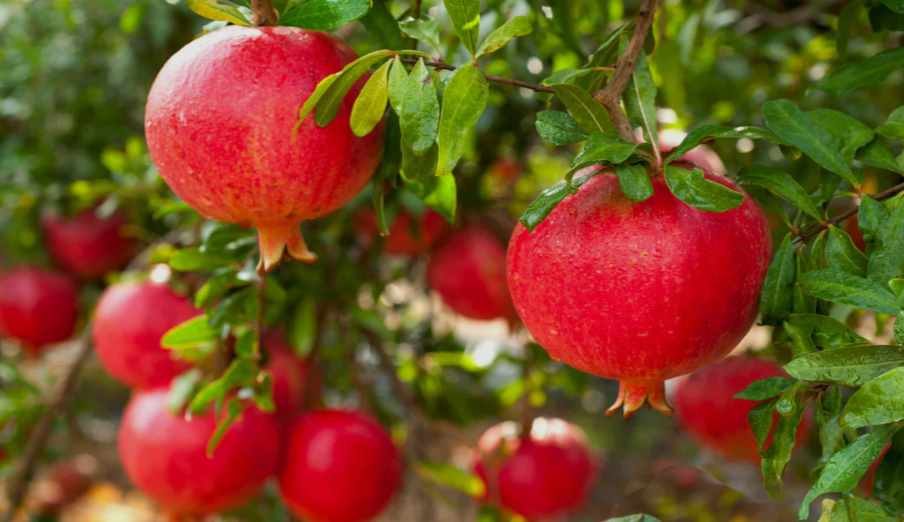
1. Wonderful
Wonderful is the most widely cultivated pomegranate in the world and the standard by which others are judged. The fruit is large, with glossy, deep red rind and dark red arils that have a rich, sweet-tart flavor. Its seeds are small and moderately hard, and the juice is intensely colored. The fruit ships well and resists splitting after rain better than most varieties.
California’s commercial industry began with cuttings of this variety brought from Florida in 1896. It is grown mainly in the San Joaquin Valley, where long, hot summers bring the fruit to full color and sugar. The harvest falls in October, later than most other California varieties. Wonderful is also planted on a large scale in Israel, Chile, Peru and South Africa.
2. Early Wonderful
Early Wonderful is a sport of Wonderful that was discovered in a California orchard and patented. The fruit is large and deep red, with thin skin and the same tangy flavor as its parent. It ripens about 2 weeks ahead of Wonderful, which gives growers an earlier harvest. The tree blooms slightly later, which helps it avoid spring frost.
It is grown in California’s San Joaquin Valley alongside its parent. Growers plant it to spread the harvest and reach the market before the main crop. The tree is medium-sized and very productive. It is also sold to home gardeners across the Southwest, where it suits the same hot, dry conditions.
3. Granada
Granada is another sport of Wonderful, with rind of a darker, blood-red shade. The fruit is slightly smaller than Wonderful and a little less tart. It ripens about a month earlier than its parent, usually in August. The red color develops well even in the heat of late summer.
The University of California lists Granada and Foothill as the main early-season varieties in the state, with Wonderful as the primary crop. Granada is grown in Tulare, Fresno and Kern counties. Its early harvest lets it open the fresh pomegranate season in American stores. It is also planted in home orchards where the summer is too short for Wonderful to ripen.
4. Foothill Early
Foothill Early produces fruit very similar to Wonderful in size, color and taste. Its main difference is timing, since it ripens 1 to 2 weeks sooner. The rind is red and the arils are dark and juicy. Growers use it to bridge the gap between Granada and the main Wonderful harvest.
It is planted in the San Joaquin Valley of California. It needs the same long, hot season as the other commercial varieties. The fruit is sold fresh and is also pressed for juice. It is rarely found outside commercial orchards, since nurseries seldom offer it to home gardeners.
5. Angel Red
Angel Red is a patented variety with bright red rind and vivid red arils. Its seeds are soft enough to chew and swallow easily. The fruit yields a high proportion of juice and ripens early, usually in September. The tree stays fairly compact, at about 10 feet tall and wide.
It is grown commercially in California, where it reaches the market ahead of Wonderful. It is also widely sold for home orchards in the South and Southwest. The tree bears heavily, and the branches may need support under a full crop. It has been tested in Florida and Georgia as a possible variety for the humid Southeast.
6. Eversweet
Eversweet is a very sweet pomegranate with almost no tartness, even before it is fully ripe. The rind is pink to red, and the arils are pale pink with clear juice that does not stain. The seeds are soft and easy to eat. The fruit needs a shorter season to mature than most varieties.
It suits coastal California and cooler inland valleys where other pomegranates fail to sweeten. Gardeners in the high desert of eastern California grow it for the same reason. It is mainly a home garden variety and is seldom planted commercially. The tree is small and can be kept in a large container.
7. Ambrosia
Ambrosia is known for its enormous fruit, which can be 2 to 3 times the size of a Wonderful. The rind is pale pink, and the arils are purple-red with a sweet-tart flavor. The juice is abundant and well balanced. The tree is vigorous and grows quickly.
It is grown in home orchards in California, Nevada and Arizona. It needs heat to ripen fully and does best in inland valleys and desert areas. The heavy fruit can bend or break young branches, so thinning helps. Its size makes it popular with gardeners who want fruit for juicing.
8. Sweet
Sweet is an old California variety with fruit lighter in color than Wonderful. The rind stays slightly greenish with a red flush even when ripe. The arils are pink and notably sweet, with very little acid. The tree bears at a young age and crops heavily.
It is grown in home gardens across California, Nevada and Arizona. It ripens early, which makes it useful in areas with shorter summers. The pale rind means ripeness is judged by taste and weight more than by color. The juice is often used in punches and other drinks.
9. Pink Satin
Pink Satin, also sold as Pink Ice and Sin Pepe, has a pink-speckled rind and light pink to rose arils. Its seeds are extremely soft, which is the meaning of its Spanish name, without seeds. The flavor is sweet and mild, with a hint of fruit punch. The fruit tastes best when left on the tree until fully ripe.
It entered the national collection from a plant introduction station in Chico, California. It is grown in home orchards in California and the Gulf states. The light juice does not stain, which makes it a good choice for families with children. The tree is medium-sized and adapts well to coastal and inland sites.
10. Sharp Velvet
Sharp Velvet, also known as Purple Heart, bears large fruit with dark red rind. The arils are deep red and have a distinctive, mildly acidic flavor. The seeds are medium in hardness. The tree is large and upright, reaching 16 feet or more.
It is grown in home gardens and small orchards in California. It needs more room than most pomegranates because of its height and spread. The tree yields heavily once established. Growers value it for both fresh eating and deep-colored juice.
11. Red Silk
Red Silk is a naturally small tree that grows to about 6 feet. The fruit is medium to large, with red rind and deep pink arils. Its flavor is sweet-tart and often compared to red berries. The tree begins bearing within a year or two of planting.
It is suited to small yards and large containers. It is grown mainly in California and the desert Southwest, where it tolerates intense heat. The compact size makes netting and harvesting easy. It is one of the best choices for gardeners who have room for only one small tree.
12. Golden Globe
Golden Globe has a rind of yellow-gold in place of the usual red. The arils are pale pink, sweet and very juicy, with soft seeds. The tree has a long flowering season and sets fruit over several months. The fruit is large and round.
It was selected in coastal California, where it performs well in mild summers. It is grown almost entirely in home gardens. The extended bloom means the harvest is spread over many weeks. The pale rind can sunburn in desert heat, so it does best near the coast.
13. Balegal
Balegal is a large, round pomegranate with pale pink rind. The arils are slightly darker than the skin and very sweet. The fruit is about 3 inches across. It was selected in San Diego, California.
It does best in the mild coastal climate of southern California. It ripens properly without the extreme heat that commercial varieties need. It is grown by home orchardists and rare fruit collectors. Cuttings are held in the national pomegranate collection at Davis, California.
14. Fleshman
Fleshman is a large, roundish fruit that is pink on the outside and inside. The arils are very sweet, with relatively soft seeds. It originated in Fallbrook, in northern San Diego County. The fruit is about 3 inches in diameter.
It is recommended for home planting in southern California and southern Nevada. It ripens well in cooler coastal summers. It has also been tested in research orchards in southern Georgia. The mild flavor suits people who find Wonderful too sharp.
15. Utah Sweet
Utah Sweet is a shrubby tree with pink flowers and pink-skinned fruit. The arils are pale pink, sweet and small, with notably soft seeds. The tree reaches about 12 feet tall and 6 feet wide. It tolerates more cold and drought than many sweet varieties.
It is grown in southern Utah, Nevada and Arizona. Once established, it needs only deep, infrequent watering. It is also planted in trial orchards in Georgia, where it had the smallest arils of 40 varieties tested. The pink flowers make it an attractive landscape shrub as well as a fruit tree.
16. Cloud
Cloud is a medium-sized pomegranate with green-red rind. Its arils are white to nearly colorless, and the juice is sweet and clear. In a Georgia trial of 40 varieties, it had the heaviest arils and the highest juice content. It came from a breeding program at the University of California.
It is grown in home gardens in California and the Southeast. The University of Georgia has kept it in its research plantings near Tifton. Its pale juice makes it useful where staining is a concern. The greenish rind gives little sign of ripeness, so growers test a fruit before picking the crop.
17. Crab
Crab is a large pomegranate with bronze-red rind. The arils are bright red and tart, with a rich flavor. In the Georgia trial, it had the reddest arils of any variety tested. The tree is a heavy and reliable bearer.
It came from the University of California breeding program. It has performed well in trials in Georgia and Florida, where humidity troubles many varieties. In Florida, fruit has been harvested as early as August. Its acidity makes it better suited to juice and cooking than to eating fresh.
18. Parfianka
Parfianka is a red pomegranate with bright red arils and very small, soft seeds. Its flavor balances sweetness and acidity, with a wine-like finish. It repeatedly ranks at or near the top in tastings of the national collection in California. It was selected by a Soviet scientist at a research station in Turkmenistan from a collection of more than 1,000 varieties.
The University of Florida has evaluated it along with other Central Asian varieties for the Southeast. It is grown in California, Florida and Georgia. The tree is compact and begins bearing within 1 to 3 years. It needs only 100 to 200 hours of winter chill, which suits mild-winter areas.
19. Desertnyi
Desertnyi has pinkish-red rind and red arils with soft seeds. The flavor is sweet with a slight tartness and a citrus-like note. In Florida trials, the peel and arils colored well by July. It comes from Turkmenistan.
It is grown in home orchards in California and Florida. Its early color makes it a candidate for humid climates, where late-ripening fruit often rots. The tree is small, which suits backyard planting. It has also survived in colder inland areas, though growth there is slow.
20. Salavatski
Salavatski bears medium to large fruit with mostly yellow rind and a pink blush. The arils are light pink to red, and the flavor is sweet and mild. The tree begins bearing early and crops heavily and consistently. It is one of the more cold-hardy varieties.
It came from Turkmenistan. It is grown in Florida, Georgia, the Carolinas and other areas with colder winters than California. Gardeners in the mid-South often choose it as their first pomegranate because of its hardiness. The plants are tall and upright and can be trained as a small tree or a multi-stemmed shrub.
21. Kazake
Kazake is a small pomegranate with yellow rind and light-colored arils. The flavor is sweet-tart, and the seeds are fairly hard. The plant is compact and tolerates cold well. It reached the United States from the former Soviet Union.
It is grown in the Southeast and in the cooler parts of the pomegranate belt. It is often recommended where winter lows threaten other varieties. The University of Florida holds it in its research collection. The small fruit is used mainly for juice.
22. Sumbar
Sumbar is a sweet, soft-seeded pomegranate with pink to red rind. The arils are pink and mild, with little acid. The fruit ripens early in the season. It is named for a river valley in southwestern Turkmenistan.
It is grown in home orchards in California and the Gulf states. Its early ripening suits areas with short or humid summers. The tree is moderately vigorous and easy to manage. It is one of several Turkmen varieties passed to American growers through the national collection.
23. Sirenevyi
Sirenevyi has large fruit with pink rind and dark, purple-red arils. The flavor is sweet with low acid, and some tasters compare it to watermelon. The seeds are soft. Its name means lilac in Russian.
It came from the Turkmenistan collection. It is grown by home gardeners in California and Florida. The contrast between the pale rind and dark arils makes it a striking fruit to cut open. It ripens in midseason and is best eaten fresh.
24. Kara Gul
Kara Gul is a dark red pomegranate with deep red arils. Its flavor is sweet-tart, with high acidity. The fruit is medium to large. It entered the national collection from Turkmenistan.
It is grown in collections and home orchards in California. It needs heat to bring out its sugar and balance the acid. Its strong color and sharp taste make it a good juice variety. It is also used for syrup and for cooking.
25. Nikitski Ranni
Nikitski Ranni has red-pink rind and red arils. The flavor is sweet and aromatic, with low to medium acidity. The fruit is large and ripens early. Its name refers to a famous botanical garden in Crimea and means early.
It is grown in California and the Southeast. It is one of the hardier Central Asian varieties and has been tried as far north as Virginia. The early harvest helps it escape autumn rains that split later fruit. The tree is productive and of moderate size.
26. Mollar de Elche
Mollar de Elche is the leading pomegranate of Spain. The rind is cream to pink, and the arils are sweet with very soft seeds. It is the only pomegranate in the world with a Protected Designation of Origin, granted in 2016. The province of Alicante grows about 85% of Spain’s pomegranates.
A study from the University of Palermo found that it ripens earlier than Wonderful in Sicily and has sweeter arils and juice. It is grown in 40 municipalities around Elche in southeastern Spain. More than half of the crop is exported, mainly to other European countries. The pale rind sunburns easily, so some growers shade the fruit.
27. Valenciana
Valenciana is the second major Spanish variety. Its fruit is yellowish-pink, sweet and soft-seeded, much like Mollar de Elche. It ripens earlier, which is the main difference between the two. The fruit is somewhat smaller.
It is grown in the provinces of Alicante and Murcia in southeastern Spain. The dry climate there, with less than 12 inches of rain a year, suits the crop well. It reaches European markets at the start of the season. Spanish breeders have crossed it with redder varieties to improve its color.
28. Dente di Cavallo
Dente di Cavallo is a traditional Italian variety whose name means horse’s tooth. The fruit is large, with yellow-green rind flushed red. The arils are pale red and sweet, and the seeds are medium-hard. The name refers to the long shape of the arils.
It is grown in Sicily, Puglia and other parts of southern Italy. It ripens in October. It is sold mainly in local markets and is common in home gardens. Newer orchards in Italy have largely turned to Wonderful and other red varieties.
29. Hicaznar
Hicaznar is the most important pomegranate in Turkey and is known there as the export pomegranate. The fruit is large, with dark red rind and deep red arils. The flavor is sweet-sour, and the juice is strongly colored. The fruit stores and ships well.
It is grown mainly in Antalya Province, which produces more than half of Turkey’s pomegranates. The provinces of Muğla and Mersin are the next largest growing areas. The fruit is exported to Europe and Russia. Sunburn and fruit cracking are the main problems growers face.
30. Acco
Acco is an early Israeli variety with red rind and red arils. The flavor is sweet, and the seeds are soft. It ripens in late summer, weeks before Wonderful. It was developed at an agricultural research center in northern Israel.
It is grown in Israel for the early export market. It has also been planted in Peru and South Africa, which supply the Northern Hemisphere in its off-season. The fruit is medium-sized and attractive. Its thin rind means it does not store as long as later varieties.
31. Malas-e-Saveh
Malas-e-Saveh is one of the best-known Iranian pomegranates. The rind is red, and the arils are red with a sweet-sour flavor. The word malas describes that balanced taste. The fruit is medium to large.
It is grown around the city of Saveh in central Iran, one of the country’s main pomegranate districts. Iran harvests about 1 million tons of pomegranates a year from roughly 90,000 hectares. Most of the crop is eaten within the country. The fruit is also made into juice and a thick, sour molasses used in cooking.
32. Rabab-e-Neyriz
Rabab-e-Neyriz has thick, dark red rind and red arils. The flavor is sweet-sour, and the fruit keeps for a long time in storage. It ripens late in the season. It is one of the main commercial varieties of southern Iran.
It is grown around Neyriz in Fars Province. The thick rind protects the fruit during shipping and storage. It is sold fresh and pressed for juice and concentrate. The variety tolerates the heat and dry air of the region well.
33. Bhagwa
Bhagwa is the leading commercial pomegranate of India. The rind is glossy and saffron-red, and the arils are deep red, sweet and soft-seeded. The thick skin protects the fruit in transport. Its name refers to its saffron color.
It is grown mainly in the state of Maharashtra, which produces most of India’s export crop. Indian growers can harvest in more than one season, since the trees flower several times a year in that climate. The fruit is shipped to the Middle East and Europe. It is also sold as packaged arils.
34. Ganesh
Ganesh is an older Indian variety that helped establish the country’s pomegranate industry. The rind is yellow with a pink blush, and the arils are pale pink. The flavor is sweet, and the seeds are soft. It was selected in the 1930s near Pune.
It is grown in Maharashtra, Karnataka and other states of western and southern India. It is sold mostly on the domestic market. Its pale color has caused it to lose ground to redder varieties such as Bhagwa. It remains an important parent in Indian breeding programs.
35. Kandhari
Kandhari is a large pomegranate with deep red rind. The arils are deep pink to blood-red, and the flavor is pleasantly acidic. The seeds are hard. It takes its name from the city of Kandahar in Afghanistan.
It is grown in Afghanistan and in the hill states of northern India. It does best where winters are cool and summers are hot and dry. The fruit is prized for its color and size. It is eaten fresh and pressed for a dark, tart juice.
Every entry now has two paragraphs of about four sentences each. The points to check before publishing are the same as before: world production figures vary widely between sources, and details for entries 2, 5, 7, 12 to 14, 22, 23, 28 and 31 to 34 come from general knowledge, not from the linked pages.
Key Takeaways
- Punica protopunica, commonly known as the pomegranate tree or Socotran pomegranate, is a species of flowering plant in the family Lythraceae. It is endemic to the island of Socotra (Yemen). Its natural habitat is subtropical or tropical dry forests. Cultivated since ancient times in the Mediterranean region of Europe and Africa, pomegranate trees have been prized for thousands of years for their fruit, which contains scores of seeds encased in sweet, tangy pulp.
- The pomegranate plant generally grows as a multi-stemmed bush or small tree that can reach a height of 10 to 12 feet at maturity. The branches have thorns or small spines and produce dark green glossy leaves that dry and drop over the winter months.
- In spring or early summer, orange to red tubular-shaped flowers appear in clusters along the branches. Pomegranate trees are self-fruitful, with both male and female flower parts on a single tree. Insects and hummingbirds help spread pollen from flower to flower, allowing fruit to form when conditions are right.
- Pomegranates thrive in climates with hot, dry summers and cool winters, making them well-suited to Mediterranean climates. However, they are adaptable and can grow in various conditions, including semi-arid environments. These trees are reliably hardy in U.S. Department of Agriculture plant hardiness zones 8 through 11.
- Pomegranate trees are relatively slow growers in their early years. When planted from seeds or cuttings, you might expect them to grow about 13-24 inches per year initially. They typically reach maturity in about 3-5 years, at which point they might start producing fruit. The growth rate might slow down as the tree matures but continues at a steady pace if conditions are favorable. In ideal conditions (full sun, well-drained soil, appropriate watering), pomegranate trees can grow more vigorously.
- With proper care, they can live for several decades. Some trees are reported to live for 100 years or more, though this is less common and depends heavily on conditions. While they can live long, their most productive years for fruit production might be within the first 30-40 years. After this, fruit production might decrease, though the tree itself can continue to thrive.
- The pomegranate fruit is roughly the size of a large orange or grapefruit, with a tough, leathery outer skin that ranges from yellow-orange to deep red when ripe. Inside, it’s filled with numerous seeds, each surrounded by a juicy, translucent aril. These arils are the edible part, varying in color from ruby red to pink. The fruit is a type of berry known botanically as a “pome.” It’s divided into compartments by white, spongy, inedible tissue, with each compartment filled with seeds.
- As the tree matures, it will begin to produce fruit that matures on the tree; generally, fruit needs about six or seven months on the tree to be ready for picking. A pomegranate is mature when it makes a tinny, metallic sound when tapped with a finger. A ripe pomegranate should never be pulled off a branch, since this may damage the fruit and possibly the tree’s bark. Rather, use scissors or clippers to cut the small stem that attaches the fruit to the tree.
- Pomegranate arils are often eaten fresh, either directly from the fruit or added to salads, yogurt, or desserts for a burst of flavor and color. The fruit juice is popular for its rich, tart flavor and is often consumed on its own or mixed into cocktails, smoothies, or sauces.
Sources:
- Colorado State University: Pomegranate Collection
- University of California: pomegranate scion and cultivar selection
- University of California: Pomegranate
- University of Florida: Cultivar Selection Guide for Florida-Grown Pomegranates
- University of Florida: pomegranates in the national collection
- University of Florida: pomegranate cultivar presentation
- University of Florida: The Pomegranate
- University of Palermo: Mollar de Elche and Wonderful in Sicily
- University of Nevada, Reno: The pomegranate
- University of California: Grow Your Own Pomegranates
- HortScience: pomegranate cultivars grown in Georgia
- ISHS: The pomegranate tree in the world
- ISHS: Pomegranate production in Turkey
- Chowhound: which country produces the most pomegranates
- Trend: Iran pomegranate production
- Foods and Wines from Spain: Granada Mollar de Elche
- CIHEAM: pomegranate improvement in Elche
- PMC: pomegranate germplasm at Elche
- USDA GRIN: pomegranate accessions
- Morton: Pomegranate, Purdue University text