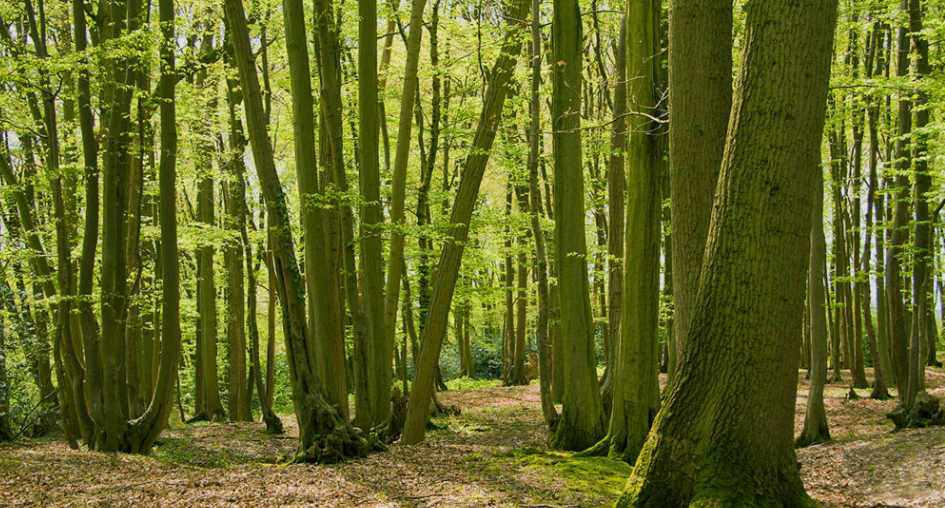
Types of hornbeam trees number between 30 and 40 worldwide, and some botanists now accept as many as 45. They are small to medium hardwoods in the birch family, spread across the temperate regions of the Northern Hemisphere. Most people know only one or two of them, usually as a clipped hedge or a shaded streamside tree.
The distribution of the group is strikingly uneven. Only two hornbeams are native to Europe and only one to eastern North America. The great majority grow in East Asia, with China holding the largest number of species.
The name describes the wood. Horn refers to its hardness, and beam is an old English word for tree. Hornbeam timber is pale, dense and difficult to split, and it was once the standard choice for ox yokes, tool handles, mallet heads, cogs and butcher’s blocks.
Hornbeams share a few features that make them easy to recognize. The leaves are 1 to 4 inches long, sharply toothed and marked with straight, parallel veins that give them a pleated look. The seeds are small nutlets held in hanging clusters of leafy bracts, which resemble the cones of the hop vine.
The 17 hornbeams below include the familiar American and European trees, a range of Asian species and the garden selections most often sold by nurseries. Each entry notes where the tree comes from, how large it grows and what sets it apart.
1. American Hornbeam
American hornbeam is a small understory tree with smooth, blue-gray bark stretched over a rippled trunk that looks like flexed muscle. That feature has given it the names musclewood, blue beech and ironwood. It usually grows 20 to 30 feet tall and about as wide.
The University of Florida lists it as native to most of the eastern United States, southeastern Quebec and southwestern Ontario. The tree tolerates shade and occasional flooding, and its wood is hard enough to dull woodworking tools quickly. The leaves turn yellow, orange and red in fall.
2. European Hornbeam
European hornbeam is the largest and most widely planted member of the group. It is native from Europe to western Asia and typically reaches about 50 feet tall and 30 feet wide. The tallest specimens exceed 100 feet.
The gray trunk is fluted, and the dark green leaves are about 3 inches long with deep, regular pleats. The tree tolerates heavy pruning and has been used for hedges and trained garden walks for centuries. It also handles drought and city conditions well.
3. Oriental Hornbeam
Oriental hornbeam is a small tree or large shrub with leaves only 1 to 2 inches long. It is native to southeastern Europe, including Hungary, Italy and the Balkans, and extends through Turkey and the Caucasus to Iran. It grows on dry, rocky hillsides where few other hornbeams would survive.
The tree rarely exceeds 30 feet and is often multi-stemmed. Its small leaves and dense twigs make it a good hedge plant and a popular subject for bonsai. It tolerates heat and drought better than the European hornbeam.
4. Japanese Hornbeam
Japanese hornbeam is a graceful tree with long, narrow leaves that carry 20 to 24 pairs of deeply pressed veins. North Carolina State University notes that it grows 20 to 30 feet tall in gardens and up to 50 feet in its native habitat. It comes from central and southern Japan and reached Western gardens in the late 1800s.
The branches spread in flat, layered tiers. The fruit clusters are 2 to 2.5 inches long and look very much like hops. The tree tolerates heavy shade and needs little care.
5. Loose-Flowered Hornbeam
The loose-flowered hornbeam is named for its open, dangling fruit clusters. It is native to Japan and Korea, where it grows in hillside woods. New leaves emerge with a red tint, which gives the tree its Japanese name, meaning red hornbeam.
The leaves are small and end in a long, slender tip. The bark is smooth and gray with pale vertical streaks. It is one of the hornbeams most often trained as bonsai in Japan.
6. Yeddo Hornbeam
Yeddo hornbeam is a medium-sized tree native to Japan, Korea and China. It takes its common name from the old name for Tokyo. The young shoots and leaf stalks are covered in fine hairs.
The leaves are oval and sharply double-toothed, turning yellow in fall. The tree can reach 40 to 50 feet in the wild. It is grown in arboretums in the United States and is another bonsai favorite.
7. Heartleaf Hornbeam
Heartleaf hornbeam has the largest leaves of the commonly grown species, often 3 to 5 inches long with a heart-shaped base. It is native to Japan, Korea, northeastern China and the Russian Far East. The bark becomes scaly and furrowed, unlike the smooth bark of most hornbeams.
The fruit clusters are thick and hop-like, with broad, overlapping bracts. The tree grows to about 50 feet in forest conditions. It is very cold-hardy and suited to northern gardens.
8. Korean Hornbeam
Korean hornbeam is a shrub or small tree that grows to about 30 feet, often with several stems. It is native to Korea, northern China and Japan. The twigs are dark maroon, and the branches tend to droop at the tips.
The glossy leaves are only about 2 inches long and turn burgundy to orange-red in fall. The tree tolerates drought, wind, hard pruning and city conditions. Its tiny leaves have made it one of the most prized hornbeams for bonsai.
9. Putuo Hornbeam
The Putuo hornbeam is one of the rarest trees in the world. It is native to Putuo Island, off the coast of Zhejiang Province in eastern China. Only a single wild tree is known to survive there.
Botanists have raised seedlings and grafted trees from that one parent to keep the species alive. The young trees are now grown in botanical gardens in China and abroad. The leaves are oval and thick, with fine teeth.
10. Henry’s Hornbeam
Henry’s hornbeam is a tall species from the mountains of central and western China. It is named after Augustine Henry, an Irish plant collector who worked in China in the late 1800s. The leaves are narrow and lance-shaped, with a long, tapered point.
The tree can reach 60 feet in the wild. It is seldom seen outside specialist collections. Its slender leaves give it a finer texture than most hornbeams.
11. Monkey-Tail Hornbeam
The monkey-tail hornbeam has the most spectacular fruit of any hornbeam. Keele University records that its pale green, papery catkins grow up to 20 inches long. The tree is native to southwestern China and was named for a Chinese botanist who first collected it in Sichuan.
The leaves are also unusually large, reaching about 10 inches, and emerge purple-bronze in spring. The tree often grows as a multi-stemmed shrub but can reach 65 feet. It is a recent arrival in Western gardens.
12. Kawakami Hornbeam
Kawakami hornbeam is native to Taiwan and southeastern China. It is a small tree, usually around 25 feet tall, with dense branching. The leaves are small and stay on the tree late into the season.
New growth is often tinted bronze-red. The tree is used for hedging and as a bonsai subject in East Asia. It is hardy enough for mild-winter parts of the United States.
13. Tropical Hornbeam
The tropical hornbeam is the southernmost member of the group in the Americas. It grows in the mountains of Mexico and Central America, in cool, humid cloud forests. Botanists have sometimes treated it as a form of the American hornbeam.
It resembles its northern relative, with a fluted gray trunk and pleated leaves. The tree grows at elevations of several thousand feet. It is not cultivated in the United States.
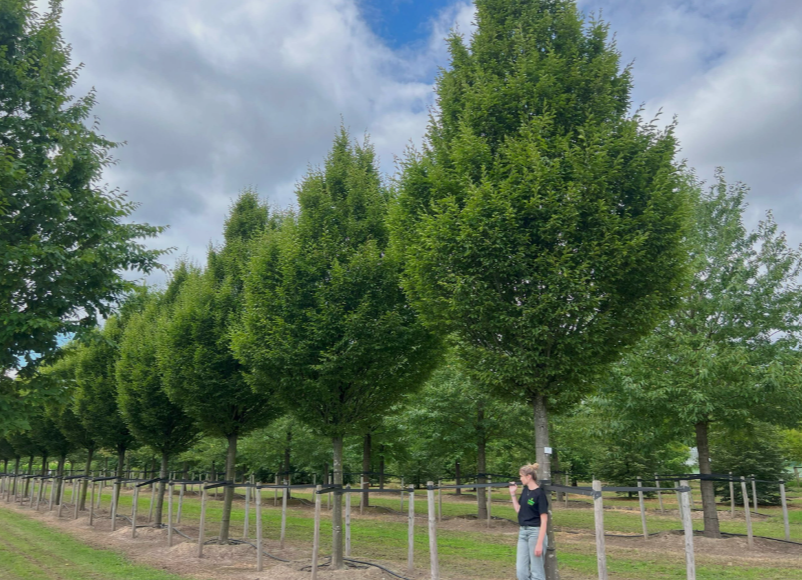
14. Pyramidal European Hornbeam
The pyramidal European hornbeam is the most common garden form of the European species. Oregon State University describes it as a tree of 30 to 50 feet that starts out columnar and soon becomes oval or vase-shaped. It was introduced before 1883 and is hardy to zone 4.
The crown is so dense and even that the tree looks sheared when it has not been touched. It has no single central trunk. It is widely used for street plantings, screens and formal avenues.
15. Frans Fontaine Hornbeam
Frans Fontaine is a narrow European hornbeam selected in the Netherlands. It grows 30 to 35 feet tall and 15 to 18 feet wide. It keeps a central leader and a tight, columnar outline.
The tree holds its narrow shape better with age than the pyramidal form. It is smaller and slower growing as well. That makes it a better fit for small gardens and confined planting strips.
16. Palisade American Hornbeam
Palisade is an upright selection of the American hornbeam. It has a narrow, oval crown formed by strongly ascending branches. It grows about 30 feet tall and half as wide.
The tree keeps the smooth, muscled bark and good fall color of the wild species. Its shape suits streets and small yards where the spreading wild tree would not fit. Other American selections include Firespire and Native Flame, both known for red-orange fall leaves.
17. Eastern Hophornbeam
The eastern hophornbeam is a close relative that shares the hornbeam name and its hard wood. It is native to eastern North America and grows 25 to 40 feet tall. The bark is brown and peels in thin, narrow strips.
Its fruit clusters look even more like hops than those of the true hornbeams, with each seed enclosed in a small, papery sac. The tree prefers drier upland soils than the American hornbeam. It is also called ironwood.
Key Takeaways:
- Hornbeam trees belong to the genus Carpinus and are known for their distinctive serrated leaves, smooth gray bark when young, and dense, rounded crowns.
- European hornbeam (Carpinus betulus) is one of the best-known hornbeam species, widely grown across Europe for hedges, ornamental planting, and formal garden designs.
- Hornbeam leaves have recognizable features, including oval shapes, pointed tips, prominent veins, and toothed edges. Many species develop yellow or golden-brown foliage in autumn.
- Hornbeam trees adapt to different growing conditions, although most prefer moist, well-drained soil and grow well in full sun or partial shade.
- Some hornbeam species are especially useful for landscaping, with European hornbeam commonly used for hedges and American hornbeam valued as an understory tree in woodland gardens.
- Hornbeam wood is exceptionally hard and dense, making it useful for tool handles, mallets, flooring, and other applications that require durable timber.
- Hornbeam trees provide ecological benefits, offering shelter for wildlife and producing seeds that contribute to forest food webs. Their dense foliage and adaptability also make them valuable additions to parks, gardens, and natural landscapes.
Sources:
- University of Florida: American Hornbeam
- NC State University: Japanese Hornbeam
- Keele University: Fang’s Hornbeam
- Oregon State University: Pyramidal European Hornbeam
- Oregon State University: Korean Hornbeam
- NC State University: Turczaninow Hornbeam
- Virginia Tech: European Hornbeam
- Purdue University Arboretum: Frans Fontaine hornbeam
- Utah State University: American Hornbeam
- Iowa State University: American Hornbeam
- Boone County Arboretum: Japanese Hornbeam
- Wikipedia: Hornbeam