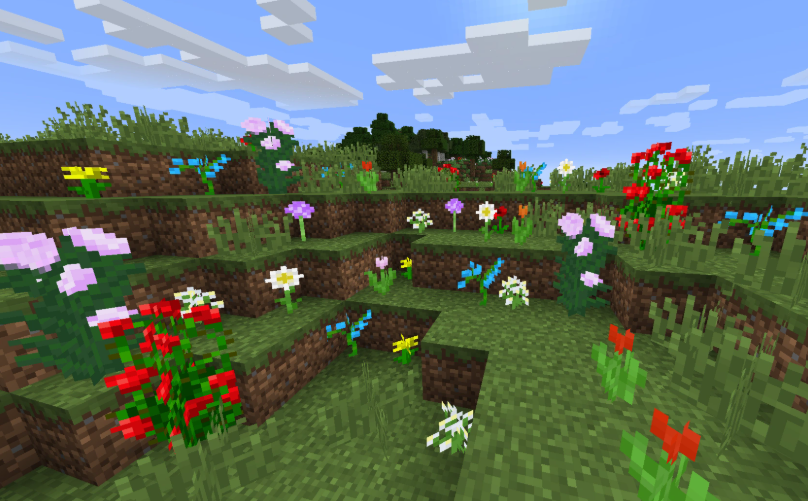
Flowers are among the most common decorative blocks in Minecraft, appearing in more than a dozen biomes across the Overworld, the Nether, and the End. As of the current version of the game, there are roughly 30 distinct flower types available to players, ranging from simple single-block blooms to rare variants that only appear under specific in-game conditions. Many of these flowers can be crafted into one of 16 available dye colors, making flower collection a core part of early and mid-game resource gathering.
Flower spawn rates vary widely by biome, with plains and flower forest biomes generating the highest density of blooms, sometimes producing more than 15 flowers per chunk during world generation. A handful of flowers, such as the wither rose and golden dandelion, cannot be found through normal exploration at all and instead require specific triggers to obtain. Below is a breakdown of every flower type currently in Minecraft, including where each one spawns and what makes it unique.
Dandelion
The dandelion is the most common flower in Minecraft, generating in nearly every grassy biome in the Overworld except for a small number of colder regions. A single dandelion can be broken instantly by hand and drops one dandelion item, which can be crafted into yellow dye. Dandelions are twice as likely to spawn in jungle, savanna, and bamboo jungle biomes compared to plains or forest, making those regions a fast source of yellow dye early in a playthrough.
Poppy
Poppies are nearly as common as dandelions, spawning in plains, forests, taiga, and several other grassy biomes across the Overworld. Each poppy drops a single item when harvested and can be crafted into red dye, one of the most frequently used dye colors for banners and terracotta. Poppies also have a small chance of dropping from iron golems upon death, with each golem dropping between 0 and 2 poppies regardless of how it was defeated.
Blue Orchid
Blue orchids are one of the more biome-restricted flowers, generating almost exclusively in swamp and mangrove swamp biomes. This flower crafts into light blue dye, a color that is otherwise somewhat difficult to obtain through natural means. Because blue orchids only appear in two biome types, players often need to travel specifically to swampland to gather a reliable supply.
Allium
Allium is a purple, spherical flower that generates naturally only in flower forest biomes, making it one of the rarer common-tier flowers to find. It can be crafted into magenta dye and is also used as an ingredient in suspicious stew, granting the Fire Resistance effect for 40 seconds when consumed. Its distinctive round shape makes it a popular choice for decorative garden builds despite its limited natural spawn range.
Azure Bluet
Azure bluets are small, pale flowers that generate in plains, sunflower plains, flower forest, and meadow biomes. Despite the name suggesting a blue color, the flower actually appears pale gray-white in-game. Azure bluets craft into light gray dye and, when used in suspicious stew, apply a short-duration Blindness effect to the player who eats it.
Red Tulip
Red tulips are one of four tulip color variants found in Minecraft, generating in plains and flower forest biomes within designated tulip patches. This flower crafts into red dye, matching the output of the poppy, which gives players two separate sources for the same color. Tulips as a group are notably absent from the standard flower spawn gradient used by most other flowers, instead appearing in their own concentrated patches.
Orange Tulip
Orange tulips share the same biome requirements as red tulips, generating in plains and flower forest tulip patches. This variant crafts into orange dye, one of only two natural flower sources for that color in the game. Like all tulip types, orange tulips cannot be duplicated using bone meal on grass in the same way that many single-block flowers can.
White Tulip
White tulips generate in the same plains and flower forest tulip patches as the other three tulip colors. This variant produces light gray dye when crafted, giving players a second source of that color alongside the azure bluet. White tulips are frequently used in villager house decorations, appearing as a common potted plant inside village buildings.
Pink Tulip
Pink tulips round out the four-color tulip set, generating alongside red, orange, and white tulips in plains and flower forest biomes. This flower crafts into pink dye, one of the more visually striking colors used in wool and banner design. Because all four tulip colors spawn in the same patches, a single tulip field can often yield 3 or more color varieties within a short walking distance.
Oxeye Daisy
Oxeye daisies generate in plains, savanna, taiga, and several village types, making them one of the more widely distributed flowers in the game. This flower crafts into light gray dye and is also found as a common potted decoration inside woodland mansions. Oxeye daisies are typically taller in appearance than dandelions despite occupying the same single-block space.
Cornflower
Cornflowers are a deep blue flower found primarily in plains biomes, generating alongside dandelions, poppies, and oxeye daisies outside of designated tulip areas. This flower is the primary natural source of blue dye, a color that would otherwise require processing lapis lazuli. Cornflowers also appear as an ingredient in suspicious stew, applying the Jump Boost effect for a short duration.
Lily of the Valley
Lily of the valley is a white, bell-shaped flower that generates in forest, flower forest, and birch forest biomes. It crafts into white dye and is one of the few flowers that, when used in suspicious stew, applies a negative Poison effect rather than a beneficial one. This makes it one of two flowers in the game associated with harmful suspicious stew effects.
Sunflower
Sunflowers are a two-block-tall flower that generates exclusively in sunflower plains biomes, one of the rarest biome variants in the Overworld. This flower always faces east, a fixed orientation that players sometimes use as a natural compass when lost. Sunflowers craft into yellow dye and, when harvested with a Fortune-enchanted tool in Bedrock Edition, can yield up to 7 sunflower items from a single plant.
Lilac
Lilacs are a two-block-tall, light-purple flower generating in forest, flower forest, birch forest, and dark forest biomes. This flower crafts into magenta dye and, like all double-height flowers, drops a full copy of itself when bone meal is applied rather than spreading to nearby blocks. Lilacs are commonly used in cottage-style builds for their soft coloring and taller profile compared to single-block flowers.
Rose Bush
Rose bushes are a two-block-tall red flower found in forest, flower forest, birch forest, and dark forest biomes. This flower crafts into red dye and, due to its height, requires 2 vertical blocks of clear space to be planted or to generate naturally. Rose bushes are one of only three double-height flowers currently in the game, alongside lilacs and peonies.
Peony
Peonies are a two-block-tall pink flower generating in the same forest-type biomes as lilacs and rose bushes. This flower crafts into pink dye and is frequently found growing in dense clusters, with some forest chunks generating more than 5 peonies in a single area. Its soft pink coloring makes it a popular choice for garden and pathway builds.
Wither Rose
The wither rose is one of the few flowers in Minecraft that does not generate naturally anywhere in the world. It only appears when the Wither boss kills a mob, leaving a single black rose at the location of death, with a 100 percent drop chance in that specific scenario. Any player or mob that touches a wither rose receives the Wither status effect, which drains health over time, making this flower a hazard as much as a decoration.
Torchflower
The torchflower is a bright orange, multi-stage crop flower introduced as part of the Trails and Tales update, and it does not spawn naturally anywhere in the world. Players must obtain torchflower seeds from villagers or from suspicious sand and gravel found in archaeology sites, then grow the plant through 3 distinct growth stages before it can be harvested. Torchflowers craft into orange dye and are also used to breed sniffer mobs.
Pitcher Plant
The pitcher plant is a two-block-tall crop flower grown from pitcher pods, which are obtained the same way as torchflower seeds through trading or archaeological digging. This plant does not generate naturally in the world and must be cultivated by players from seed. Pitcher plants craft into cyan dye and are unique among flowers for their curved, pitcher-shaped silhouette.
Open Eyeblossom
The open eyeblossom is a glowing flower found in the pale garden biome, and it becomes active during nighttime hours, closing again once daylight returns. This flower emits a light level of 14 while open and can be used in suspicious stew to apply a Nausea effect. Open eyeblossoms also have a rare chance to release a Creaking-like screech when a player walks near them at night.
Closed Eyeblossom
The closed eyeblossom is the daytime form of the eyeblossom flower, appearing in the same pale garden biome as its open counterpart. Unlike the open variant, the closed eyeblossom does not emit light and instead crafts into gray dye rather than orange. The two eyeblossom states automatically transition between each other roughly every in-game day and night cycle.
Cactus Flower
Cactus flowers generate naturally on top of cacti that have grown between 2 and 3 blocks tall, appearing primarily in desert and badlands biomes. This flower has a relatively low natural spawn chance, appearing on only a small percentage of eligible cacti during any given day. Cactus flowers are used primarily for decoration and do not currently craft into a unique dye color.
Spore Blossom
Spore blossoms are a ceiling-mounted flower found exclusively in lush cave biomes, generating on the underside of stone and dripstone blocks. This flower continuously releases falling particle spores that drift downward, creating one of the more visually distinct ambient effects in any biome. Spore blossoms cannot be crafted into dye and serve a purely decorative and atmospheric role.
Chorus Flower
The chorus flower forms at the tip of a growing chorus plant, found exclusively in the End dimension on End stone. Each chorus flower has roughly a 25 percent chance per random tick to either grow another chorus plant segment, produce additional flower buds, or die off entirely if it cannot find suitable End stone nearby. While technically part of the chorus plant structure, the flower head itself is the only harvestable component that drops chorus fruit.
Wildflowers
Wildflowers are a bush-style decorative plant found in birch forest, old growth birch forest, and meadow biomes, generating in loose clusters rather than single blocks. This plant crafts into yellow dye, giving players a third natural source of that color alongside dandelions and sunflowers. Wildflower bushes are visually denser than single flowers, often displaying multiple bloom clusters on a single block.
Pink Petals
Pink petals are a decorative ground-cover plant found scattered beneath cherry trees in the cherry grove biome. Unlike most flowers, pink petals can be stacked in groups of up to 4 on a single block, allowing players to adjust the visual density of a cherry blossom-themed build. This plant does not currently produce a dye and is used almost entirely for aesthetic purposes.
Crimson Roots
Crimson roots are a red, root-like plant found scattered across the crimson forest biome in the Nether. Although classified under the flower block tag in Bedrock Edition, crimson roots do not produce any dye when harvested and serve mainly as a decorative ground cover. This plant generates in dense patches, sometimes covering more than 40 percent of the visible ground in a crimson forest chunk.
Warped Roots
Warped roots are the blue-toned counterpart to crimson roots, generating throughout the warped forest biome in the Nether. Like crimson roots, this plant is grouped with flowers in Bedrock Edition’s inventory categorization but does not yield any dye color. Warped roots can be planted on warped nylium, soul sand, soul soil, and several other Nether-specific blocks, giving them more placement flexibility than most Overworld flowers.
Golden Dandelion
The golden dandelion is one of the rarest flowers in Minecraft, obtainable only as a reward from ominous vaults generated inside trial chambers. This flower does not spawn naturally anywhere in the world and cannot be farmed or duplicated through bone meal like standard dandelions. Its bright golden coloring distinguishes it from the standard yellow dandelion, making it a sought-after decorative item among players who complete trial chamber challenges.