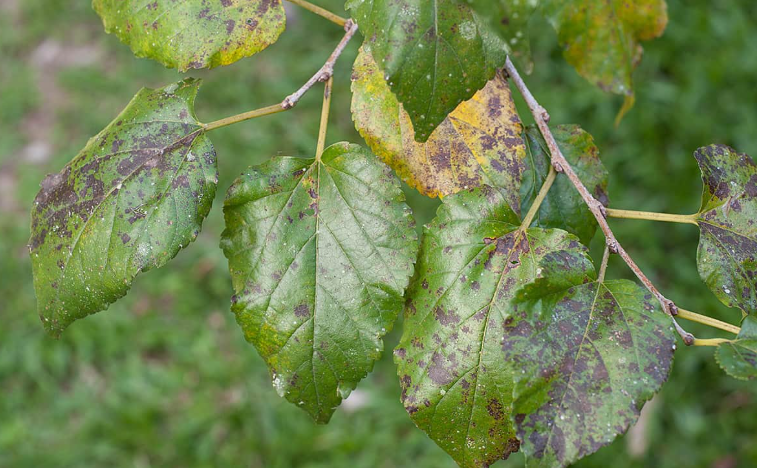
Mulberry trees are generally vigorous plants once established, but they are not completely free from problems. Their leaves can be attacked by insects, while wet weather may encourage fungal leaf diseases. Stressed trees can also become more vulnerable to cankers, root diseases, and other disorders.
The interesting thing about mulberries is that the problem is not always where you first notice the symptom. Yellow leaves, for example, can result from disease, poor drainage, drought, nutrient problems, or root damage. Likewise, spotted leaves may be caused by several unrelated fungi.
That is why successful mulberry care starts with observation rather than immediately reaching for a treatment. Look at the leaves, shoots, branches, fruit, trunk, and soil separately. Then consider the weather and growing conditions.
Mulberry trees are generally described as healthy and robust once established, although the RHS lists leaf spot, coral spot, powdery mildew, and other problems among those that can occur.
Below are some of the most important pests and diseases to watch for, together with practical ways to manage them.
1. Mulberry Leaf Spot
Mulberry leaf spot is one of the more recognizable diseases of these trees. It is caused by the fungus Mycosphaerella mori and is particularly associated with black and white mulberries.
The disease becomes more noticeable during wet periods, especially from late spring through early autumn.
Symptoms
Look for:
- Small brown or dark spots on leaves
- Spots that gradually enlarge
- Yellowing around damaged areas
- Premature leaf drop
- Reduced fruit production during severe infections
A badly affected tree may lose a substantial amount of foliage during a wet season.
However, there is an important distinction: the RHS notes that although severe infections can cause early defoliation and reduce the crop, mature trees usually suffer little long-term loss of vigor.
How to Control Mulberry Leaf Spot
Start with sanitation.
Remove heavily infected fallen leaves from around the tree rather than allowing them to accumulate.
Pruning can also help create better air circulation through a dense canopy. Avoid unnecessarily wetting the foliage when irrigating.
If leaf spot repeatedly becomes severe, locally approved fungicides may be considered. Texas A&M Extension notes that fungicides may be appropriate for valuable specimens when leaf spots become serious.
2. Powdery Mildew
Powdery mildew is another fungal problem that can affect mulberry foliage.
Unlike diseases that produce wet-looking lesions, powdery mildew often announces itself with a distinctly dusty appearance.
Symptoms
Affected leaves may develop:
- White powdery patches
- Distorted new growth
- Curled leaves
- Yellowing
- Premature leaf decline in severe cases
The RHS lists powdery mildew among the common problems that may affect mulberries.
How to Control It
Good air circulation is one of the simplest preventative measures.
Avoid excessive crowding and prune appropriately to prevent the canopy from becoming extremely dense.
Also avoid excessive nitrogen fertilization, which can encourage large amounts of tender new growth.
Where disease is persistent, consider varieties known to perform well under your local conditions.
3. Mulberry Rust
Rust diseases can affect mulberry foliage and may become more noticeable under favorable environmental conditions.
Symptoms
Possible signs include:
- Yellow or orange spots
- Rust-colored pustules
- Discolored foliage
- Premature leaf drop
The appearance can vary according to the particular rust organism involved.
How to Control Mulberry Rust
Keep the canopy reasonably open so that leaves dry more quickly after rain.
Remove heavily affected leaves where practical and clear fallen diseased material.
Avoid unnecessary overhead irrigation.
If the disease becomes severe year after year, a local plant-health specialist can help determine the exact rust involved and whether a registered treatment is worthwhile.
4. Mulberry Leaf Blight
Leaf blight is another foliar disease reported on mulberry.
Texas A&M Extension lists leaf blight among the diseases that can affect mulberry trees, while FAO material on mulberry cultivation also lists leaf blight among important foliar diseases.
Symptoms
Affected foliage may develop:
- Brown or dark lesions
- Irregular dead areas
- Rapid browning
- Premature leaf drop
Control
Remove severely affected leaves and maintain good sanitation.
Improve airflow through dense branches and avoid prolonged leaf wetness.
Because several diseases can produce similar leaf symptoms, accurate identification is useful before applying any disease-specific treatment.
5. Bacterial Blight
Bacterial blight is one of the more important diseases to recognize because it can affect not only leaves but also young shoots and branches.
Texas A&M identifies the causal bacterium as Pseudomonas syringae pv. mori.
Symptoms
Look for:
- Water-soaked leaf spots
- Brown or black lesions
- Dark streaks on shoots
- Wilting young leaves
- Dead shoot tips
- Cankers on branches
The disease tends to become more troublesome during prolonged wet conditions. An extension response on mulberry also notes that bacterial blight becomes more prevalent with sustained wetness.
How to Control Bacterial Blight
Avoid unnecessary overhead irrigation.
Prune dead or severely affected shoots during suitable dry weather and dispose of infected material.
Disinfect pruning tools when moving between affected and healthy portions of the tree.
Avoid creating unnecessary wounds because damaged tissue can provide opportunities for infection.
Where serious disease occurs, local extension recommendations should guide any chemical treatment.
6. Sooty Canker
Sooty canker is a serious fungal disease that can affect stressed mulberry trees.
It attacks woody tissues and can interfere with the movement of water and nutrients.
Symptoms
You may notice:
- Dead or dying branches
- Brown, wet-looking areas on branches
- Splitting bark
- Black, soot-like fungal material
- Progressive branch dieback
- Wilting foliage above affected areas
An extension diagnosis describes sooty canker as an opportunistic disease that can take advantage of weakened trees and pruning wounds.
How to Control Sooty Canker
Prevention begins with keeping the tree vigorous.
Avoid unnecessary injury to branches and protect the tree from prolonged drought stress.
Prune affected branches back to healthy wood where possible.
Severely affected trees may require professional assessment because the disease can progress into major branches and trunks.
7. Coral Spot
Coral spot is a fungal disease that affects woody tissues.
It is particularly noticeable because of the small, brightly colored structures that develop on dead branches.
The RHS lists coral spot among diseases that can affect mulberry trees.
Symptoms
Look for:
- Dead twigs
- Branch dieback
- Small orange, pink, or coral-colored raised spots
- Dead sections of bark
How to Control Coral Spot
Remove dead and infected branches.
Do not leave diseased wood lying underneath the tree.
Prune during appropriate dry weather and use clean tools.
Maintaining overall tree vigor is important because coral spot often becomes associated with weakened or dead wood.
8. Armillaria Root Rot
Armillaria root rot is a serious soil-associated disease that can affect mulberries.
Unlike a leaf disease, it begins largely below ground, so the first visible symptoms may be general decline rather than obvious spots.
Symptoms
Affected trees may develop:
- Poor growth
- Small or weak leaves
- Yellowing foliage
- Premature leaf drop
- Branch dieback
- General decline
Fungal growth or mushrooms may sometimes appear around the base of the tree or near infected roots.
Extension guidance identifies Armillaria root rot as one of the diseases capable of infecting mulberry.
How to Control It
Prevention is much easier than treatment.
Avoid planting mulberries in persistently waterlogged soil.
Do not repeatedly overwater established trees.
If a tree is declining despite apparently adequate watering, inspect the root zone rather than assuming it needs even more water.
Once Armillaria is well established, management can be difficult, so professional diagnosis is worthwhile.
9. Root-Knot Nematodes
Root-knot nematodes are microscopic organisms that attack plant roots.
They are particularly relevant in areas where mulberries are cultivated for leaf production.
FAO material identifies root knot among important soil-borne diseases of mulberry, while agricultural literature has documented Meloidogyne species affecting mulberry roots.
Symptoms
Above ground, affected trees may show:
- Weak growth
- Yellow leaves
- Reduced vigor
- Poor response to fertilizer
- Smaller foliage
Below ground, roots may develop abnormal swellings or galls.
How to Manage Root-Knot Nematodes
Avoid moving contaminated soil from one area to another.
Use healthy planting material and maintain good soil conditions.
Crop rotation can be useful in agricultural systems, although options depend on the particular production system and nematode species.
Where nematodes are suspected, a soil or root test can provide much more useful information than treating the tree based only on yellow leaves.
10. Mealybugs
Mealybugs are soft-bodied insects covered with a characteristic white, waxy material.
They can occur on young stems, leaf axils, and other protected areas.
Mulberry cultivation literature identifies mealybugs, including Maconellicoccus hirsutus, as important pests in some production systems.
Symptoms
Look for:
- White cottony clusters
- Sticky honeydew
- Yellowing leaves
- Weak new growth
- Ant activity around affected areas
How to Control Mealybugs
Inspect the undersides of leaves and areas where branches meet.
Small infestations can often be removed manually or washed away.
Encourage beneficial insects and avoid unnecessary broad-spectrum insecticides.
For severe infestations, use only a treatment approved for the particular crop and pest in your location.
11. Scale Insects
Scale insects can be surprisingly difficult to notice because many remain attached to branches and resemble small bumps.
UC IPM lists scales among the invertebrate pests that may affect mulberry.
Symptoms
Possible signs include:
- Small bumps on branches
- Yellowing leaves
- Weak growth
- Sticky honeydew
- Black sooty mold
How to Control Scale
Inspect branches closely, particularly where stems are crowded.
Light infestations can sometimes be managed by physically removing affected insects or pruning heavily infested branches.
Natural predators can also provide useful biological control.
If treatment is necessary, identify the scale first because different species have different vulnerable stages.
12. Whiteflies
Whiteflies can gather beneath mulberry leaves and feed on plant sap.
UC IPM lists whiteflies among the pests associated with mulberry.
Symptoms
You may see:
- Tiny white insects flying when foliage is disturbed
- Yellowing leaves
- Sticky honeydew
- Sooty mold
- Reduced plant vigor during heavy infestations
Control
Inspect leaf undersides regularly.
A strong stream of water can help dislodge some insects.
Encourage beneficial predators and avoid unnecessarily disrupting them.
For serious infestations, use an appropriate locally registered treatment according to its label.
13. Mulberry Caterpillars
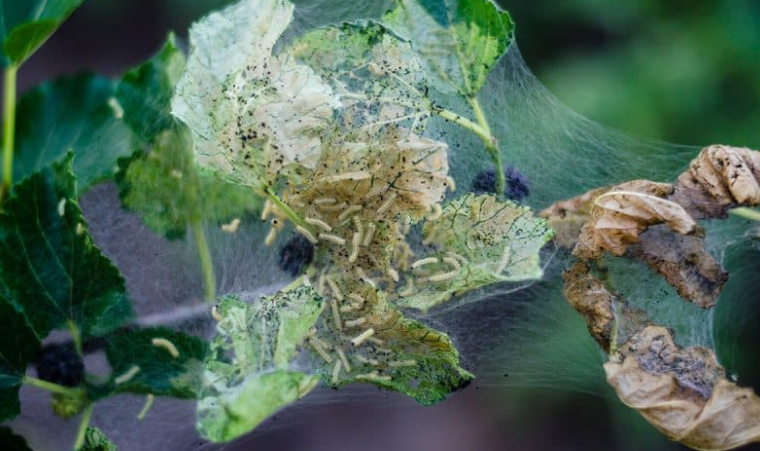
Several caterpillars can feed on mulberry foliage.
This is especially relevant where mulberries are grown for their leaves, because heavy defoliation can reduce leaf availability.
UC IPM lists foliage-feeding caterpillars among the insect pests associated with mulberry.
FAO also identifies specific caterpillar pests in mulberry production systems, including the leaf roller Diaphania pulverulentalis and Bihar hairy caterpillar.
Symptoms
Look for:
- Holes in leaves
- Ragged leaf margins
- Rolled leaves
- Caterpillars on foliage
- Webbing around folded leaves
- Rapid loss of young leaves
How to Control Caterpillars
Inspect leaves frequently.
Remove small numbers by hand when practical.
Encourage birds and predatory insects.
If significant defoliation occurs, identify the caterpillar before choosing a treatment.
14. Thrips
Thrips are tiny insects that feed by damaging plant tissue.
FAO identifies thrips among minor pests of mulberry.
Symptoms
Possible signs include:
- Silvery streaks
- Fine pale marks
- Distorted young leaves
- Browned leaf edges
- Weak new growth
Control
Monitor young foliage regularly.
Maintain good plant vigor and avoid excessive insecticide use.
Natural predators can help suppress low populations.
If the problem becomes severe, identify the species and select a locally approved control method.
15. Mites
Mites are another pest group associated with mulberry.
UC IPM lists mites among the potential invertebrate pests of mulberry.
Symptoms
Affected foliage may develop:
- Fine yellow stippling
- Bronzing
- Dull coloration
- Premature leaf decline
- Fine webbing in severe cases
How to Control Mites
Mites tend to become more troublesome when plants are stressed by hot and dry conditions.
Maintain appropriate soil moisture and inspect the undersides of leaves.
Avoid unnecessary broad-spectrum insecticides because they may eliminate predatory mites and other beneficial organisms.
16. Borers
Some wood-boring insects can attack mulberry branches and trunks.
North Carolina State Extension specifically lists borers as a potential problem on mulberry, particularly in southern areas.
Symptoms
Watch for:
- Holes in branches
- Sawdust-like material
- Weak or dying branches
- Wilting above a damaged section
- Tunnels beneath the bark
Borers often become more problematic when trees are already stressed.
How to Control Borers
The best defense is a vigorous tree.
Avoid unnecessary wounds and protect the tree from prolonged drought or other stress.
Remove badly damaged branches where appropriate.
If multiple branches are suddenly declining, investigate the possibility of boring insects rather than assuming the tree simply needs fertilizer.
17. Bacterial Leaf Scorch
Bacterial leaf scorch is another disorder listed among potential problems of red mulberry.
Symptoms
Possible symptoms include:
- Brown leaf margins
- Leaf scorch
- Premature leaf drop
- Gradual branch decline
The symptoms can resemble drought stress, which makes diagnosis particularly important.
How to Respond
Check the tree’s watering and root conditions first.
Do not assume that brown leaf edges automatically mean the tree needs fertilizer or more water.
If symptoms recur despite appropriate growing conditions, professional diagnosis may be useful.
18. Wetwood or Slime Flux
UC IPM lists wetwood, also called slime flux, among diseases or disorders associated with mulberry.
Symptoms
The condition can involve:
- Wet-looking areas on the trunk
- Liquid seepage
- Discolored bark
- Unpleasant odors in some cases
Management
Avoid unnecessarily injuring the trunk.
Maintain good overall tree health and avoid excessive irrigation.
Because several trunk disorders can look similar, diagnosis is especially useful when liquid is continuously emerging from the trunk.
Why Mulberry Leaves Turn Yellow
Yellow leaves are one of the most common reasons gardeners become concerned about mulberry trees.
But yellowing alone does not identify a specific disease.
Possible causes include:
- Natural aging
- Drought
- Excessive moisture
- Root damage
- Nutrient deficiencies
- Root rot
- Insect feeding
- Leaf diseases
UC IPM lists water deficit, excess water, nutrient deficiencies, and salinity among environmental disorders that can affect mulberries.
The pattern matters.
If only a few older leaves turn yellow while the rest of the tree looks vigorous, the cause may be completely normal.
If the entire canopy begins yellowing while the soil remains wet, investigate the roots and drainage.
If yellowing appears alongside spots, webbing, insects, or distorted growth, look for pests or disease.
Why Mulberry Leaves Develop Brown Spots
Brown spots can have several causes.
Fungal leaf spot is one possibility, especially during wet weather.
Other possibilities include:
- Bacterial blight
- Leaf blight
- Sun or heat stress
- Drought
- Chemical injury
- Insect feeding
The location and shape of the spots provide useful clues.
For example, water-soaked spots followed by shoot damage are more suggestive of bacterial problems, while numerous leaf spots appearing during prolonged wet weather may point toward fungal leaf spot.
A Simple Mulberry Pest and Disease Identification Chart
| What you notice | Possible cause |
|---|---|
| Brown or dark spots on leaves | Mulberry leaf spot |
| White powder on leaves | Powdery mildew |
| Orange or rust-colored spots | Rust |
| Water-soaked leaf lesions | Bacterial blight |
| Black soot-like material on branches | Sooty canker |
| Orange or coral-colored spots on dead branches | Coral spot |
| White cottony insects | Mealybugs |
| Small bumps on stems | Scale insects |
| White insects flying from leaves | Whiteflies |
| Ragged or rolled leaves | Caterpillars |
| Silvery streaks | Thrips |
| Fine stippling or bronzing | Mites |
| Holes in branches | Borers |
| General decline with damaged roots | Root rot or nematodes |
| Yellowing with wet soil | Root stress or excess moisture |
This chart is a starting point rather than a diagnosis. Several pests and diseases can produce similar symptoms.
How to Prevent Mulberry Pests and Diseases
The best time to control a mulberry problem is often before it becomes visible.
1. Start With a Healthy Tree
Inspect new trees carefully before planting them.
Check the leaves, stems, trunk, and root ball for insects, unusual discoloration, wounds, and signs of disease.
Starting with healthy planting material is one of the simplest ways to avoid introducing problems.
2. Give the Tree Enough Space
Mulberries can become large trees.
UC IPM notes that many mulberries grow approximately 20–60 feet tall and that their shallow roots can spread extensively near the soil surface.
Give the tree sufficient room for its canopy and roots.
Overcrowding can reduce airflow and make some foliar diseases more troublesome.
3. Improve Air Circulation
A dense canopy can remain humid after rain.
Prune appropriately to remove dead, damaged, or poorly positioned branches and allow better movement of air.
Do not over-prune healthy branches simply to make the tree look sparse.
4. Avoid Waterlogged Soil
Mulberries generally perform best in conditions with adequate moisture but good drainage.
North Carolina State Extension describes red mulberry as best suited to rich, moist, well-drained soil.
Poor drainage can create root problems and weaken the entire tree.
5. Water During Extended Dry Periods
Established mulberries can tolerate some drought, but prolonged water stress can weaken trees.
UC IPM notes that mulberries tolerate aridity once established but grow faster when adequate moisture and nutrients are available.
Water deeply when necessary rather than constantly giving the root zone small amounts of water.
6. Keep Fallen Leaves and Diseased Material Under Control
Remove heavily infected leaves and fruit where practical.
This is particularly important for leaf diseases that can persist in fallen plant material.
Good sanitation reduces the amount of disease material available to start another infection cycle.
7. Inspect the Tree Regularly
Look underneath leaves, not just at the top of the canopy.
Check:
- Leaf undersides
- Young shoots
- Branch junctions
- Trunk
- Base of the tree
- Developing fruit
- Soil around the roots
Early detection gives you more options.
8. Protect Beneficial Insects
Not every insect found on a mulberry is harmful.
Predatory insects can help suppress aphids, mites, caterpillars, and other pests.
Avoid treating minor infestations unnecessarily.
This is particularly important in a tree that is otherwise growing vigorously.
When Should You Actually Treat a Mulberry Tree?
This is an important question because seeing a pest does not automatically mean you need a pesticide.
Consider treatment when:
- The pest population is increasing rapidly.
- Leaves are being seriously damaged.
- New shoots are being distorted.
- Fruit quality is declining.
- The tree is losing significant foliage.
- A disease is spreading rapidly.
- The plant is young or already stressed.
If damage is minor and the tree remains vigorous, monitoring may be the better choice.
When treatment is necessary, identify the pest or disease first. Then use a product specifically registered for that pest and crop in your location, following the label’s directions and any harvest restrictions.
The Most Effective Overall Strategy
Mulberry trees respond best to a preventive and observation-based approach rather than a calendar of unnecessary treatments.
A useful strategy is:
Healthy planting material → suitable site → good drainage → appropriate watering → reasonable pruning → regular inspection → sanitation → targeted intervention when necessary.
This approach is particularly valuable because mulberries are generally robust trees. The RHS describes established mulberries as generally healthy and robust, while UC IPM also lists a range of pests, diseases, and environmental disorders that can occasionally affect them.
It is also worth remembering that the list of possible problems varies according to the species, climate, and whether the tree is being grown primarily for fruit, ornament, or leaf production.
For example, FAO’s mulberry production information identifies leaf spot, leaf rust, powdery mildew, leaf blight, bacterial blight, root rot, root knot, and several insect pests as important problems in mulberry cultivation systems.
So there is no universal treatment plan that works equally well everywhere.
What You’ll Eventually Learn From Growing Mulberry
Growing a mulberry teaches you to look beyond individual symptoms.
A yellow leaf is not automatically a disease. A brown spot is not automatically a fungus. A few insects on a leaf do not necessarily mean the tree is under serious attack.
With experience, you begin to look at patterns.
You notice whether the damage is occurring on old leaves or new growth. You check whether the soil is dry or saturated. You inspect the undersides of leaves for insects. You examine branches for cankers and holes. You consider whether the problem appeared after heavy rain, extreme heat, drought, or pruning.
That is perhaps the most useful lesson of growing mulberries: healthy plants are managed through observation, not constant intervention.
Once you understand what normal mulberry growth looks like, unusual changes become much easier to recognize. And when you can distinguish a minor cosmetic problem from a genuine disease or pest outbreak, you can respond more accurately, avoid unnecessary treatments, and keep the tree productive for many years.