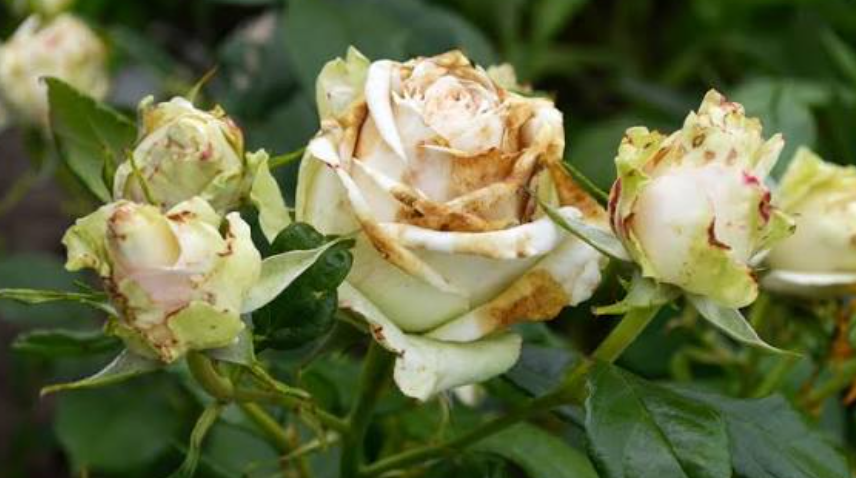
Roses are among the most rewarding plants to grow, but they are also among the garden plants that tend to attract attention from pests and diseases. A rose can look vigorous one week and then develop spotted leaves, distorted shoots, damaged buds, or dying stems soon afterward.
However, not every imperfect rose is suffering from a serious problem. A few insects may cause little lasting damage, older leaves naturally decline, and environmental stress can sometimes produce symptoms that resemble disease. The key is to identify the pattern before deciding what to do.
Common rose problems include black spot, powdery mildew, rust, downy mildew, canker, gray mold, aphids, rose slugs, Japanese beetles, rose chafers, and several other pests. University of Minnesota Extension’s rose diagnostic guide groups problems according to symptoms on leaves, stems, flowers, and buds, which is a useful way to approach diagnosis.
The most reliable strategy is usually a combination of good growing conditions, regular inspection, sanitation, pruning, resistant varieties where available, protection of beneficial insects, and targeted treatment when a problem is severe.
1. Rose Black Spot
Black spot is probably the disease most gardeners associate with roses.
It is caused by the fungus Diplocarpon rosae and primarily affects the leaves, although symptoms can also occur on canes.
What Black Spot Looks Like
The first signs are usually dark purple-black spots with irregular or feathery edges.
As the disease progresses:
- Yellow areas develop around the spots.
- Leaves may turn completely yellow.
- Infected leaves can fall prematurely.
- Severe plants may become thin and bare.
- Dark lesions can occasionally appear on canes.
University of Minnesota Extension describes the characteristic combination of dark leaf spots, surrounding yellowing, and premature leaf drop.
How to Control Black Spot
Start with sanitation.
Remove heavily infected fallen leaves and keep the area around the rose reasonably clean. Black spot pathogens can survive in fallen leaves and diseased plant material.
Water the soil rather than repeatedly wetting the foliage. Good air circulation is equally important because leaves that remain wet for long periods provide favorable conditions for infection.
Prune overcrowded growth to improve airflow, but avoid removing large amounts of healthy foliage unnecessarily.
Where black spot occurs regularly, choose cultivars bred for improved resistance.
Fungicides can protect healthy foliage when disease pressure is high, but they work best as preventative measures rather than as a way of restoring leaves that are already badly infected.
2. Powdery Mildew
Powdery mildew is another familiar rose disease. Unlike many fungal diseases that require prolonged leaf wetness, powdery mildew can become troublesome under conditions that are relatively warm and humid without leaves remaining constantly wet.
Symptoms
Look for:
- White or gray powdery growth
- Distorted young leaves
- Curled or twisted foliage
- White coating on stems
- Infected flower buds
- Poorly developed young shoots
University of Minnesota Extension notes that powdery mildew is often most severe on young rose leaves and shoots.
How to Control Powdery Mildew
Avoid overcrowding roses.
Give plants enough space for air to move through the canopy. Pruning during the dormant season can improve light penetration and circulation.
Avoid excessive nitrogen fertilization because overly vigorous young growth can be particularly susceptible to powdery mildew.
If a rose has a history of severe infection, monitor new growth closely and begin appropriate preventative management early in the season.
3. Rose Rust
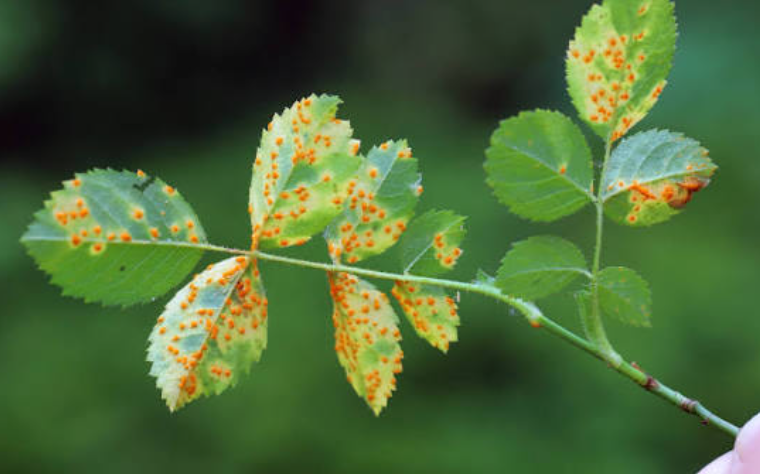
Rose rust is a fungal disease that produces distinctive orange or rust-colored symptoms.
Symptoms
The most recognizable signs are:
- Orange raised spots or pustules
- Orange powdery material on the underside of leaves
- Yellowing foliage
- Distorted leaves
- Premature leaf loss in severe cases
University of Minnesota Extension identifies orange raised bumps on the undersides of leaves as a characteristic symptom of rose rust.
How to Control Rose Rust
Remove badly infected leaves when practical and dispose of them rather than leaving them around the base of the plant.
Improve airflow by avoiding excessively dense growth.
Try to keep irrigation directed toward the soil instead of the foliage.
If rust returns every year, consider a rose variety with better disease resistance.
4. Downy Mildew
Downy mildew is different from powdery mildew despite the similarity in their names.
It tends to favor cool, wet conditions.
Symptoms
Affected roses can develop:
- Purplish-red or dark blotches
- Reddish-black lesions on stems and leaf stalks
- Yellowing leaves
- Premature leaf drop
- Grayish growth on the undersides of leaves when humidity is high
University of Minnesota Extension notes that downy mildew commonly occurs during cool, wet weather.
How to Control It
Improve air movement around plants.
Avoid unnecessary overhead irrigation.
Remove severely affected foliage and clean up fallen plant debris.
If the disease has been a recurring problem, preventive management is generally more useful than waiting until most of the foliage is infected.
5. Rose Canker
Rose canker affects the woody stems and canes rather than simply producing spots on leaves.
Several fungi can cause canker-like symptoms.
Symptoms
Look for:
- Dead sections on otherwise healthy canes
- Pale or discolored patches
- Cracked or flaky bark
- Reddish-purple borders around affected areas
- Small dark fungal structures on dead tissue
University of Minnesota Extension lists dead branches, discolored patches, cracked bark, and small dark structures among symptoms associated with rose canker.
How to Control Rose Canker
Prune infected canes back into healthy tissue.
Use clean pruning equipment and avoid moving contaminated material around the garden.
Remove badly diseased cuttings rather than leaving them underneath the rose.
Prevent unnecessary wounds to stems because damaged tissue can provide opportunities for infection.
6. Botrytis or Gray Mold
Gray mold, caused by Botrytis cinerea, can be particularly noticeable on flowers and buds.
Symptoms
You may see:
- Small reddish or brown spots on petals
- Brown, collapsing flowers
- Buds that fail to open
- Brown lesions on stems
- Gray fuzzy growth during cool, damp weather
These symptoms are documented by University of Minnesota Extension in its rose diagnostic guide.
How to Control Gray Mold
Remove affected flowers and buds promptly.
Improve air circulation around the plant and avoid keeping foliage and flowers unnecessarily wet.
Clean up fallen petals and other decaying plant material.
During prolonged wet weather, inspect roses more frequently because infections can spread quickly under favorable conditions.
7. Rose Mosaic Virus
Not every rose disease is fungal or bacterial.
Rose mosaic refers to a group of virus-related symptoms that can produce unusual patterns on leaves.
Symptoms
Affected leaves may show:
- Yellow zigzag patterns
- Rings
- Lines
- Mottled areas
- Distortion
- Reduced growth
University of Utah Extension notes that rose mosaic is associated with several viruses and can produce irregular yellow patterns on foliage.
How to Manage Rose Mosaic
Viral diseases are fundamentally different from fungal leaf spots.
Removing infected plants may be considered when symptoms are severe, especially if valuable roses are involved. Controlling aphids alone is not a reliable cure because transmission can occur before insecticides eliminate the insects.
When purchasing new roses, start with healthy, reputable planting material.
8. Aphids
Aphids are among the most common insects found on roses.
They are small, soft-bodied insects that tend to gather around tender shoots and flower buds.
Symptoms
Heavy infestations can cause:
- Curled young leaves
- Distorted shoots
- Stunted new growth
- Clusters of insects on buds
- Sticky honeydew on foliage
Rose aphids are particularly associated with new shoots and buds. University of Minnesota Extension notes that low to moderate numbers generally cause little damage, while heavy populations can distort young growth.
How to Control Aphids
Don’t automatically treat every aphid you see.
Small populations are often controlled naturally by ladybirds, lacewings, and other predators.
A strong stream of water can dislodge aphids from tender growth.
If populations become large and are damaging new growth, use an appropriate control method according to local recommendations and product labeling.
Avoid unnecessary broad-spectrum insecticide use because it can also kill beneficial insects.
9. Rose Slugs
Despite their name, rose slugs are actually sawfly larvae rather than true slugs.
They feed on rose foliage and can produce an unusual type of damage.
Symptoms
Young larvae may create windowpane damage, in which the tissue between the leaf veins is eaten while the veins remain.
The damaged area initially appears translucent and may later turn brown.
Older larvae can chew actual holes through leaves.
University of Minnesota Extension identifies rose slugs and bristly rose slugs as common causes of this type of leaf damage.
How to Control Rose Slugs
Inspect the undersides of leaves.
Small numbers can often be removed manually or washed away.
Encourage natural predators and monitor new foliage during periods when larvae are active.
10. Japanese Beetles
Japanese beetles can be particularly destructive to roses during their active season.
Adult beetles feed on both foliage and flowers.
Symptoms
Their feeding creates:
- Skeletonized leaves
- Large holes
- Damaged petals
- Brown or deteriorating flowers
University of Minnesota Extension notes that adult Japanese beetles feed on rose leaves and flowers, often leaving foliage with a lace-like appearance.
How to Control Japanese Beetles
Begin monitoring when beetles first appear.
For a small number of roses, physically removing adult beetles can be practical.
Inspect plants frequently because early control can be easier than dealing with a large population.
The important point is that Japanese beetle damage is often primarily cosmetic on established healthy roses, although heavy feeding can be more serious on young or stressed plants.
11. Rose Chafers
Rose chafers are another beetle that can make roses look badly damaged in a short time.
Adults feed on flowers and leaves.
Symptoms
Look for:
- Large irregular holes in flowers
- Skeletonized leaves
- Missing petal tissue
- Numerous beetles congregating on blossoms
University of Minnesota Extension reports that rose chafers commonly feed on rose blossoms and can skeletonize foliage.
How to Control Rose Chafers
If only a few are present, hand removal can be practical.
Physical barriers can also protect plants during the relatively short period when adult beetles are active.
For serious infestations, use only products approved for roses in your area and follow the label.
12. Leafcutting Bees
Not every insect making holes in rose leaves is a pest.
Leafcutting bees create distinctive, smooth, semicircular pieces missing from leaf margins.
University of Minnesota Extension identifies smooth half-moon-shaped holes as characteristic of leafcutting bee activity.
Should You Control Them?
Usually, there is little reason to do so.
Leafcutting bees are valuable pollinators, and their leaf damage is generally cosmetic.
This is an excellent example of why identification should come before treatment.
If you see a few perfectly rounded pieces missing from leaves, the plant may not need any intervention at all.
13. Rose Leafhoppers
Leafhoppers are small insects that feed on plant juices.
They can be difficult to notice because they move quickly when disturbed.
Symptoms
Possible signs include:
- Fine pale speckling
- Yellowing
- Weak-looking foliage
- Small insects jumping or flying from leaves
Control
Inspect the undersides of leaves and new growth.
Maintain healthy plants and encourage beneficial insects.
For significant infestations, use an appropriate locally approved treatment only when necessary.
14. Spider Mites
Spider mites are tiny pests that become more troublesome during hot, dry conditions.
Because they are so small, gardeners often notice their damage before they notice the mites.
Symptoms
Look for:
- Fine yellow stippling
- Bronzed foliage
- Dull leaves
- Fine webbing during heavy infestations
- Premature leaf decline
How to Control Spider Mites
Avoid allowing roses to become severely drought-stressed.
Wash foliage with water where appropriate, paying attention to leaf undersides.
Avoid unnecessary insecticide use because some pesticides can eliminate natural enemies and potentially make mite problems worse.
15. Thrips
Thrips are tiny insects that can feed on rose flowers and developing buds.
They are especially frustrating because the damage may become apparent only after a flower begins opening.
Symptoms
Possible signs include:
- Distorted flowers
- Brown or discolored petal edges
- Streaking
- Damaged buds
- Poorly opening flowers
Inspect flowers closely when symptoms appear.
Remove severely damaged blooms and maintain good garden hygiene.
Because thrips can be difficult to control once populations become established inside flowers, early monitoring is more useful than waiting for widespread damage.
16. Rose Rosette Disease
Rose rosette disease is a serious disease of roses and deserves special attention because affected plants generally cannot simply be restored with a fungicide.
Symptoms
Possible symptoms include:
- Unusually vigorous clusters of shoots
- Excessive thorniness
- Distorted foliage
- Abnormally colored leaves
- Enlarged or elongated shoots
- Abnormal flower development
The disease is associated with a virus and is transmitted by tiny eriophyid mites.
What to Do
If rose rosette is suspected, obtain a reliable diagnosis before removing valuable plants.
Do not assume that every unusually vigorous shoot is rose rosette. Roses can naturally produce strong shoots, and herbicide exposure, mites, and other problems can sometimes create similar abnormalities.
If the disease is confirmed, management focuses primarily on removing infected plants and reducing opportunities for the disease to spread.
17. Verticillium Wilt
Verticillium wilt is a soil-associated disease that can affect roses.
It interferes with the plant’s vascular system, making it difficult for water to move normally through the plant.
Symptoms
Affected roses may show:
- Wilting shoot tips
- Yellowing leaves
- Browning leaves
- Progressive dieback
- Purplish or dark streaks in stems
University of Minnesota Extension describes young cane tips wilting first, followed by yellowing and browning leaves and progressive cane death.
Control
Diagnosis is important because drought, root damage, and other diseases can create similar symptoms.
Avoid planting susceptible roses repeatedly in soil known to have a serious history of Verticillium problems.
Remove severely affected plants when appropriate and avoid spreading contaminated soil around the garden.
18. Rose Streak
Rose streak is a viral disease that can produce symptoms on foliage and canes.
Symptoms
Possible signs include:
- Yellow leaves
- Random brown dead areas
- Premature leaf drop
- Brown or black streaks on canes in susceptible varieties
University of Minnesota Extension lists these symptoms among those associated with rose streak.
Management
Because viral diseases cannot simply be cured with a conventional fungicide, prevention and the use of healthy planting material are important.
If symptoms are unusual or persistent, obtain an accurate diagnosis before removing the plant.
How to Tell What Is Wrong With a Rose
One of the easiest ways to make rose diagnosis more complicated than necessary is to start with the name of a disease.
A better approach is to start with the symptom.
Black spots + yellow leaves
Think about black spot first, particularly when leaves are falling prematurely.
White powder on young leaves
Powdery mildew is a strong possibility.
Orange pustules under leaves
Investigate rose rust.
Lace-like leaves
Check for Japanese beetles, rose chafers, or rose slugs.
Sticky young shoots covered with tiny insects
Aphids are likely.
Brown, collapsing flower buds
Consider Botrytis, especially during cool, wet conditions.
Dead sections of cane
Inspect carefully for canker, winter injury, pruning problems, or other causes of dieback.
This symptom-first approach helps prevent unnecessary treatments.
How to Prevent Rose Pests and Diseases
The healthiest roses are not necessarily those that receive the most treatments. They are often the ones growing in conditions that make problems less favorable in the first place.
Give Roses Enough Air
Avoid planting roses too closely together.
Good air circulation helps foliage dry more quickly and can reduce the conditions favorable to several fungal diseases.
Water at the Base
Whenever practical, direct irrigation toward the soil rather than repeatedly wetting the leaves.
University of Utah Extension recommends avoiding wetting foliage when managing leaf-spot diseases.
Keep the Ground Around Roses Clean
Remove fallen leaves and badly diseased plant material.
This is particularly useful for leaf-spot diseases because pathogens can survive in fallen leaves and produce new spores under suitable conditions.
Prune With a Purpose
Pruning should not simply mean cutting the rose as much as possible.
Remove dead and diseased wood, open congested areas where appropriate, and aim for a balanced canopy.
Over-pruning can stimulate excessive tender growth, which may be particularly susceptible to some diseases such as powdery mildew.
Avoid Excessive Fertilizer
Too much fertilizer can encourage rapid, soft growth.
Feed according to the plant’s needs rather than assuming that heavier feeding automatically produces better roses.
Choose Resistant Roses
If black spot or powdery mildew has repeatedly ruined your roses, changing varieties can be more effective than repeatedly fighting the same disease.
When buying a rose, consider disease resistance alongside flower color, fragrance, size, hardiness, and bloom period.
Inspect Roses Regularly
A five-minute inspection can reveal a problem before it becomes an outbreak.
Check:
- New shoots
- Leaf undersides
- Flower buds
- Petals
- Stems
- The base of the plant
- Fallen leaves
Look for changes rather than perfection.
A Simple Rose Pest and Disease Identification Chart
| What you see | Possible cause |
|---|---|
| Black spots with yellowing leaves | Black spot |
| White powder on leaves and buds | Powdery mildew |
| Orange pustules under leaves | Rose rust |
| Purplish-red leaf blotches in cool, wet weather | Downy mildew |
| Dead patches on canes | Canker |
| Brown, collapsing flower buds | Botrytis/gray mold |
| Yellow zigzag or mosaic patterns | Rose mosaic |
| Tiny insects clustered on new shoots | Aphids |
| White woolly patches | Woolly apple aphid |
| Windowpane leaf damage | Rose slug |
| Lace-like leaves and damaged flowers | Japanese beetle or rose chafer |
| Smooth semicircular leaf cuts | Leafcutting bee |
| Fine yellow stippling | Spider mites or other sap-feeding pests |
| Unusually vigorous, distorted shoots | Investigate rose rosette and other causes |
| Wilting and progressive cane death | Verticillium wilt, root problems, or other stress |
This table is a starting point rather than a definitive diagnosis. Several problems can look alike, so consider the season, weather, location of the damage, and condition of the whole plant.
The Best Way to Manage Rose Problems
There is no single spray, fertilizer, or trick that prevents every rose pest and disease.
A better strategy is to build a layered defense.
Start with a healthy, disease-resistant plant. Give it enough space. Keep water off the foliage when possible. Remove diseased leaves and dead wood. Inspect the plant regularly. Encourage beneficial insects. Then intervene when monitoring shows that a pest or disease actually needs intervention.
This is essentially an integrated pest-management approach: prevention and observation come before unnecessary chemical treatment.
It is also important to remember that damage does not always equal danger.
A few aphids may disappear after beneficial insects arrive. A leafcutting bee may make several neat holes without harming the rose. A small amount of Japanese beetle feeding may look ugly but have little long-term effect on an established plant. University of Minnesota Extension notes that healthy mature plants can tolerate considerable Japanese beetle feeding, although flowers can be badly damaged.
The goal, therefore, should not be to create a rose with absolutely no insects or blemishes. The goal is to maintain a rose that is healthy enough to tolerate minor problems and monitored closely enough that serious ones are caught early.
What You’ll Eventually Learn From Growing Roses
Growing roses teaches an important gardening lesson: the appearance of a plant is a clue, not a diagnosis.
You begin to recognize the difference between black spot and ordinary leaf aging, between a leafcutter bee and a leaf-chewing beetle, and between powdery mildew and environmental stress. You learn that a clean garden, good airflow, sensible watering, and the right variety can prevent many problems before they become serious.
Most importantly, you learn to observe before reacting.
That habit is valuable far beyond roses. Once you become comfortable examining leaves, flowers, stems, soil, insects, and weather together, diagnosing problems in many other garden plants becomes much easier.
A rose does not need to be completely free of pests and diseases to be a successful plant. What matters is understanding which problems deserve action, which can be tolerated, and which can be prevented through better growing conditions. That is ultimately what turns rose care from a constant battle into a manageable part of gardening.