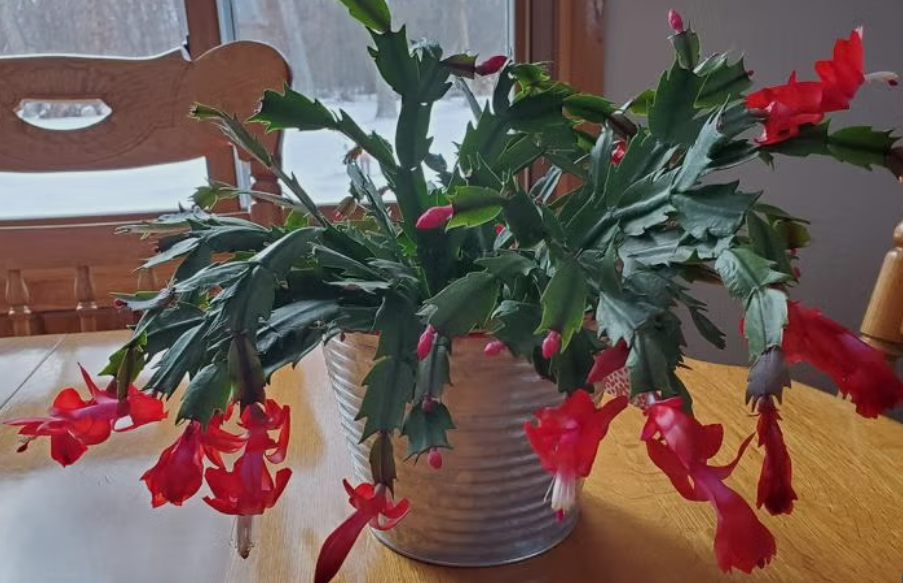
The Thanksgiving cactus is a holiday plant that often blooms just as the autumn season turns toward winter. Its flattened stems end in sharp, claw-like points, and its flowers hang from the branch tips in shades of pink, red, orange, purple, and white. Families often keep one for many years, moving it to a bright windowsill each fall and watching for the first buds to form, which makes it one of the most reliable seasonal bloomers a home grower can own.
Although it is sold as a holiday plant, the Thanksgiving cactus is a forest species, not a desert cactus. In the wild it grows on tree branches in humid, shaded habitats, and its flowering depends on seasonal changes in light and temperature. Once a grower understands that background, the plant’s needs become predictable, and its bloom schedule can be guided with some confidence.
Where the Thanksgiving Cactus Comes From
The Thanksgiving cactus belongs to the genus Schlumbergera, a group of epiphytic cacti native to the Atlantic coastal mountains of southeastern Brazil. The genus was named in 1858 by the French horticulturist Charles Lemaire to honor Frédéric Schlumberger, a cactus enthusiast. Wild plants in this region grow in filtered forest light, rooted in leaf litter and bark, where rain and humid air keep them moist for much of the year.
The species name truncata refers to the segment tips, which appear cut off or truncated at the ends. The plant is sometimes also called the crab cactus or claw cactus because of its angular, toothed margins. Its close relatives include the Christmas cactus, which is generally a hybrid whose parentage includes this species. Over the last two centuries, breeders have developed many colors and flower forms from these early parent plants, and the cultivated Thanksgiving cactus you buy today is typically a selected form of the wild species.
Recognizing a Thanksgiving Cactus
The stems are the easiest feature to check. Each segment is flattened and jointed, but its edges have pointed projections, sometimes described as teeth or claws, that give the plant a sharper outline than the scalloped segments of the Christmas or Easter cactus. The segment tips are cut off square, which accounts for the species name and helps set it apart from its relatives. As the plant matures, its segments branch into arching, drooping sections that can spill over the edges of a hanging basket.
The flowers provide the second clue. Thanksgiving cactus blooms are asymmetrical, with a bent or zygomorphic shape, and the petals sweep backward in a way that looks almost swept or reflexed. Colors include pink, red, orange, purple, and white, and the blooms appear at the ends of the segments, often in clusters. Each flower lasts several days, and a healthy plant can produce a long display over several weeks.
The plant does not have true leaves. The stems perform photosynthesis and store water, so they should feel firm and fleshy. Segments that become wrinkled, soft, or translucent usually indicate a watering problem, while pale or yellowing stems often signal too much direct light or a shortage of nutrients.
Also Read: Types of Cactus Plants
Facts About the Thanksgiving Cactus
- Scientific name: Schlumbergera truncata
- Genus: Schlumbergera, named in 1858 by Charles Lemaire
- Plant family: Cactaceae, though it is a forest cactus rather than a desert species
- Native range: the Atlantic coastal mountains of southeastern Brazil
- Growth habit: epiphytic, growing on tree branches and rocks in shaded forest
- Stem structure: flattened, jointed segments with pointed, claw-like margins and squared tips
- Common names: Thanksgiving cactus, crab cactus, and claw cactus
- Bloom season: typically late autumn, often around the Thanksgiving holiday in North America
- Flower colors: pink, red, orange, purple, and white
- Pet safety: generally listed as non-toxic to cats and dogs by the ASPCA
- Lifespan: well-kept plants can live for decades
Growing Considerations
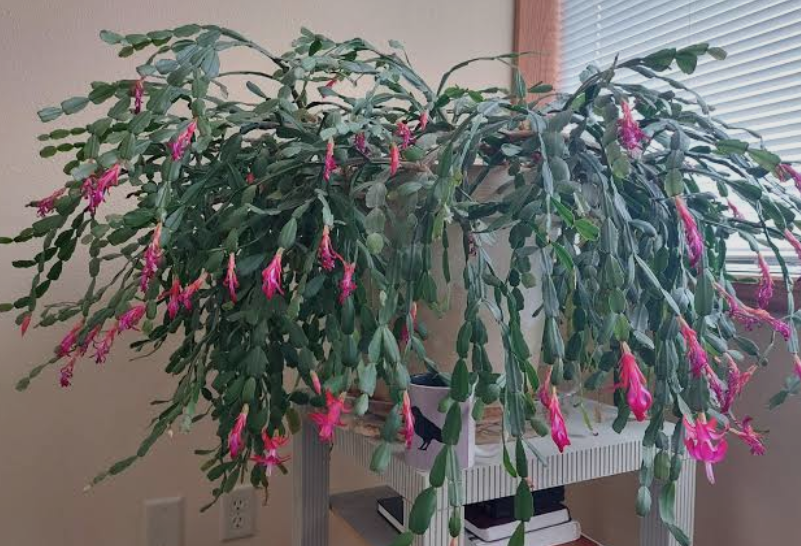
Bright, filtered light suits the Thanksgiving cactus best. An east or north window is usually a good choice, and a spot a few feet back from a south or west window can also work well when a sheer curtain softens the sun. Direct hot sun can scorch the segments and turn them reddish or yellow, while deep shade leads to weak, leggy growth and few flowers. Turning the pot every few weeks keeps the plant balanced, since the segments tend to lean toward the light source.
Watering should match the plant’s forest origins. Allow the top inch of potting mix to dry before watering thoroughly, then empty the saucer so the roots never stand in water. The plant needs somewhat more consistent moisture while it is forming buds and blooming, and it can be watered a little less during the warm months when growth slows. Overwatering is the most common cause of trouble, and it often shows up as soft, dark segments near the base. Erring on the dry side is safer than keeping the soil wet.
Temperature and rest govern the flowering cycle. During the growing season, the plant does well between about 60 and 70°F (16 to 21°C). To set buds, it needs cool nights of roughly 50 to 55°F (10 to 13°C) and shorter days over several weeks in autumn. Many growers place the plant in a bright, cool room in early fall, away from lamps and from the glow of artificial light at night, which can interfere with bud formation. Once buds appear, keep the plant in one spot and avoid drafts, heaters, and sudden temperature changes, since bud drop is a common reaction to disturbance.
Potting, feeding, and propagation are simple with a little attention to timing. Use a loose, well-draining potting mix, such as a standard blend with added perlite or bark, in a container with drainage holes that is only slightly larger than the root ball. Repot every three to four years, ideally in spring after flowering, and keep the plant a little root-bound for better blooming.
Feed monthly during spring and summer with a balanced liquid fertilizer at half strength, then stop feeding in early autumn when buds begin to form. To propagate, twist off two to four segments, let the cut ends dry for a day, then insert them into moist potting mix. Roots usually develop within a few weeks, and a new plant can bloom within a year or two.
Also Read: How To Grow And Care For Poinsettia
Frequently Asked Questions
How is the Thanksgiving cactus different from the Christmas cactus?
The Thanksgiving cactus has pointed, claw-like segment margins and squared tips, and its flowers are asymmetrical with swept-back petals. The Christmas cactus has more rounded, scalloped segments and symmetrical flowers. The Thanksgiving cactus usually blooms a few weeks earlier, in late autumn.
Why won’t my Thanksgiving cactus bloom?
The most common cause is insufficient cool, short-day conditions in autumn. Warm rooms, bright artificial light at night, and fertilizing too late into the season can all delay or prevent buds. Give the plant cooler nights and darker evenings for several weeks.
Why are the buds falling off?
Bud drop usually follows a change in location, temperature, or watering. Moving the plant, placing it near a heater or drafty window, or letting the soil dry out completely while buds are forming can all trigger it. Keep the plant in a steady spot once buds appear.
Why are the segments turning yellow or wrinkled?
Yellowing often comes from too much direct sun or a lack of nutrients. Wrinkled segments usually point to underwatering, while soft, dark segments suggest overwatering and root rot. Check the roots and adjust watering to match the plant’s needs.
Is the Thanksgiving cactus safe around pets?
The ASPCA generally lists the Thanksgiving cactus as non-toxic to cats and dogs. Pets may still chew on the segments and develop mild stomach upset, so it is wise to place the plant out of reach.
Can I grow a new Thanksgiving cactus from a cutting?
Yes. Twist off two to four healthy segments, allow the cut ends to dry for a day, and insert them into moist potting mix. Roots usually form within a few weeks, and the new plant can flower within a year or two if it receives proper light and cool autumn nights.
1 thought on “Thanksgiving Cactus: Facts, Identification & Growing Guide”