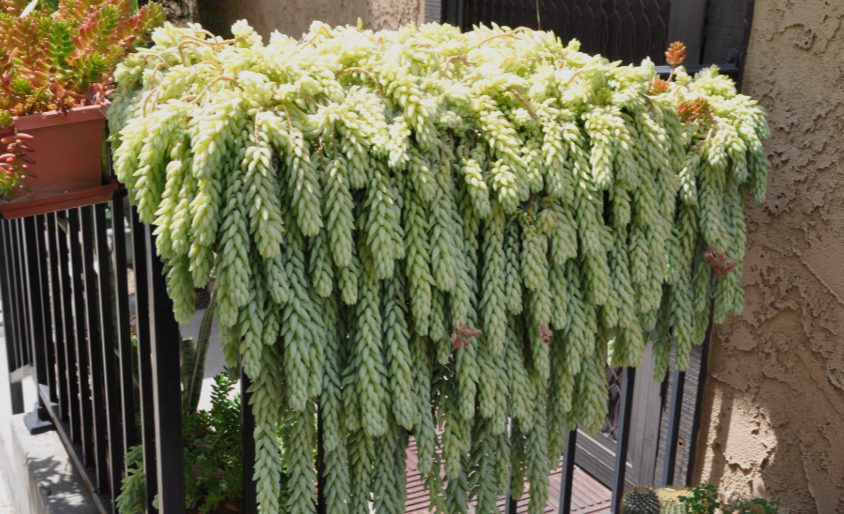
Burro’s tail is one of the most distinctive trailing plants in cultivation. Its long stems hang from baskets and high shelves in cascades of plump, blue-green leaves that look like strings of beads or tiny teardrops. Collectors and people who want a dramatic, low-maintenance display both value it, and a well-grown specimen can fill a large hanging pot within a few years.
The plant is also more delicate than its sturdy appearance suggests. Its leaves are packed with water, coated with a powdery waxy layer, and detach at the slightest touch. Knowing how the plant stores water and how it sheds leaves explains most of its care requirements.
Where Burro’s Tail Comes From
Burro’s tail is a succulent in the stonecrop group of the genus Sedum, within the family Crassulaceae. Its natural habitat is the mountainous terrain of southern Mexico, where it grows on rocky cliffs and ledges in dry, sunny conditions. In the wild, the stems trail over rock faces and draw moisture from brief rains and the mist that gathers in the higher country.
The species name is usually linked to a horticulturist named Morgan, although the early history of the name is not well documented. The plant is also known as donkey’s tail or horse’s tail, a reference to the look of its hanging stems. It has been cultivated for a long time and is now widely sold as a houseplant in temperate regions. Its adaptation to dry rock faces explains why it handles drought so well at home.
Recognizing Burro’s Tail
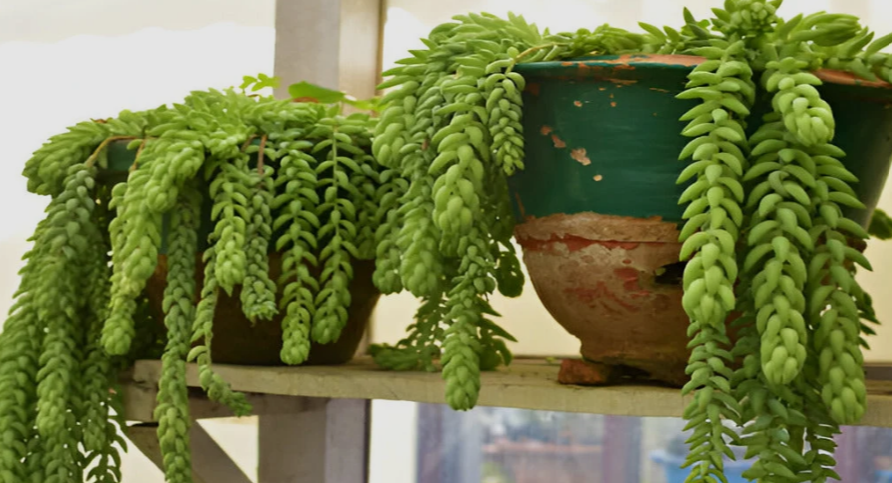
The leaves are the easiest feature to identify. They are fleshy, cylindrical to teardrop-shaped, and arranged in a spiral around the stem. Each leaf is typically about half an inch to an inch long, with a rounded tip. The surface is blue-green to gray-green and covered with a whitish, powdery coating that reduces water loss and reflects strong sunlight.
The stems are the second clue. They are slender and trailing, and mature plants can carry stems three to four feet long. The stems are generally pale green to gray-green, and the lower sections gradually become woodier and browner, while the growing tips stay soft and fleshy. Because each stem is heavy with leaves, mature plants hang in dense, rope-like curtains.
Flowers are uncommon indoors but may appear in late spring or summer on plants that receive enough light. The blooms are small and star-shaped, usually pink to magenta, and cluster at the stem tips. Flowering is more reliable in outdoor or greenhouse settings, where the plant gets stronger light and a cooler winter rest.
Also Read: Other Types of Houseplants
Facts About Burro’s Tail
- Scientific name: Sedum morganianum
- Plant family: Crassulaceae, the stonecrop family
- Native range: the mountainous terrain of southern Mexico
- Growth habit: trailing succulent that hangs from rocks and containers
- Leaf feature: plump, teardrop-shaped leaves covered with a powdery waxy coating
- Common names: burro’s tail, donkey’s tail, and horse’s tail
- Flowers: small, star-shaped, pink to magenta, usually produced at stem tips
- Stem length: mature trailing stems can reach three to four feet
- Outdoor hardiness: generally limited to USDA zones 10 and 11
- Pet safety: generally listed as non-toxic to cats and dogs by the ASPCA
Best Use Cases
Burro’s tail works best where its trailing stems can fall freely. Hanging baskets near a bright window are the classic setting, since the cascade shows off the plant’s form and keeps the leaves away from foot traffic. A high shelf, a macramé hanger, or the top of a bookcase in a sunny room works equally well, and the plant can also be used to soften the edge of a plant stand or a tall pot of other succulents.
Outdoors, the plant suits rock gardens, dry banks, and sunny containers on a patio or balcony where rain can drain quickly. It also fits well in a succulent arrangement, where its blue-green foliage contrasts with upright rosettes such as echeveria. Because it needs little water and no regular feeding, it is a practical choice for busy households, offices with bright windows, and anyone who wants a striking plant that does not demand constant attention.
USDA Zones
Burro’s tail grows outdoors year-round only in frost-free climates, generally USDA zones 10 and 11. In these regions it can be planted in the ground in sunny, well-draining spots or in hanging containers on a covered patio. Temperatures that drop to freezing or below will damage the leaves and stems, and even brief frost can cause the plant to collapse, so frost protection is essential in cooler areas.
In zone 9 and cooler, the plant is best grown in containers that can be moved indoors before the first cold nights, usually when temperatures start to fall toward 50°F (10°C). Many gardeners in temperate regions enjoy the plant outdoors during summer and bring it inside in autumn. Gradual acclimation helps prevent leaf drop, so moving it into a shaded spot for a week before it goes indoors often makes the transition smoother.
Growth Rate and Lifespan
Burro’s tail grows at a moderate pace when conditions are right. In warm, bright locations, the trailing stems can extend steadily through the growing season, adding new leaves at the tips while older sections gradually mature. Growth slows noticeably in winter, and plants grown in dim light tend to stretch and thin rather than fill out. Most container plants reach a full, hanging form within a few years, though the exact rate varies with light, temperature, and feeding.
With good care, burro’s tail can live for many years, and established plants are often passed down among growers. Older stems can become woody and sparse at the base, and the leaves nearest the soil may shed over time. Propagating from healthy stem tips keeps the plant full and renews its appearance, so a long-lived specimen does not have to be a single, aging plant. Regular cuttings are an effective way to maintain a dense, vigorous display indefinitely.
Growing Considerations
Bright light is essential. Burro’s tail grows best in full sun to bright, filtered light, such as a south or west window with a sheer curtain or a spot a few feet back from a sunny window. Low light leads to stretched, pale stems and weak growth, while very intense direct sun can scorch the leaves or turn them reddish. Turning the container every few weeks helps the stems grow evenly and keeps the cascade full on all sides.
Watering should be infrequent and thorough. Water only when the soil has dried completely, which in many homes means every two to three weeks, and then soak the mix and let all excess water drain away. The leaves store water, so the plant tolerates dry spells well, but soggy soil quickly leads to root and stem rot. In winter, when growth slows, water even less often. A pot with drainage holes and a fast-draining succulent mix is essential, since standing water is the most common cause of decline.
Temperature and handling need attention. Burro’s tail prefers warm conditions between about 60 and 80°F (16 to 27°C) during the growing season and can tolerate slightly cooler nights, though it should stay above about 50°F (10°C). It is sensitive to frost and will not survive a freeze. Because the leaves detach easily, the plant should be moved carefully and hung where it will not be brushed against often. Repotting is best done in spring, and the plant should be given a few days to settle before watering.
Potting, feeding, and propagation keep the plant full and healthy. Use a gritty, well-draining succulent or cactus mix, or add perlite or pumice to a standard mix, and choose a container that fits the root ball closely. Feed lightly once or twice during spring and summer with a diluted succulent fertilizer, and avoid feeding in winter. Stem cuttings root readily once they have callused for a few days, and fallen leaves can be laid on barely moist mix to form new plants. Each fallen leaf can root and grow into a small plant within a few weeks, which makes propagation an easy way to start new specimens.
Also Read: Poinsettia Plant, The most Popular Houseplant In North America
Frequently Asked Questions
Why are the leaves falling off my burro’s tail?
Leaves detach easily, so even gentle handling can cause some loss. Leaf drop can also result from overwatering, sudden temperature changes, or moving the plant to a new location. Keep the plant steady, water only when the soil is dry, and handle it carefully.
Can I regrow a plant from a fallen leaf?
Yes. Let the leaf dry for a day or two, then lay it on barely moist succulent mix. Roots and a small rosette usually form within several weeks, and the new plant can be grown on as normal.
Why are the stems turning brown or mushy?
Mushy, brown stems usually indicate rot caused by overwatering or poor drainage. Remove the damaged sections, allow the cut ends to callus, and repot in dry, gritty mix. Water less often going forward.
How often should I water a burro’s tail?
There is no fixed schedule. Water when the soil has dried completely, which may be every two to three weeks in a bright home and less often in winter. Always let excess water drain away.
Does burro’s tail flower?
It can, though flowers are more common in greenhouses and outdoor settings with strong light and a cool winter rest. Indoor plants may flower occasionally when conditions are favorable.
Is burro’s tail safe around pets?
The ASPCA generally lists burro’s tail as non-toxic to cats and dogs. Pets may still chew on the leaves and stems and develop mild stomach upset, so it is wise to hang the plant out of reach.