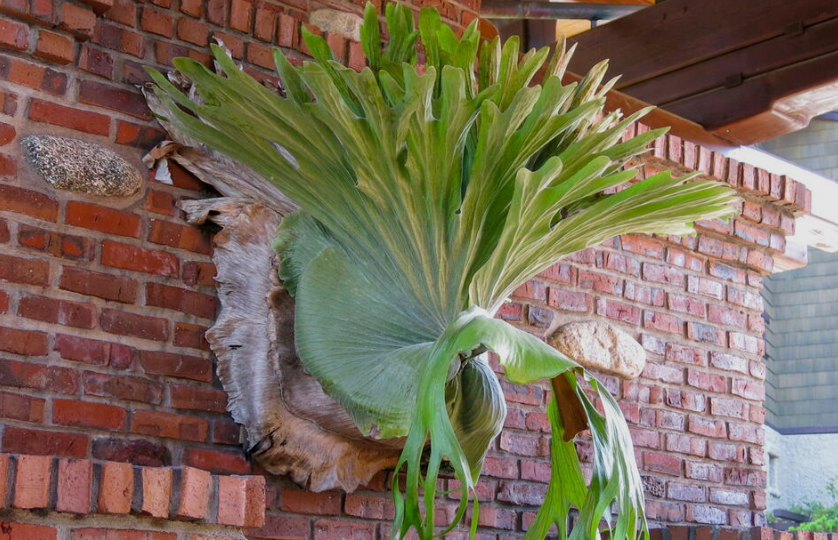
The staghorn fern is one of the most dramatic plants a home grower can keep. Its branching fronds look like the antlers of a deer, and its flat, shield-shaped base fans out against a wall or wooden board like a piece of living sculpture. Few ferns draw attention so quickly, which is why it appears in conservatories, plant shops, and garden displays around the world.
Despite its appearance, the staghorn fern is not a typical potted fern. It does not grow in soil. In nature it attaches itself to tree branches and trunks, collecting water and nutrients from rain, falling leaves, and the debris that gathers around its base. Understanding that natural habit explains nearly every decision a grower makes, from how the plant is mounted to how often it needs water.
Where Staghorn Ferns Come From
The genus Platycerium belongs to the family Polypodiaceae and includes roughly eighteen species. Their natural range covers the tropical regions of Africa, Madagascar, Southeast Asia, Australia, and several Pacific islands. In these forests they grow as epiphytes, plants that live on other plants without taking nutrients from them. A staghorn fern on a tree limb is simply using the bark as a place to anchor.
The most widely grown species is Platycerium bifurcatum, often called the common staghorn or elkhorn fern. Others, including Platycerium superbum from Australia and Platycerium coronarium from Southeast Asia, are also cultivated, each with slightly different frond shapes and sizes. Some species are grown as houseplants, while others suit greenhouses or warm outdoor gardens in frost-free regions.
Recognizing the Two Kinds of Fronds
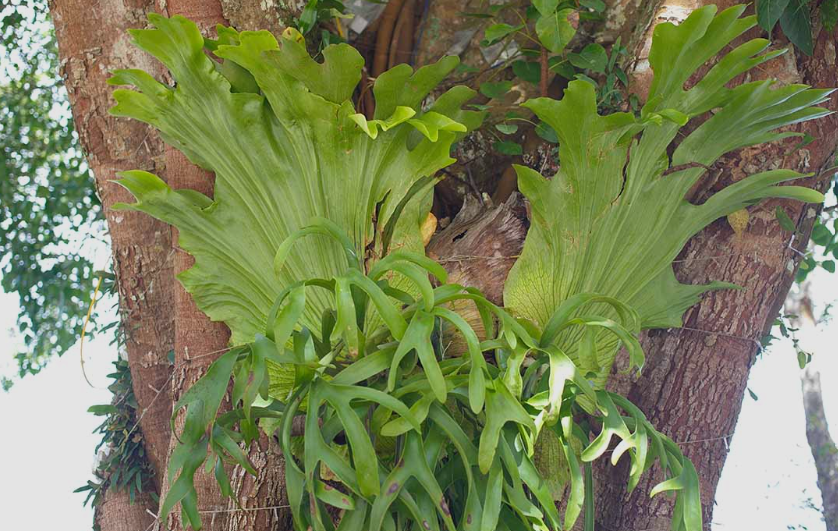
A mature staghorn fern has two distinct types of fronds, and telling them apart is the key to understanding the plant. The first type is the basal, or shield, frond. It forms a flat, rounded mass that clings to the mounting surface and protects the roots. Early in the plant’s life the shield is green and fresh, but over time it turns tan or brown. This color change is normal, and the shield should be left in place, since it stores water and captures leaf litter and other organic matter that feeds the plant.
The second type is the fertile frond, which is the antler-shaped growth that gives the plant its name. These fronds are forked and often pendant, and they grow outward and downward from the shield. On the underside of the mature fertile fronds, brown patches appear, which contain the spores used for reproduction. Some growers find these patches unattractive, but they are a sign of a healthy, mature plant. Fertile fronds can be long-lived and may last several years before they are replaced.
Facts About the Staghorn Fern
- Genus: Platycerium, in the family Polypodiaceae
- Number of species: roughly eighteen, depending on classification
- Native range: tropical Africa, Madagascar, Southeast Asia, Australia, and parts of the Pacific
- Growth habit: epiphytic, living on trees and rocks rather than in soil
- Frond types: sterile shield fronds that protect the roots, and fertile antler fronds that bear spores
- Common species: Platycerium bifurcatum, Platycerium superbum, and Platycerium coronarium
- Reproduction: by spores, or by separating offsets, called pups, that form at the base
- Pet safety: generally listed as non-toxic to cats and dogs by the ASPCA
- Lifespan: well-cared-for plants can live for decades
Growing Considerations
Light and placement come first. Staghorn ferns prefer bright, indirect light, such as a spot near an east-facing window or a few feet back from a south or west window. Direct afternoon sun can scorch the fronds and dry out the shield too quickly, while deep shade causes the plant to stall and produce fewer fertile fronds. Mounting the fern on a board or in a basket and hanging it near a window gives it both air circulation and the light it needs.
Watering is the task that most often determines success. Because the plant gathers water in its shield, it should be soaked rather than lightly misted. A common approach is to submerge the mounted fern in water for ten to fifteen minutes, then let it drain completely before rehanging it. How often to do this depends on temperature, humidity, and the mounting material, but the shield should feel moist and never soggy. Standing water left in the shield or around the roots can cause rot, so drainage is essential.
Temperature and humidity should stay within a comfortable range. Staghorn ferns do best between about 60 and 85°F (15 to 29°C) and should be protected from temperatures below roughly 50°F (10°C). Moderate to high humidity supports healthy new growth, and a humidifier or a location near other plants can help in dry indoor air. Outdoors, the fern can thrive in frost-free climates, and it is best sheltered from strong winds and heavy rain that can damage the fronds.
Feeding should be light, and the plant should be fertilized only during its active growing period. A diluted, balanced fertilizer applied about once a month during spring and summer is usually enough. Heavy feeding can cause salt buildup on the shield and mounting material, which shows up as brown edges or white crust. Pests such as scale, mealybugs, and spider mites can appear in dry conditions, and they are generally removed by wiping the fronds or using insecticidal soap. If a pup forms at the base, it can be separated carefully once it has its own roots and a few fronds, then mounted separately to create a new plant.
Frequently Asked Questions
Can staghorn ferns grow in soil?
They can survive in a loose, well-draining medium, but they do not naturally grow in soil. Mounting on wood, cork, or in a basket with sphagnum moss better matches how they grow in the wild and allows air to reach the roots.
Why is the shield frond turning brown?
The lower shield naturally browns as it ages, and this is normal. Brown patches that feel mushy or spread quickly, however, may indicate overwatering or rot, and the affected area should be checked.
Is the brown patch on the underside of the fronds a disease?
No. Those patches contain spores, which are a normal part of the reproductive cycle. They are a sign that the fern is mature and healthy.
How often should I water my staghorn fern?
There is no fixed schedule. Soak the plant when the shield feels dry to the touch and the mounting material is lightly dry, then allow it to drain fully. Warm, bright conditions usually call for more frequent watering than cool, dim ones.
Can I propagate a staghorn fern?
Yes. Pups that form at the base can be separated once they have developed roots and several fronds of their own. Spore propagation is possible but slow and requires a more controlled environment.
Why are the new fronds small or misshapen?
Small or deformed fronds often result from too little light, low humidity, or inconsistent watering. Adjusting the location and establishing a steady watering routine usually improves new growth over time.
1 thought on “Staghorn Fern (Platycerium): Identification, and Growing Guide”