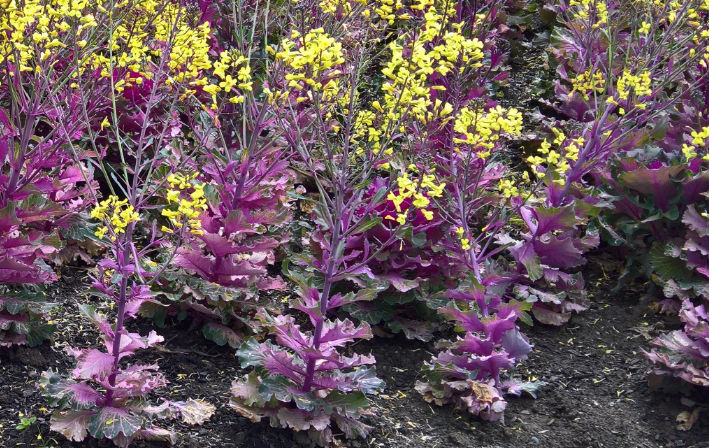
Plants with purple leaves and yellow flowers combine 2 pigment systems that work almost independently of each other, since the purple in the foliage comes from anthocyanins concentrated in the leaf tissue, while the yellow in the flowers typically comes from an entirely separate group of pigments called carotenoids or flavonoids. That independence explains why this specific combination shows up reliably across several completely unrelated plant families rather than being the product of any single shared ancestor.
One genus in particular, Berberis, produces this pairing with remarkable consistency, since nearly every purple-leaved barberry cultivar still produces the same small, pale yellow flowers typical of the species regardless of how dramatically the foliage has been bred to change. That reliability makes barberry cultivars some of the most dependable plants for gardeners specifically seeking this color combination.
These plants span native Pacific Northwest woodlands, Mediterranean herb gardens, and tropical succulents, with growth habits ranging from towering shrubs to low groundcovers. What follows covers 28 plants known for purple leaves and yellow flowers, along with where each one grows and the data behind its coloring.
Purple Barberry ‘Rose Glow’
Purple barberry ‘Rose Glow’ is a cultivar of a shrub native to Japan, and according to the North Carolina Extension Gardener Plant Toolbox, it produces small, yellow, fragrant flowers tinged with purple in mid to late spring, held against reddish to purplish leaves mottled with pink and white. A mature shrub typically reaches 5 feet tall and 4 feet wide.
It grows as a landscape shrub throughout temperate regions of the United States, though its parent species is classified as invasive in several states.
Purple Barberry ‘Concorde’
Purple barberry ‘Concorde,’ also sold as Black Beauty, is a cultivar of the same Japanese species, producing the same small, pale yellow spring flowers typical of the genus against one of the darkest purple-black foliage colors available among barberry cultivars. A mature shrub typically reaches 2 to 3 feet tall, considerably more compact than many other cultivars.
It grows as a landscape shrub throughout temperate regions of the United States.
Purple Barberry ‘Royal Cloak’
Purple barberry ‘Royal Cloak’ is a cultivar valued for its large, deep purple leaves and the same reliable pale yellow spring flowers found throughout the species. A mature shrub typically reaches 4 to 5 feet tall, with foliage color holding well through summer heat.
It grows as a landscape shrub throughout temperate regions of the United States.
Purple Barberry ‘Helmond Pillar’
Purple barberry ‘Helmond Pillar’ is a narrow, upright cultivar displaying deep purple foliage on a distinctly columnar growth habit, along with the species’ typical small yellow spring flowers. A mature shrub typically reaches 4 to 5 feet tall but only 1 to 2 feet wide.
It grows as a landscape accent shrub throughout temperate regions of the United States, valued for fitting into narrow planting spaces.
Purple Barberry ‘Crimson Pygmy’
Purple barberry ‘Crimson Pygmy’ is a dwarf cultivar producing reddish-purple foliage on a low, dense, mounding shrub, along with the same pale yellow flowers typical of the species each spring. A mature plant typically reaches 1.5 to 2 feet tall.
It grows as a low landscape shrub throughout temperate regions of the United States.
Purple Barberry ‘Golden Ring’
Purple barberry ‘Golden Ring’ displays deep purple leaves edged in a narrow band of yellow-gold, distinct from solid-colored cultivars, alongside the species’ typical small yellow spring flowers. A mature shrub typically reaches 4 to 5 feet tall.
It grows as a landscape shrub throughout temperate regions of the United States.
Purple Barberry ‘Admiration’
Purple barberry ‘Admiration’ is a dwarf cultivar with intense red-orange leaves often edged in yellow, alongside the species’ characteristic small yellow spring flowers. A mature plant typically reaches 1 to 1.5 feet tall.
It grows as a compact landscape or container shrub throughout temperate regions of the United States.
Mahonia
Mahonia, also called Oregon grape, is native to western North America, and according to Oregon State University’s Landscape Plants database, its glossy, holly-like leaves may turn bronze to bright red-purple in winter, especially in cold areas with full sun, while bright yellow flowers appear in dense terminal clusters each early spring. A mature shrub typically reaches 3 to 6 feet tall, and it’s the official state flower of Oregon.
It grows throughout the Pacific Northwest and is widely planted as a landscape shrub across much of the temperate United States.
Bronze Fennel
Bronze fennel is a color form of a culinary herb native to the Mediterranean region, displaying finely divided, feathery foliage in coppery bronze-purple beneath flat clusters of small yellow flowers that appear in mid to late summer. A mature plant can reach 4 to 5 feet tall, fully edible with the same anise flavor as green fennel.
It grows as a garden perennial or self-seeding annual throughout temperate regions of the United States.
Purple Oxalis Vulcanicola
Purple oxalis vulcanicola is native to Central America, displaying glossy, bronze-purple clover-like leaves topped with bright yellow, cup-shaped flowers throughout the growing season. A mature plant typically stays low, generally under a foot tall, spreading into a dense mat.
It grows as a groundcover in warm climates and as a houseplant or seasonal container plant elsewhere throughout the United States.
Euphorbia Amygdaloides ‘Purpurea’
Euphorbia amygdaloides ‘Purpurea,’ also called purple wood spurge, is a color form of a plant native to Europe, displaying deep purple foliage topped with clusters of chartreuse-yellow flower bracts in spring. A mature plant typically reaches 1 to 2 feet tall. Its milky sap can cause skin irritation on contact.
It grows as a garden perennial throughout temperate regions of the United States, tolerating dry shade better than many other purple-leaved perennials.
Euphorbia Dulcis ‘Chameleon’
Euphorbia dulcis ‘Chameleon’ is a color form of a plant native to Europe, displaying deep purple-bronze foliage topped with clusters of small yellow-green flower bracts in late spring. A mature plant typically reaches 1 to 1.5 feet tall, self-seeding readily once established.
It grows as a garden perennial throughout temperate regions of the United States.
Euphorbia ‘Blackbird’
Euphorbia ‘Blackbird’ is a cultivar displaying some of the darkest, nearly black-purple foliage available among ornamental spurges, topped with clusters of bright chartreuse-yellow flower bracts in spring. A mature plant typically reaches 1.5 to 2 feet tall.
It grows as a garden perennial throughout temperate regions of the United States.
Euphorbia Characias ‘Purpurea’
Euphorbia characias ‘Purpurea’ is a color form of a plant native to the Mediterranean region, displaying purple-tinged blue-green foliage topped with large, rounded clusters of chartreuse-yellow flower bracts each spring. A mature plant can reach 3 to 4 feet tall.
It grows as a garden perennial throughout temperate regions of the United States, tolerating drought once established.
Euphorbia Cotinifolia
Euphorbia cotinifolia, also called Caribbean copper plant, is native to Mexico and Central America, displaying rounded, deep purple-red leaves and small, inconspicuous yellow-green flower clusters. A mature shrub can reach 12 to 15 feet tall in frost-free climates.
It grows as a landscape shrub in South Florida and other tropical regions and as an annual elsewhere throughout the United States.
Ligularia ‘Britt Marie Crawford’
Ligularia ‘Britt Marie Crawford’ is a cultivar of a plant native to Asia, displaying large, rounded, deep purple-bronze leaves topped with spikes of bright yellow-orange daisy-like flowers in mid to late summer. A mature plant typically reaches 2 to 3 feet tall.
It grows as a garden perennial throughout temperate regions of the United States, favoring consistently moist, rich soil in partial shade.
Ligularia ‘Desdemona’
Ligularia ‘Desdemona’ closely resembles ‘Britt Marie Crawford’ in its purple-bronze foliage and yellow-orange summer flower spikes, distinguished by slightly more heart-shaped leaves with purple undersides. A mature plant typically reaches 3 to 4 feet tall.
It grows as a garden perennial throughout temperate regions of the United States, requiring consistent moisture to prevent wilting in full sun.
Dahlia ‘Moonfire’
Dahlia ‘Moonfire’ is a cultivar bred for its combination of dark bronze-purple foliage and bright yellow-orange single flowers with a contrasting dark center. A mature plant typically reaches 1.5 to 2 feet tall.
It grows as a warm-season garden tuber throughout temperate regions of the United States.
Dahlia ‘David Howard’
Dahlia ‘David Howard’ is a cultivar combining deep bronze-purple foliage with warm orange-yellow double flowers. A mature plant typically reaches 2 to 3 feet tall, blooming from midsummer through the first frost.
It grows as a warm-season garden tuber throughout temperate regions of the United States.
Crocosmia ‘Solfatare’
Crocosmia ‘Solfatare’ is a cultivar of a plant native to South Africa, displaying grassy, bronze-purple foliage topped with soft apricot-yellow flowers on arching stems in summer. A mature clump typically reaches 2 to 3 feet tall.
It grows as a garden perennial throughout temperate regions of the United States, spreading slowly via underground corms.
Purple Hazelnut ‘Red Majestic’
Purple hazelnut ‘Red Majestic’ is a variegated form of a shrub native to Europe, displaying deep purple, twisted branches and leaves alongside the species’ typical dangling, pale yellow catkins that appear in late winter before the leaves emerge. A mature shrub typically reaches 8 to 10 feet tall.
It grows as a landscape specimen shrub throughout temperate regions of the United States.
Purple Giant Filbert
Purple giant filbert, botanically Corylus maxima ‘Purpurea,’ is native to southeastern Europe and Asia Minor, displaying deep purple leaves alongside the same pale yellow catkins typical of hazelnut relatives each late winter. A mature shrub or small tree can reach 15 to 20 feet tall.
It grows as a landscape specimen throughout temperate regions of the United States, also producing edible purple-husked hazelnuts.
Lesser Celandine ‘Brazen Hussy’
Lesser celandine ‘Brazen Hussy’ is a cultivar of a plant native to Europe, displaying glossy, deep purple-bronze heart-shaped leaves topped with glossy, bright yellow star-shaped flowers in early spring. A mature plant stays low, generally under 4 inches tall.
It grows as a spring-blooming groundcover in shaded garden beds throughout temperate regions of the United States, going dormant by early summer.
Black Aeonium
Black Aeonium, particularly the cultivar ‘Zwartkop,’ is native to the Canary Islands, displaying rosettes of glossy, near-black purple succulent leaves that, once a rosette reaches maturity, send up a tall spike of small, bright yellow star-shaped flowers. A mature plant can reach 2 to 3 feet tall before flowering.
It grows as a landscape and container succulent in mild, frost-free coastal climates of California and the Southwest.
Kalanchoe Thyrsiflora ‘Flapjacks’
Kalanchoe thyrsiflora ‘Flapjacks’ is native to South Africa, displaying large, flat, paddle-shaped leaves that redden to a deep purple-red at the edges, with mature plants sending up a tall spike of small, bright yellow flowers. A mature rosette typically reaches 1 to 1.5 feet tall before flowering.
It grows as a container succulent and landscape accent in mild, frost-free climates throughout the United States.
Canna ‘Wyoming’
Canna ‘Wyoming’ is a cultivar of a plant native to South America, displaying broad, deep purple-bronze leaves topped with bright orange-yellow flowers throughout summer. A mature plant can reach 5 to 6 feet tall.
It grows as a warm-season garden perennial or annual throughout temperate regions of the United States.
Canna ‘Intrigue’
Canna ‘Intrigue’ is a cultivar displaying narrow, deep purple-bronze foliage topped with bright orange-yellow flowers throughout the growing season. A mature plant can reach 5 to 6 feet tall, with notably slender leaves compared to broader-leaved canna cultivars.
It grows as a warm-season garden perennial or annual throughout temperate regions of the United States.
Purple Castor Bean ‘Carmencita’
Purple castor bean ‘Carmencita’ is a cultivar of a plant native to eastern Africa, displaying large, deeply lobed, dark red-purple leaves alongside flower spikes combining prominent yellow-green male flowers with reddish female flowers. A mature plant can reach 6 to 8 feet tall in a single growing season. Its seeds contain ricin, one of the most potent natural toxins known, and should never be handled by children.
It grows as a dramatic warm-season garden annual throughout temperate regions of the United States.
Further References
- Goldilocks — North Carolina Extension Gardener Plant Toolbox — Documents ‘Persian Chocolate,’ which has purple foliage and golden flowers, plus other foliage-and-flower combinations.
- Japanese Barberry — North Carolina Extension Gardener Plant Toolbox — Describes the ‘Atropurpurea’ cultivar, which combines purple foliage with yellow flowers.
- Ligularia — UMass Amherst — Highlights ‘Britt-Marie Crawford,’ known for deep purple foliage and contrasting bright yellow flowers.
- Heliopsis — North Carolina Extension Gardener Plant Toolbox — Includes ‘Burning Hearts,’ which has dark purple leaves and golden-yellow petals, making it a strong match for this topic.
- Colocasia esculenta ‘Black Magic’ — University of North Florida — Documents ‘Black Magic’ as having dark purple leaves and small yellow flowers beneath the foliage.