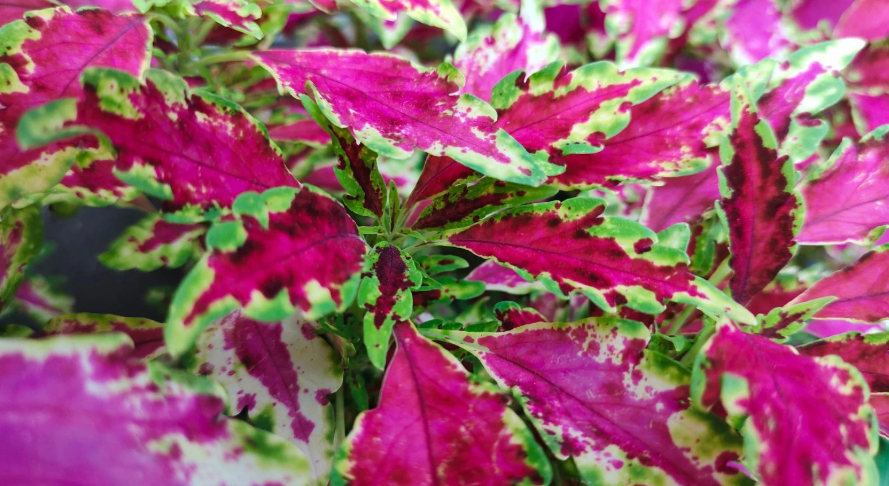
Plants with green and pink leaves get their coloring from a genuinely different pigment system than white or yellow variegated plants, since the pink and red tones typically come from anthocyanins, the same class of pigments responsible for red autumn leaves and purple fruit skins, layered over or alongside the usual green chlorophyll. Because these pink sections often still contain some functioning chlorophyll underneath the anthocyanin layer, many pink-leaved plants tolerate brighter light than pure white variegated plants without the same risk of leaf scorch.
That pigment distinction also explains why pink coloring in many of these plants shifts noticeably with light intensity and even temperature, intensifying in bright, cooler conditions and fading toward plain green when a plant is grown in low light or excessive heat. Several of the most sought-after pink-leaved houseplants command genuinely high prices specifically because stable, vivid pink variegation is harder to reproduce reliably through propagation than green foliage.
These plants span tropical rainforest understories, temperate garden borders, and edible vegetable beds, with native ranges stretching from Brazilian jungles to Mediterranean coastlines. What follows covers 30 plants known for green and pink leaves, along with where each one grows and the data behind its coloring.
Tricolor Stromanthe
Tricolor stromanthe, also called ‘Triostar,’ is native to the tropical rainforests of Brazil, displaying large, pointed leaves splashed with white, cream, and vivid pink alongside deep green, with a solid magenta-pink underside. A mature plant typically reaches 2 to 3 feet tall, requiring consistently high humidity to prevent its variegated edges from browning. Its pink coloring intensifies with brighter indirect light.
It’s grown as a houseplant worldwide, considered one of the more demanding variegated tropical plants to keep looking its best.
Pink Princess Philodendron
Pink Princess philodendron is a variegated cultivar of a species native to Colombia, displaying dark green to near-black leaves marked with irregular, saturated hot pink sectors. Because the pink variegation is chimeral, meaning it results from genetically distinct cell layers, propagated cuttings can vary enormously in how much pink each new plant ultimately displays. A mature plant can climb several feet with adequate support.
It’s grown as a houseplant worldwide, commanding a premium price among collectors specifically because of the unpredictability and rarity of well-variegated cuttings.
Polka Dot Plant
Polka dot plant is native to Madagascar and parts of Southeast Asia and South Africa, displaying green leaves densely speckled with pink, red, or white spots depending on the cultivar. A mature plant typically stays compact, reaching 1 to 2 feet tall, though it’s most often grown as a smaller potted specimen. Its spotted coloring is most vivid in bright, indirect light.
It’s grown as a houseplant and warm-season garden annual throughout temperate regions of the United States, tending to become leggy and lose its compact shape without regular pinching.
Nerve Plant
Nerve plant, particularly pink-veined cultivars sometimes called ‘Pink Angel,’ is native to the tropical rainforests of Peru and other parts of South America, displaying dark green leaves etched with a fine network of vivid pink veins. A mature plant stays extremely low and spreading, generally under 6 inches tall. It requires consistently high humidity, often grown in a terrarium to prevent its thin leaves from crisping.
It’s grown as a houseplant worldwide, among the more humidity-demanding plants commonly sold for indoor cultivation.
Rex Begonia
Rex begonia, particularly pink-patterned cultivars, is a hybrid group derived from a species native to northeastern India, displaying large, asymmetrical leaves marked with swirling bands of silver, pink, purple, and green. A mature plant typically reaches 1 to 2 feet tall, grown primarily for its dramatic foliage rather than its relatively insignificant flowers. Its coloring is most vivid in bright, indirect light with consistent humidity.
It’s grown as a houseplant worldwide, propagated readily from leaf cuttings, which is part of why so many distinct color patterns have been developed over the decades.
Pink Caladium
Pink caladium, including cultivars like ‘Pink Beauty’ and ‘Carolyn Whorton,’ is native to the tropical rainforests of South America, displaying large, heart-shaped leaves marked with pink centers and veining surrounded by green margins. Grown from an underground tuber, the plant goes fully dormant each winter in temperate climates. A mature plant typically reaches 1 to 2 feet tall during the growing season.
It’s grown as a warm-season annual or houseplant across most of the United States, thriving in shaded, humid garden beds during summer.
Ti Plant
Ti plant, botanically Cordyline fruticosa, is native to Australia and the western Pacific islands, and according to the North Carolina Extension Gardener Plant Toolbox, its stunning foliage appears in shades of pale pink, green, purple, or deep red depending on the specific cultivar, with pink cultivars including ‘Pink Passion’ and ‘Sherbert.’ A mature plant typically reaches 3 to 10 feet tall depending on growing conditions. It’s frequently grown in Hawaiian gardens, where it’s believed to bring good luck.
It grows as a houseplant in temperate climates and as an outdoor landscape shrub in South Florida and other frost-free regions, requiring bright indirect light to maintain its most vivid coloring.
Tradescantia ‘Nanouk’
Tradescantia ‘Nanouk’ is a variegated cultivar of a plant native to Mexico, displaying narrow, succulent leaves striped in shades of pink, cream, and green, with a purple underside. A mature plant sprawls or trails, typically staying under a foot tall while spreading considerably wider. Its pink coloring intensifies dramatically with more direct sunlight, fading toward plain green in shadier locations.
It’s grown as a houseplant worldwide, having become one of the most popular tradescantia cultivars in cultivation since its relatively recent introduction.
Oyster Plant ‘Tricolor’
Oyster plant ‘Tricolor’ is a variegated cultivar of a species native to Mexico and Central America, displaying sword-shaped leaves striped in pink, cream, and green on the upper surface, with a deep purple underside. A mature clump typically reaches 1 to 2 feet tall, forming dense rosettes that spread slowly over time. Its pink and cream striping is most vivid in full sun.
It grows as a landscape groundcover in warm, frost-free regions of the United States and as a houseplant elsewhere.
Calathea Roseopicta
Calathea roseopicta, sometimes called the rose-painted calathea, is native to the tropical rainforests of Brazil, displaying broad, rounded leaves marked with a distinct pink to rose-colored band following the leaf’s central pattern, with a deep purple underside. A mature plant typically reaches 1 to 2 feet tall. Like most calathea species, its leaves fold upward at night in a movement sometimes called “praying.”
It’s grown as a houseplant worldwide, requiring consistently high humidity and evenly moist soil to keep its pink markings from browning at the edges.
Prayer Plant ‘Fascinator Tricolor’
Prayer plant ‘Fascinator Tricolor’ is a variegated cultivar of a species native to the rainforests of Brazil, displaying oval green leaves marked with dark blotches and a network of vivid pink veins radiating outward. A mature plant stays low and spreading, generally under a foot tall. Like other prayer plants, its leaves fold upward each evening and open again each morning.
It’s grown as a houseplant worldwide, favoring bright, indirect light and consistent humidity to maintain its pink vein coloring.
Copper Plant
Copper plant, botanically Acalypha wilkesiana, is native to Fiji and neighboring islands of the South Pacific, and according to the North Carolina Extension Gardener Plant Toolbox, its 4 to 8 inch heart-shaped leaves come in mottled combinations of green, purple, yellow, orange, copper, crimson, pink, or white depending on the cultivar, with ‘Tricolor’ specifically combining shades of green, cream, pink, copper, and red. A mature shrub typically reaches 3 to 4 feet tall.
It grows as a landscape shrub throughout South Florida and other frost-free regions, requiring full sun for its best, most saturated leaf coloring.
Pink Aglaonema
Pink aglaonema, including cultivars like ‘Siam Aurora’ and ‘Pink Dalmatian,’ is native to the tropical forests of Southeast Asia, displaying dark green leaves marked with pink spots, speckles, or veining depending on the cultivar. A mature plant typically reaches 1 to 2 feet tall, among the more tolerant of low indoor light compared to other pink-variegated houseplants. Its coloring is most vivid in bright, indirect light.
It’s grown as a houseplant worldwide, considered one of the more forgiving and low-maintenance options for gardeners wanting pink foliage indoors.
Krimson Queen Hoya
Krimson Queen hoya is a variegated cultivar of a vining succulent native to Southeast Asia and Australia, displaying thick, waxy green leaves edged in cream, with new growth emerging a distinct pink before maturing. A mature vine can trail or climb several feet over time, growing slowly. Its pink new growth is most pronounced in bright light.
It’s grown as a houseplant worldwide, valued both for its colorful foliage and its fragrant, star-shaped flower clusters produced once the plant matures.
Pink Syngonium
Pink syngonium, particularly the cultivar ‘Pink Splash,’ is native to the tropical rainforests of Central and South America, displaying arrow-shaped leaves speckled and splashed with pink across a green background. As the plant matures, its leaves become more deeply lobed compared to the simple arrow shape of young growth. A mature vine can climb several feet with support.
It’s grown as a houseplant worldwide, with pink coloring that tends to be most vivid on younger leaves before mellowing somewhat as the plant ages.
Bloodleaf Plant
Bloodleaf plant, botanically Iresine herbstii, is native to Brazil, displaying deep red to magenta-pink leaves with vivid pink veins running throughout, often grown alongside green-leaved bedding plants for high contrast. A mature plant typically reaches 1 to 2 feet tall, commonly grown as a warm-season annual outside its native tropical range. Its coloring is most intense in full sun.
It grows as a garden annual throughout temperate regions of the United States and as a houseplant in colder climates.
Alocasia ‘Pink Dragon’
Alocasia ‘Pink Dragon’ is a hybrid cultivar related to species native to Southeast Asia, displaying dark green, arrow-shaped leaves with a bright pink stem and midrib running down each leaf. A mature plant typically reaches 1 to 2 feet tall, favoring consistently moist soil and high humidity. Its striking pink stem contrasts sharply against the deep green foliage.
It’s grown as a houseplant worldwide, considered a relatively compact option compared to many larger alocasia species.
Pink Peperomia
Pink peperomia, particularly the cultivar ‘Rosso,’ is a hybrid derived from species native to South America, displaying deep green, ridged upper leaves with a vivid magenta-pink underside visible along the leaf edges. A mature plant stays compact, generally under a foot tall. Its pink coloring is most visible from beneath or along the leaf margins rather than across the entire leaf surface.
It’s grown as a houseplant worldwide, tolerating lower light and less frequent watering than many other pink-foliage plants.
Pink Rubber Plant
Pink rubber plant, particularly the cultivar ‘Ruby,’ is a variegated form of a tree native to Southeast Asia, displaying dark green leaves edged in cream with a pronounced pink to red blush, especially on new growth. A mature indoor specimen can reach 6 to 8 feet tall. Its pink coloring is more pronounced than other variegated rubber plant cultivars, particularly when grown in bright light.
It’s grown as a houseplant worldwide, requiring brighter light than solid green rubber plants to maintain its pink and cream variegation.
Pink Croton
Pink croton, a color form of Codiaeum variegatum, is native to India, Malaysia, and islands of the South Pacific, and according to University of Florida IFAS Extension, croton leaf colors range from reds, oranges, and yellows to green in nearly limitless combinations, with certain cultivars leaning heavily toward pink and rose tones. A mature plant grown outdoors in frost-free climates can reach 6 to 10 feet tall.
It grows as a landscape shrub in South Florida and other frost-free regions and as a houseplant elsewhere, requiring bright light to maintain vivid coloring.
Pink Neoregelia Bromeliad
Pink neoregelia bromeliad is a hybrid cultivar derived from species native to Brazil, displaying a rosette of stiff, glossy green leaves that blush pink to red toward the center, especially just before the plant flowers. A mature rosette typically reaches 1 to 2 feet across. Its central coloring intensifies as the plant approaches its single blooming cycle, after which the main rosette naturally declines.
It’s grown as a houseplant and warm-climate landscape plant throughout the United States, favoring bright light to develop its strongest pink blush.
Pink Coleus
Pink coleus, including cultivars like ‘Pink Chaos,’ is a hybrid derived from species native to Southeast Asia, and according to the University of Georgia’s College of Agricultural and Environmental Sciences, newer sun-tolerant coleus varieties have expanded dramatically beyond the shade-only cultivars once typical of the plant, with cultivars like ‘Stained Glassworks Luminesce’ displaying an almost iridescent hot pink coloring. A mature plant typically reaches 1 to 2 feet tall in a single growing season.
It grows as a garden annual throughout temperate regions of the United States, thriving in both sun and shade depending on the specific cultivar chosen.
Pink Splash Pilea
Pink splash pilea, particularly the cultivar ‘Norfolk,’ is a variegated form of a plant native to Central and South America, displaying deeply puckered, quilted green leaves with a pink to bronze blush across the surface. A mature plant typically reaches 8 to 12 inches tall, favoring bright, indirect light to maintain its coloring. Its textured leaf surface adds visual interest beyond the coloring alone.
It’s grown as a houseplant worldwide, generally less common in cultivation than its solid green relatives.
Angel Wing Begonia
Angel wing begonia, particularly cultivars with pink-spotted foliage, is a hybrid group derived from species native to Brazil, displaying elongated, wing-shaped green leaves marked with silvery pink spots or splashes. A mature plant can reach 2 to 4 feet tall, producing drooping clusters of pink flowers that complement the spotted foliage. Its coloring is most vivid in bright, indirect light.
It’s grown as a houseplant and warm-season garden annual throughout temperate regions of the United States.
Calathea ‘Dottie’
Calathea ‘Dottie’ is a variegated cultivar of a species native to Brazil, displaying nearly black leaves marked with a bold hot pink margin and pink midrib, among the most dramatic color contrasts of any commonly cultivated calathea. A mature plant typically reaches 1 to 2 feet tall, requiring high humidity and consistent moisture. Its pink margin remains vivid even in relatively low light compared to some other calathea cultivars.
It’s grown as a houseplant worldwide, prized specifically for its striking near-black and pink color combination.
Pink Quill
Pink quill, botanically Tillandsia cyanea, is native to the tropical forests of Ecuador, displaying narrow, arching green leaves and a flattened, bright pink bract structure that resembles a large feather or quill rising from the center of the plant. The pink coloring belongs to the bract rather than true foliage, though it persists for months, considerably longer than the small purple flowers that emerge from within it. A mature plant typically reaches under a foot tall.
It’s grown as a houseplant worldwide, requiring bright, indirect light and, as an epiphyte in its native habitat, doesn’t require soil to grow successfully.
Pink Splash Ivy
Pink splash ivy, particularly the cultivar ‘Pink ‘n Curly,’ is a variegated form of a vine native to Europe and western Asia, displaying curly, crinkled green leaves with new growth tips emerging in a soft pink before maturing to cream and green. A mature vine can trail several feet. Its pink new growth is most pronounced in cooler temperatures and bright light.
It’s grown as a houseplant worldwide, valued for combining unusual leaf texture with its seasonal pink coloring.
Pink Sedum
Pink sedum, particularly the cultivar ‘Tricolor’ of two-row stonecrop, is a variegated form of a succulent groundcover native to the Caucasus region, displaying small, fleshy leaves edged in white with a distinct pink blush, especially at the growing tips. A mature planting stays low, generally under 4 inches tall, spreading slowly to form a dense mat. Its pink coloring intensifies in full sun and cooler weather.
It grows as a groundcover throughout temperate regions of the United States, tolerating drought and poor soil better than most other pink-foliage plants.
Strawberry Saxifrage
Strawberry saxifrage, also called strawberry begonia despite belonging to neither the strawberry nor begonia family, is native to eastern Asia, displaying rounded, olive-green leaves marked with silvery veining and a distinct reddish-pink underside and stem. A mature plant stays low, generally under 6 inches tall, spreading via long, thin runners similar to a true strawberry plant. Its pink coloring is most visible on the leaf undersides and stems rather than the leaf’s upper surface.
It grows as a groundcover in shaded garden beds across much of the temperate United States, favoring consistently moist, well-drained soil.
Pink Swiss Chard
Pink Swiss chard, particularly the cultivar ‘Bright Lights,’ is a variegated form of a leafy vegetable native to the Mediterranean region, displaying broad, crinkled green leaves with vivid pink stems and veining running throughout. A mature plant typically reaches 1 to 2 feet tall, fully edible and often grown as much for its ornamental color as for cooking. Its pink coloring intensifies with cooler fall temperatures.
It grows as a garden vegetable throughout temperate regions of the United States, tolerating light frost better than many other leafy greens.
Further References
- Polka Dot Plant — North Carolina Extension Gardener Plant Toolbox — Covers Hypoestes phyllostachya, which has green leaves marked with pink, rose, red, or white patches and spots.
- Tradescantia zebrina — University of Wisconsin–Madison Extension — Describes cultivars such as ‘Quadricolor’ and ‘Nanouk’, which feature combinations of green, pink, cream, purple, and violet-pink on their foliage.
- Croton — University of Wisconsin–Madison Horticulture — Details croton cultivars with green leaves marked by pink, red, yellow, orange, and other colors.
- Chinese Evergreen — Clemson Cooperative Extension — Includes cultivars such as ‘Red Ruby’, ‘Suzy’, and ‘Wishes’, which have green foliage combined with pink or red coloration.
- Triostar Stromanthe — University of Florida IFAS Extension — Provides identification and growing information for ‘Triostar’, known for green-and-white variegated leaves with reddish-pink undersides.