Plants with yellow and green leaves get their two-tone foliage through several distinct routes, from stable genetic mutations that suppress chlorophyll in specific leaf zones to naturally occurring golden-leaved forms selected and propagated because gardeners simply liked the color. Unlike the crisp white variegation seen on some cultivated plants, yellow and gold variegation often carries at least a trace of functioning chlorophyll in the paler tissue, which is part of why many yellow-green plants tolerate more direct sun than their pure white counterparts without scorching.
That extra tolerance for light has made yellow and gold foliage especially popular for brightening shaded garden corners and adding warm color to landscapes without relying on flowers, since the effect lasts through an entire growing season rather than a brief bloom window. Light exposure still matters enormously for keeping the color vivid, since most of these plants fade toward plain green in deep shade and can scorch if moved too abruptly into intense, unfiltered sun.
These plants span tropical houseplants, temperate garden shrubs, and ornamental grasses, with native ranges stretching from Japanese woodlands to West African forests. What follows covers 21 plants known for yellow and green leaves, along with where each one grows and the data behind its coloring.
Snake Plant ‘Laurentii’
Snake plant ‘Laurentii’ is a variegated form of a succulent native to West Africa, displaying broad yellow margins running the length of its stiff, upright, dark green leaves. It’s the most widely available variegated snake plant cultivar, considerably more common in cultivation than white-striped forms. A mature plant typically reaches 2 to 4 feet tall.
It’s grown as a houseplant worldwide, tolerating low light, infrequent watering, and general neglect better than nearly any other commonly cultivated variegated plant.
Golden Pothos
Golden pothos, the standard form most commonly sold under that name, is native to the South Pacific island of Mo’orea in French Polynesia, displaying irregular yellow marbling and splashing across its heart-shaped green leaves. A mature vine can trail or climb 10 feet or more indoors, and its color pattern intensifies with brighter indirect light. It remains one of the most widely sold houseplants in the world.
It’s grown as a houseplant worldwide, tolerating low light, inconsistent watering, and a wide range of indoor conditions better than almost any other common variegated plant.
Gold Dust Plant
Gold dust plant, botanically Aucuba japonica ‘Variegata,’ is native to China, the Korean Peninsula, Taiwan, and Japan, and according to the North Carolina Extension Gardener Plant Toolbox, its glossy green leaves are blotched with golden yellow spots that provide year-round color, with the effect most vivid when the plant is grown in full shade. A mature shrub typically reaches 4 to 6 feet tall and wide, growing slowly into a dense, rounded form.
It grows as a landscape shrub throughout the southeastern United States and as a potted houseplant farther north, tolerating heavy shade and poor soil better than most other broadleaf evergreens.
Golden Privet
Golden privet is a variegated form of a shrub native to Japan, displaying glossy green leaves broadly edged in bright yellow. A mature shrub typically reaches 8 to 10 feet tall if left unpruned, though it’s most often maintained as a clipped hedge at a smaller size. Its color intensifies in full sun, unlike many other yellow-variegated shrubs that prefer partial shade.
It grows as a landscape hedge shrub throughout temperate regions of the United States, tolerating heavy pruning and a wide range of soil conditions.
Gold-Edged Hosta
Gold-edged hosta, including cultivars like ‘Frances Williams’ and ‘Gold Standard,’ is a variegated form of a shade perennial native to East Asia, displaying broad, irregular gold to yellow margins surrounding a blue-green or green center. Unlike white-margined hosta cultivars, gold-edged types generally tolerate and even require more direct morning sun to develop their strongest color. A mature plant can range from 1 to 3 feet across depending on the specific cultivar.
It grows as a shade garden perennial throughout the northern and midwestern United States, among the most widely planted perennials in American gardens.
Golden Euonymus
Golden euonymus, particularly the cultivar ‘Aureomarginatus,’ is a variegated form of a shrub native to Japan and Korea, displaying glossy green leaves broadly edged in bright yellow. A mature shrub typically reaches 8 to 10 feet tall if left unpruned, though it’s commonly kept smaller through regular shearing. Its evergreen foliage provides year-round color in mild-winter climates.
It grows as a landscape shrub throughout the southern and mid-Atlantic United States, tolerating salt spray and coastal conditions better than many other variegated shrubs.
Golden Full Moon Maple
Golden full moon maple, botanically Acer shirasawanum ‘Aureum,’ is native to Japan, and according to Oregon State University’s Landscape Plants database, it was introduced from Japan to Holland around 1865 and reached England by 1881. Its rounded, deeply lobed leaves emerge bright yellow in spring, shifting to a greenish-yellow through summer before turning gold to orange in fall. A mature specimen grows slowly, eventually reaching 16 to 20 feet tall with an equal spread.
It grows as a landscape specimen tree throughout temperate regions of the United States, requiring some afternoon shade to prevent its golden leaves from scorching in intense summer sun.
Golden Japanese Forest Grass
Golden Japanese forest grass, particularly the cultivar ‘Aureola,’ is a variegated form of an ornamental grass native to Japan, displaying fine yellow stripes running the length of its soft, cascading green blades. A mature clump typically reaches 1 to 2 feet tall, forming a graceful, mounding shape well suited to shaded borders. Unlike many ornamental grasses, it thrives in shade rather than requiring full sun.
It grows as a shade garden perennial throughout temperate regions of the United States, valued for brightening dark garden corners without needing direct sunlight.
Golden Creeping Jenny
Golden creeping Jenny is a golden-leaved form of a groundcover native to Europe, displaying small, rounded, chartreuse to yellow-green leaves along low, trailing stems. A mature planting spreads rapidly, rooting at each node, and typically stays under 2 inches tall. Its color is most vivid in full sun, fading toward plain green in deeper shade.
It grows as a groundcover throughout temperate regions of the United States, commonly used to spill over the edges of containers and garden walls.
Golden Oregano
Golden oregano is a golden-leaved form of a culinary herb native to the Mediterranean region, displaying small, rounded, chartreuse to yellow-green leaves on low, spreading stems. A mature plant typically reaches 6 to 12 inches tall, remaining fully edible and aromatic despite its ornamental coloring. Its foliage color is most pronounced in cooler weather and can fade toward green during peak summer heat.
It grows as a garden perennial or culinary herb throughout temperate regions of the United States, favoring full sun and well-drained soil.
Golden Sedum
Golden sedum, particularly the cultivar ‘Ogon,’ is a golden-leaved form of a succulent groundcover native to Japan, displaying small, rounded, bright chartreuse-yellow leaves along low, trailing stems. A mature planting stays under 4 inches tall, spreading slowly to form a dense mat. Its color intensifies in full sun and can shift toward a more solid green in shadier locations.
It grows as a groundcover and container succulent throughout temperate regions of the United States, tolerating drought once established.
Croton
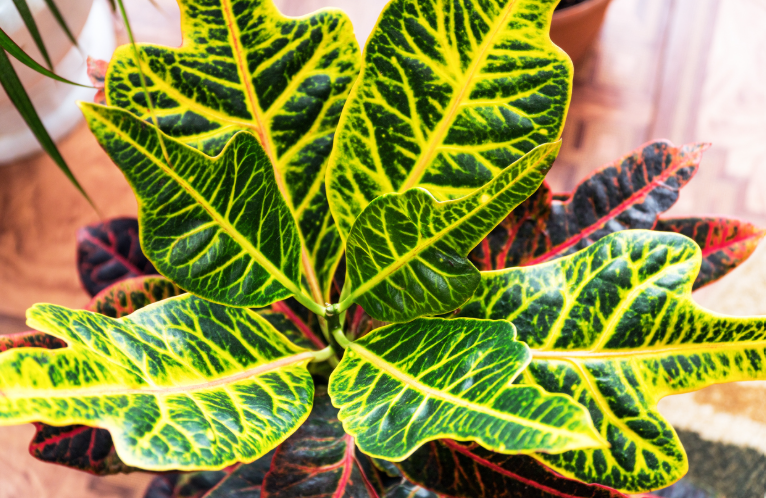
Croton, botanically Codiaeum variegatum, is native to India, Malaysia, and islands of the South Pacific, and according to University of Florida IFAS Extension, few other plants can surpass its combination of foliage color and leaf shape variation, with colors ranging from reds, oranges, and yellows to green in nearly limitless combinations. A mature plant grown outdoors in frost-free climates can reach 6 to 10 feet tall, though it stays considerably smaller as a houseplant.
It grows as a landscape shrub in South Florida and other frost-free regions and as a houseplant elsewhere, requiring bright light to maintain its most vivid coloring.
Golden Barberry
Golden barberry, particularly the cultivar ‘Aurea,’ is a golden-leaved form of a shrub native to Japan, displaying small, rounded leaves in a bright yellow to chartreuse color throughout the growing season. A mature shrub typically reaches 3 to 4 feet tall, considerably more compact than the species’ purple-leaved cultivars. Its foliage can scorch in intense afternoon sun, generally performing best with some light shade.
It grows as a landscape shrub throughout temperate regions of the United States, though its parent species is classified as invasive in several states.
Golden Spirea
Golden spirea, including cultivars like ‘Gold Mound’ and ‘Goldflame,’ is a golden-leaved form of a shrub native to Japan, displaying small, narrow leaves in shades of yellow to chartreuse, often emerging with orange or bronze tones in spring. A mature shrub typically reaches 2 to 3 feet tall, forming a dense, mounding shape. Its foliage color intensifies in full sun.
It grows as a landscape shrub throughout temperate regions of the United States, commonly used as a low border or foundation planting.
Golden Ninebark
Golden ninebark, particularly the cultivar ‘Dart’s Gold,’ is a golden-leaved form of a shrub native to eastern North America, and according to the North Carolina Extension Gardener Plant Toolbox, its leaves emerge yellow before shifting to a yellowish-green or light green as the season progresses. A mature shrub typically reaches 8 to 10 feet tall, with peeling, exfoliating bark that adds winter interest once the leaves drop.
It grows as a landscape shrub throughout the eastern and midwestern United States, tolerating wet soil and urban conditions better than many other flowering shrubs.
Golden Elderberry
Golden elderberry, particularly cultivars like ‘Sutherland Gold,’ is a golden-leaved form of a shrub native to North America and Europe, displaying finely divided, fern-like leaves in a bright yellow-green color throughout the growing season. A mature shrub typically reaches 6 to 8 feet tall, producing the same white flower clusters and dark berries as green-leaved elderberry. Its foliage color is most vivid in full sun.
It grows as a landscape shrub throughout temperate regions of the United States, favoring consistently moist soil.
Variegated Dieffenbachia
Variegated dieffenbachia, commonly called dumb cane, is native to the tropical rainforests of the Caribbean and South America, displaying large, broad leaves mottled with irregular patches of cream, yellow, and green depending on the specific cultivar. A mature plant typically reaches 3 to 5 feet tall indoors. Every part of the plant contains calcium oxalate crystals that cause painful swelling of the mouth and throat if chewed, which is how it earned its common name.
It’s grown as a houseplant worldwide, tolerating moderate to low indoor light better than many other variegated tropical plants.
Golden Japanese Sweet Flag
Golden Japanese sweet flag, particularly the cultivar ‘Ogon,’ is a variegated form of a grass-like perennial native to Japan, displaying narrow, arching leaves striped in yellow and green. A mature clump typically reaches 8 to 12 inches tall, thriving in consistently moist to wet soil unlike most true ornamental grasses. Its coloring holds up well in both sun and partial shade.
It grows as a groundcover or pond-edge perennial throughout temperate regions of the United States, favoring moist soil along water features.
Golden Bamboo
Golden bamboo is native to southeastern China, displaying green leaves on canes that mature to a warm golden-yellow color, with certain variegated forms also showing yellow-and-green striped foliage. A mature stand can reach 40 to 60 feet tall under favorable conditions, spreading aggressively via underground rhizomes. It’s classified as invasive across much of the southeastern United States due to its rapid, difficult-to-contain spread.
It grows throughout the southeastern United States, and root barriers are strongly recommended to prevent it from spreading beyond an intended planting area.
Yellow-Edged Yucca
Yellow-edged yucca, particularly the cultivar ‘Color Guard,’ is a variegated form of a succulent native to the southeastern United States, displaying stiff, sword-shaped leaves with a bright yellow center bordered by green margins, a reversed variegation pattern compared to most yellow-edged plants. A mature clump typically reaches 2 to 3 feet tall, with tall flower spikes rising several feet above the foliage in summer. Its foliage color intensifies with more direct sun exposure.
It grows as a landscape accent plant throughout much of the United States, tolerating drought and poor soil better than most other variegated perennials.
Golden Threadleaf Cypress
Golden threadleaf cypress, particularly the cultivar ‘Golden Mop,’ is a golden-leaved form of a conifer native to Japan, displaying fine, thread-like, chartreuse to golden-yellow foliage in a dense, mounding form. A mature shrub typically reaches 2 to 4 feet tall and wide, growing slowly over many years. Its color is most vivid in full sun, fading toward a duller green-gold in shadier locations.
It grows as a landscape shrub throughout temperate regions of the United States, valued for providing year-round color and texture even through winter.
Further References
- Variegation Sensation – Variegated Plants — University of Florida IFAS Extension — Explains yellow-and-green variegation and provides examples including shell ginger, Ficus, bromeliads, ornamental grasses, citrus, and other landscape plants.
- Pothos — University of Wisconsin–Madison Extension — Covers yellow-green foliage in cultivars such as Golden Pothos, ‘Lime,’ and ‘Lemon Meringue,’ with photographs and cultivar descriptions.
- Variegated Shell Ginger — University of Florida IFAS Extension — Provides identification details for Alpinia zerumbet ‘Variegata’, which has distinctive green-and-yellow variegated leaves.
- Croton — University of Wisconsin–Madison Extension — Describes numerous croton cultivars with green foliage marked by yellow, gold, orange, and other colors, making it useful for identifying colorful foliage patterns.
- Using Foliage Color — University of Georgia Extension — Explains how variegated leaves commonly combine green with yellow, cream, or other colors and provides examples of plants with multicolored foliage.