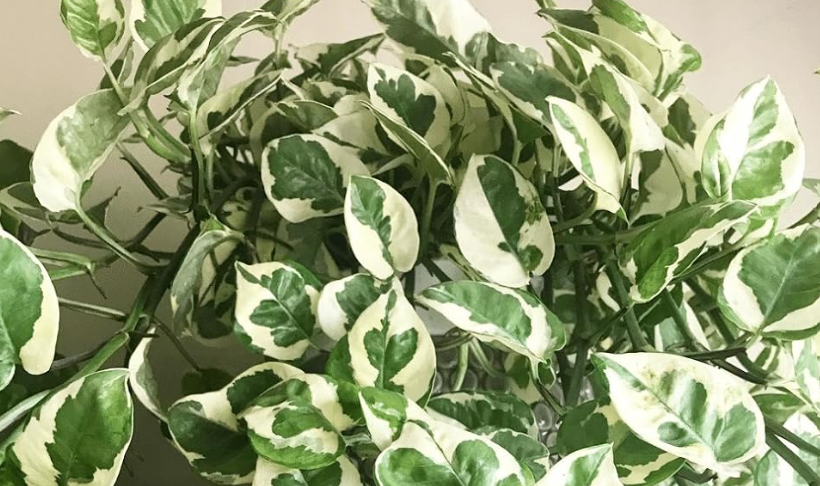
Plants with white variegation get their striking two-tone or patterned leaves from a genuinely interesting biological quirk rather than any deliberate dye or treatment. According to the University of Illinois Extension, variegated leaves are frequently the result of a chimera, a plant made up of 2 or more genetically distinct cell layers, where the white sections simply lack the chlorophyll-producing cells found in the surrounding green tissue.
That missing chlorophyll isn’t just cosmetic, since the white portions of a variegated leaf contribute little to no photosynthesis, which is why heavily variegated plants often grow more slowly than their fully green counterparts and why a stem that reverts to solid green usually grows noticeably faster than the rest of the plant. Because that reversion tends to outcompete the slower variegated growth over time, most variegated cultivars need occasional pruning of any all-green shoots to keep the pattern from disappearing entirely.
These plants span tropical houseplant collections, shaded perennial borders, and ornamental shrub and grass plantings, with native ranges stretching from Southeast Asian rainforests to European woodlands. What follows covers 28 plants known for white variegation, along with where each one grows and the data behind its distinctive foliage.
Variegated Monstera
Variegated monstera, most famously the cultivar known as Monstera Albo, is a variegated form of a species native to the tropical rainforests of southern Mexico and Central America. Its large, deeply split leaves display irregular white or cream sectors alongside the deep green typical of the species, a chimeral pattern that has made it one of the most sought-after and expensive houseplants in cultivation. A mature plant can develop leaves exceeding a foot across under the right growing conditions.
It’s grown as a houseplant worldwide, requiring bright, indirect light to sustain the non-photosynthesizing white tissue without scorching it.
Monstera ‘Thai Constellation’
Monstera ‘Thai Constellation’ is a stable variegated cultivar developed from tissue culture in Thailand, distinguished from Monstera Albo by its more evenly distributed, speckled cream variegation resembling a scattering of stars across each leaf. Unlike some chimeral variegated plants, this cultivar’s pattern is genetically stable and far less prone to reverting to solid green. A mature plant can reach several feet in height when given a supporting pole to climb.
It’s grown as a houseplant worldwide, commanding a premium price in the ornamental plant trade specifically due to its stable, reliably patterned variegation.
Variegated Pothos
Variegated pothos, particularly the cultivar ‘Marble Queen,’ is a variegated form of a vine native to French Polynesia, displaying heavy, marbled patches of white and cream across its heart-shaped green leaves. Because a significant portion of each leaf can be nearly white, this cultivar grows notably slower than solid green pothos varieties. A mature vine can trail several feet in length.
It’s grown as a houseplant worldwide, tolerating a wide range of indoor light conditions better than many other variegated species, though brighter light helps maintain the strongest contrast.
Variegated Snake Plant
Variegated snake plant, particularly the cultivar ‘Bantel’s Sensation,’ is a variegated form of a succulent native to West Africa, displaying narrow, crisp white vertical stripes running the length of its otherwise dark green, upright leaves. It grows more slowly than the common green snake plant, and its rarity in commercial production has kept it a sought-after specialty variety. A mature plant typically reaches 2 to 3 feet tall.
It’s grown as a houseplant worldwide, tolerating low light and infrequent watering better than almost any other commonly cultivated variegated plant.
Variegated Rubber Plant
Variegated rubber plant, particularly the cultivar ‘Tineke,’ is a variegated form of a tree native to Southeast Asia, displaying cream and white margins alongside soft pink new growth on its large, glossy leaves. A mature indoor specimen can reach 6 to 10 feet tall, considerably smaller than the 100-foot heights the species can reach in its native rainforest habitat.
It’s grown as a houseplant worldwide, requiring brighter light than the solid green form to maintain vivid variegation without the leaves fading toward plain green.
Variegated Philodendron
Variegated philodendron, particularly the cultivar ‘White Wizard,’ is a variegated form of a climbing plant native to Central and South American rainforests, producing large, glossy leaves marked with bold, irregular white and cream sectors. Because the white portions of each leaf can be extensive, this cultivar is notably more light-sensitive than solid green philodendrons and requires careful acclimation to avoid leaf scorch. A mature plant can climb several feet with adequate support.
It’s grown as a houseplant worldwide, valued among collectors specifically for how dramatically its variegation pattern can differ from leaf to leaf on the same plant.
Variegated Peace Lily
Variegated peace lily, particularly the cultivar ‘Domino,’ is a variegated form of a plant native to the tropical rainforests of Central and South America, displaying fine white streaks and speckles across its otherwise deep green, glossy leaves. Unlike the solid green form, the variegated cultivar generally requires slightly brighter indirect light to maintain its pattern. A mature plant typically reaches 1 to 2 feet tall indoors.
It’s grown as a houseplant worldwide, tolerating lower light than most variegated plants, though its white sections remain more prone to browning if the soil is allowed to dry out completely.
Variegated Spider Plant
Variegated spider plant, particularly the cultivar ‘Vittatum,’ is a variegated form of a plant native to coastal regions of South Africa, displaying a broad white to cream central stripe running down each narrow, arching green leaf. A mature plant produces long, wiry stems bearing small plantlets that can be rooted to propagate new, identically variegated plants. It typically reaches 1 to 2 feet tall and wide.
It’s grown as a houseplant worldwide, considered one of the easiest variegated plants to grow successfully, tolerating a wide range of light and watering conditions.
Variegated Syngonium
Variegated syngonium, particularly the cultivar ‘White Butterfly,’ is a variegated form of a climbing plant native to the tropical rainforests of Central and South America, displaying pale, nearly white centers on its arrow-shaped leaves surrounded by a green border. As the plant matures, its leaf shape changes considerably, developing more deeply lobed leaves compared to the simple arrow shape of young growth. A mature vine can climb several feet with support.
It’s grown as a houseplant worldwide, valued for maintaining a relatively stable variegation pattern compared to some other tropical variegated vines.
Calathea ‘White Fusion’
Calathea ‘White Fusion’ is a variegated cultivar of a plant native to the tropical rainforests of Brazil, displaying irregular splashes of white and pale green across its dark green leaves, with a deep purple underside providing dramatic contrast. It’s considered one of the more demanding calathea cultivars to grow, requiring consistently high humidity and evenly moist soil to prevent crisping along its variegated edges. A mature plant typically reaches 1 to 2 feet tall.
It’s grown as a houseplant worldwide, prized among collectors despite its reputation for being more finicky than most other variegated tropical plants.
Caladium
Caladium, particularly white-leaved cultivars like ‘White Christmas,’ is native to the tropical rainforests of South America, displaying large, heart-shaped leaves that are almost entirely white with contrasting green veins running throughout. Grown from an underground tuber, the plant goes fully dormant each winter in temperate climates, regrowing from the same tuber the following spring. A mature plant typically reaches 1 to 2 feet tall during the growing season.
It’s grown as a warm-season annual or houseplant across most of the United States, thriving in shaded, humid garden beds during summer.
Variegated Hosta
Variegated hosta is native to East Asia, and according to University of Minnesota Extension, groups of variegated hostas with white or cream margins can be planted alongside other white-flowering plants to create a glowing “moonlight garden” effect in the evening. More than 4,000 cultivars exist, with variegation patterns ranging from a light-colored margin around a dark center to the reverse pattern of a dark margin around a pale center. A mature plant can range from a few inches to several feet across depending on the cultivar.
It grows as a shade garden perennial throughout the northern and midwestern United States, generally requiring more direct morning sun than solid green hostas to maintain vivid white variegation.
Variegated Dracaena
Variegated dracaena, particularly cultivars like ‘White Stripe,’ is a variegated form of a plant native to tropical Africa, displaying bold white to cream stripes running the length of its narrow, arching leaves. A mature indoor specimen can reach 6 to 8 feet tall over many years of slow growth. Its striped foliage remains one of the more dramatic and widely available variegated houseplant options.
It’s grown as a houseplant worldwide, tolerating lower light than many other variegated plants, though brighter conditions generally produce the crispest white striping.
Variegated English Ivy
Variegated English ivy, particularly cultivars like ‘Glacier,’ is a variegated form of a vine native to Europe and western Asia, displaying gray-green leaves edged in creamy white. A mature vine can climb or trail several feet, commonly grown as a hanging houseplant or outdoor groundcover in mild climates. Its variegated form is generally less aggressive and easier to manage than the solid green species, which has become invasive across much of North America.
It’s grown as both a houseplant and outdoor groundcover across temperate regions of North America and Europe.
Variegated Boxwood
Variegated boxwood, particularly the cultivar ‘Elegantissima,’ is a variegated form of a shrub native to Europe, North Africa, and western Asia, and according to the North Carolina Extension Gardener Plant Toolbox, it displays small, bright green leaves with broad, irregular creamy white margins, appearing almost entirely white from a distance. A mature shrub typically reaches 5 feet tall and 4 feet wide.
It grows as a landscape shrub throughout temperate regions of the United States, performing best in partial shade or morning sun, since leaves can scorch in full afternoon sun.
Variegated Privet
Variegated privet, particularly cultivars with the common name ‘Argenteum,’ is a variegated form of a shrub native to Japan, displaying glossy green leaves edged in creamy white. A mature shrub typically reaches 8 to 12 feet tall if left unpruned, though it’s commonly maintained as a clipped hedge at a much smaller size. Its variegated form is considerably less commonly naturalized than the solid green species, which has become invasive in parts of the eastern United States.
It grows as a landscape hedge shrub throughout temperate regions of the United States, tolerating heavy pruning and a wide range of soil conditions.
Variegated Weigela
Variegated weigela, particularly the cultivar ‘My Monet,’ is a variegated form of a shrub native to eastern Asia, displaying green leaves edged in ivory, pink, or white depending on light exposure and season, with variegation running whiter in shade and pinker in full sun. A mature plant stays notably compact, typically reaching just 1 to 2 feet tall, considerably smaller than most other weigela cultivars. It blooms less prolifically than solid-colored weigela varieties, with the foliage serving as the main ornamental feature.
It grows as a landscape shrub throughout temperate regions of the United States, valued specifically for its compact size and season-long foliage color rather than its flowers.
Variegated Dogwood
Variegated dogwood, particularly the cultivar ‘Elegantissima,’ is a variegated form of a shrub native to Siberia and northern China, and according to the University of Illinois Extension, its white leaf margins are a classic example of a periclinal chimera, one of the most stable forms of variegation found in cultivated plants. A mature shrub typically reaches 8 to 10 feet tall, with bright red winter stems providing a second season of ornamental interest once the leaves drop.
It grows as a landscape shrub throughout the northern United States, favoring moist soil along stream banks and garden borders.
Variegated Hydrangea
Variegated hydrangea, particularly the cultivar ‘Mariesii Variegata,’ is a variegated form of a shrub native to Japan, displaying green leaves irregularly edged in creamy white beneath its typical lacecap flower clusters. A mature shrub typically reaches 3 to 5 feet tall, generally staying more compact than solid green hydrangea cultivars. Its variegated foliage remains ornamental even outside the relatively brief summer flowering period.
It grows as a landscape shrub throughout temperate regions of the United States, preferring partial shade to protect its variegated leaves from scorching in intense afternoon sun.
Variegated Solomon’s Seal
Variegated Solomon’s seal is a variegated form of a woodland perennial native to Europe and Asia, displaying crisp white margins along its arching, paired green leaves, with small white bell-shaped flowers dangling beneath the foliage in spring. A mature plant typically reaches 1 to 2 feet tall, spreading slowly via underground rhizomes to form an expanding colony over several years. Its variegated form is considerably more popular in cultivation than the solid green species.
It grows as a shade garden perennial throughout temperate regions of the United States, thriving in the same rich, moist woodland soil favored by hosta and other shade-loving perennials.
Ribbon Grass
Ribbon grass, also called gardener’s garters, is a variegated form of a grass native to Europe, Asia, and North America, displaying bold white and green longitudinal stripes running the full length of each blade. A mature clump can spread aggressively via rhizomes, often requiring root barriers or container planting to prevent it from overtaking a garden bed. It typically reaches 2 to 3 feet tall.
It grows throughout temperate regions of North America and Europe, tolerating both moist and moderately dry soil better than many other variegated ornamental grasses.
Variegated Iris
Variegated iris, particularly the cultivar ‘Variegata’ of sweet iris, is a variegated form of a plant native to the Mediterranean region, displaying crisp white and green vertical stripes running the length of its sword-shaped leaves, with fragrant pale purple flowers appearing in late spring. A mature clump typically reaches 1 to 2 feet tall. Its striped foliage remains ornamental well after the relatively brief flowering period ends.
It grows as a garden perennial throughout temperate regions of the United States, tolerating dry soil and full sun better than many other variegated perennials.
Hakone Grass
Hakone grass, particularly the cultivar ‘Albo-striata,’ is a variegated form of an ornamental grass native to Japan, displaying fine white stripes running the length of its soft, cascading green blades. A mature clump typically reaches 1 to 2 feet tall, forming a graceful, mounding shape well suited to shaded borders and containers. Unlike many ornamental grasses, it tolerates shade rather than requiring full sun.
It grows as a shade garden perennial throughout temperate regions of the United States, valued specifically for combining variegated interest with genuine shade tolerance.
Variegated Agave
Variegated agave, particularly the cultivar ‘Marginata,’ is a variegated form of a succulent native to Mexico, displaying thick, spiny, blue-green leaves edged in creamy white or yellow. A mature rosette can reach 3 to 5 feet across, considerably smaller than the solid green species, which can exceed 10 feet in diameter at full maturity. Its variegated form is widely grown as an accent plant in warm, dry landscapes.
It grows as a landscape and container succulent throughout warm, arid regions of the southwestern United States, tolerating drought and poor soil better than nearly any other variegated plant on this list.
Snow-on-the-Mountain
Snow-on-the-mountain is native to the central Great Plains of North America, displaying leaves with broad white margins surrounding a green center, a natural variegation pattern rather than a cultivated chimera. A mature plant typically reaches 1 to 3 feet tall, with its milky sap capable of causing skin irritation on contact. Its white-edged foliage is often mistaken for a flower at a distance, since the true flowers are small and inconspicuous.
It grows across the central and southern Great Plains, particularly common in overgrazed pastures and dry, open prairie habitats.
Variegated Fatsia Japonica
Variegated fatsia japonica is a variegated form of a shrub native to Japan and Korea, displaying large, glossy, deeply lobed leaves edged in creamy white. A mature shrub typically reaches 5 to 8 feet tall, tolerating deep shade better than most other broadleaf evergreen shrubs. Its bold, tropical-looking foliage provides strong textural contrast in shaded garden beds.
It grows as a landscape shrub in mild coastal climates and as a houseplant elsewhere, favoring consistently moist, well-drained soil.
Tricolor Sage
Tricolor sage is a variegated cultivar of common sage, native to the Mediterranean region, displaying leaves marked with irregular patches of white, green, and purple. A mature plant typically reaches 1 to 2 feet tall, less vigorous and slightly more cold-sensitive than solid green culinary sage. Its foliage remains edible, though the variegated form is grown as often for ornamental interest as for culinary use.
It grows as a garden perennial or annual throughout temperate regions of the United States, favoring full sun and well-drained soil.
Variegated Vinca Minor
Variegated vinca minor, particularly the cultivar ‘Variegata,’ is a variegated form of a groundcover native to Europe, displaying small, glossy green leaves edged in creamy white, with pale blue-violet flowers appearing in spring. A mature planting spreads via trailing stems that root at each node, typically staying under 6 inches tall. Its variegated form is somewhat less aggressive in spreading than the solid green species, which has become invasive in parts of the eastern United States.
It grows as a groundcover throughout temperate regions of the United States, tolerating deep shade better than most other variegated groundcover options.
Further References
- Variegation Sensation – Variegated Plants — University of Florida IFAS Extension — Explains plant variegation and gives examples of plants with white, cream, yellow, and other foliage patterns.
- Pothos — University of Wisconsin–Madison Horticulture — Covers white-variegated pothos cultivars such as Marble Queen, Pearls and Jade, and Tricolor.
- Spider Plant — University of Wisconsin–Madison Horticulture — Describes several cultivars with white or cream stripes and margins, including ‘Vittatum,’ ‘Variegatum,’ and ‘Milky Way.’
- Tradescantia zebrina — University of Wisconsin–Madison Horticulture — Includes cultivars with cream and white striped variegation, including ‘Quadricolor’ and ‘Albovittata.’
- Cast Iron Plant — University of Florida IFAS Extension — Provides information on cultivars with distinctive white or pale variegation, including ‘Milky Way’ and other patterned forms.