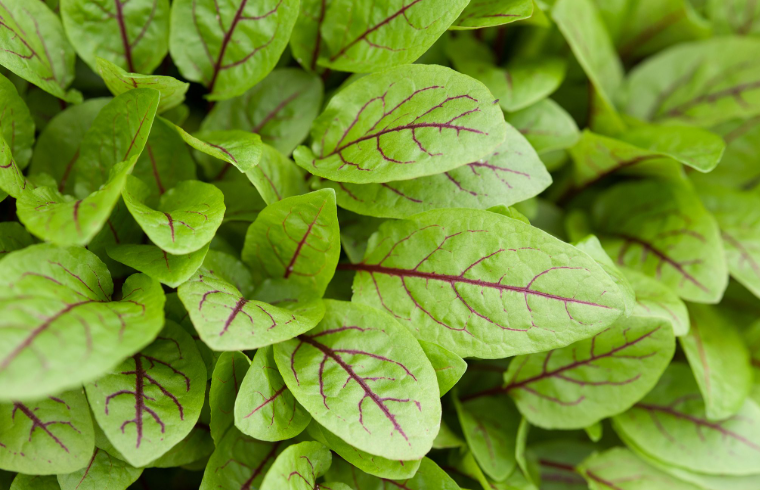
Plants with green leaves and red veins get that contrast from anthocyanin pigments concentrated specifically along the vascular tissue running through each leaf, rather than spread evenly across the whole leaf surface the way solid red or purple foliage typically develops. That concentration along the veins isn’t just decorative, since the vascular bundles are also where a leaf transports water, sugars, and nutrients, and the same pigments that create the red color are believed to help protect that tissue from excess light and oxidative stress.
This trait shows up across an unusually wide range of unrelated plant families, from tropical houseplants to backyard vegetables, which suggests the red-vein pattern has evolved independently multiple times rather than being inherited from any single common ancestor. A handful of the plants on this list develop the trait naturally as a species-wide characteristic, while others are specific cultivars bred and selected purely because gardeners found the contrast attractive.
These plants span tropical rainforest houseplants, temperate vegetable gardens, and shaded perennial borders, with native ranges stretching from Brazilian jungles to European wetlands. What follows covers 21 plants known for green leaves and red veins, along with where each one grows and the data behind its coloring.
Red-Veined Prayer Plant
Red-veined prayer plant, botanically Maranta leuconeura ‘Erythroneura,’ is native to the tropical rainforests of Brazil, and its species name literally translates to “red-nerved,” referring to the vivid red veins radiating across each oval green leaf. A mature plant stays low and spreading, generally under a foot tall. Like other prayer plants, its leaves fold upward each evening and reopen each morning, a movement thought to help the plant manage moisture loss overnight.
It’s grown as a houseplant worldwide, favoring bright, indirect light and consistent humidity to keep its red vein pattern vivid.
Red-Veined Nerve Plant
Red-veined nerve plant, a color form of Fittonia albivenis, is native to the tropical rainforests of Peru and other parts of South America, displaying dark green leaves etched with a dense network of bright red veins running through the entire leaf surface. A mature plant stays extremely low and spreading, generally under 6 inches tall. It requires consistently high humidity, often grown in a closed terrarium to prevent its thin leaves from crisping at the edges.
It’s grown as a houseplant worldwide, among the more humidity-demanding plants commonly sold for indoor cultivation.
Bloody Dock
Bloody dock, botanically Rumex sanguineus, is native to Europe and parts of northern Iran, and according to the North Carolina Extension Gardener Plant Toolbox, it has beautiful deeply-veined leaves that offer both ornamental and edible value, growing best in full sun and moist, well-drained soil. A mature clump typically reaches 1 to 1.5 feet tall and wide. Its young leaves can be eaten raw or cooked similarly to true sorrel, though flavor grows more bitter as the plant matures.
It grows as a garden perennial throughout temperate regions of the United States, naturally thriving in ditches and other consistently moist ground.
Beet Greens
Beet greens, the foliage of the common garden beet, are native to the Mediterranean coast, naturally displaying dark green leaf blades with prominent, deep red veins and stems that intensify as the plant matures. A mature plant typically produces leaves 8 to 12 inches long above its familiar red root. Both the leaves and root are edible, with the greens often cooked similarly to spinach or chard.
It grows as a garden vegetable throughout temperate regions of the United States, tolerating light frost better than many other leafy greens.
Rhubarb Begonia
Rhubarb begonia, botanically Begonia erythrophylla, is a hybrid derived from species native to Mexico, displaying rounded, glossy green leaves with a network of reddish veins visible on the upper surface and a solid deep red underside. A mature plant typically reaches 1 to 1.5 feet tall, spreading via thick, creeping rhizomes along the soil surface. Its name references both its round leaf shape and its reddish coloring.
It’s grown as a houseplant worldwide, tolerating lower light than many other begonia varieties while still maintaining its distinctive vein pattern.
Red Vein Chinese Spinach
Red vein Chinese spinach, a color form of Amaranthus tricolor, is native to tropical Asia, displaying green leaves marked with prominent red to maroon veins and a central red blotch near the leaf base. A mature plant typically reaches 2 to 3 feet tall. Its young leaves are widely eaten as a cooked green throughout Southeast Asian and South Asian cuisine.
It grows as a warm-season garden vegetable throughout the southern and eastern United States, favoring full sun and consistently warm temperatures.
Croton ‘Petra’
Croton ‘Petra’ is a cultivar of Codiaeum variegatum, native to India, Malaysia, and islands of the South Pacific, displaying broad, glossy green leaves marked with bold yellow, orange, and red veins radiating outward from the central midrib. A mature plant grown outdoors in frost-free climates can reach 6 to 8 feet tall. It’s among the most widely sold croton cultivars specifically because of its dramatic, multicolored vein pattern.
It grows as a landscape shrub in South Florida and other frost-free regions and as a houseplant elsewhere, requiring bright light to maintain vivid vein coloring.
Croton ‘Mrs. Iceton’
Croton ‘Mrs. Iceton’ is another cultivar of Codiaeum variegatum, native to the same South Pacific and Southeast Asian range as other croton varieties, displaying narrow, twisted green leaves marked with cream and red veining that deepens in color as each leaf matures. A mature plant typically reaches 4 to 6 feet tall. Its narrower, more twisted leaf shape distinguishes it visually from broader-leaved croton cultivars like ‘Petra.’
It grows as a landscape shrub in frost-free regions of the United States and as a houseplant elsewhere.
Rex Begonia
Rex begonia, particularly cultivars with pronounced red venation, is a hybrid group derived from a species native to northeastern India, displaying large, asymmetrical leaves marked with swirling patterns of silver, red, and green following the leaf’s vein structure. A mature plant typically reaches 1 to 2 feet tall, grown primarily for its dramatic foliage rather than its relatively insignificant flowers. Its coloring is most vivid in bright, indirect light with consistent humidity.
It’s grown as a houseplant worldwide, propagated readily from leaf cuttings, which has allowed for an enormous range of distinct vein and color patterns to be developed over the decades.
Caladium ‘Red Flash’
Caladium ‘Red Flash’ is a cultivar of a species native to the tropical rainforests of South America, displaying large, arrow-shaped green leaves marked with bold red veins and scattered pink spots across the surface. Grown from an underground tuber, the plant goes fully dormant each winter in temperate climates. A mature plant typically reaches 1 to 2 feet tall during the growing season.
It’s grown as a warm-season annual or houseplant across most of the United States, thriving in shaded, humid garden beds during summer.
Ornamental Amaranth
Ornamental amaranth, particularly the cultivar ‘Early Splendor,’ is derived from species native to the Americas, displaying broad green leaves marked with a deep red-purple center and prominent red veining radiating outward. A mature plant typically reaches 3 to 4 feet tall in a single growing season. Its coloring intensifies as the plant matures through summer.
It grows as a garden annual throughout temperate regions of the United States, favoring full sun and warm temperatures.
Garden Rhubarb
Garden rhubarb is native to Siberia and other cold regions of Asia, and according to University of Minnesota Extension, the plant’s stalk color can vary from crimson red to light green depending on variety, with the leaf blade typically green and marked by prominent red veins radiating outward from the red-toned petiole. A mature plant can grow up to 3 to 4 feet wide, remaining productive in the same spot for 8 or more years. Its leaf blades are toxic due to concentrated oxalic acid, though the reddish stalks are widely used in pies and preserves.
It grows as a garden perennial throughout the northern United States and Canada, favoring consistently cool climates.
Ornamental Angelica
Ornamental angelica, particularly the cultivar ‘Vicar’s Mead,’ is a variegated form of a plant native to Europe, displaying deeply divided green leaves marked with reddish-purple veins and stems, topped with rounded clusters of pale pink flowers in summer. A mature plant can reach 4 to 6 feet tall. Its dramatic red-veined foliage remains ornamental well before the plant flowers.
It grows as a garden perennial or biennial throughout temperate regions of the United States, favoring moist, rich soil in partial shade.
Coral Bells
Coral bells, particularly cultivars like ‘Berry Smoothie,’ is a variegated form of a plant native to North America, displaying ruffled, rounded green to bronze leaves marked with contrasting red to crimson veining following the leaf’s natural vein structure. A mature clump typically reaches 8 to 12 inches tall, sending up tall, wiry flower stalks in late spring. Its foliage color intensifies in cooler temperatures and fades somewhat during peak summer heat.
It grows as a garden perennial throughout temperate regions of the United States, tolerating a range of light conditions from full sun to partial shade.
Red Vein Plantain
Red vein plantain, a color form of common plantain sometimes sold as ‘Rubrifolia,’ is native to Europe and Asia, displaying broad, ribbed green leaves marked with reddish-purple veins running the length of each leaf. A mature plant typically reaches 6 to 12 inches tall when flowering. Unlike the plain green weedy form found in most lawns, this ornamental selection is deliberately cultivated for its coloring.
It grows as a garden perennial throughout temperate regions of the United States, tolerating poor, compacted soil better than many other ornamental perennials.
Red-Veined Coleus
Red-veined coleus, including cultivars bred specifically for prominent vein contrast, is derived from species native to Southeast Asia, displaying broad green leaves with a network of deep red to burgundy veins radiating from the central rib. A mature plant typically reaches 1 to 2 feet tall in a single growing season. Its vein contrast is generally most vivid in bright, indirect light.
It grows as a garden annual throughout temperate regions of the United States, thriving in both sun and shade depending on the specific cultivar chosen.
Red Vein Ornamental Kale
Red vein ornamental kale, including cultivars like ‘Redbor,’ is a form of a plant native to the eastern Mediterranean and Asia Minor, displaying deeply ruffled green leaves marked with dark red-purple veins and a red-tinged margin. A mature plant typically reaches 1 to 2 feet tall, remaining fully edible despite being grown primarily for ornamental fall and winter color. Its coloring intensifies dramatically after exposure to cold temperatures.
It grows as a cool-season garden vegetable and ornamental throughout temperate regions of the United States, tolerating frost better than most other leafy vegetables.
Malabar Spinach
Malabar spinach, particularly the red-stemmed form, is native to tropical Asia and Africa, displaying thick, glossy, heart-shaped green leaves with reddish veins and stems running throughout the twining vine. A mature vine can climb 6 to 10 feet in a single growing season. Its leaves are edible and used similarly to true spinach, particularly popular in hot, humid climates where true spinach struggles to grow.
It grows as a warm-season garden vegetable throughout the southern United States, thriving in heat and humidity that would cause other leafy greens to bolt.
Perilla
Perilla, particularly bicolor forms of the plant sometimes called shiso, is native to East Asia, displaying green leaves with a reddish-purple underside and reddish veins visible on the top surface where the two colors meet. A mature plant typically reaches 1 to 2 feet tall. Its leaves are widely used in Japanese and Korean cuisine, both fresh and pickled.
It grows as a garden herb throughout temperate regions of the United States, self-seeding readily once established in a garden bed.
Coleus ‘Religious Radish’
Coleus ‘Religious Radish’ is a distinct cultivar derived from species native to Southeast Asia, displaying broad green leaves with a bold red center and vivid red veining extending toward the leaf margins. A mature plant typically reaches 1 to 2 feet tall in a single growing season. Its strongly contrasting vein pattern has made it a popular choice for mixed container plantings.
It grows as a garden annual throughout temperate regions of the United States, tolerating both sun and partial shade depending on growing conditions.
Copper Plant
Copper plant, botanically Acalypha wilkesiana, particularly the cultivar ‘Marginata,’ is native to Fiji and neighboring islands of the South Pacific, and according to the North Carolina Extension Gardener Plant Toolbox, its 4 to 8 inch heart-shaped leaves come in mottled combinations of green, purple, and red depending on the cultivar, with prominent red veining visible against the bronze-green leaf surface. A mature shrub typically reaches 3 to 4 feet tall.
It grows as a landscape shrub throughout South Florida and other frost-free regions, requiring full sun for its best, most saturated vein coloring.
Further References
- Caladiums — University of Wisconsin–Madison Extension — Provides detailed descriptions of caladium cultivars with red veins, green margins, and contrasting foliage patterns. It includes examples such as ‘Carolyn Whorton,’ ‘Pink Beauty,’ and ‘Pink Gem.’
- Inheritance of Leaf Shape and Main Vein Color in Caladium — University of Florida IFAS — Explains the different vein colors found in caladiums, including red, white, and green main veins, with photographs and cultivar information.
- Hardy Begonia — North Carolina Extension Gardener Plant Toolbox — Describes Begonia grandis, which has green upper leaf surfaces and reddish-green undersides with prominent red veins.
- Begonia — University of Arkansas System Division of Agriculture — Provides identification details for hardy begonia, including its olive-green leaves and prominent carmine-red veins.
- ‘Tapestry’ Caladium — University of Florida IFAS — Describes a caladium with green leaf margins and distinctive red primary veins, along with photographs and detailed foliage characteristics.