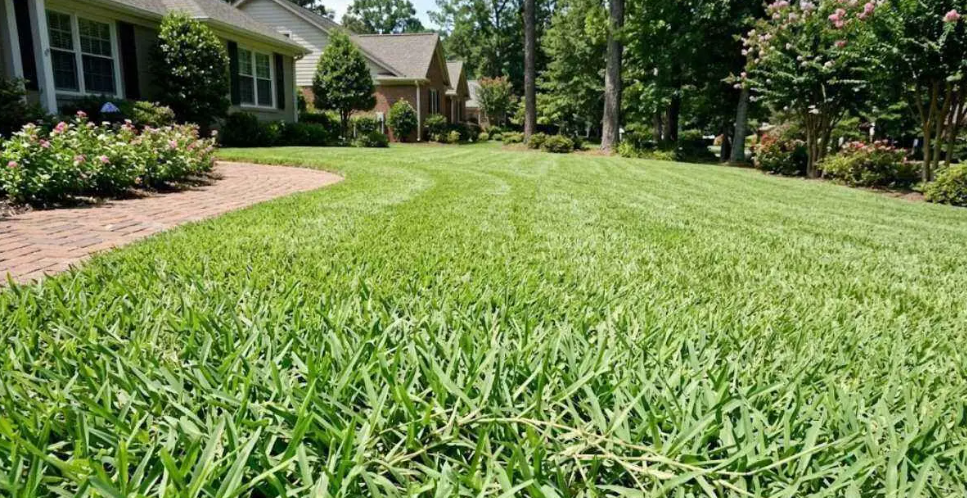
Controlling weeds in centipede grass lawns requires a genuinely different approach than managing weeds in most other turfgrass, since centipede is unusually sensitive to several of the herbicides and cultural practices that work perfectly well on bermudagrass, zoysia, or cool-season lawns. According to University of Tennessee Extension’s turfgrass weed science program, centipedegrass is intolerant of many herbicides commonly used for broadleaf and grassy weed control in other turf types, which means a standard big-box store weed-and-feed product can do more harm to a centipede lawn than the weeds it’s meant to control.
That sensitivity runs alongside centipede’s other defining trait: it’s a genuinely low-input grass that actively declines under the kind of heavy fertilization that would help other lawns outcompete weeds on their own. Getting weed control right in a centipede lawn means working with those two constraints together, choosing the right products at the right rates and timing, while leaning more heavily on cultural practices than a typical turf management program would.
What follows covers 21 effective ways to control weeds specifically in centipede grass lawns, along with the data and product-specific guidance that makes each one work without damaging the turf itself.
Mow at the Correct Height
Mowing centipede grass at the correct height, generally between 1.5 and 2 inches, keeps the canopy dense enough to shade out weed seedlings without stressing a grass that grows slowly and doesn’t recover quickly from scalping. Cutting it too short removes too much leaf area for the plant to recover between mowings, opening up bare patches that weeds readily colonize.
Mowing every 5 to 7 days during the active growing season keeps up with growth without removing more than the recommended third of the leaf blade at once, a rule that applies to centipede just as it does to other turfgrass species.
Keep Nitrogen Fertilization Very Low
Keeping nitrogen fertilization very low, generally between 0 and 2 pounds per 1,000 square feet per year, is the single most important rule for centipede grass, since excessive nitrogen is the primary documented cause of a condition called centipedegrass decline. According to University of Georgia’s College of Agricultural and Environmental Sciences, unwarranted nitrogen application can lead to thatch buildup and disease problems in addition to the decline itself, both of which create thin, weakened turf that weeds move into readily.
Unlike most warm-season lawns, where heavier feeding is a standard weed-suppression strategy, centipede genuinely performs better and resists weed encroachment more effectively on a lean diet.
Test and Manage Soil pH
Testing and managing soil pH matters more for centipede than for most other lawn grasses, since it thrives in acidic soil and actually suffers when pH climbs too high. According to the University of Arkansas Division of Agriculture, lime should only be applied if soil pH drops below 5.0, since centipede prefers more acidic conditions than most turfgrass species.
As soil pH rises above 6.0, iron availability drops significantly, and the resulting chlorotic, yellowed turf is both less able to compete with weeds and more likely to be mistaken for a nitrogen deficiency, leading well-meaning homeowners to apply the nitrogen that actually triggers decline.
Use Iron Instead of Nitrogen for Color
Using a chelated iron supplement rather than nitrogen fertilizer is the standard recommendation for improving centipede’s color without triggering the excess growth that leads to decline and thinning. According to University of Arkansas Extension, iron should be applied specifically when the lawn shows a yellow appearance indicative of iron deficiency, sprayed as needed to improve turf color without the downsides of nitrogen.
This substitution keeps the lawn looking healthy and green enough to visually compete with weeds while avoiding the thatch buildup and disease pressure that heavier nitrogen programs create.
Wait for Complete Spring Green-Up
Waiting for complete spring green-up before applying any fertilizer or postemergent herbicide prevents unnecessary stress on a grass that’s already vulnerable during its slow transition out of winter dormancy. According to Clemson Cooperative Extension’s Home and Garden Information Center, if a weed problem develops before the grass has fully greened, the better approach is to mow and bag the weeds rather than spray, waiting until the turf has recovered before any herbicide application.
Applying herbicides to centipede during this vulnerable green-up window significantly increases the risk of turf injury, even from products otherwise considered safe for the species.
Apply Pre-Emergent Herbicides on Time
Applying pre-emergent herbicides by March 1 in most centipede-growing regions gets ahead of crabgrass and goosegrass germination before soil temperatures trigger their seeds to sprout. Products containing prodiamine, dithiopyr, or simazine are generally considered safe pre-emergent options for centipede when applied at labeled rates.
Once centipede has fully greened up, it’s typically too late for a standard pre-emergent application, since many summer annual weeds have already germinated by that point in the season.
Avoid Quinclorac Entirely
Avoiding quinclorac entirely is one of the more important product-specific rules for centipede grass, since this common crabgrass-control active ingredient causes severe turf injury, stunting, or even localized death when applied to this particular species. While quinclorac is a standard, effective option on many other warm-season lawns, its use on centipede should be avoided regardless of how the product is marketed for general lawn use.
Checking the active ingredient list on any pre-mixed weed-and-feed or crabgrass killer before applying it to a centipede lawn is essential, since quinclorac appears in many widely sold retail products.
Use Extreme Caution With 2,4-D
Using extreme caution with 2,4-D, a common ingredient in many broadleaf herbicide mixes, is necessary because centipede shows documented sensitivity to it both during spring green-up and during hot summer temperatures. According to Clemson Cooperative Extension, 2,4-D should be used at reduced rates with careful attention to label directions, and applications should generally be limited to no more than 2 times per year with at least 30 days between treatments.
Heat compounds the risk considerably, so 2,4-D and similar phenoxy herbicides are best avoided entirely during the hottest stretches of summer even at reduced rates.
Avoid MSMA
Avoiding MSMA, an organic arsenical herbicide once commonly used for grassy weed control, is recommended specifically because centipede shows the same kind of sensitivity to it that it does to 2,4-D. University of Arkansas Extension lists MSMA alongside 2,4-D as herbicides requiring particular caution on centipede lawns.
Its increasingly limited availability due to regulatory restrictions has made this less of a practical concern than it once was, but it remains worth checking product labels carefully before use.
Use Atrazine as a Dual-Purpose Option
Using atrazine as a dual-purpose option takes advantage of one of the few herbicides genuinely well suited to centipede, since it offers both pre-emergent and post-emergent activity against a wide variety of annual broadleaf weeds. According to University of Georgia’s CAES Field Report, atrazine is sold combined with a nitrogen-free dry fertilizer carrier under a specific commercial brand, allowing it to be applied even after green-up without contributing to the nitrogen levels that trigger centipede decline.
It can be applied to both actively growing and dormant centipede, making it one of the more flexible tools available for season-long broadleaf weed suppression.
Use Metsulfuron for Broadleaf Control
Using metsulfuron, sold under retail names including Manor and Blade, provides an effective broadleaf herbicide option that won’t damage centipede when applied according to the label. University of Arkansas Extension specifically recommends this active ingredient as an excellent choice for broadleaf weed control that avoids the injury risk associated with 2,4-D-based products.
It’s a useful alternative for homeowners specifically seeking to avoid the phenoxy herbicide family altogether given centipede’s documented sensitivity to that entire chemical class.
Use Sethoxydim for Grassy Weed Control
Using sethoxydim, sold under retail names including Vantage and Segment, provides a genuinely safe post-emergent option for controlling grassy weeds without harming centipede turf. Application rates should stay at or below half an ounce per 1,000 square feet to remain within safe, effective limits.
This herbicide targets grassy weeds specifically through a different mode of action than the broadleaf products, making it a useful complement to metsulfuron or atrazine in a complete weed control program.
Consider Mesotrione for Crabgrass
Considering mesotrione, sold under the retail name Tenacity, offers another post-emergent option specifically for crabgrass that’s already emerged and growing, used at labeled rates when pre-emergent timing has already been missed. It works through a different mechanism than quinclorac, making it a safer alternative for centipede lawns dealing with established crabgrass.
Combining a properly timed pre-emergent application with mesotrione as backup for any escapes generally provides more complete season-long crabgrass control than relying on either product alone.
Use Halosulfuron for Nutsedge
Using halosulfuron, sold under the retail name SedgeHammer, or sulfentrazone-based products addresses nutsedge and kyllinga, weeds that standard broadleaf herbicides like 2,4-D have essentially no effect on regardless of the rate applied. University of Arkansas Extension specifically recommends halosulfuron-based products for post-emergent sedge control in centipede lawns.
Since nutsedge spreads aggressively through underground tubers, repeat applications are typically necessary to achieve full control even with an effective product.
Limit Herbicide Applications to No More Than Twice Yearly
Limiting two- or three-way broadleaf herbicide mixes containing 2,4-D combinations to no more than 2 applications per year, with a minimum of 30 days between treatments, keeps cumulative herbicide stress on centipede within a range the grass can tolerate. University of Arkansas Extension specifically cites this limit for products combining 2,4-D with dicamba or mecoprop.
Exceeding this frequency substantially increases the risk of visible turf injury, even when individual applications are made at correctly labeled rates.
Avoid Overwatering
Avoiding overwatering helps prevent the shallow root growth and disease pressure that create thin, weakened turf vulnerable to weed encroachment, since centipede rarely needs supplemental irrigation once established except during extended hot, dry, windy stretches. University of Arkansas Extension recommends watching for a dark, bluish-gray color, visible footprinting, or wilted, folded leaves as the signal that irrigation is actually needed.
Overwatering also contributes directly to large patch disease, a fungal problem that creates bare, weed-prone circular patches in the lawn.
Improve Drainage in Problem Areas
Improving drainage in low-lying or compacted areas addresses one of the underlying causes of large patch disease and general turf thinning, both of which open the door to weed colonization in a centipede lawn. Reducing nitrogen fertilization and irrigation alongside improved drainage is the standard combined approach for managing large patch, since fungicides alone provide limited control of the disease.
Aerating compacted soil in high-traffic areas provides similar benefits, allowing centipede’s shallow root system better access to air and water.
Avoid Overseeding With Ryegrass
Avoiding overseeding centipede lawns with annual or perennial ryegrass for winter color, a common practice on bermudagrass lawns, helps prevent competition that can weaken centipede’s recovery the following spring. Because centipede is already a slow-growing, low-vigor species, the added competition from an overseeded cool-season grass can delay green-up and leave the lawn more vulnerable to weeds during that recovery window.
Homeowners wanting winter color in a centipede lawn are generally better served by accepting winter dormancy than risking a weakened spring recovery.
Repair Bare and Thin Areas Promptly
Repairing bare and thin areas promptly with sod or plugs, typically spaced on 6 to 12 inch centers, prevents weeds from establishing in exactly the openings where centipede struggles to fill in on its own. Centipede spreads via stolons at a notably slower rate than bermudagrass or zoysia, meaning bare patches persist and invite weeds considerably longer if left to recover unassisted.
Late spring is generally the recommended window for replanting bare areas, giving new sod or plugs a full growing season to establish before winter dormancy.
Time Herbicide Applications Around Weather
Timing herbicide applications around weather conditions rather than a fixed calendar date accounts for the fact that weed control can be reduced or turf injury increased depending on conditions at the time of spraying. Applications made during heavy dew, fog, drizzle, or when weeds are already stressed from drought tend to perform poorly regardless of which product is used.
Extreme heat compounds herbicide injury risk on centipede specifically, making mild, dry conditions the safest and most effective window for any herbicide application.
Spot-Treat Rather Than Broadcast Spray
Spot-treating isolated weeds rather than broadcast spraying an entire lawn minimizes centipede’s total herbicide exposure, an important consideration given how many common products carry real injury risk for this particular species. Hand-pulling scattered weeds before they set seed remains one of the lowest-risk options available for a lawn as herbicide-sensitive as centipede.
This targeted approach also reduces the overall cost and product use of a weed control program, since most centipede lawns don’t develop the kind of uniform, lawn-wide weed pressure that would justify a full broadcast application.
Further References
- Centipedegrass Lawn Maintenance Calendar — NC State Extension — Covers mowing, watering, preemergence and postemergence weed control, and precautions when using herbicides on centipedegrass.
- Centipedegrass for Florida Lawns — University of Florida IFAS Extension — Provides detailed information on centipedegrass maintenance and common lawn weeds, with guidance on preventing weed invasion through proper lawn management.
- Weed Management Guide for Florida Lawns — University of Florida IFAS Extension — Discusses preemergence and postemergence weed control, grassy weeds, sedges, and the importance of preventive management in centipedegrass lawns.
- Centipedegrass Yearly Maintenance Program — Clemson Cooperative Extension — Provides seasonal centipedegrass maintenance recommendations, including preemergent and postemergent weed control strategies.
- Weed Control in Centipedegrass — University of Tennessee Extension — A centipedegrass-specific extension publication focused on weed-control practices and herbicide management.